
Instantly clearing a fogged windshield isn’t a magic button sequence; it’s about actively managing your car’s entire moisture ecosystem, a system constantly under attack by Quebec’s extreme climate.
- Your car’s A/C is your most powerful dehumidifier, and it must be run year-round—even in extreme cold—to prevent seal failure and maintain its function.
- A musty, “wet dog” smell in spring is a clear sign of a compromised moisture ecosystem, where trapped winter humidity has bred mold in your A/C system.
Recommendation: Treat your A/C system as a year-round humidity management tool, not just a summer cooling device. Proactive use and maintenance prevent the moisture buildup that causes dangerous fogging.
That moment of panic is all too familiar for a Quebec driver. One minute you’re driving in a cold rain or swirling snow, the next your windshield is a blinding sheet of white fog. You frantically blast the defrost, but the cold, humid air only seems to make it worse. Your visibility is gone, and the situation becomes dangerous in seconds. Most advice centres on a simple checklist: turn on the A/C, switch off recirculation, and crank the heat. While these are parts of the solution, they are merely reactions to a much deeper problem.
These quick fixes fail to address the root cause: your vehicle’s cabin has become a compromised moisture ecosystem. Throughout our harsh winters and damp springs, humidity from your breath, wet boots, and melting snow gets trapped inside. This moisture saturates the air, carpets, and seats, creating the perfect conditions for condensation the moment the glass temperature drops below the air’s dew point. The real battle isn’t against the fog you see, but against the invisible humidity that’s already taken over your car.
But what if the key wasn’t just reacting to fog, but proactively managing your car’s internal climate as a complete system? This guide moves beyond the basics to give you an HVAC specialist’s perspective. We’ll explore why your A/C system is your most critical all-season tool, how to diagnose its health, and how Quebec’s unique climate—from ‘verglas’ to ‘la fonte’—wages a constant war on your vehicle’s components, from the A/C compressor right down to the brakes.
By understanding the science of humidity control within your vehicle, you can move from frantically fighting fog to maintaining a clear, safe cabin environment, no matter what the forecast holds. This article breaks down the essential knowledge needed to master your car’s climate.
Summary: Mastering Cabin Air for Clear Visibility in All Seasons
- Why Is Your Car AC Smelling Like Wet Dog in the Spring?
- Why You Must Run Your AC Even When It Is -10°C Outside?
- Auto Climate vs Manual Fan: Which Warms the Cabin Faster?
- The Hissing Sound That Means Your AC Compressor Is About to Die
- When to Recharge Your AC: Signs You Are Low on Freon
- The Visibility Hazard: Using Summer Wipers in an Ice Storm
- Turbo vs Non-Turbo: Which Engine Warms Up Faster in -30°C?
- Why Do Rear Brakes Seize More Often Than Front Brakes in Quebec?
Why Is Your Car AC Smelling Like Wet Dog in the Spring?
As the last of the snow melts away during ‘la fonte’ (the spring thaw), you turn on your car’s ventilation and are hit with a musty, damp odour, often described as a “wet dog” smell. This isn’t just an unpleasant annoyance; it’s a critical diagnostic signal. That smell is the result of mold and bacteria thriving in the dark, damp environment of your A/C system’s evaporator core. Throughout the winter, as you run the heat, moisture from snow-covered boots and humid breath condenses on the cold evaporator. When you park, this moisture sits in the dark, often mixed with road salt residue and organic debris sucked in by the ventilation system.
This creates an ideal breeding ground. When spring arrives and temperatures rise, this microbial colony flourishes, releasing foul-smelling gases that are blown directly into your cabin. This indicates that your vehicle’s moisture ecosystem is severely out of balance. The presence of this smell is proof that excess humidity has been allowed to linger unchecked within the HVAC system, a problem that directly leads to the window fogging issues that plague drivers during colder, wetter months.
Ignoring this smell means you are breathing in mold spores, a potential health concern. It also points to a system that is becoming less efficient. In Canada’s harsh climate, this trapped moisture can accelerate the degradation of A/C components. Some reports show that A/C systems can lose a significant portion of their efficiency annually if not properly maintained, eventually leading to the failure of major components if the underlying moisture problem isn’t addressed during seasonal check-ups.
Therefore, that spring smell is your car’s way of telling you that its ability to manage humidity has been compromised, setting you up for poor defogging performance when you need it most.
Why You Must Run Your AC Even When It Is -10°C Outside?
The idea of running the air conditioner when it’s freezing outside seems completely counterintuitive. Many drivers believe the A/C is only for cooling and shut it off from October to May to save fuel. This is one of the most significant and costly mistakes a driver in a cold climate can make. Your A/C’s primary function in winter is not cooling; it is dehumidification. The system pulls moisture out of the cabin air with remarkable efficiency, which is the secret to clearing a foggy windshield fast. When you direct air to the defrost setting, most modern vehicles automatically engage the A/C compressor for this exact reason.
Beyond just clearing your view, running the A/C periodically throughout the winter is critical for the health of the system itself. The A/C system contains rubber seals and O-rings that need to be kept lubricated. The refrigerant, often known by the brand name Freon, is mixed with a special oil that circulates through the system when it’s running. As one Canadian auto parts supplier notes, many drivers in cold Canadian provinces forget to run their AC during winter, causing these vital seals to dry out. When spring arrives and you turn the system on for the first time, these brittle seals can crack, causing a slow leak of refrigerant and a costly repair down the line.
This constant cycling between deep freezes and heated interiors also creates immense physical stress on your vehicle, a phenomenon known as thermal shock. Your windshield is a prime example of a component under this stress.

As the image above illustrates, the formation of ice crystals creates microscopic stress points on the glass. Running your A/C helps manage the interior humidity, reducing the amount of condensation that can freeze and exacerbate this stress. Actively using your A/C is a proactive measure against both visibility issues and mechanical failure.
Think of it as exercise for your HVAC system; a few minutes of operation each week keeps the components lubricated, the seals supple, and your windshield clear, saving you from much larger headaches.
Auto Climate vs Manual Fan: Which Warms the Cabin Faster?
When you get into a freezing car, the first instinct is to crank the fan speed to maximum and the temperature to high. While this feels proactive, it’s often less effective and can even prolong the time it takes to defog your windshield. Manual control blasts frigid air onto a cold windshield, which does little to help with evaporation and can even create a thin layer of ice if the conditions are right. An “Auto” climate control system, by contrast, is far more intelligent. It waits for the engine to generate some heat before gradually increasing the fan speed, ensuring that the air hitting the glass is warm and effective at evaporating moisture.
Furthermore, an automatic system intelligently manages the A/C compressor and air recirculation for you. It knows to keep recirculation off during defogging to bring in drier outside air, and it engages the A/C to dehumidify that air. Many drivers using manual controls forget to turn off the recirculation button, which just cycles the same moist, humid air inside the cabin, making the fogging problem worse. The difference in performance is not trivial.
To put this into perspective, a clear comparison highlights the efficiency of the automatic approach. The following table, based on data from consumer testing, shows how each mode performs in cold conditions.
| Feature | Auto Climate Mode | Manual Fan Control |
|---|---|---|
| Initial Defogging Time | 2-3 minutes | 4-5 minutes |
| AC Engagement | Automatic for dehumidification | Must be manually activated |
| Fan Speed Control | Gradual increase as engine warms | Can blast cold air initially |
| Recirculation Management | Automatically disabled | Often left on by mistake |
| Effectiveness with Multiple Passengers | Good with manual override | Poor without proper settings |
This methodical approach is backed by science. A former NASA engineer, Mark Rober, applied scientific testing to find the fastest defogging method. His findings, detailed in a widely-cited analysis of the optimal 4-step method, confirmed that the fastest way to clear a windshield involves: turning the heat to full, turning the A/C on, ensuring recirculation is off, and cracking the windows for a few seconds to quickly exhaust the most humid air. This is almost exactly what an “Auto” climate system is programmed to do.
Trusting your car’s automatic system is not just a matter of convenience; it’s a scientifically proven way to achieve faster, more efficient defogging and warming.
The Hissing Sound That Means Your AC Compressor Is About to Die
A persistent hissing sound from your dashboard when the A/C or defrost is running is a deeply concerning sign. While some brief hisses can be normal as pressure equalizes, a continuous hiss often indicates a refrigerant leak. This is your A/C system’s cry for help. The sound is caused by high-pressure gas escaping from a crack in a hose, a failing seal, or, in a worst-case scenario, the compressor itself. When a leak occurs, the system loses not only its ability to cool and dehumidify but also the vital lubricating oil mixed with the refrigerant. Running an A/C system low on oil will inevitably lead to the seizure and catastrophic failure of the compressor, the heart of the system.
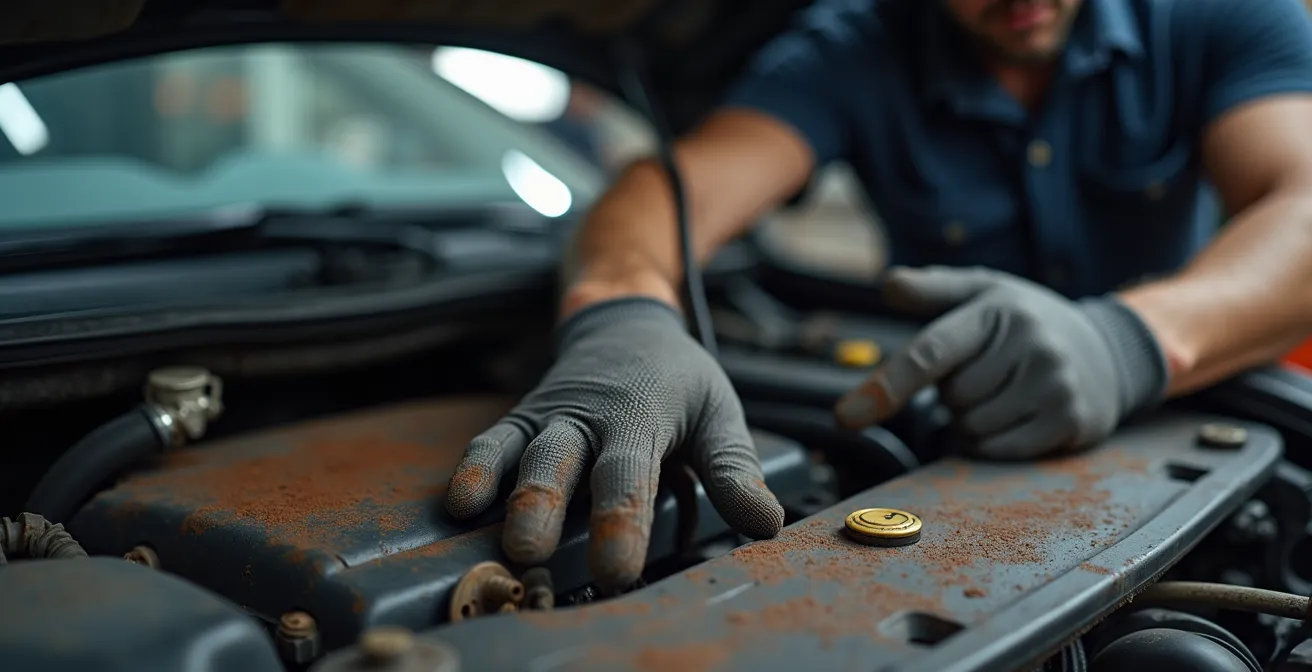
In Quebec, A/C systems face a particularly harsh enemy: road salt. The corrosive mixture sprayed on roads all winter gets kicked up into the engine bay, coating every component. This salt accelerates corrosion on the aluminum lines and fittings of the A/C system, eating away at the metal and creating weak points that eventually turn into leaks. This is why spring inspections are so critical for Quebec drivers; the damage done during the winter often only becomes apparent on the first warm day of spring when the A/C fails to blow cold.
The visual evidence of this damage is often stark, showing the destructive power of our climate on sensitive automotive components.
Ignoring that hissing sound is a significant financial gamble. A small leak can sometimes be repaired for a few hundred dollars. However, once the compressor fails due to lack of lubrication, the repair becomes much more involved, requiring a full replacement of the unit, flushing of the system, and recharging. According to Canadian automotive repair data, this can be a substantial expense, with compressor replacements costing between CAD $600 and $1,500, depending on the vehicle. That hissing sound is the final warning before a minor issue becomes a major repair bill.
Ultimately, addressing the hiss promptly is the only way to avoid a much larger and more expensive system failure, especially in an environment that actively works to destroy these components.
When to Recharge Your AC: Signs You Are Low on Freon
Many people believe you only need an A/C recharge when the system stops blowing cold air. This is a common and flawed assumption. A vehicle’s A/C system is a sealed unit, and if it’s low on refrigerant (often called Freon), it means there is a leak somewhere. The first and most critical function it loses is not its cooling power, but its dehumidifying capacity. This is a crucial distinction for drivers focused on visibility and safety. Your windows will start fogging up more easily and take longer to clear long before you notice the air isn’t as cold in July.
This subtle decline in performance is the most important sign to watch for. If you notice this winter’s fog seems harder to beat than last year’s, it’s a strong indicator that your system is low on refrigerant. As leading technicians point out, the loss of dehumidifying power is the canary in the coal mine for A/C problems.
A system low on refrigerant loses its dehumidifying capacity long before it stops cooling.
– Chapel Hill Tire Technicians, AC Compressor Diagnosis Guide
Other tell-tale signs include the A/C clutch not engaging (you won’t hear the typical ‘click’ when you turn it on) or visible leaks of a greasy substance around the A/C line fittings. You can perform a simple diagnostic test yourself on a cool, humid morning: start the car, turn the A/C to its coldest setting on defrost, and time how long it takes to completely clear the windshield. If it takes more than two or three minutes, or if it struggles to clear completely, your system is likely underperforming and needs a professional inspection for leaks and a potential recharge.
Action Plan: Auditing Your AC’s Dehumidification Signal
- Points of Contact: Identify all signals of poor dehumidification. This includes slow defogging, a musty smell from the vents, or a constantly clammy feeling in the cabin.
- Collecte: Inventory the specific conditions when the problem occurs. Does it happen with one passenger or several? Is it worse in rain or just cold? Note the time it takes to defog.
- Coherence: Compare these observations to how the system should perform. An effective system should clear a fogged windshield in under 3 minutes and should not produce any foul odours.
- Mémorabilité/Émotion: Is the problem just a minor annoyance or a genuine safety hazard? Quantify the impact: “My visibility was blocked for 5 minutes on the highway.” This highlights the urgency.
- Plan d’Intégration: Based on the audit, prioritize action. A persistent smell or a 5+ minute defog time means you should schedule a professional HVAC service immediately to check for leaks and mold.
Catching low refrigerant levels early not only restores your defogging power but also prevents the catastrophic compressor damage that occurs when the system runs without enough lubricating oil.
The Visibility Hazard: Using Summer Wipers in an Ice Storm
In Quebec, precipitation isn’t just rain or snow; it can be ‘verglas’—a treacherous freezing rain that coats every surface in a layer of clear ice. During these events, visibility isn’t just reduced; it can be completely eliminated. This is where the distinction between winter and summer wiper blades becomes a critical safety issue. Standard summer wipers have a flexible, open frame. In an ice storm, this frame quickly becomes packed with ice, making the blade stiff and preventing it from conforming to the curve of the windshield. The result is streaking, chattering, and large, uncleared patches that render your view dangerously obscured.
Winter wiper blades are designed specifically to combat this problem. They feature a rubber-wrapped, one-piece frame that prevents ice from building up on the blade’s structure. This allows the blade to remain flexible and maintain firm, even contact with the glass, effectively clearing away freezing rain and sleet. Some models are even heated to further enhance their performance in the most extreme conditions. Using summer wipers during a Quebec ice storm is like trying to run a marathon in flip-flops—you are using the wrong equipment for the conditions, with potentially disastrous consequences.
The problem is compounded by frost. Frost forms when the outside temperature is below freezing and moisture in the air freezes directly onto the cold glass, creating a crystalline layer. Summer blades are often too soft or become too rigid in the cold to effectively scrape this layer off. This is not merely an inconvenience; it’s a significant safety hazard that severely impairs a driver’s vision and dramatically increases the risk of an accident during our most challenging driving season.
Investing in a quality set of winter wipers is not an upgrade; it’s a non-negotiable piece of safety equipment for any vehicle navigating the realities of a Quebec winter.
Turbo vs Non-Turbo: Which Engine Warms Up Faster in -30°C?
When it’s -30°C outside, every minute spent waiting for your car to warm up feels like an eternity. The speed at which your engine reaches its operating temperature directly impacts how quickly you can get warm, effective heat to your defrost vents. In this regard, there’s a noticeable difference between modern turbocharged engines and older, naturally aspirated ones. A smaller, turbocharged engine often warms up faster under a light load than a larger, non-turbo engine at idle. This is because the turbocharger itself is a significant source of heat, and putting the engine under a gentle driving load generates heat more quickly than letting it sit and idle.
The old advice of letting your car idle for 10-15 minutes is not only inefficient for modern engines but also prolongs your wait for a clear windshield. The optimal strategy, especially for a turbo engine, is different:
- Start the engine and wait only 30-60 seconds for the oil to begin circulating.
- Begin driving gently. This light load helps the engine and turbocharger build heat much faster than idling.
- Turn the heat and defrost on immediately. Even if the air is still cool, it will start the process of moving air across the heater core.
- Ensure the A/C is activated to dehumidify the air, and keep the recirculation setting off.
This “drive-off gently” method leverages the engine’s design to your advantage, cutting down the time you spend shivering and staring at a foggy window. While a non-turbo engine will also warm up faster with gentle driving compared to idling, the effect is often more pronounced with a turbo. The key takeaway is that getting the vehicle moving (gently!) is the fastest way to get your heat and defrost systems working at peak efficiency in extreme cold.
This knowledge allows you to adapt your winter morning routine for faster, safer departures, regardless of the ‘frette’ outside.
Key Takeaways
- Window fog is a symptom of a larger problem: a compromised cabin moisture ecosystem, exacerbated by Quebec’s climate.
- Your A/C system is a year-round dehumidifier. Failing to run it in winter causes mechanical damage and reduces its ability to clear fog.
- Proactive management—using Auto climate control, installing winter wipers, and recognizing warning signs like smells or sounds—is more effective than reactive defogging.
Why Do Rear Brakes Seize More Often Than Front Brakes in Quebec?
It may seem unrelated, but the reason your rear brakes are more likely to seize is directly connected to the central theme of this guide: the relentless assault of moisture and corrosion in the Quebec climate. While front brakes handle the majority of the braking force and generate more heat (which helps burn off moisture), rear brakes—especially drum brakes or parking brakes integrated into rear discs—are more susceptible to the insidious effects of sitting in a damp, salty environment. During ‘la fonte’, the slushy mix of water and corrosive road salt is constantly sprayed onto the undercarriage, coating every component.
When you park your car, especially with the parking brake engaged, this corrosive mixture sits on the brake components. Moisture can seep into the parking brake cable sheaths, freeze, and cause the cable to seize. On rear disc brakes, the calipers and slider pins are more prone to seizing from corrosion due to less frequent, forceful use compared to the front. This is why you might hear a scraping sound or feel a drag from the rear of the car after it has been parked for a few days in wet, slushy weather. The brakes have literally rusted in place.
This demonstrates the interconnected nature of vehicle health in our province. Managing the corrosion cycle is a holistic task. The same professional undercarriage wash that removes corrosive salt from your brake lines and suspension also cleans your A/C condenser and compressor, protecting them from premature failure. An inspection for brake health is an opportune moment to also check the condition of nearby A/C lines. It’s all part of the same battle against the destructive combination of moisture and salt.
To ensure your vehicle remains safe and reliable, you must adopt a comprehensive maintenance strategy that actively combats moisture and corrosion across all systems, from the windshield down to the wheels.