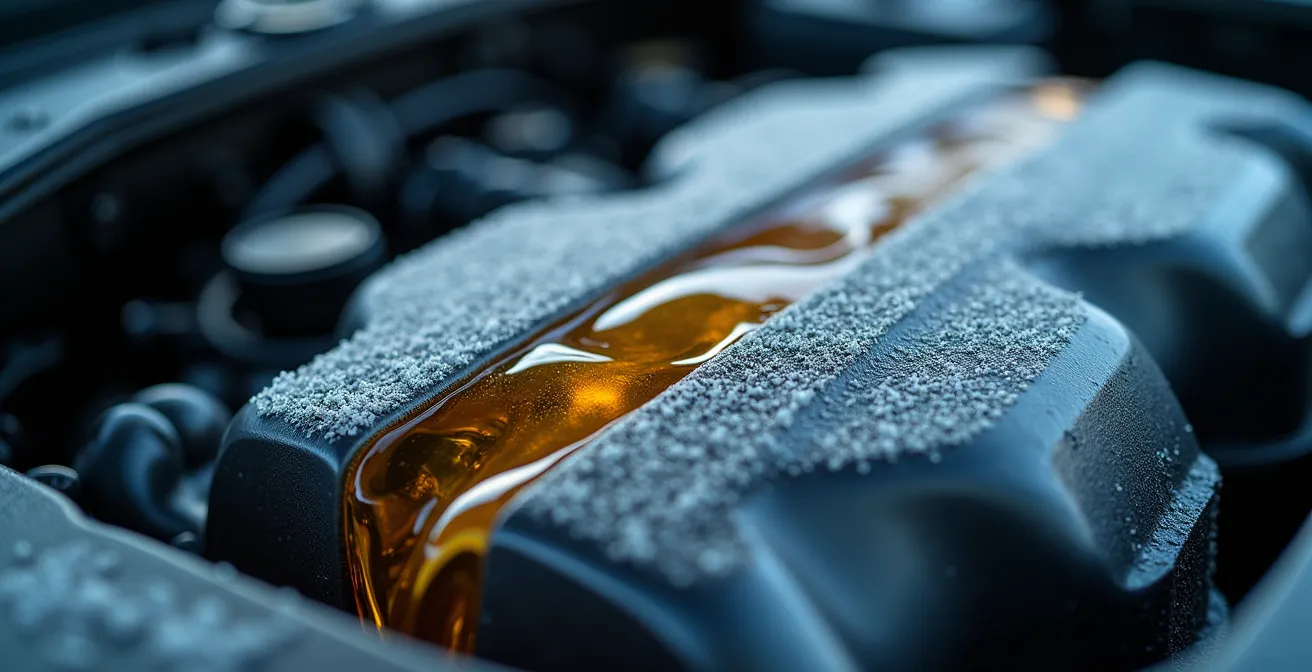
Contrary to popular belief, ‘all-season’ maintenance is a myth in Quebec; your vehicle’s survival through winter depends on fighting the physics of extreme cold, not just checking boxes.
- At -30°C, conventional oil turns to sludge, starving your engine and turbo of lubrication on startup.
- A battery’s cranking power is cut in half, and standard antifreeze can fail, leading to a cracked engine block.
Recommendation: Treat fall maintenance as a non-negotiable pre-winter defense strategy focused on fluid viscosity, battery health, and cold-rated components.
Every January, I see the same thing: cars that won’t start, tow trucks lining the streets, and frustrated owners shivering in the bitter Quebec cold. They all say some version of, “But I just got it checked!” The problem is, a standard check-up or “all-season” mindset is a recipe for disaster when the temperature plummets to -30°C. Most guides give you a generic checklist: check fluids, check tires. This is dangerously incomplete.
The truth is, preparing a car for a Quebec winter isn’t about ticking boxes. It’s a battle against physics. It’s about understanding how extreme cold fundamentally changes the properties of metal, rubber, and fluids. The fall oil change isn’t just a routine task; it’s the single most important preventative measure against catastrophic engine failure. Skipping it, or choosing the wrong type of oil, is like sending a soldier into battle without armour.
But if the real key isn’t just *what* you check, but *why* it fails in the cold, what should you focus on? This guide isn’t another generic list. It’s a mechanic’s breakdown of the critical failure points caused by extreme cold. We’ll go beyond the platitudes and explore the science of why synthetic oil is non-negotiable, how to test your block heater before it’s too late, and why your summer wipers are a visibility hazard waiting to happen. This is your strategy to ensure your car not only starts but runs safely through the harshest days of a Quebec winter.
This article will guide you through the essential pre-winter checks, explaining the science behind each recommendation to help you avoid costly and dangerous failures. The following summary outlines the critical areas we will cover to arm your vehicle against the cold.
Summary: A Mechanic’s Guide to Surviving a Quebec Winter
- Why Does Synthetic Oil Flow Better at -30°C Than Conventional Oil?
- How to Check Your Block Heater Before the First Freeze?
- Antifreeze Concentration: What Ratio Protects You Down to -40°C?
- The Visibility Hazard: Using Summer Wipers in an Ice Storm
- When to Replace Your Car Battery: The 4-Year Rule
- Turbo vs Non-Turbo: Which Engine Warms Up Faster in -30°C?
- Why Your Dashboard Sensors Fail Faster in Winter Conditions?
- How to Beat the Rush for the December 1st Winter Tire Deadline?
Why Does Synthetic Oil Flow Better at -30°C Than Conventional Oil?
The most critical moment for your engine in winter is the first few seconds after a cold start. At -30°C, conventional motor oil doesn’t just get thick; it essentially turns into cold molasses. This high viscosity means the oil pump struggles to circulate it, leaving vital engine components, like bearings and valvetrains, momentarily unlubricated. This is where the majority of engine wear occurs, a slow and silent killer that shortens your engine’s life with every freezing start. Conventional and synthetic blend oils simply take too much time to flow smoothly through the engine in these conditions.
Synthetic oil, on the other hand, is engineered at a molecular level to resist this gelling. Its uniform molecules allow it to maintain a much lower viscosity at extreme low temperatures. This is often indicated by the “0W” or “5W” rating (the ‘W’ stands for Winter). When you turn the key, synthetic oil flows almost immediately, providing critical lubrication and preventing the metal-on-metal contact that causes irreversible damage. Think of it as the difference between trying to suck a thick milkshake through a straw versus water. One gets there instantly; the other takes a damaging amount of effort.
For Quebec drivers, this isn’t an upgrade; it’s a necessity. Making the switch to a full synthetic oil before the first deep freeze is the single best investment you can make in your engine’s longevity. Even allowing the engine to idle for 30-60 seconds before driving can make a significant difference by giving the oil, synthetic or not, a chance to circulate properly.
How to Check Your Block Heater Before the First Freeze?
A block heater is your engine’s best friend on a frigid morning, but only if it works. Too many drivers plug their car in, assume it’s working, and are met with a dead engine anyway. Testing it in October, before you actually need it, is a simple task that prevents a major headache in January. The most basic test is to plug it in and listen. You should hear a faint, steady humming or sizzling sound coming from the engine block. If it’s silent, there’s a problem.
For a more definitive check, plug it in for about an hour on a cool day. Afterwards, feel the engine block near where the heater is installed; it should be noticeably warm to the touch. While you’re at it, inspect the entire length of the cord. Look for cracks in the insulation, especially near the plug and where it enters the engine bay. A frayed or damaged cord isn’t just ineffective; it’s a serious fire hazard. If you find any damage, replace the cord immediately.
Using a block heater does more than just help your car start; it significantly reduces engine wear and emissions. As one expert from a leading Quebec organization points out, it’s a smarter way to warm your vehicle.
Rather than idling your engine while parked, take it easy on the road instead. Your vehicle will warm up faster, consume less fuel, and emit fewer pollutants. By preheating your engine with a block heater, you shorten the period when exhaust gases are untreated—an excellent way to protect the environment.
– Sylvain Légaré, Research Analyst, Mobility, CAA-Quebec
Plugging in for two to three hours before you plan to leave is all you need. Any longer just wastes electricity without providing additional benefit.
Antifreeze Concentration: What Ratio Protects You Down to -40°C?
The term “antifreeze” is a bit misleading; it’s the specific mixture of antifreeze and water that determines your level of protection. Using a pre-mixed 50:50 solution might be fine for southern Ontario, but it’s playing with fire in many parts of Quebec. As water freezes, it expands by about 9%, an unstoppable force that can crack an engine block or radiator, leading to thousands of dollars in repairs. Your goal is to ensure the freezing point of your coolant is well below the coldest temperatures you’ll face.
This is where precision matters. The only way to know your exact level of protection is to test the coolant with a refractometer, a tool that provides a precise reading of the freeze point. A cheap floating-ball tester is simply not accurate enough for the demands of a Quebec winter. Your target ratio should be based on your specific region, as a higher concentration of antifreeze is needed for more northern areas.

This simple visual test, shown in the image above, provides instant peace of mind or a clear warning that your system needs service. The following table, based on an analysis of winter maintenance needs, is an essential guide for every Quebec driver.
| Antifreeze:Water Ratio | Protection Temperature | Recommended Region |
|---|---|---|
| 50:50 | -37°C | Southern Ontario, Maritime provinces |
| 55:45 | -45°C | Most Quebec regions |
| 60:40 | -52°C | Northern Quebec, Prairies |
| 70:30 | -64°C | Extreme northern territories |
Your 5-Point Coolant System Pre-Winter Audit
- Test coolant strength with a refractometer before temperatures drop below freezing.
- Drain and flush the cooling system if the coolant is over 2 years old or appears contaminated.
- Check the coolant level when the engine is cold; it should be between the MIN and MAX marks on the reservoir.
- Inspect radiator hoses for cracks, softness, or bulges that cold weather will worsen.
- Verify thermostat operation by ensuring your car’s heater provides ample heat once the engine is warm.
The Visibility Hazard: Using Summer Wipers in an Ice Storm
Visibility is your first line of defense in winter driving, and it’s an area where compromise is not an option. Many drivers don’t realize that windshield wipers are not all created equal. Summer or “all-season” wipers use a standard rubber that becomes hard and brittle in freezing temperatures. When faced with an ice storm or freezing rain, this hardened rubber can’t conform to the shape of the windshield, leaving dangerous streaks and uncleared patches directly in your line of sight.
Winter wipers are fundamentally different. They are constructed with a softer, more resilient rubber compound that stays flexible even at -40°C. More importantly, they feature a protective rubber sheath over the blade’s frame. According to the Government of Quebec’s road safety guidelines, this design is critical because it “prevents ice from sticking,” ensuring the blade can properly pivot and maintain even pressure across the glass. This small feature is the difference between a clear view and being effectively blind in a sleet storm.
Furthermore, proper visibility isn’t just a safety recommendation; it’s the law. Driving with an improperly cleared vehicle—that includes snow on the roof or an iced-over windshield—is not only reckless but can also be expensive. In Quebec, you are liable for a $60 to $100 fine if your vehicle is not properly cleared of all snow and ice. Swapping to a quality pair of winter wipers in the fall is a low-cost, high-impact action that protects your safety and your wallet.
When to Replace Your Car Battery: The 4-Year Rule
Your car’s battery is an electrochemical device, and its performance is directly tied to temperature. As the cold sets in, the chemical reactions inside the battery slow down, drastically reducing its ability to produce cranking amps. This isn’t a minor dip in performance. Once the temperature reaches freezing, a battery’s capacity is already reduced by around 20% at 0°C. At -30°C, that same battery has lost a staggering 50% of its power. At the same time, the engine’s cold, thick oil requires more than double the power to turn over. This combination of reduced supply and increased demand is why weak batteries fail on the first truly cold day.
This is why the “4-Year Rule” is a critical guideline for Quebec drivers. A car battery’s lifespan is typically three to five years. Pushing a four-year-old battery through another harsh winter is a gamble you are likely to lose. As CAA National notes, a battery’s age is a primary indicator of its reliability in the cold.
It works harder in cold temperatures, so a weak one is a liability. If it’s between three to five years old, chances are that it could fail.
– CAA National, Winter Car Care Guide
Before winter, it’s essential to have your battery’s health checked with a professional load tester. This test simulates the high demand of a cold start and can identify a weakening battery long before it leaves you stranded. Also, ensure the battery terminals are clean and free of corrosion, as this can impede the flow of what little power the battery can produce. If your battery is approaching the four-year mark, replacing it in the fall is a proactive move that provides complete peace of mind.
Turbo vs Non-Turbo: Which Engine Warms Up Faster in -30°C?
The rise of smaller, turbocharged engines has been great for fuel economy, but it introduces a specific vulnerability in extreme cold. A turbocharger is a precision-engineered turbine that can spin at over 200,000 RPM. It relies on a constant, pressurized flow of clean oil to lubricate and cool its bearings. On a -30°C morning, this is where the danger lies. A non-turbo engine might struggle with thick oil, but a turbo engine can be catastrophically damaged by it.
When you start a car with a turbocharger in deep cold, the thick, sludgy conventional oil is slow to reach the turbo’s delicate bearings. This brief period of oil starvation, even for just a few seconds, can cause severe scoring and premature failure of the turbo unit—a repair that can easily cost thousands. This is another reason why full synthetic oil is not just recommended but essential for turbocharged vehicles in cold climates. Synthetic oil’s ability to flow quickly at low temperatures ensures the turbo receives immediate lubrication, protecting it from damage.
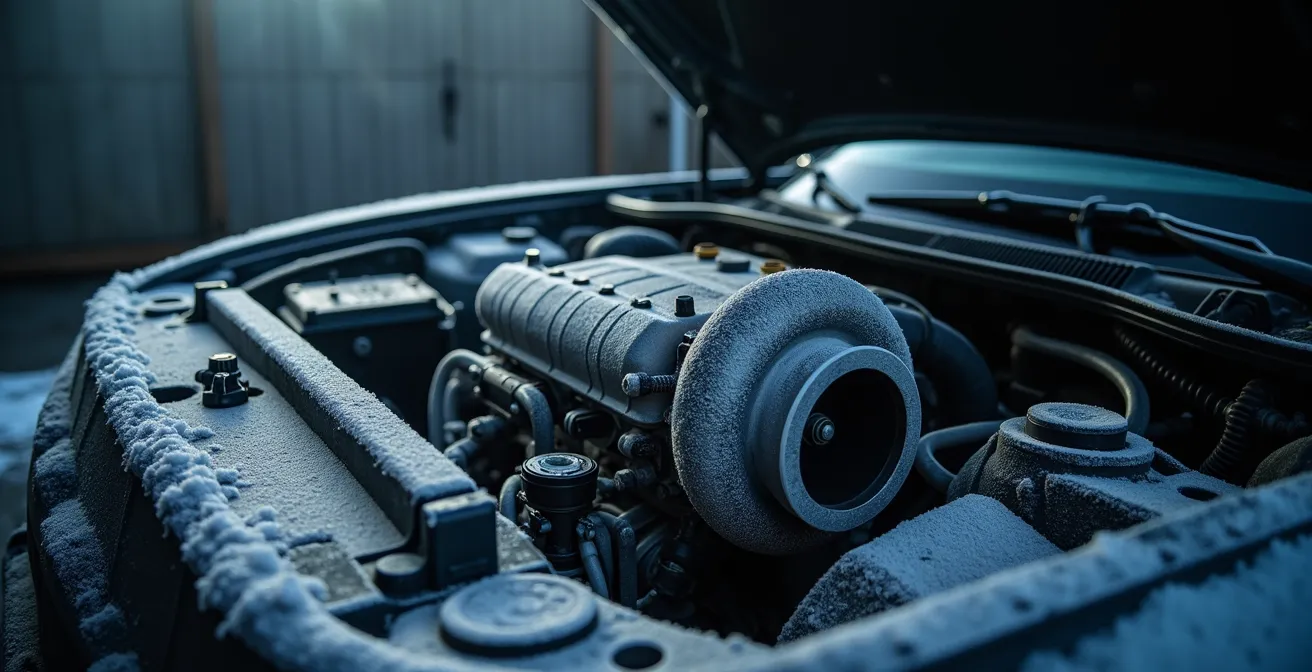
In terms of warm-up speed, a non-turbocharged, larger displacement engine often warms its cabin faster simply due to its larger mass and thermal inefficiency. However, the critical factor for engine health is not cabin warmth, but the speed of oil circulation. For any engine, but especially a turbocharged one, the goal is to get warm oil flowing as quickly as possible. A block heater is invaluable here, as it pre-warms both the coolant and the oil, drastically reducing the risk of a damaging cold start.
Why Your Dashboard Sensors Fail Faster in Winter Conditions?
Winter doesn’t just attack your engine; it wages a war on your car’s nervous system: the network of sensors that monitor everything from tire pressure to wheel speed. These sensors and their wiring are exposed to a brutal combination of thermal shock, moisture, and corrosive road salt, leading to a spike in dashboard warning lights during the winter months.
The most common victim is the Tire Pressure Monitoring System (TPMS). Air is a gas, and its pressure drops as it gets colder. For every 6°C drop in ambient temperature, your tire pressure can decrease by 1 PSI. This is why a tire that was perfectly inflated in the fall can trigger a TPMS warning light on the first cold morning, as tire pressure naturally drops in cold weather. It’s crucial to check and adjust your tire pressure when the tires are cold for an accurate reading.
Other sensors are physically vulnerable. ABS wheel speed sensors are located in the wheel wells, where they are constantly bombarded by salt spray and ice chunks. This leads to corrosion on the connectors and physical damage to the wiring, which can disable your anti-lock braking system. Backup cameras become useless when coated in road grime, and parking sensors can give false readings when covered in ice. A key preventative step during fall maintenance is to inspect exposed sensor wiring and apply dielectric grease to connectors to seal out moisture and prevent corrosion.
Key takeaways
- Winter readiness in Quebec is a fight against physics, not a simple checklist; “all-season” is a myth.
- Full synthetic oil is non-negotiable to prevent engine and turbo starvation at -30°C.
- Your battery loses half its power in extreme cold; replace it proactively based on the 4-Year Rule, not after it fails.
How to Beat the Rush for the December 1st Winter Tire Deadline?
In Quebec, the December 1st winter tire deadline creates a predictable rush at every garage, leading to long waits and limited appointment slots. Beating this rush isn’t about getting your tires on in September; it’s about strategic timing. The key is to watch the forecast, not the calendar. Winter tires are made of a softer rubber compound designed to stay flexible and grip the road in the cold. Installing them too early, when temperatures are still consistently warm, can cause the soft tread to wear down prematurely.
The golden rule, as advised by experts at CAA-Quebec, is to make the switch when the temperature starts to consistently hover around 7°C for several consecutive days. This is the point where all-season tire compounds begin to harden and lose their grip, while winter tires enter their optimal performance window. This usually happens sometime in mid-to-late October in most of Quebec, making it the perfect time to book your appointment.
By scheduling your tire change for this period, you not only ensure your vehicle is ready for the first surprise snowfall but you also avoid the November chaos. You get your choice of appointment times, and technicians aren’t rushed, leading to better service. Don’t wait for the law to tell you when to be safe. Let the thermometer be your guide, and book your appointment a month to two weeks before the December 1st deadline. This simple act of foresight is the final piece of your vehicle’s winter armour.
Don’t wait for the first freeze to discover a problem. Book a comprehensive fall inspection with a trusted mechanic now and give your vehicle the professional defense it needs to survive a Quebec winter with reliability and safety.
Frequently Asked Questions about Winter Car Preparation in Quebec
When should I book my winter tire appointment?
To get your winter tires changed, make an appointment between one month and two weeks before December 1st. There’s no need to go any earlier, as it can cause premature wear on the tires, and waiting any later can be dangerous and lead to long waits.
Why not install winter tires too early?
A winter tire’s soft rubber compound relies on cold temperatures to perform properly and resist wear. Installing them when the weather is still consistently warm will cause the tread to wear down much faster, reducing the lifespan and effectiveness of the tire.
How can I check if my winter tires are still good?
In Quebec, a common and effective method is the quarter test. Insert a 25-cent coin into the tread with the caribou’s muzzle facing down. If the muzzle remains visible, the tire’s tread is too worn out (below the legal limit of 1.6 mm) and it needs to be replaced for your safety.