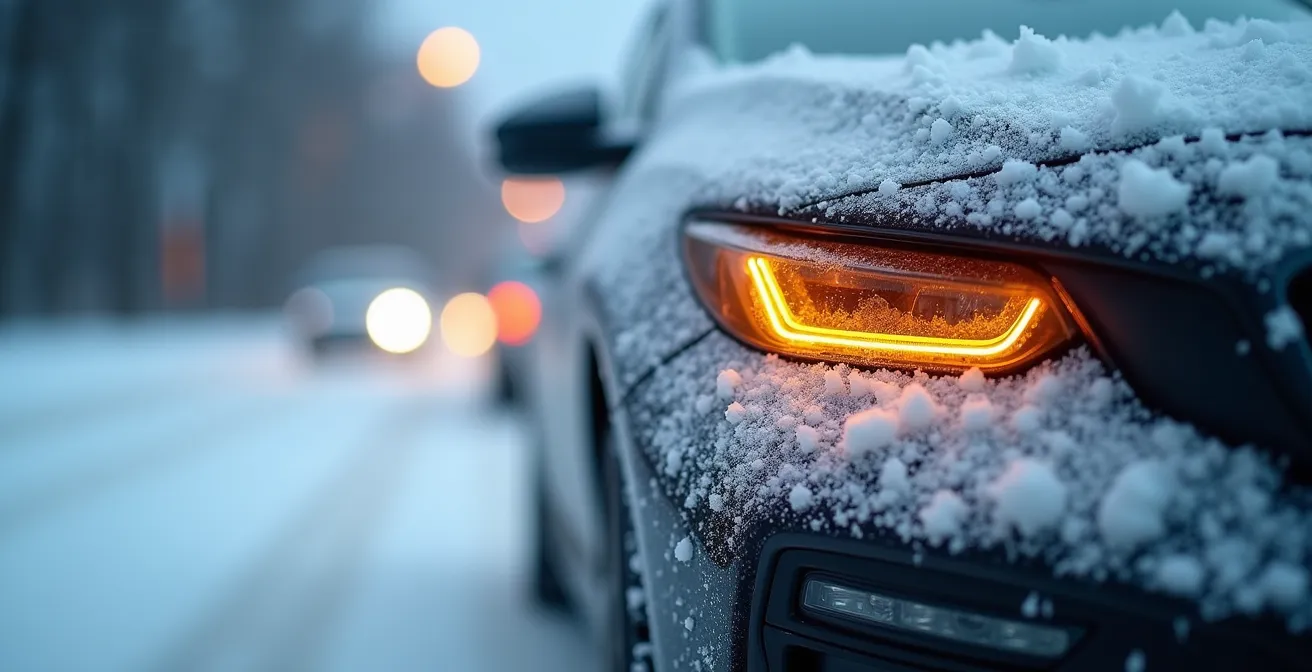
Contrary to popular belief, your Adaptive Cruise Control (ACC) failing in a Quebec snowstorm isn’t a technical flaw; it’s a critical safety communication telling you that you have reached the system’s operational limit.
- Sensor blockage from snow or slush is the system’s way of saying it can no longer see the road safely.
- Conditions like ice or blowing snow, common in Quebec, are environments where ACC is not designed to operate, regardless of sensor cleanliness.
Recommendation: Treat any ACC “System Unavailable” message in winter not as an annoyance, but as a non-negotiable command to disengage all cruise control and resume full manual driving.
You’re on the 20, heading towards Quebec City. The snow is coming down, a familiar sight for any highway driver in the province. Your vehicle, equipped with the latest Advanced Driver-Assistance Systems (ADAS), is handling the steady pace with its Adaptive Cruise Control engaged. Then, a sudden beep and a message on your dashboard: “ACC Unavailable.” The car’s automated systems have given up, leaving you to take full control in worsening conditions. This sudden technological surrender is frustrating and, for many drivers, confusing. Why does this expensive technology, meant to make driving easier, fail when you might need it most?
The common answer is simple: the radar sensor is blocked by snow and slush. While true, this only scratches the surface. Many drivers believe the goal is to simply keep the sensor clean, or that the technology is just buggy. This misses the fundamental point. That “System Unavailable” message is not just an error. It’s a crucial piece of system talk-back, a deliberate design feature to prevent the system from operating outside its safe parameters. It’s the car telling you, “I’m blind now. It’s all on you.”
This guide reframes that perspective. As an ADAS safety trainer, my goal is to teach the limits of automation. Instead of seeing this as a technological failure, you will learn to interpret it as a vital signal. We’ll move beyond the simple act of wiping a sensor and into the mindset of proactive disengagement. You will understand why trusting your ACC in stop-and-go Montreal traffic is a psychological trap, how to interpret Transports Québec’s 511 road conditions in the context of your car’s abilities, and when the only safe move is to turn the system off entirely. Mastering your modern vehicle isn’t just about knowing which buttons to press; it’s about understanding when the technology itself tells you to stop trusting it.
This article is structured to build your expertise progressively, moving from the immediate problem to strategic decision-making. The following sections will equip you with the knowledge to manage your vehicle’s assistance systems safely and effectively throughout a Quebec winter.
Summary: Mastering Adaptive Cruise Control in a Quebec Winter
- How to Keep Your Radar Sensor Clear of Slush on Long Trips?
- Adaptive vs Standard Cruise: Which Saves More Gas in Heavy Traffic?
- The Reaction Time Trap: Trusting ACC Too Much in Stop-and-Go
- How to Adjust Following Distance to Prevent Cut-Ins in Montreal Traffic?
- When to Disengage ACC: Construction Zones and Exit Ramps
- When to Cancel Your Trip: Interpreting Transports Québec Road Conditions
- The “System Unavailable” Message: Dirt, Snow, or Broken Sensor?
- Do Collision Avoidance Systems Actually Lower Your Insurance in Quebec?
How to Keep Your Radar Sensor Clear of Slush on Long Trips?
The most common cause of an ACC failure in a snowstorm is a blocked sensor. This sensor, often located in the lower grille or behind the vehicle’s emblem, is the “eyes” of the system. When it’s caked in ice and road slush, it can’t get a clear reading, and for safety, it shuts down. While pulling over to wipe it is the immediate fix, proactive measures are far more effective for long winter drives.
Before you even begin your trip, ensure the sensor area is completely clean and dry. Applying a hydrophobic coating or a quality car wax to the sensor cover can be a game-changer. These treatments create a slick surface that helps slush and ice slide off more easily instead of building up. It’s the same principle as Rain-X on your windshield. This won’t prevent buildup entirely during a heavy, wet snowfall, but it can significantly extend the time before the sensor becomes obstructed.
During a trip, if you must pull over, use a soft microfiber cloth to clean the sensor. Avoid abrasive brushes or scrapers that could scratch the plastic cover, permanently affecting the radar’s accuracy. Some drivers keep a small spray bottle of winter-grade washer fluid in their car for this purpose, as it helps melt ice quickly without causing damage. Remember, a clean sensor is the first line of defense, but it’s not an invincible solution. The system’s limitations go far beyond simple obstruction.
Adaptive vs Standard Cruise: Which Saves More Gas in Heavy Traffic?
One of the selling points of Adaptive Cruise Control is its potential for improved fuel efficiency. By maintaining a consistent following distance and applying smoother, more calculated acceleration and deceleration than a human driver, the system can avoid the jerky inputs that waste gas. A Canadian analysis confirms that by reacting more swiftly than a person, ACC can optimize braking and acceleration, leading to fuel savings in clear conditions. However, the moment winter weather enters the equation, this benefit is overshadowed by a critical safety risk.
The core principle of safe winter driving is to minimize the use of any form of cruise control on slick surfaces. As Ron Wilson of the Alberta Motor Association stated in a cautionary piece for The Globe and Mail, “you never want to use it on wet or icy roads.” This applies to both standard and adaptive systems. If your vehicle hits a patch of black ice, the cruise control’s prime directive is to maintain speed. This can cause the wheels to spin, leading to a sudden and catastrophic loss of control. The system has no way of knowing the road surface is compromised.
Therefore, the debate over fuel savings becomes moot. In heavy but dry traffic, ACC likely has a slight edge in fuel economy. But in the slushy, unpredictable conditions of a Quebec winter, the only correct answer is to use neither. The risk of the system making a poor decision on a low-traction surface far outweighs any potential savings at the pump. Safety always dictates that on snowy or icy roads, the driver’s foot must be in full control of the accelerator and brake.
The Reaction Time Trap: Trusting ACC Too Much in Stop-and-Go
Adaptive Cruise Control systems can feel superhuman. Where a human driver’s reaction time is typically between one and two seconds, research shows that ACC systems react in under one second. This rapid response creates incredibly smooth acceleration and braking, which can lull a driver into a state of “automation complacency.” You begin to trust the machine implicitly, your focus drifts, and your readiness to intervene diminishes. This is the reaction time trap, and it’s particularly dangerous in winter.
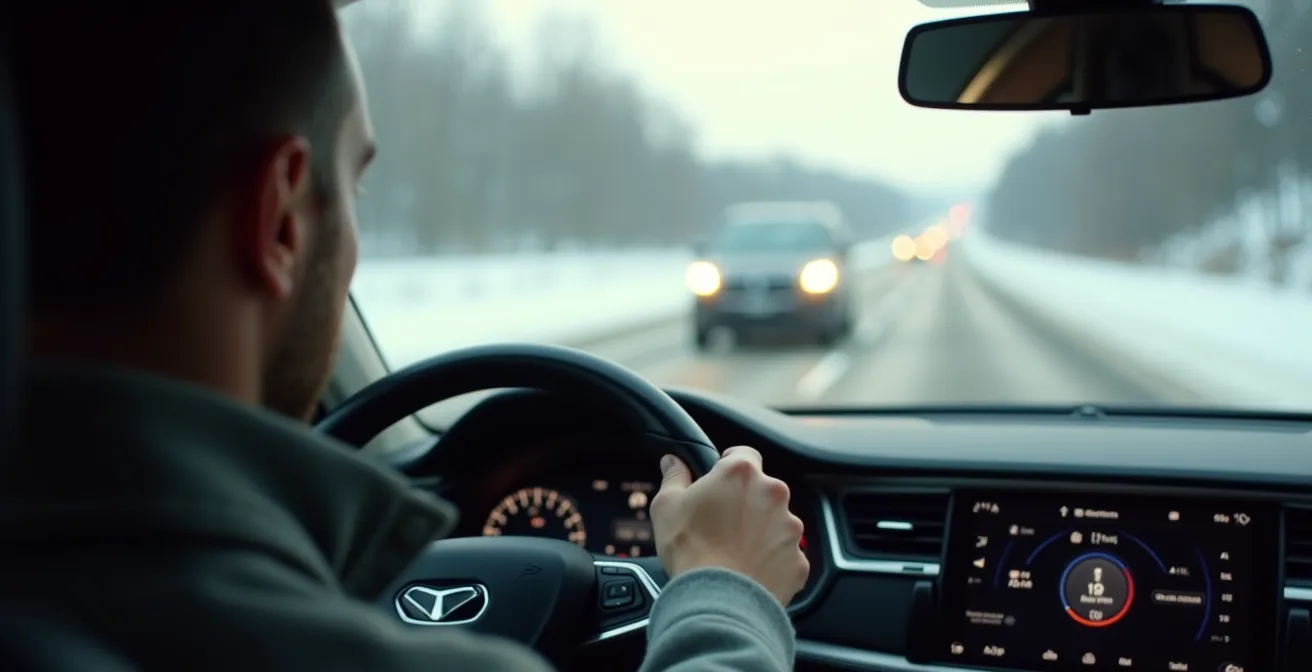
This over-trust is hazardous because the system is not infallible; it is simply following its programming. It doesn’t see a patch of ice or anticipate a sudden lane change from a car two vehicles ahead. Even more dangerous is the phenomenon of sensor degradation. Before a sensor becomes fully blocked, its readings can become unreliable. This can lead to terrifying situations, as described by one driver:
When the sensor starts to get covered, it doesn’t fail to a ‘blocked’ state, but a ‘nothing there’ state. I felt and noticed my car start to accelerate, getting closer to the car ahead.
– Ford Escape Forum User, Ford Escape Forum Discussion
This is the ultimate trap: the system doesn’t just fail, it fails by doing the exact opposite of what you expect, accelerating when it should be braking. It highlights the absolute necessity of remaining an active, engaged supervisor of the technology at all times. Your fast reaction time is the final, and most important, safety system.
How to Adjust Following Distance to Prevent Cut-Ins in Montreal Traffic?
Setting the correct following distance on your ACC is a delicate balance, especially in the notoriously dense traffic of Montreal. Set it too long, and you invite other drivers to constantly cut in front of you, causing your car to brake repeatedly. Set it too short, and you reduce your safety margin, particularly in wet or snowy conditions. Your vehicle’s ACC settings are not “set it and forget it”; they are tools that require dynamic adjustment based on your environment.
Vehicle manufacturers provide clear guidance on how these settings correlate to time-based gaps. Mastering their use is key to a smoother, safer commute. The general rule is to match the gap to your speed and the traffic density. In slow, stop-and-go traffic on the Décarie, a shorter setting is appropriate. At highway speeds on the 40, a longer distance is non-negotiable.
This table, based on information provided by manufacturers like Chevrolet, breaks down the intended use for each setting. However, in a Quebec winter context, there is one overriding rule: always default to the longest possible setting. The electronic system cannot account for the drastically increased braking distance on ice or packed snow.
| Distance Setting | Typical Gap (seconds) | Best Use Case | Cut-in Risk |
|---|---|---|---|
| Shortest | 1.0-1.5 | Stop-and-go under 30 km/h | Low |
| Medium | 1.5-2.5 | City driving 30-60 km/h | Moderate |
| Long | 2.5-3.5 | Highway 60+ km/h | High |
| Longest | 3.5+ | Winter/wet conditions | Very High |
While the high risk of cut-ins with the longest setting is an annoyance, it is a manageable one. A catastrophic rear-end collision on an icy patch because your following distance was too short is not. Always prioritize safety over the minor inconvenience of another driver merging into your lane.
When to Disengage ACC: Construction Zones and Exit Ramps
Adaptive Cruise Control excels in predictable environments: straight highways with clear lane markings and consistent traffic flow. It fails, by design, in chaotic and unpredictable situations. Two of the most common “no-go” zones for ACC are construction zones and highway exit ramps, both of which are rendered even more treacherous by winter conditions.
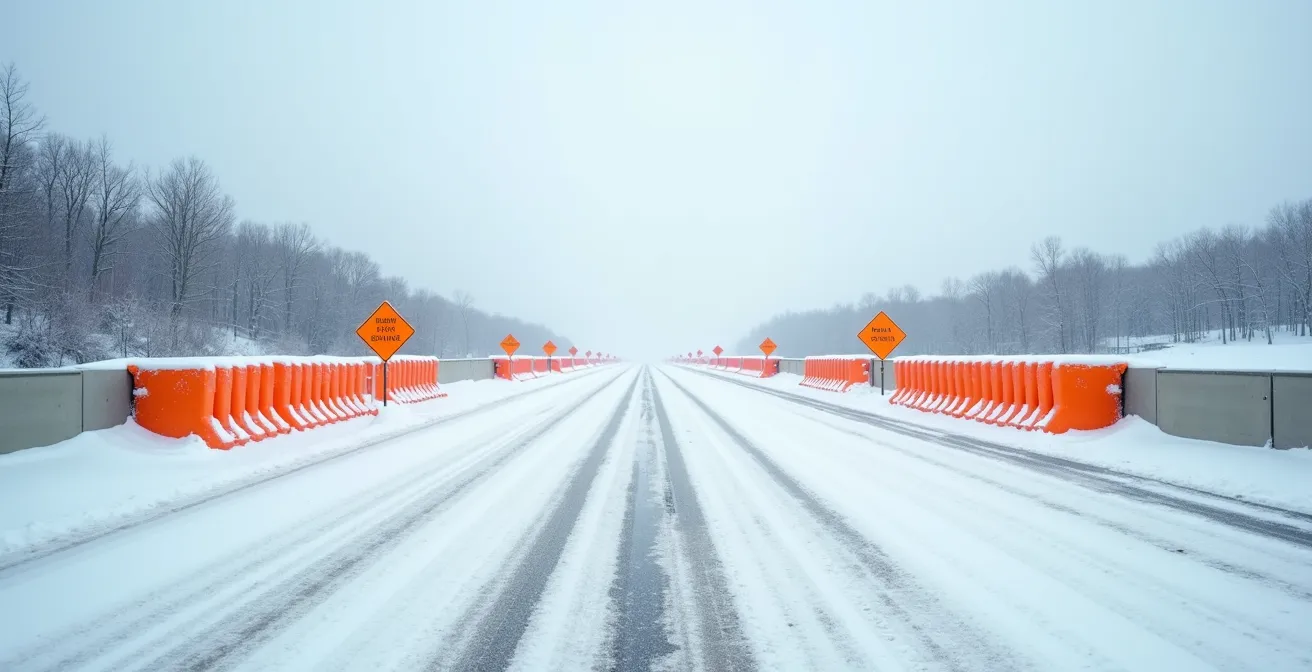
A Quebec construction zone in winter is a sensor’s nightmare. Faded or snow-covered lane markings, narrow temporary lanes, concrete barriers, and a forest of orange cones create a level of visual chaos the system is not designed to interpret. The radar may not distinguish a temporary barrier from a slow-moving truck, or the camera may lose track of the lane entirely. Relying on ACC in such an environment, like the Turcot Interchange during its reconstruction, is a recipe for disaster. The only safe action is proactive disengagement—turning the system off *before* you enter the zone.
Similarly, tight exit ramps with short deceleration lanes demand manual control. Your ACC is focused on the car ahead, not on the rapidly approaching curve or the need to slow down for a 50 km/h ramp. It will maintain speed for too long, forcing you into abrupt, late braking, which is extremely dangerous on a potentially icy off-ramp. You, the driver, must anticipate the exit and disengage the system well in advance to ensure a smooth and safe deceleration.
Your Action Plan: ACC Disengagement Protocol
- Immediate Disengagement: As soon as you see the first orange signs indicating a construction zone ahead, turn off your ACC.
- Anticipate Exits: Before approaching your desired highway exit, especially those with tight curves or short deceleration lanes, cancel the ACC.
- Assess Lane Markings: If snow or slush obscures the painted lane markings, your lane-keeping assist features are compromised. Disengage all assistance systems.
- Handle Complex Interchanges: For major, quasi-permanent construction zones like the Turcot or Lafontaine Tunnel projects, make it a habit to drive manually through the entire segment.
- Confirm Clear Conditions: Only re-engage ACC once you have completely cleared the construction zone or interchange and can confirm clear, visible lane markings ahead.
When to Cancel Your Trip: Interpreting Transports Québec Road Conditions
Before you even get behind the wheel for a long-distance winter drive, your most important safety tool is your web browser or smartphone. The Québec 511 service by Transports Québec provides real-time road condition information that should be treated as a direct input for your decision-making, not just for your route, but for whether you use your vehicle’s assistance systems at all.
The terminology used by Québec 511 directly correlates to the operational limits of your ACC and other ADAS features. As safety officials across Canada warn, cruise control systems are programmed to maintain a set speed, and if the vehicle hits an icy patch, this programming can cause the wheels to spin up to maintain that speed, potentially causing a complete loss of vehicle control as noted by TranBC’s official winter driving guide. Understanding how to translate the official report into actionable decisions for your car’s tech is a critical skill.
This guide helps you decode the official terms. If the conditions include anything other than “Bare,” you should seriously question the use of ACC. If “Possible Ice” or “Blowing Snow” is reported, the decision is simple: do not use any form of cruise control, period.
| Quebec 511 Term | ACC Expected Performance | Recommendation |
|---|---|---|
| Chaussée enneigée (Snow-covered road) | Sensor blockage likely within 30 min | Disable ACC preemptively |
| Visibilité réduite (Reduced visibility) | Camera-based features will fail | Manual driving only |
| Poudrerie (Blowing snow) | Intermittent sensor failures | ACC unreliable – avoid use |
| Verglas possible (Possible ice) | System cannot detect ice | Never use any cruise control |
Sometimes, the safest decision is to postpone or cancel your trip. If the 511 report is a sea of red and purple, indicating widespread snow cover, ice, and poor visibility, no amount of advanced technology can make the journey safe. The smartest drivers know when to stay home.
The “System Unavailable” Message: Dirt, Snow, or Broken Sensor?
When the “ACC Unavailable” or “Front Sensor Blocked” message appears, it’s a moment of truth. Your car is talking to you, and you need to diagnose its message. Is it a temporary obstruction, or a more serious issue? Your response depends on the context.
In 90% of winter cases, the cause is environmental: a buildup of snow, slush, or road salt on the radar sensor or the windshield area in front of the forward-facing camera. A safe stop and a quick wipe with a soft cloth will usually resolve the issue, and the system will become available again after a few moments of driving. However, if the message persists in clear, dry weather, you need to investigate further.
A persistent error could indicate a more permanent problem. Start with a visual inspection. Look for physical damage to the sensor area in the grille—cracks or deep pitting from gravel or chunks of ice can knock the highly sensitive radar out of alignment. Also check for corrosion on any visible electrical connectors, a common problem with road salt. If there’s no visible damage but the system still won’t activate, the issue is likely an internal fault or, most commonly, a loss of calibration. Any minor front-end impact, even sliding into a snowbank, can be enough to require a mandatory recalibration by a qualified dealer. This is not a DIY fix; it requires specialized equipment to ensure the sensor is aimed correctly.
Follow this simple troubleshooting flow:
- Check the Environment: Is it actively snowing or slushy? If yes, find a safe place to pull over and gently clean the sensor in your grille and the windshield area in front of your rearview mirror.
- Inspect for Damage: If the weather is clear, carefully inspect the sensor for cracks, deep scratches, or signs of impact.
- Look for Corrosion: Check any visible wiring or connectors near the sensor for the tell-tale green or white crust of salt corrosion.
- Consider Recent Impacts: Have you had any front-end collisions or even bumped a parking curb or snowbank recently? If so, calibration is the most likely culprit.
- Visit a Professional: If the system remains unavailable after cleaning and a visual inspection reveals no issues, it’s time to book a service appointment for a diagnostic and potential recalibration.
Key Takeaways
- ACC failure in winter is a safety feature, not a flaw, signaling the system’s operational limits have been reached.
- Proactive management, like cleaning sensors and using hydrophobic coatings, is more effective than reactive fixes.
- Never use any form of cruise control on wet, icy, or snow-covered roads, as the risk of losing control outweighs any benefit.
- Automation complacency is a major risk; always remain an active supervisor, ready to take immediate manual control.
Do Collision Avoidance Systems Actually Lower Your Insurance in Quebec?
It’s a logical assumption: if you pay extra for advanced safety systems like ACC and Automatic Emergency Braking (AEB), your insurance premiums should go down. After all, these systems are designed to prevent accidents. In Quebec, however, the reality is far more complex, and a discount is far from guaranteed. Insurers are well aware of the technology’s limitations, especially in winter.
Insurance companies base their rates on vast amounts of data. They know that while ADAS can prevent some types of collisions, the systems are rendered ineffective by the very conditions that make driving most dangerous. For example, they consider that ACC cannot compensate for the 5-7 times longer braking distance on ice, even with winter tires. The technology’s benefits are largely negated when road friction disappears. Furthermore, there’s a financial catch: when an ADAS-equipped vehicle is in a minor fender-bender, the repair costs can be exorbitant. A simple bumper replacement can turn into a multi-thousand-dollar job if it involves replacing and, crucially, recalibrating the radar and camera sensors.
This high repair cost can offset the savings from fewer accidents. In Quebec, any potential discount would only apply to the private insurance portion of your policy, which covers material damage. Your public plan with the SAAQ, which covers bodily injury in a no-fault system, is unaffected. While some insurers may offer unspecified discounts for “vehicle safety features,” they rarely single out ACC. Your best bet is to contact your insurer directly—be it Desjardins, Intact, or La Capitale—and ask if they offer an explicit discount for your vehicle’s specific ADAS package. Don’t be surprised if the answer is nuanced. The industry is still learning how to price the complex relationship between high-tech assistance and high-cost repairs.
Frequently Asked Questions About Adaptive Cruise Control in Quebec
Does the SAAQ public insurance cover ADAS-related claims?
The SAAQ covers bodily injury in a no-fault public plan. Any ADAS discount would only apply to the private insurance portion covering material damage.
Why might insurers hesitate to offer ADAS discounts?
While ADAS prevents accidents, the high cost of repairing and recalibrating sensors after minor fender-benders can offset savings from fewer claims.
Do major Quebec insurers offer explicit ACC discounts?
Contact insurers like Desjardins, Intact, or La Capitale directly as policies vary and may not explicitly advertise ADAS discounts.