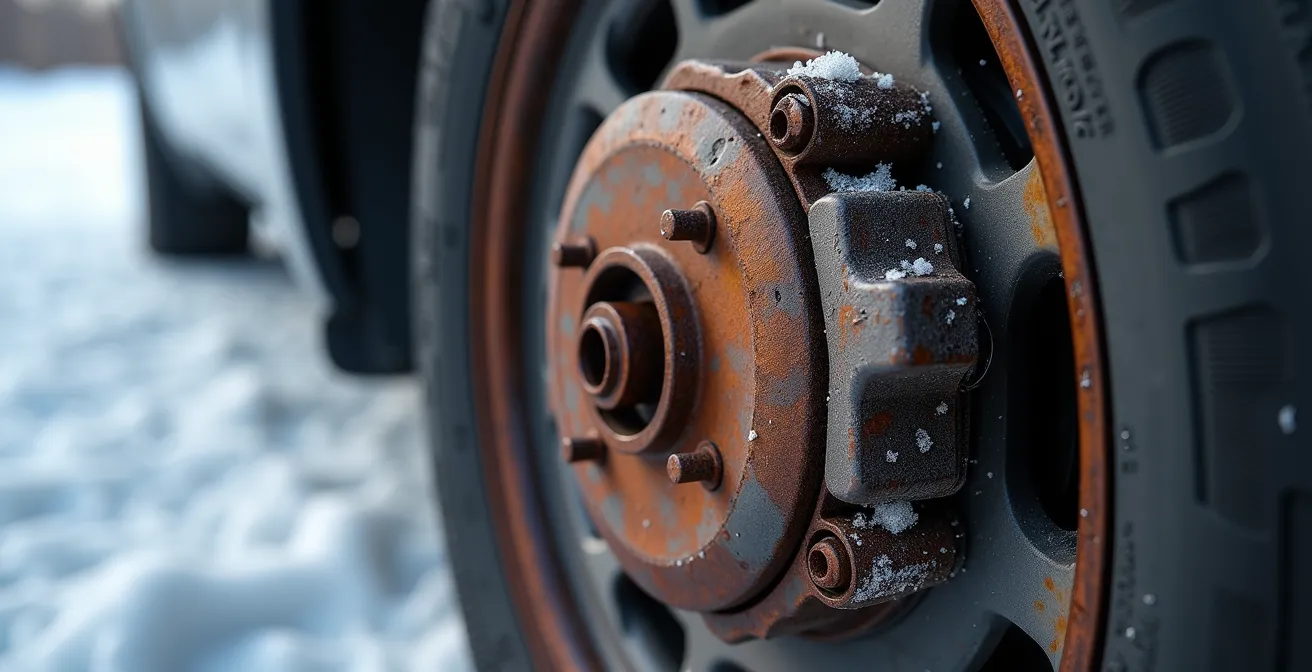
Contrary to popular belief, your rear brakes aren’t failing from overuse; they are seizing from chronic *underuse* in Quebec’s harsh, salt-filled winters.
- Your front brakes perform up to 70% of the braking, leaving the rear brakes cold, wet, and unable to burn off corrosive moisture.
- Quebec’s specific road salt mixture creates an aggressive brine that becomes trapped in rear caliper mechanisms, dramatically accelerating rust and seizure.
Recommendation: The key to avoiding failure is not driving differently, but implementing a proactive bi-annual maintenance schedule focused on cleaning and lubricating caliper components, especially during tire changeovers.
If you’re a Quebec driver, you might have faced a puzzling and expensive reality: a mechanic tells you your rear brakes are completely seized and need replacement, even though the pads look barely worn. You drive the car every day, so how can they fail from what seems like a lack of use? This isn’t a fluke; it’s a predictable outcome of modern vehicle design clashing with our province’s uniquely harsh winter conditions. Your intuition is correct—it’s the very lack of heavy use that dooms your rear brakes.
Most of the stopping power in a front-wheel-drive car is handled by the front brakes. They work hard, get hot, and in doing so, constantly burn off the moisture and road grime that cause rust. Your rear brakes, however, are often just along for the ride. They engage with less force and less frequency, meaning they rarely reach the temperatures needed to self-clean. They stay cool, damp, and become a perfect trap for a corrosive cocktail of water, dirt, and road salt.
This guide moves beyond the simple “salt causes rust” explanation. We’ll delve into the specific mechanical and chemical reasons why your rear brakes are in a constant battle for survival. We will explore the science behind salt’s corrosive power, the right way to maintain your braking system against it, and why certain common habits might actually be making the problem worse. Understanding this “perfect storm” of underuse and hyper-aggressive corrosion is the first step toward breaking the cycle of premature failure and unexpected repair bills.
To navigate this complex issue, this article breaks down the problem and its solutions into clear, actionable sections. You’ll find everything you need to understand, diagnose, and prevent rear brake seizure in the Quebec climate.
Table of Contents: Understanding and Preventing Brake Seizure in Quebec
- Why Does Road Salt Cause Brake Calipers to Lock Up?
- How to Rinse Salt Off Your Brakes Without Freezing Them?
- Coated Rotors vs Standard: Are They Worth the Extra Cost in the Rust Belt?
- The Parking Brake Mistake: Why You Shouldn’t Use It in Wet Freezing Weather?
- When to Service Your Brakes: Every 6 Months or Every Year?
- Why Does Speeding 10 km/h Increase Your Stopping Distance by 10 Meters?
- Why Do Quebec Cars Rust 3x Faster Than Those in British Columbia?
- Why Does Your Adaptive Cruise Control Fail During a Snowstorm?
Why Does Road Salt Cause Brake Calipers to Lock Up?
The core of the problem lies in a simple chemical reaction supercharged by our winter environment. Every year, Canadian municipalities spread over 5 million tonnes of road salt to keep roads clear. While essential for safety, this salt turns your vehicle’s undercarriage into a laboratory for corrosion. When salt (sodium chloride) and other de-icing agents mix with melted snow, they create a conductive solution called an electrolyte. This brine splashes onto your brake components, dramatically accelerating the electrochemical process of rusting.
As a brake specialist, I can tell you that rust doesn’t form uniformly. It targets the most vulnerable, unpainted metal parts with tight tolerances—precisely the characteristics of a brake caliper. The caliper’s job is to squeeze brake pads against the rotor, and it relies on slide pins moving freely within a bracket. These pins are the primary victims. The salt brine seeps into the rubber boots meant to protect them, creating what we call corrosion hotspots. Rust builds up, the pins can no longer slide, and the caliper becomes frozen in place. It either fails to engage, reducing your stopping power, or worse, fails to release, keeping the pad in constant contact with the rotor.
This electrolytic acceleration is why a car can develop severe brake issues in just one or two Quebec winters. According to brake system experts, road salt acts as a catalyst, allowing rust to form much faster and do more damage than it would with water alone. This turns the natural, slow process of oxidation into an aggressive attack on your braking system’s critical moving parts, leading directly to a seized caliper.
How to Rinse Salt Off Your Brakes Without Freezing Them?
While you can’t stop the salt, you can mitigate its damage with regular cleaning. However, spraying water on your brakes in a Quebec winter requires a bit of strategy to avoid creating a new problem: ice. The goal is to flush away the corrosive brine without letting water freeze inside the brake components. The key is temperature management. The best time to wash your undercarriage is on a milder day (above freezing) or immediately after a long drive when the brakes and wheels are still warm from use. This residual heat will help evaporate the water quickly.
A pressure washer or a high-pressure wand at a car wash is your best tool. Focus the spray on the inner side of the wheel, aiming directly at the caliper and rotor. You need to get into all the nooks and crannies to dislodge the caked-on salt and grime. An undercarriage wash at an automatic car wash is a great, hands-off option. The most critical part of the process is what you do afterward. If possible, park the vehicle in a heated garage to allow everything to dry thoroughly. If you can’t, take the car for a short, brisk drive with some moderate braking to generate heat and evaporate any remaining moisture before parking it for the night.
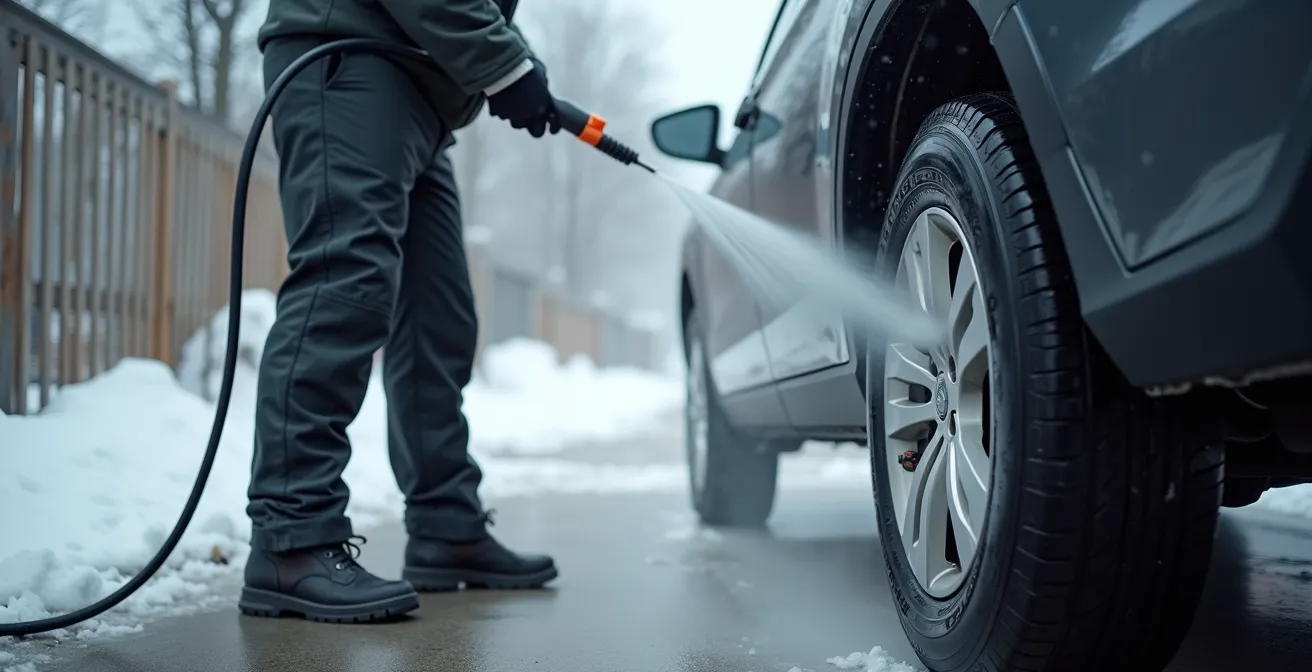
This proactive cleaning, especially after a major snowstorm or when the roads are visibly white with salt, disrupts the corrosive process. By regularly flushing the salt away, you prevent it from accumulating in those critical moisture traps around the caliper pins and pistons, giving your brakes a fighting chance to survive the winter without seizing.
Coated Rotors vs Standard: Are They Worth the Extra Cost in the Rust Belt?
When it comes time to replace your rotors, you’ll be faced with a choice: standard, uncoated rotors or premium, coated ones. For a Quebec driver, this isn’t just an aesthetic decision; it’s a strategic investment against corrosion. Uncoated rotors are bare cast iron, and they will show surface rust almost immediately after exposure to moisture. While some of this rust is scraped off the pad contact area during braking, the rest of the rotor—especially the cooling vanes and the “hat” section that fits over the hub—remains vulnerable.
Coated rotors are treated with a protective layer designed to resist corrosion. These coatings come in various forms, such as zinc plating or more advanced Geomet and E-coating finishes. This barrier prevents salt brine from directly contacting the iron, significantly delaying the onset of severe rust. While the pad will wear the coating off the braking surface, the rest of the rotor remains protected. This prevents the cooling vanes from getting clogged with rust flakes (which leads to overheating) and stops the rotor hat from rusting and potentially seizing to the hub, making future service much more difficult.
The small premium for coated rotors pays for itself in longevity and reduced service headaches. For example, a set of four Geomet-coated rotors might cost only about $40 more than standard ones for a common vehicle like a Honda Civic. Considering they can last years longer in a salty environment, the value is clear.
The following table, based on data from industry testing, illustrates the significant difference in durability.
| Coating Type | Salt Spray Resistance | Expected Lifespan | Cost Premium |
|---|---|---|---|
| Geomet® (Zinc-Aluminum) | 480 hours | 3-4 years | $10/rotor |
| E-Coating (Electrostatic) | 120-300 hours | 1-2 years | $5-7/rotor |
| Standard (Uncoated) | 24 hours | <1 year | Base price |
| Zinc Plating | 240 hours | 2-3 years | $7-8/rotor |
The Parking Brake Mistake: Why You Shouldn’t Use It in Wet Freezing Weather?
Using your parking brake (or handbrake) is a deeply ingrained safety habit. In most conditions, it’s the right thing to do. However, in Quebec’s wet and freezing winters, it can be the very action that causes your rear brakes to seize. Most modern cars use the rear brakes for the parking brake mechanism, either through a small drum brake inside the rotor or by mechanically actuating the disc brake caliper. After driving through slush and salty water, this mechanism is soaking wet.
If you engage the parking brake and leave the car overnight in freezing temperatures, that water can turn to ice, effectively “gluing” the brake pads to the rotor or freezing the cable and lever mechanism in place. The result is a car that won’t move in the morning. As the RAC Drive technical team points out, this is a common winter scenario:
It will be difficult to reverse or release the handbrake, as the rear brake will be stuck on. This symptom is more common in winter temperatures as the mechanism can freeze up due to ingress of snow and ice.
– RAC Drive Technical Team, RAC Drive Brake Seizure Guide
So, what’s the safe alternative when parking on a level surface? Forgo the parking brake. Instead, rely on your transmission to hold the vehicle. For automatic cars, simply putting it in ‘Park’ is sufficient. For manual transmissions, leave the car in first gear or reverse. On a hill, this technique is still your first line of defense, but you should add another layer of safety by turning your front wheels sharply toward the curb. This way, if the car were to roll, it would be stopped by the curb immediately.
- Leave the vehicle in ‘Park’ (automatic) or in gear (manual).
- Turn your wheels toward the curb when parked on an incline.
- Use wheel chocks for extra security on very steep grades.
- Only engage the parking brake after a long drive once you are certain the brakes have had time to dry out from their own heat.
When to Service Your Brakes: Every 6 Months or Every Year?
In a milder climate, you might only service your brakes when the pads are worn. In Quebec, this is a recipe for seized calipers and costly replacements. The guiding principle here is proactive maintenance. You need to service your brakes based on time and season, not just mileage. The ideal rhythm for a Quebec driver is a full brake service every six months, or at the very least, once a year. The perfect time to do this is during your seasonal tire changeovers. Since winter tires are mandatory as of December 1st, you’re already bringing your car to the garage—make a brake inspection and service part of that routine.
But what does a proper “brake service” for our conditions actually entail? It’s much more than a quick visual inspection. It involves:
- Disassembly: The mechanic should remove the caliper from its mounting bracket.
- Cleaning: All rust and built-up grime must be cleaned from the caliper bracket and the slide pin bores.
- Lubrication: The slide pins must be coated with a high-temperature, water-resistant silicone or ceramic-based brake lubricant before being reinserted.
- Inspection: The mechanic should also check the condition of the caliper piston boots for any tears that could let in moisture and inspect the brake lines for corrosion.
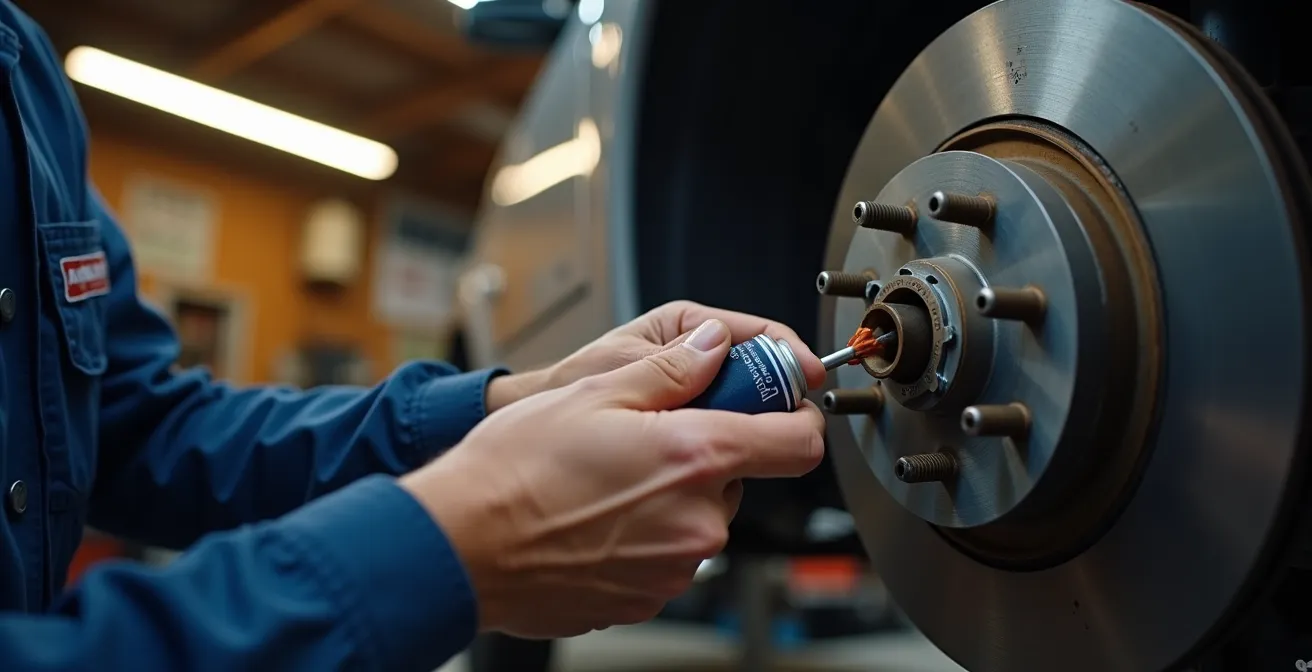
This proactive lubrication is the single most effective defense against seizing. It ensures the moving parts continue to move freely despite the constant assault from salt and moisture. For low-mileage drivers, this service is even more critical. Because your brakes aren’t used heavily, they rely entirely on this manual cleaning and lubrication to stay functional. Skipping this service to save a few dollars almost guarantees a much larger bill for replacing entire calipers and rotors down the road.
Why Does Speeding 10 km/h Increase Your Stopping Distance by 10 Meters?
The physics of braking are unforgiving. Your stopping distance doesn’t increase linearly with speed; it increases exponentially because kinetic energy is proportional to the square of your velocity. This means even a small increase in speed has a massive impact on the energy your brakes must dissipate. Going from 50 km/h to 60 km/h might not feel dramatically faster, but it requires significantly more work from your brakes to bring the vehicle to a halt. In ideal, dry conditions, this can add many meters to your stopping distance.
Now, factor in Quebec’s winter reality. On snowy or icy roads, your stopping distance can easily double or even triple as your tires struggle for grip. If your braking system is already compromised by a seized rear caliper, the situation becomes critical. A single seized caliper can lead to a 30-50% reduction in overall braking effectiveness. Your car will not only take much longer to stop, but it will also likely pull dangerously to one side as the remaining functional brakes try to compensate. The balanced distribution of braking force between all four wheels is lost.
This is where the “underuse” principle of rear brakes comes back to haunt you. The brakes you rely on least in daily driving become absolutely essential in an emergency stop, especially on a slippery surface where every ounce of braking force counts. A seized rear brake isn’t just a maintenance issue; it’s a profound safety compromise that dramatically extends your stopping distance precisely when you need it to be shortest. The extra 10 meters you need to stop could be the difference between a close call and a serious collision.
Why Do Quebec Cars Rust 3x Faster Than Those in British Columbia?
The dramatic difference in vehicle longevity between Canada’s coasts is not an exaggeration; it’s a reality dictated by climate and road maintenance policy. A car in Vancouver, with its mild, rainy winters, might see its original brake components last for 8-10 years. In Montreal or Quebec City, you’d be lucky to get 3-5 years out of the same parts. The primary culprit is the type and quantity of de-icing agents used. While British Columbia’s Lower Mainland uses minimal salt, Quebec battles its severe ice and snow with an aggressive mix of sodium chloride and calcium chloride.
Calcium chloride is particularly effective at melting ice in very low temperatures, but it’s also significantly more corrosive to metal than standard rock salt. This creates a hyper-corrosive environment for our vehicles that is among the harshest in North America. This is the “hyper-aggression” part of the perfect storm that targets your brakes. The constant exposure to this chemical brine means the battle against rust is relentless from November to April.
The impact of different provincial strategies on brake component lifespan is stark, as this data clearly shows. Provinces that use less salt or use it in colder, drier conditions see significantly longer life from their vehicle components.
This table, based on a comparative analysis of provincial road maintenance, highlights why Quebec is a unique hotspot for corrosion.
| Province | Salt Usage | Brake Life Impact |
|---|---|---|
| Quebec | Sodium & calcium chloride mix | 3-4 year average |
| Ontario | Heavy salt use | 3-5 year average |
| British Columbia | Minimal coastal areas only | 8-10 year average |
| Prairie Provinces | Less salt due to extreme cold | 5-7 year average |
Key Takeaways
- Rear brake seizure in Quebec is primarily caused by underuse, which prevents them from self-cleaning moisture and salt.
- Proactive bi-annual service, focusing on cleaning and lubricating caliper slide pins, is more important than mileage for preventing failure.
- Investing in coated rotors and avoiding the parking brake in freezing, wet conditions are crucial preventative strategies for Quebec drivers.
Why Does Your Adaptive Cruise Control Fail During a Snowstorm?
While seemingly unrelated to mechanical brake seizure, the failure of modern driver-assist systems (ADAS) like adaptive cruise control (ACC) during a snowstorm is rooted in the same winter reality: your car’s sensors and systems are under assault. Your ACC relies on a radar sensor, usually mounted in the front grille, to maintain distance from the vehicle ahead. During a heavy snowfall, this sensor can easily become caked with snow and ice, blinding it and causing the system to disengage.
This highlights a broader principle of winter driving: your vehicle’s safety depends on a network of interconnected systems, both mechanical and electronic, all of which must be kept clean and functional. A seized brake caliper is a mechanical failure, while a blocked ACC sensor is an electronic one, but both compromise your safety. This is why a holistic approach to winter vehicle readiness is so important. When you are checking your tire pressure and cleaning your lights, you should also be wiping your ADAS sensors clear.
Furthermore, these electronic systems rely on the mechanical systems to function correctly. The anti-lock braking system (ABS), for instance, is a critical electronic safety net. As the TIRECRAFT technical team emphasizes, “Once roads become icy in winter, your anti-lock brakes could be the only thing saving you from losing control.” But your ABS can only do its job if the mechanical calipers are able to respond instantly to its commands. A seized caliper can’t be modulated by the ABS, rendering one of your most important safety features useless at that wheel.
Action Plan: Winter Safety System Check
- Choose an empty, snowy parking lot to safely test your vehicle’s response.
- Perform gentle brake application tests when no other vehicles are present to feel for any pulling or imbalance.
- Monitor how your vehicle responds and listen for any unusual grinding or squealing sounds that indicate brake issues.
- Visually inspect your brake condition through the wheel spokes and clean any ADAS sensors on your grille and bumpers.
- If you notice any pulling, reduced stopping power, or warning lights, have the system professionally inspected immediately.
Frequently Asked Questions About Brake Maintenance in Quebec
How often should I service my brakes in Quebec?
Given that Quebec law mandates winter tires be installed by December 1st, the best practice is to schedule a comprehensive brake service at the same time as your fall and spring tire changeovers. This bi-annual schedule ensures your brakes are prepared for the strain of winter and cleaned of corrosive salt in the spring.
What does a proper Quebec brake service include?
A proper service goes beyond just checking pad thickness. It must include the disassembly of the brake calipers, thorough cleaning of the mounting brackets and slide pins, and re-lubrication of all moving parts with high-temperature, water-resistant grease. This prevents the components from seizing due to rust and corrosion.
Should low-mileage drivers service brakes more frequently?
Yes, paradoxically. Low-mileage drivers are at higher risk for seized calipers because their brakes are not used enough to heat up and burn off moisture. For these drivers, a professional inspection and lubrication service every six months is not just recommended; it is essential to prevent premature failure from corrosion.