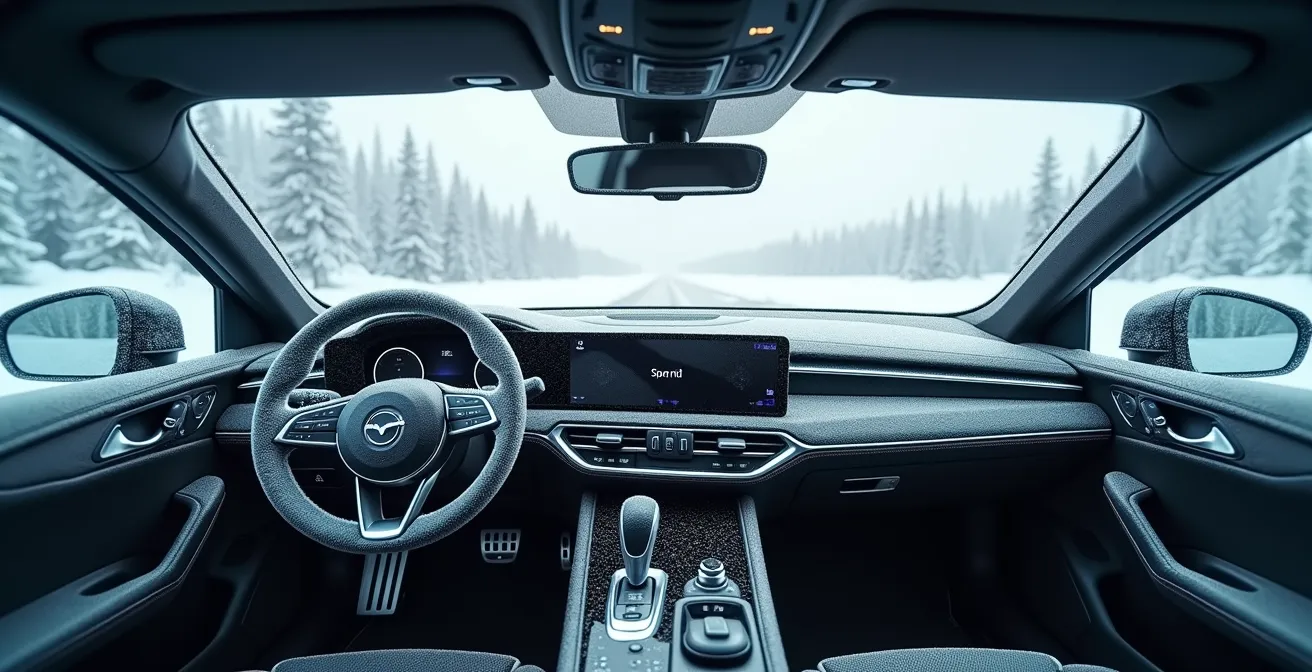
The sharp rise in repair costs for modern cars in Quebec is not just about complexity; it’s a financial trap caused by accelerated winter degradation of electronics, a concept we’ll call “electronic rust.”
- Extreme temperature swings cause a “thermal shock cascade,” leading to premature sensor failure.
- Preventative measures, especially annual rustproofing and using synthetic oil, offer the highest return on investment by preserving both function and resale value.
Recommendation: Shift your focus from purchase price to a Total Cost of Ownership (TCO) model that anticipates the “5-Year Sensor Cliff”—the point where repair costs predictably spike.
If you own a car made in the last decade, you’ve likely felt the sting of a surprisingly high repair bill for what seemed like a minor issue. A dashboard light appears, and suddenly you’re facing a four-figure estimate. As a pragmatic Quebec owner, you understand that our harsh winters are tough on vehicles, but the escalating costs for modern cars feel disproportionate. Many explanations point to the obvious: cars are more complex, labour is expensive, and parts are intricate. While true, these are surface-level observations.
These common refrains miss the core of the issue, which is a perfect storm of factors unique to our climate. The problem isn’t just that cars have more sensors; it’s how our specific environment wages a hidden war on them. The real financial threat lies in a combination of accelerated wear that standard maintenance schedules don’t account for, and a used car market that brutally punishes owners for predictable, climate-induced failures. The key to financial survival isn’t avoiding technology, but understanding its specific vulnerabilities in our environment.
This analysis will move beyond the platitudes to provide a clear financial roadmap. We will dissect the primary culprits behind these inflated costs, from the physics of sensor failure in extreme cold to the strategic missteps that can erase thousands from your car’s value. We’ll explore why certain engines have a better chance of reaching high mileage, when the optimal time to sell your high-tech car is, and how simple preventative choices can radically alter your long-term ownership costs. This is your guide to mastering the Total Cost of Ownership in Quebec’s challenging automotive landscape.
text
This article provides a detailed breakdown of the financial realities of owning a modern vehicle in Quebec. Explore the summary below to navigate through the key factors that drive up repair costs and learn how to manage them effectively.
Summary: Decoding Modern Vehicle Repair Costs in Quebec
- Why Your Dashboard Sensors Fail Faster in Winter Conditions?
- How to Spot Electrical Lemons Before Buying a Used Car in Montreal?
- Turbocharged vs Naturally Aspirated: Which Engine Survives 300,000 km?
- The Resale Value Mistake That Costs Owners $5,000 After 4 Years
- When to Sell Your High-Tech Car: The 5-Year Sensor Cliff
- Why Does Synthetic Oil Flow Better at -30°C Than Conventional Oil?
- The Hidden Cost of Buying a Discontinued Car Model in 2024
- Sedan or SUV: Which Body Type Lose Less Value in Quebec?
Why Your Dashboard Sensors Fail Faster in Winter Conditions?
The primary driver of increased repair costs in modern vehicles isn’t just the number of sensors, but their drastically reduced lifespan in Quebec’s climate. The phenomenon can be described as a “thermal shock cascade.” When your car moves from a -30°C outdoor temperature into a heated garage, the rapid expansion and contraction of materials creates micro-fractures in the plastic casings and solder joints of electronic sensors. This process is relentless and cumulative over a winter season.
Once these seals are compromised, a second, more insidious process begins: “electronic rust.” Salt-laden humidity from melted snow wicks into these tiny cracks, corroding the delicate circuits of oxygen sensors, wheel speed sensors, and ABS modules. A single failure is costly enough; a single sensor replacement typically costs between $200 and $500. When you factor in diagnostic time and labour, where the auto mechanic hourly rate in Quebec is $90-$150, a cascade of sensor failures can quickly exceed the cost of a major mechanical repair on an older vehicle.
This isn’t a random failure; it’s a predictable outcome of modern design meeting a harsh environment. The interconnected nature of modern vehicles means the failure of one sensor (like a wheel speed sensor) can trigger warning lights for multiple systems, including traction control and ABS, leading to complex and expensive diagnostics. This is a core component of the modern car’s TCO blind spot.
How to Spot Electrical Lemons Before Buying a Used Car in Montreal?
When inspecting a used car in Montreal, your focus must shift from traditional mechanical checks to a forensic search for “electronic rust.” A shiny exterior can easily hide a history of thermal shock and salt exposure that has compromised the vehicle’s complex wiring and modules. The key is to be methodical and test every single electronic function, no matter how trivial it seems.
Start the car and let it run. Scrutinize the dashboard for any warning lights that flicker or remain on after the initial self-test. Pay close attention to ABS, airbag, and check engine lights. Then, systematically test every button, switch, and function: power windows, door locks, heated seats, infotainment screen responsiveness, and climate control. A lagging power window or a climate control system that hesitates to switch modes can be an early sign of a failing Body Control Module (BCM)—an expensive repair.
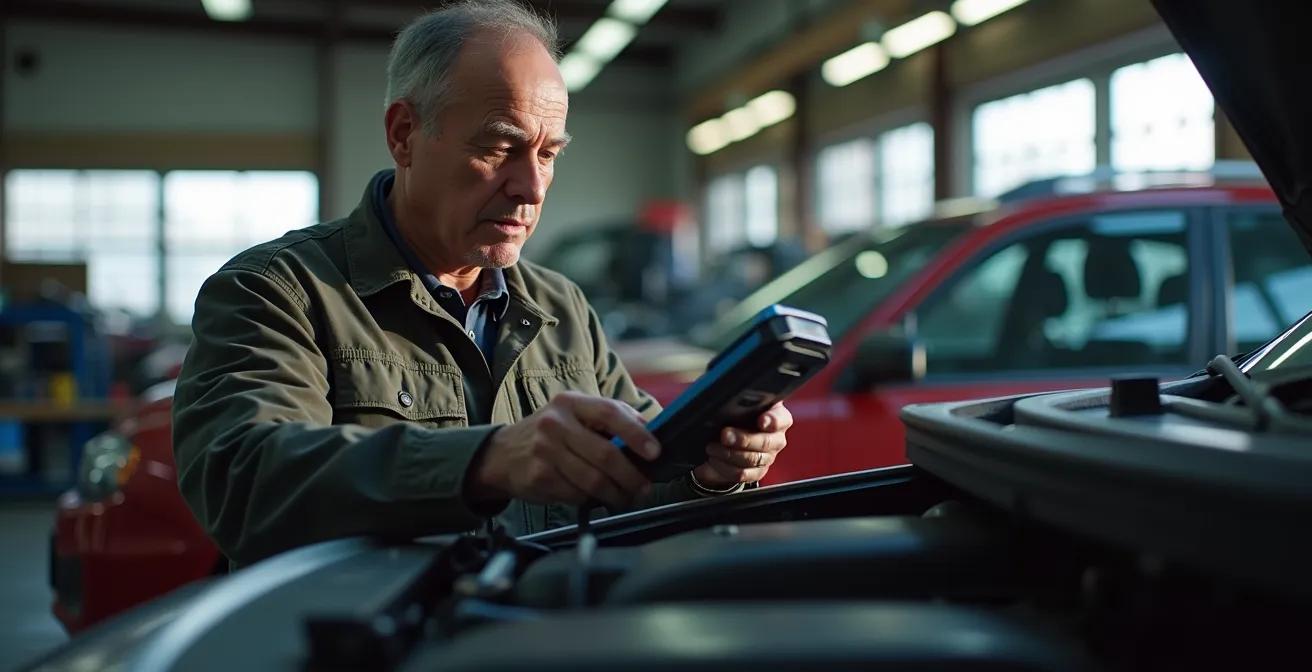
This visual and functional inspection gives you clues, but a professional pre-purchase inspection (PPI) with a diagnostic scanner is non-negotiable. This tool can uncover stored error codes that sellers may have cleared just before your arrival. A history of intermittent sensor faults is a major red flag indicating advanced electronic rust. The image below shows this critical diagnostic step in action, a vital part of any serious used car evaluation in our climate.
A comprehensive inspection is your best defense against inheriting someone else’s expensive problems. Do not underestimate the importance of components like the heating system and battery condition, as they are essential for safety and reliability on icy roads and during extreme cold snaps.
Your Pre-Purchase Electrical Inspection Checklist
- Systematically test all dashboard functions: watch for defective sensors, warning lights, or on-board computer issues.
- Operate all power accessories: check for malfunctioning power windows, locks, and mirrors which can signal deeper electrical issues.
- Verify heating and A/C systems: ensure the blower and temperature controls work correctly, as these are critical for safety on snowy and icy roads.
- Check battery health: inspect terminals for corrosion and ask for a load test, as aging batteries often fail in the first cold snap.
- Demand a diagnostic scan: look for stored or pending error codes related to the engine, transmission, ABS, and airbag systems.
Turbocharged vs Naturally Aspirated: Which Engine Survives 300,000 km?
From a Total Cost of Ownership perspective, the choice between a turbocharged and a naturally aspirated engine is a calculated risk, especially for owners planning to keep their vehicle long-term. Turbocharged engines, common in modern SUVs and even sedans for their efficiency and power, introduce a significant point of failure that is highly sensitive to maintenance and climate. A turbocharger operates under extreme heat and pressure, making it vulnerable to oil contamination and thermal stress—both of which are heightened by Quebec’s driving conditions.
The financial downside of a turbo is substantial. As the table below illustrates, replacing a failed turbocharger is a multi-thousand-dollar repair. A single turbo replacement can easily cost over $2,000 when parts and labour are combined, and twin-turbo systems found in V6 or V8 engines can run upwards of $6,000. This doesn’t even account for potential collateral damage to the engine if the failure is catastrophic.
In contrast, a naturally aspirated engine, while often less powerful for its displacement, is mechanically simpler. It lacks the complex plumbing, high-pressure seals, and extreme operating temperatures of a turbo system. For an owner aiming for 300,000 km, this simplicity translates directly to higher reliability and lower potential for a single, budget-destroying repair. While a modern turbo engine can be reliable with meticulous maintenance (specifically, high-quality synthetic oil changes), the naturally aspirated option inherently carries a lower long-term financial risk profile.
| Repair Type | Cost Range | Labor Hours | Notes |
|---|---|---|---|
| Single Turbo Replacement | $1,500-$2,000 | 4-6 hours | Most common repair |
| Twin-Turbo System (V6/V8) | Up to $6,000 | 8-12 hours | Performance vehicles |
| Engine Tuning Post-Repair | $200-$400 | 1-2 hours | Required for optimal performance |
| Preventive Oil Changes | $60-$160 | 0.5 hours | Critical for turbo longevity |
The Resale Value Mistake That Costs Owners $5,000 After 4 Years
The single most costly mistake a Quebec car owner can make is underestimating the financial impact of rust. In our market, corrosion is the number one killer of resale value, far outweighing mileage or even mechanical condition. Buyers here are conditioned to inspect a vehicle’s undercarriage first, and the sight of peeling paint and orange blooms on the frame or suspension components can instantly erase thousands of dollars from an asking price. This is not just a cosmetic issue; it signals a future of seized bolts, failed brake lines, and compromised structural integrity.
The financial logic is undeniable. An annual investment in rustproofing is one of the few maintenance items that provides a direct, measurable return. According to industry analysis, annual rustproofing treatments are especially critical in provinces with heavy winter road salt, and this small expense prevents thousands in depreciation. A four-year-old vehicle that has been treated annually will present a clean, solid undercarriage, commanding a premium price. An identical, untreated vehicle will show the tell-tale signs of four winters of salt assault, forcing the seller to accept a significantly lower offer.
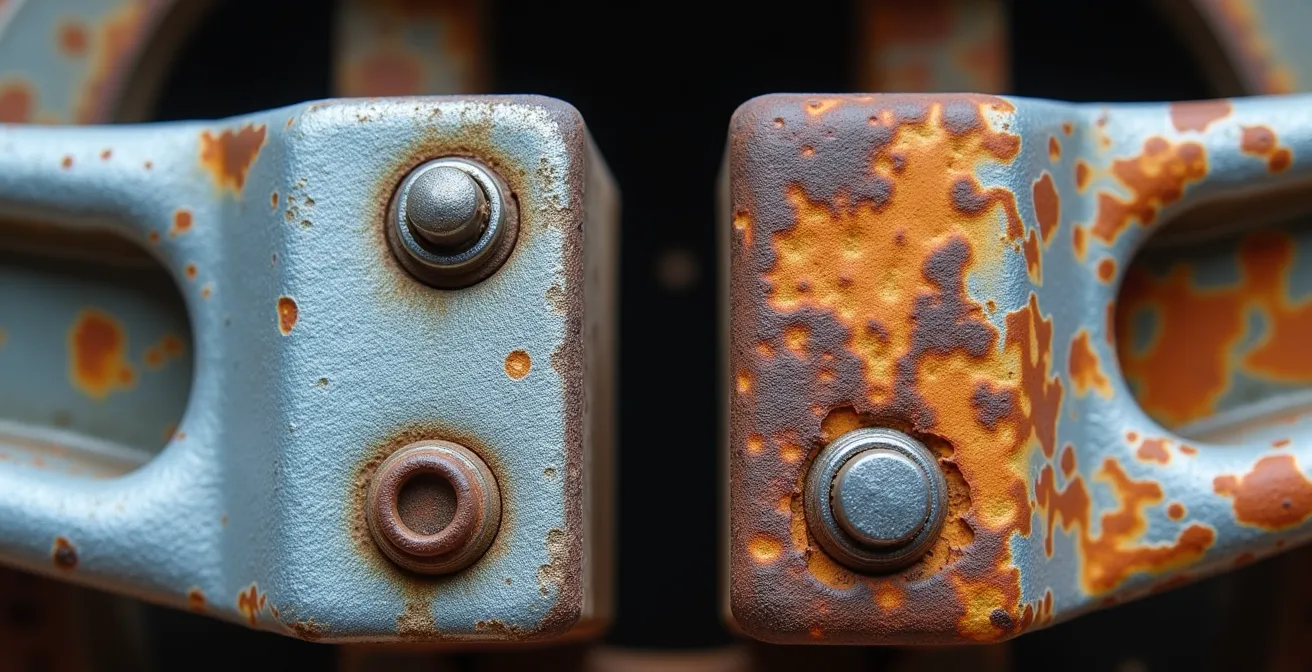
The visual evidence is stark. The image below provides a side-by-side comparison that every Quebec car buyer instinctively understands. The vehicle on the left represents preserved value; the one on the right represents a major financial liability for the next owner. Forgoing a yearly $120 treatment can easily result in a $5,000 reduction in value when it comes time to sell or trade in the vehicle. It is the definition of being “penny wise and pound foolish.”
This preventative measure is not an upsell; it is a core component of any sound financial strategy for vehicle ownership in a northern climate. It protects not only the metal but also the vulnerable electrical connectors and sensor housings that are mounted to the chassis.
When to Sell Your High-Tech Car: The 5-Year Sensor Cliff
For modern, technology-laden vehicles in Quebec, maintenance costs do not rise in a straight line. Instead, they often follow a curve that steepens dramatically around the five-year mark. This is what can be termed the “5-Year Sensor Cliff,” a financial tipping point where the cumulative damage from thermal shock and electronic rust begins to manifest as a series of frequent, overlapping, and expensive electronic failures.
During the first 3-4 years, most vehicles are covered by a manufacturer’s warranty, and failures are sporadic. However, once the warranty expires, the owner is fully exposed to the costs. This is when the car hits the cliff. A single wheel speed sensor might fail, followed by an oxygen sensor a few months later, and then a mysterious parasitic battery drain. Each repair, while manageable on its own, adds up. Data suggests that as vehicles age, these costs escalate significantly; most cars hit an average maintenance cost range of $1,500 per year around the 10-year mark, but the journey there starts accelerating post-warranty.
Financial prudence requires anticipating this cliff. As one maintenance budget analysis suggests, if you were setting aside $75 per month for maintenance during the warranty period, you should consider increasing that to $125 or even $150 per month immediately after the warranty expires. This isn’t just for tires and brakes; it’s to build a fund specifically for the inevitable electronic gremlins. For many owners, the most financially sound decision is to sell the vehicle just before it reaches this 5-to-7-year-old window, offloading the highest-risk period of ownership to the next buyer and resetting their own TCO clock with a newer vehicle.
Why Does Synthetic Oil Flow Better at -30°C Than Conventional Oil?
The choice between synthetic and conventional oil is not a matter of preference in Quebec; it’s a critical decision for engine longevity. At -30°C, conventional oil thickens to the consistency of honey, a phenomenon known as gelling. During a cold start, this thick oil starves the engine’s critical components—like bearings, camshafts, and especially turbochargers—of lubrication for several crucial seconds. This brief period of metal-on-metal contact is a primary cause of premature engine wear.
Synthetic oil, by contrast, is engineered at a molecular level to be more uniform and stable. Its molecules are consistent in size and shape, allowing them to slide past each other with far less resistance at low temperatures. This means that even at -30°C, synthetic oil remains fluid enough to be pumped instantly through the engine upon startup, providing immediate protection. For a modern engine with tight tolerances and components like a turbocharger spinning at over 100,000 RPM, this immediate lubrication is non-negotiable.
While a synthetic oil change is more expensive, with the cost of an oil change in Canada typically ranging from $60 to $160 depending on the type, the added cost is a high-value investment. It directly mitigates the single most damaging event an engine experiences in our climate: the cold start. Following a disciplined maintenance schedule with the correct type of oil is a foundational element of reaching high mileage without catastrophic failure.
Your Action Plan for Winter Engine Health
- Choose the right oil: Before winter, switch to a full synthetic oil with a viscosity grade (e.g., 0W-20, 5W-30) specifically recommended by your manufacturer for cold climates.
- Follow strict change intervals: Schedule oil changes every 5,000 to 10,000 km, depending on your vehicle model and oil type, to prevent sludge buildup that worsens cold-flow issues.
- Prioritize for turbos: If you have a turbocharged engine, using a premium quality synthetic oil is mandatory to prevent oil starvation and coke deposits in the turbo’s bearings during cold starts.
- Don’t neglect the battery: Have your battery’s performance tested before winter, as cold weather significantly reduces its efficiency and a weak battery struggles to turn over an engine with thick oil.
The Hidden Cost of Buying a Discontinued Car Model in 2024
Choosing a discontinued car model might seem like a smart way to get more features for your money, but it can be a significant TCO blind spot, particularly for vehicles over five years old. The hidden cost is not in the initial purchase but in the long-term availability and price of replacement parts. While manufacturers are legally required to provide parts for a certain period, this often applies to common mechanical components, not necessarily the unique electronic modules, trim pieces, or body panels that define a specific model.
As a discontinued model ages, the supply of new OEM (Original Equipment Manufacturer) parts dwindles. Owners are then forced into a difficult market of used, remanufactured, or aftermarket parts. A unique infotainment head unit or a specific transmission control module can become nearly impossible to find. This scarcity drives up prices and can lead to significant vehicle downtime while a mechanic scours scrapyards or specialized suppliers across the country. What would be a simple module swap on a popular model like a Honda Civic becomes a multi-week ordeal for a discontinued sedan.
This issue becomes particularly acute in the 6-to-9-year age range, a critical window for vehicle ownership. As noted by the Automobile Protection Association (APA), this is precisely when Canadian owners often face unexpected and expensive repairs. The following testimony highlights this common and frustrating experience.
In Canada, this typically occurs when the car is between six and nine years old. Eventually the car won’t start two or three times in winter due to neglected maintenance and incorrect diagnosis or repair procedures, or the owner incurs two or three unforeseen and expensive repair bills.
For a discontinued model, these “unforeseen bills” are amplified by parts scarcity. The initial savings on the purchase price can be quickly erased by a single, hard-to-source electronic component failure, turning a perceived bargain into a long-term financial headache.
Key Takeaways
- Prioritize Prevention: Annual rustproofing and using full synthetic oil are not expenses but high-ROI investments that directly combat Quebec’s climate-specific vehicle degradation.
- Anticipate the “5-Year Sensor Cliff”: Plan your ownership cycle or budget for a sharp increase in electronic repairs after the warranty period expires.
- Value Simplicity for Longevity: For long-term ownership (200,000+ km), mechanically simpler systems like naturally aspirated engines present a lower risk of a single, catastrophic repair bill.
Sedan or SUV: Which Body Type Lose Less Value in Quebec?
In the Quebec used car market, not all vehicles depreciate equally. Your choice of body type—specifically, sedan versus SUV—has a profound and predictable impact on your Total Cost of Ownership through its effect on resale value. The market has overwhelmingly shifted in favor of sport utility vehicles, driven by their perceived practicality in winter conditions and their versatile cargo space. This high demand directly translates to slower depreciation and better value retention for SUV owners.
The data is unambiguous. Recent market analysis shows that SUVs accounted for 50.46% of the Canadian used car market and continue to grow rapidly. This dominance means there are more buyers competing for used SUVs, which keeps their prices strong. In contrast, the demand for sedans, especially larger or non-luxury models, has softened considerably. While a sedan might be more fuel-efficient, that single advantage is often outweighed by the thousands of dollars in extra depreciation it will suffer compared to a similarly priced SUV over the same period.
The depreciation table below clearly quantifies this value-retention mismatch. A typical SUV can be expected to retain 45-50% of its value after five years, whereas a sedan might only hold onto 40-45%. For luxury sedans, the drop is even more precipitous. This market reality is further confirmed by dealer-level data.
| Vehicle Type | 3-Year Depreciation | 5-Year Value Retention | Market Demand |
|---|---|---|---|
| Full-Size Trucks | Less than 35% | Over 50% of MSRP | Very High |
| SUVs | 35-40% | 45-50% of MSRP | High |
| Sedans (Camry/Civic) | Over 45% | 40-45% of MSRP | Moderate |
| Luxury Sedans | 50% or more | 35-40% of MSRP | Low |
| Compact Cars | Over 50% | Less than 40% of MSRP | Low |
Speaking on market dynamics, an industry expert highlights the stark difference in desirability from a dealer’s perspective, which is a direct reflection of consumer demand. As Steeve De Marchi of the AMVOQ stated regarding recent trends:
Net profit on sedans is very low, averaging $756 over the last quarter of 2023. For SUVs, the profit margin remains attractive, at an average of $7,600.
– Steeve De Marchi, Association des marchands de véhicules d’occasion (AMVOQ)
Ultimately, navigating the high cost of modern vehicle ownership in Quebec requires a shift in mindset. Instead of reacting to failures, you must proactively manage risks by making informed decisions on maintenance, model selection, and timing your exit strategy. Applying this analytical approach is the only way to protect your investment against the predictable challenges of our climate.