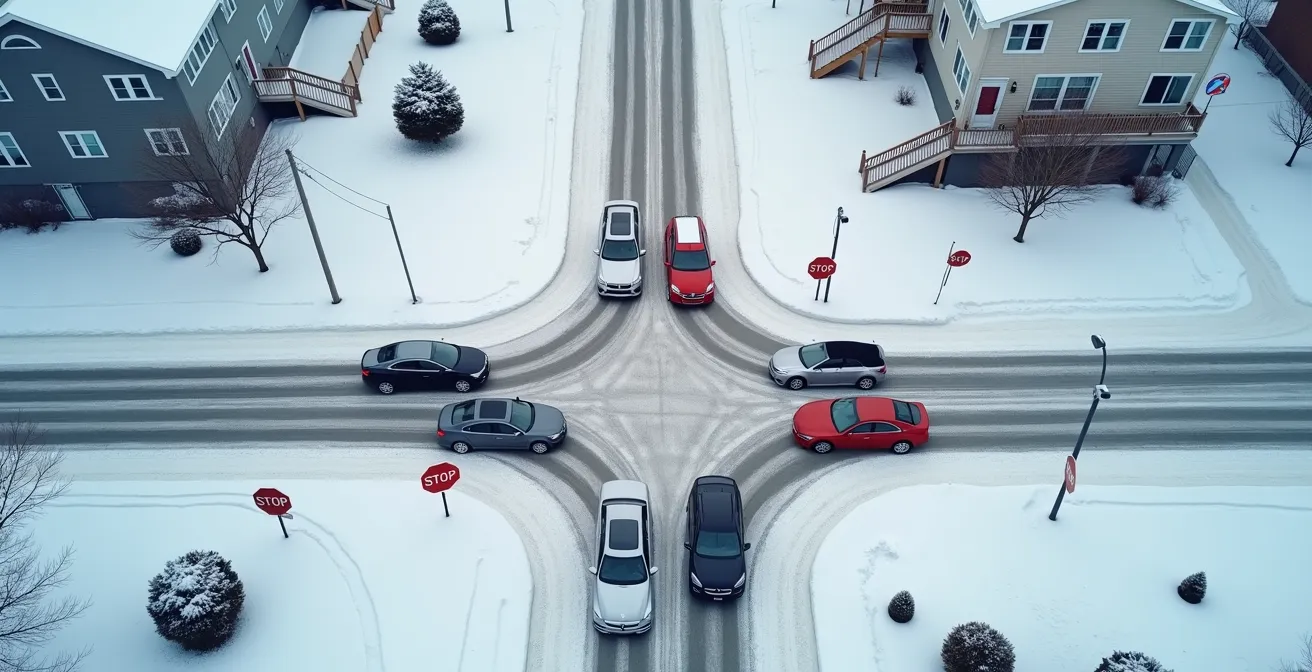
The confusion at a Quebec four-way stop isn’t a failure of drivers, but a failure of relying on a single rule. The “first-to-arrive” principle is only the beginning. True mastery comes from understanding a clear hierarchy of regulations: from statutory law and common practice down to the unwritten social protocols that resolve ambiguity. This guide decodes that hierarchy for complex scenarios, moving you from hesitation to confident decision-making.
It’s a scenario every Quebec driver knows intimately: the four-way stop standoff. Four vehicles arrive at an intersection at seemingly the same instant. A tense pause follows, filled with hesitant hand gestures, cautious inching forward, and the silent, awkward negotiation of who proceeds first. Most of us were taught the simple rules: the first vehicle to arrive and stop has priority, and if two arrive simultaneously, the driver on the right goes first. These are the platitudes of driver’s education.
But these basic rules quickly crumble in the face of real-world complexity. What happens when four cars arrive at once? What subtle cues dictate the flow when the official handbook offers no clear answer? The reality is that safe navigation in Quebec isn’t about memorizing one or two rules; it’s about understanding a hidden hierarchy of decision-making. The law provides a foundation, but it’s the layer of accepted practices and defensive anticipation that truly prevents accidents.
This is where the true key to Quebec road mastery lies. It’s not just about the 4-way stop, but also about knowing the specific nuances of roundabouts, the unique restrictions on the Island of Montreal, and the logic behind seemingly arbitrary rules. This article will dissect that hierarchy. We will move beyond the basic textbook answers to explore the specific, often confusing, situations that define driving in this province, providing you with a clear framework for confident and safe navigation.
To navigate Quebec’s roads with confidence, it is essential to understand not just the general rules, but their specific applications in a variety of common situations. The following sections break down some of the most frequently misunderstood scenarios, providing clarity and actionable guidance.
Summary: Navigating Quebec’s Unique Right-of-Way Rules
- How to Signal Correctly When Exiting a Roundabout?
- Right on Red: Where Is It Prohibited on the Island of Montreal?
- When Must You Stop for a School Bus on a Divided Highway?
- The $170 Fine: Failing to Yield to Pedestrians at Crosswalks
- The Zipper Merge: Why You Should Merge Late, Not Early?
- Why Do Traffic Lights Desynchronize During Major Snow Operations?
- Why Are Speed Fines Doubled Even When No Workers Are Present?
- How to Anticipate Other Drivers’ Mistakes to Avoid Accidents?
How to Signal Correctly When Exiting a Roundabout?
Roundabouts, or traffic circles, are increasingly common in Quebec for a simple reason: they are remarkably effective at improving traffic flow and safety. In fact, studies show that Canadian roundabouts reduce severe crashes by up to 80% compared to traditional intersections. However, their effectiveness hinges on every driver following a consistent and predictable procedure, especially when it comes to signaling. The most common point of confusion is not entering, but exiting.
The cardinal rule is to signal your exit, not your entrance. You should activate your right turn signal just before you reach your desired exit. This communicates your intention to leave the circle, allowing drivers waiting to enter and those behind you to anticipate your move. To execute this maneuver correctly according to Transports Québec guidelines, follow these steps:
- Choose your lane before entering: Based on your final destination (e.g., right lane for the first or second exit), and stay in that lane.
- Drive counter-clockwise: Yield to traffic already in the circle and proceed from right to left.
- Signal your exit early: Activate your right turn signal as you pass the exit *before* the one you intend to take.
- Exit cautiously: Check your mirrors and be vigilant for pedestrians and cyclists at the crosswalk as you leave the roundabout.
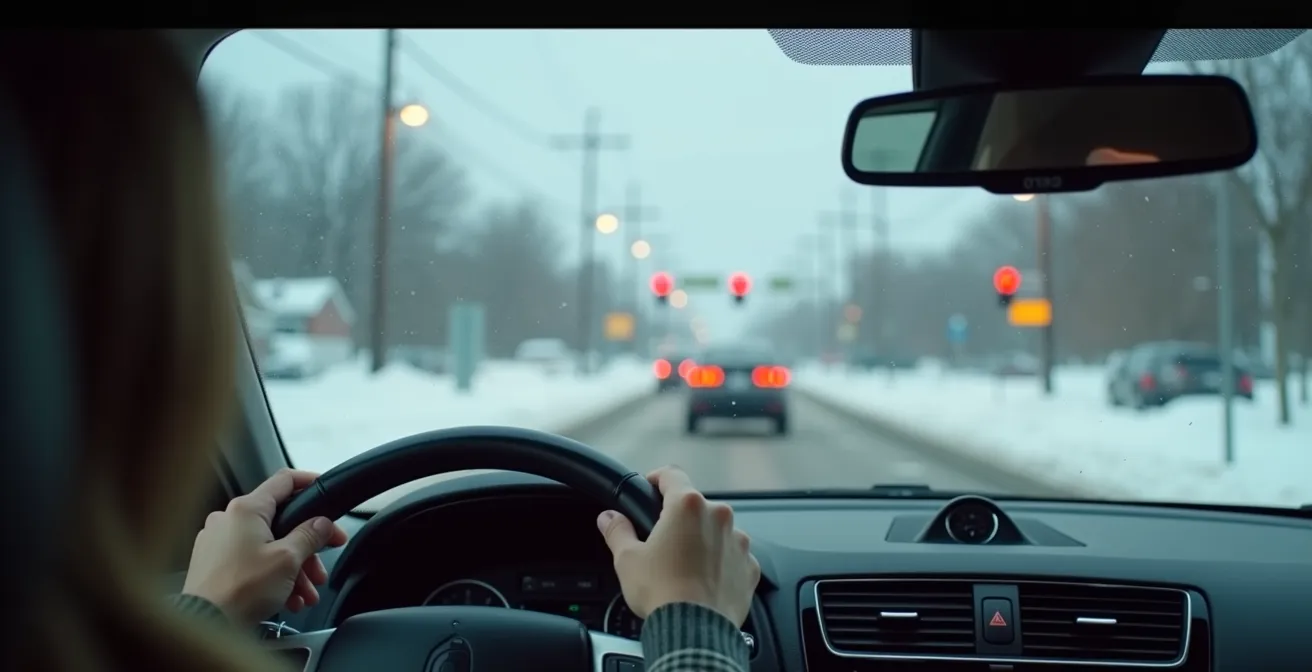
This image illustrates the correct positioning and signaling for a driver preparing to exit a multi-lane roundabout, a critical skill for navigating modern Quebec road design, especially in winter conditions.
Remember, you should never stop inside the roundabout unless it is absolutely necessary to avoid a collision. Consistent and early signaling is the key to making these intersections safe and efficient for everyone. It transforms a potentially confusing circle into a predictable, flowing system.
Right on Red: Where Is It Prohibited on the Island of Montreal?
The “right turn on a red light” is a privilege that has been available to drivers throughout most of Quebec since 2003, intended to improve traffic fluidity. However, there is one major, non-negotiable exception that trips up countless visitors and new residents: the entire Island of Montreal. On the island, turning right on a red light is strictly prohibited at all times, unless a specific sign explicitly permits it (which is exceedingly rare).
This rule is not a suggestion; it’s an absolute enforced to manage the high density of pedestrians, cyclists, and complex intersections characteristic of the urban core. The potential for conflict between turning vehicles and vulnerable road users is deemed too high. For drivers accustomed to this maneuver elsewhere, it requires a conscious mental shift upon entering the island’s territory. Forgetting this rule can lead to fines and, more importantly, create a dangerous situation for pedestrians who are crossing with the right-of-way.
The distinction between the Island of Montreal and the rest of the province is the most critical jurisdictional nuance to understand regarding this rule, as detailed in this comparison.
| Location | Right on Red Status | Since When | Exceptions |
|---|---|---|---|
| Island of Montreal | Prohibited | Always | None – strictly enforced |
| Rest of Quebec | Permitted | 2003 | Unless sign indicates otherwise |
| Other Canadian Provinces | Generally Permitted | Various | Check local signage |
The takeaway is simple: once you are on the Island of Montreal, the default rule for a red light is to come to a complete stop and wait for it to turn green. Treat every red light as an absolute stop signal, and you will stay safe and avoid violations. This is a foundational piece of Montreal-specific road knowledge.
When Must You Stop for a School Bus on a Divided Highway?
The rules surrounding school buses are among the most stringently enforced in Quebec, and for good reason. Failing to stop for a school bus with its flashing red lights activated is a serious offense that puts children’s lives at risk. The penalties reflect this, with infractions resulting in a $200 to $300 fine and 9 demerit points. On a standard two-lane or multi-lane road without a physical median, the rule is unequivocal: all traffic, in both directions, must stop.
The critical point of confusion arises on divided highways. When does a road qualify as “divided” enough to exempt opposing traffic from stopping? The Sûreté du Québec (SQ) and SPVM are clear: the exemption only applies if there is a raised physical median or barrier between your vehicle and the bus. A simple painted line, a turning lane, or a grassy strip flush with the road is not sufficient. The barrier must be a tangible, raised structure that physically separates the lanes of traffic.
In all situations where you must stop, the law requires you to maintain a distance of at least five metres from the bus. This creates a safe zone for children who may be crossing the road. The rule’s logic is to eliminate all ambiguity: if you see flashing red lights on a school bus, your default action should always be to stop, unless you are absolutely certain a raised median separates you from it.
The $170 Fine: Failing to Yield to Pedestrians at Crosswalks
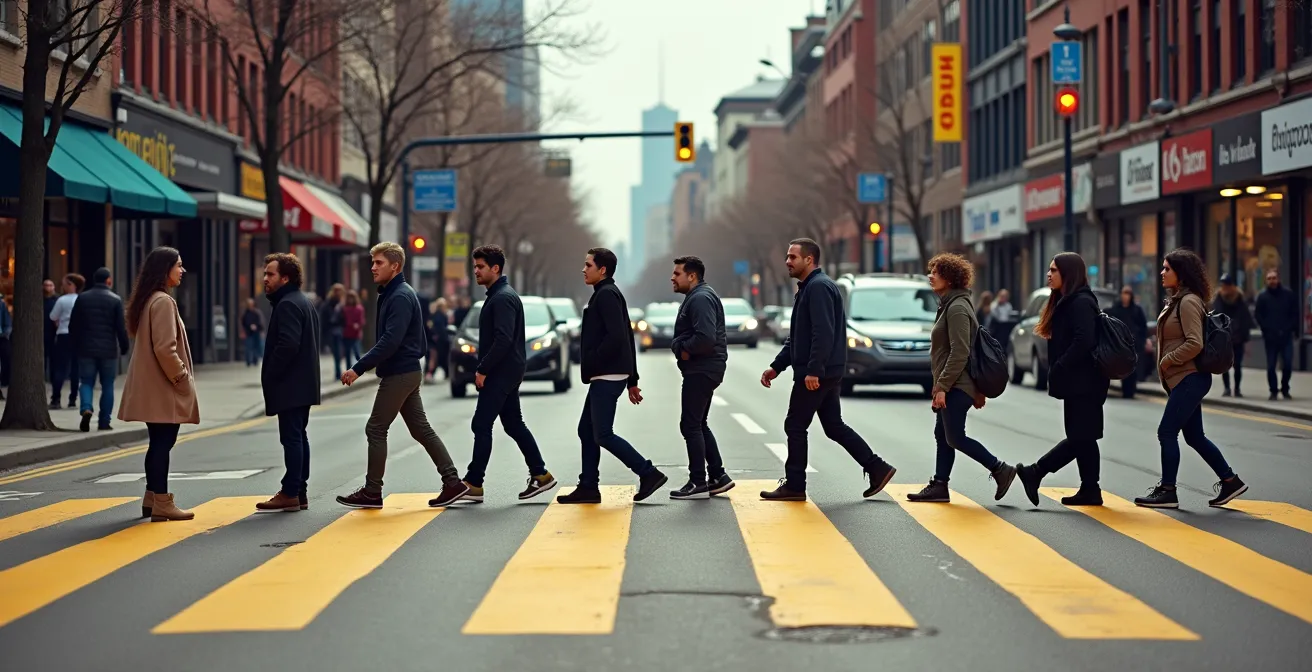
In the urban hierarchy of road users, pedestrians at designated crosswalks have absolute priority. Failing to respect this right-of-way is not only dangerous but also costly, with fines starting around $170 and including demerit points. The Service de police de la Ville de Montréal (SPVM) emphasizes that drivers must come to a complete stop before the stop line or the edge of the crosswalk whenever a pedestrian is waiting to cross or has entered the crosswalk.
This rule applies at intersections with traffic lights, stop signs, and marked mid-block crosswalks. A common and hazardous mistake is the “rolling stop,” where a driver turning right slows down but doesn’t fully stop, encroaching on the pedestrian’s path. Even if a collision is avoided, blocking the crosswalk forces the pedestrian to navigate around the vehicle, placing them in a vulnerable position. The legal requirement is a complete stop behind the line.
The image below captures the essence of this rule: vehicles waiting patiently, providing a clear and safe path for pedestrians at a high-visibility crosswalk in Montreal. This visual represents the expected standard of care in the city.
To avoid violations and ensure pedestrian safety, internalize these key behaviours:
- Always yield to pedestrians if their crossing signal is active or if they have a green light at an intersection without a specific pedestrian signal.
- Never block a crosswalk while waiting for traffic to clear. Stop before it, not in it.
- Exercise extreme caution when turning. Your focus should be on scanning the crosswalk for people before checking for oncoming cars.
This mindset shift—from “looking for a gap in traffic” to “confirming the crosswalk is clear first”—is fundamental to safe urban driving in Quebec.
The Zipper Merge: Why You Should Merge Late, Not Early?
The zipper merge, or “la fermeture éclair,” is one of the most misunderstood and socially contentious driving maneuvers in Quebec. The technique is simple: when two lanes merge into one due to a lane closure, drivers should use both lanes fully up to the merge point and then take turns proceeding in a one-by-one, zipper-like fashion. While this is promoted by Transports Québec as the most efficient method, it often clashes with a deep-seated cultural preference for merging early.
Many drivers who merge early perceive those who drive to the end of the closing lane as “cheating” or being rude. In reality, the opposite is true. From a traffic flow physics perspective, early merging is highly inefficient. It effectively closes a lane long before necessary, shortening the available road space and creating a single, longer, and slower-moving line of traffic. The zipper merge, by contrast, uses the full capacity of the road for as long as possible, resulting in a traffic queue that is up to 40% shorter and keeps both lanes moving more smoothly.
The key to its success is cooperation at the merge point. The driver in the through-lane must graciously allow one vehicle from the closing lane to merge. Conversely, the driver in the closing lane should merge at a speed consistent with the flow of traffic, without forcing their way in. While it may feel counter-intuitive or even impolite to some, refusing to let someone merge in this situation can be considered blocking traffic, which is a violation. Adopting the zipper merge is a collective action that improves traffic flow for everyone.
Why Do Traffic Lights Desynchronize During Major Snow Operations?
Drivers in Quebec often notice a frustrating phenomenon during and after a major snowstorm: traffic lights that are normally perfectly synchronized suddenly seem to operate randomly, creating gridlock. This is not a system failure. It is a deliberate, manual intervention by municipal traffic management authorities, such as Montreal’s Mobility Control Center. The goal of traffic light synchronization is to create “green waves” that optimize traffic flow under normal conditions. However, a snowstorm is anything but a normal condition.
During snow removal operations, the city’s priorities shift from traffic fluidity to logistical efficiency. Major arteries must be cleared, and fleets of snowplows, graders, and trucks need unimpeded access. To achieve this, traffic controllers will manually override the synchronized system. They may hold a green light longer on a side street to allow a convoy of plows to enter a main artery, or they may change the cycle timing on an avenue to prioritize the snow removal route over cross-traffic. This temporarily sacrifices the smooth flow for individual cars in favor of getting the city’s infrastructure cleared more quickly.
Furthermore, winter conditions themselves necessitate slower, more cautious driving. The Canada Safety Council recommends drivers drive slowly and increase following distances significantly in snowy and icy conditions. The desynchronized lights, while frustrating, are a part of this larger system of winter traffic management. Drivers can use apps like Québec 511 to stay informed about road conditions and active operations, but the best strategy is patience and an adjusted, slower pace.
Why Are Speed Fines Doubled Even When No Workers Are Present?
Driving through a Quebec construction zone and seeing a sign for doubled fines can be irritating, especially when the lane is clear and there are no workers in sight. This leads many drivers to question the fairness of the rule. However, the law is unambiguous: the doubled fines apply to the entire officially designated work zone, regardless of whether workers are physically present. The justification for this is rooted in a broader definition of “hazard.”
A work zone is inherently less safe than a regular stretch of road, even when empty. The potential dangers that justify the reduced speed limit and increased penalties are often part of the infrastructure itself and include:
- Modified road layouts: Temporary lane shifts, sharp curves, or narrowed lanes that require lower speeds to navigate safely.
- Uneven pavement: Milled surfaces, steel plates, or significant bumps can cause a loss of vehicle control at high speeds.
- Hidden obstacles: Equipment, materials, or temporary barriers may be located close to the travelled lane.
- Reduced or absent shoulders: This eliminates the margin for error if a driver needs to swerve or pull over.
The doubled fines serve as a powerful deterrent to ensure drivers slow down and remain vigilant for these non-obvious hazards. The law is designed to protect not only the workers when they are present, but also the drivers themselves from the intrinsic risks of a roadway under construction.
Action Plan: Construction Zone Speed Compliance
- Watch for the distinct orange construction zone signage that indicates the start of the zone and the warning of doubled fines.
- Reduce your speed to the posted limit immediately upon entering the marked zone, not when you see the first cone or worker.
- Maintain the reduced speed throughout the entire zone until you see a sign indicating the end of the work zone or a return to the normal speed limit.
- Be aware that fines apply 24/7 to the legally designated zone, not just during work hours or based on worker visibility.
- Stay alert for modified road layouts, uneven surfaces, and temporary barriers that may require your full attention.
Key Takeaways
- Driving rules in Quebec operate on a hierarchy; when basic rules are ambiguous, local context and defensive posture take precedence.
- Jurisdictional nuance is critical: a legal maneuver in one part of Quebec (like right-on-red) can be a serious violation on the Island of Montreal.
- True defensive driving is proactive, involving the anticipation of common, predictable errors from other drivers based on context and location.
How to Anticipate Other Drivers’ Mistakes to Avoid Accidents?
Mastering the written rules of the road is only the first level of becoming a safe driver. The highest level is developing the ability to anticipate the mistakes of others. According to the SPVM, driver behavior causes 80% of collisions, meaning that most accidents are predictable and therefore avoidable. Proactive, defensive driving is a mindset where you treat other vehicles as unpredictable variables and constantly scan for clues about their intentions.
This involves looking beyond the vehicle itself and considering the context. Who is likely driving? Are they a tourist confused by a flashing green arrow? A local in a rush? Someone with out-of-province plates unfamiliar with Montreal’s no-right-on-red rule? This is not about profiling, but about using environmental clues to build a dynamic risk assessment. For instance, at a four-way stop where you arrive simultaneously with another car, a defensive strategy is to deliberately yield and arrive second. This costs you a single second but completely eliminates the ambiguity and risk of a collision.
Recognizing common patterns of error associated with different driver types in Quebec can provide a significant defensive advantage. This table outlines a few examples.
| Driver Type | Common Errors in Quebec | Defensive Strategy |
|---|---|---|
| Ontario Plates | Attempt right on red in Montreal | Give extra space at red lights |
| Vermont/NY Plates | Confusion at flashing green arrows | Be prepared for hesitation |
| Local Quebec Drivers | Speed through late yellow lights | Delay entering intersection on fresh green |
| Tourist Drivers | Unfamiliar with roundabout rules | Allow extra following distance |
Ultimately, anticipating mistakes means letting go of the assumption that everyone else will follow the rules perfectly. By maintaining a safe following distance, covering your brake at intersections, and constantly asking “What is the worst possible thing that driver could do right now?”, you shift from a reactive to a proactive state, giving you the time and space to avoid the accidents that others might cause.
Integrate this hierarchical, context-aware framework into every drive. By moving beyond simple rule memorization to active anticipation, you can navigate Quebec’s complex road network with the highest degree of confidence and safety.
Frequently Asked Questions About Who Actually Has Priority at a 4-Way Stop?
Is the zipper merge legally required in Quebec?
Yes, it’s an expected and legal maneuver promoted by Transports Québec for traffic efficiency.
Why do some Quebec drivers see late merging as impolite?
Cultural driving habits favor early merging, but this actually reduces road capacity and creates longer backups.
Can refusing to let someone merge be considered illegal?
Yes, it can be interpreted as blocking traffic, which is a traffic violation.