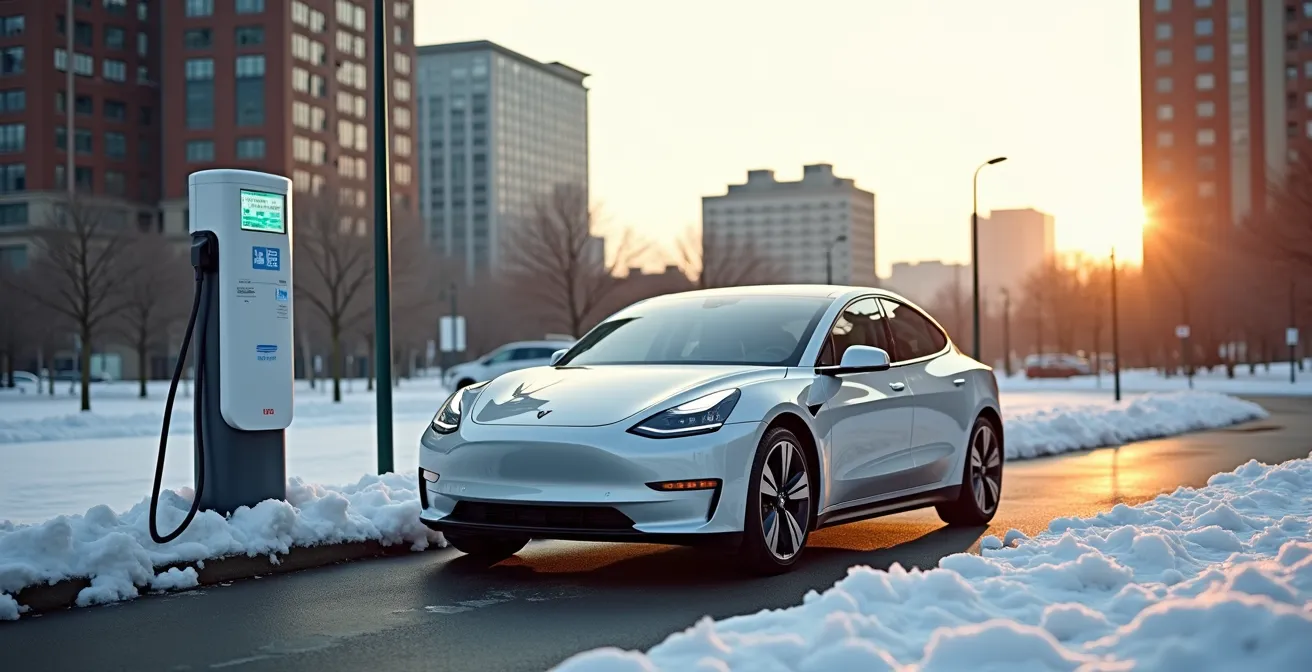
The 2035 ban is not a sudden stop but a gradual, predictable transition; your gas car’s value depends on strategic timing, not a single date.
- Provincial rebates are decreasing annually, making the next 12-24 months a key window for EV purchase decisions.
- Gas car values will see tiered depreciation, with clear inflection points around 2028 and 2032, but they will not become worthless overnight.
Recommendation: Your best move is to create a personal 5-year transition plan based on your driving needs, housing situation, and the predictable market shifts outlined in this guide.
For pragmatic drivers in Quebec, the headlines about Canada’s 2035 ban on new gas-powered vehicles can spark a sense of urgency and confusion. Common wisdom seems to split into two camps: a panicked rush to sell your internal combustion engine (ICE) vehicle before it becomes “worthless,” or a simple, often impractical, suggestion to “just buy an electric vehicle (EV) now.” Both of these approaches miss the crucial details of the policy’s implementation.
The reality is that the transition away from gas vehicles is not a cliff edge waiting in 2035. It is a carefully managed, multi-year roadmap with predictable stages, incentive phase-outs, and evolving market dynamics. Understanding this timeline is the key to making a sound financial decision. For a current owner or prospective buyer, the question isn’t a binary choice between gas and electric today. Instead, it’s about developing a personal strategy based on clear inflection points that will dictate resale values, availability, and the total cost of ownership.
This guide moves beyond the alarmist headlines to provide a clear, strategic framework. We will analyze the specific regulations and market forces at play in Quebec, from the declining Roulez Vert rebate to the legal realities of installing a charger in a condo. This is your roadmap to navigate the next decade, ensuring your transportation decisions are informed, timely, and financially sound.
To help you navigate this complex transition, this article breaks down the key questions and strategic milestones. The following sections provide a clear roadmap for every pragmatic driver in Quebec facing the 2035 deadline.
Summary: A Strategic Guide to Quebec’s 2035 EV Transition
- How to Claim the Roulez Vert Rebate Before It Decreases?
- How to Force Your Condo Board to Allow EV Charger Installation?
- Why Are Some EV Models Impossible to Find in Stock?
- Will Your Gas Car Be Worthless in 2030 Due to New Mandates?
- When to Upgrade Your Electrical Panel for a Level 2 Charger?
- When Will Gas Car Values Crash in Quebec: 2028 or 2032?
- When to Switch to Low-Carbon Transport: A 5-Year Roadmap for Families
- Should You Buy a Gas Engine Vehicle Before the 2035 Ban in Canada?
How to Claim the Roulez Vert Rebate Before It Decreases?
The Government of Quebec’s Roulez Vert program has been a powerful driver of EV adoption, but its financial incentives are on a scheduled decline. For pragmatic buyers, understanding and acting on this timeline is a critical strategic move. The province has invested heavily, with $400 million spent on the program between April 2023 and January 2024 alone, signaling a massive but time-limited push towards electrification. The key takeaway is that the maximum rebate is decreasing each year, making an earlier purchase significantly more advantageous.
The rebate for a new fully electric vehicle, which was $7,000 in 2024, drops to $4,000 in 2025, then to $2,000 in 2026, before being eliminated entirely in 2027. A similar reduction applies to plug-in hybrids and used EVs. This scheduled phase-out is a deliberate policy tool designed to accelerate adoption in the short term. For a family budgeting for a new vehicle, claiming the rebate before the next reduction can save thousands of dollars, directly impacting the total cost of ownership.
To secure the rebate, you must follow the program’s steps precisely. This includes registering for online services *before* acquiring the vehicle and ensuring the vehicle is registered within the eligible dates, as there is a temporary suspension period early in the year. Many dealerships can apply the rebate directly at the point of sale, simplifying the process for the buyer.
The table below, based on an analysis of provincial subsidy guides, clearly illustrates the financial incentive’s decline over time.
| Year | Fully Electric Vehicle | Plug-in Hybrid | Used EV | Charging Station |
|---|---|---|---|---|
| 2024 | $7,000 | $5,000 | $3,500 | $600 |
| 2025 | $4,000 | $2,000 | $2,000 | $600 |
| 2026 | $2,000 | $1,000 | $1,000 | $600 |
| 2027 | $0 | $0 | $0 | $0 |
How to Force Your Condo Board to Allow EV Charger Installation?
For many prospective EV owners in Quebec, the biggest hurdle isn’t the vehicle cost but the “right to charge,” especially in multi-unit residential buildings (MURBs). Historically, condo boards could block charger installations due to concerns about cost, electrical capacity, or liability. However, the legal landscape in Quebec is shifting decisively in favor of residents. You no longer have to just ask for permission; you have the power to compel action, backed by provincial policy and funding.
Quebec is a leader in Canada, with strong regulations supporting EV infrastructure. The province is extending its building code to require EV-readiness in all new apartment buildings and has released draft regulations to enforce this. Furthermore, the government has allocated $108 million specifically to help fund the necessary electrical upgrades in existing MURBs. This means that a condo board’s argument about prohibitive costs is significantly weakened. You can present your request not as a personal expense but as a building upgrade supported by substantial government subsidies.
The strategy is to approach your condo board with a well-researched proposal. This should include information on the provincial grants available, a load calculation for the building’s electrical system (often done by an electrician), and a clear plan for installation. By framing the installation as a value-adding, government-supported modernization project rather than a personal request, you change the dynamic from seeking a favor to implementing a provincially-backed policy.

This visual represents the very transition your building needs to undergo. The move from outdated infrastructure to a modern, EV-ready electrical system is a necessary step towards future-proofing the property and increasing its value for all residents, not just EV owners. It’s an investment in compliance and modernity.
Why Are Some EV Models Impossible to Find in Stock?
If you’ve tried to shop for a popular electric vehicle in Quebec, you’ve likely encountered long waitlists and a frustrating lack of inventory. This isn’t a sign of a struggling market; it’s the result of Quebec’s runaway success in EV adoption. The province has created a supercharged demand that outstrips the current supply allocated by automakers. Essentially, some models are hard to find because nearly everyone wants one.
The numbers are telling. Quebec accounts for a disproportionately large portion of Canada’s EV market. A recent analysis shows that Quebec, with just over 20% of the country’s population, is responsible for nearly half of all EV sales, capturing a remarkable 33% market share for new vehicle sales. This intense concentration of demand means that vehicles sent to the province are often sold before they even arrive at the dealership. Automakers, who allocate vehicles across North America, are still catching up to this regional demand surge.
This situation is amplified by Quebec’s Zero-Emission Vehicle (ZEV) standard, which mandates that automakers sell a certain percentage of EVs. This policy, combined with generous incentives, has created a perfect storm of demand. As Daniel Breton, CEO of Electric Mobility Canada, stated in an interview with Electric Autonomy, this is by design:
Quebec wants to stay the leader in EV adoption in Canada
– Daniel Breton, Electric Mobility Canada CEO interview with Electric Autonomy
For the pragmatic buyer, this means a strategic approach is needed. It may involve placing an order well in advance, being flexible on trim or color options, or considering a wider range of models, including those from manufacturers who are more aggressively supplying the Quebec market.
Will Your Gas Car Be Worthless in 2030 Due to New Mandates?
One of the most persistent fears surrounding the 2035 ban is that gas-powered cars will rapidly lose all value, leaving owners with a worthless asset. This is a misconception. The 2035 rule bans the sale of *new* internal combustion engine (ICE) vehicles; it does not make existing ones illegal to own, drive, or, most importantly, resell. The transition will create a gradual depreciation curve, not a sudden crash.
Quebec’s regulations are clear: models from 2034 or earlier that are already registered in the province can remain on the roads and can be resold within the used vehicle market. This creates a legal and functional secondary market for hundreds of thousands of vehicles. In fact, market analysis suggests that gas vehicles purchased as late as 2034 are expected to remain road-ready until 2050. Gas stations and maintenance infrastructure will adapt to serve this declining but long-term fleet for decades.
The key to understanding future value lies in the mandatory sales targets leading up to 2035. The transition is phased, giving the market time to adjust. A car purchased today will not fall off a value cliff in 2030. Instead, its value will be determined by supply and demand within a protected, but shrinking, market of used gas cars. The most significant value drops will correlate with the points where EV sales targets ramp up sharply, increasing the supply of used EVs and providing more alternatives to gas.
This table of Canada’s EV sales mandate, based on data from multiple government and industry reports, shows the structured nature of the transition.
| Year | Required EV Sales % | Implication |
|---|---|---|
| 2023 | Baseline | 10% actual |
| 2026 | 20% | Target pending |
| 2028 | 34% | Accelerated growth |
| 2030 | 60% | Major transition point |
| 2035 | 100% | Full mandate |
When to Upgrade Your Electrical Panel for a Level 2 Charger?
For homeowners, installing a Level 2 (240V) charger is the key to unlocking the convenience of EV ownership. However, not all homes are immediately ready. The decision to upgrade your electrical panel depends on its existing capacity, age, and your home’s total electrical load. For many Quebec homes, especially older ones, this upgrade is a necessary first step in the EV transition.
The first step is a simple assessment. A 200-amp (200A) panel, common in newer homes, typically has enough capacity to handle a Level 2 charger without an upgrade. An older 100-amp (100A) panel, often found in bungalows from the 1970s, will likely require a full replacement to safely manage the additional load. Beyond the main amperage, you’ll need two free adjacent slots in your breaker box for the 240V circuit. If your panel is already full with breakers for an electric stove, dryer, and central air conditioning, an upgrade or a sub-panel will be necessary.
While this might seem daunting, it’s a well-trodden path. A CMEQ-certified master electrician can perform an official load calculation to give you a definitive answer. Furthermore, programs from Hydro-Québec like Hilo offer smart charging solutions that can help manage electrical load during peak hours, potentially delaying the need for a costly panel upgrade. It’s also worth noting that Quebec continues to invest in public infrastructure, with a goal to improve the ratio to one public charging station per 16 EVs by 2030, providing more options for those who cannot immediately install home charging.
Your Electrical Panel Audit Checklist
- Check Main Panel Amperage: Locate the main breaker and look for a “100A” or “200A” rating. A 200A panel is a strong indicator you have sufficient capacity.
- Count Available Breaker Slots: You need at least one empty double-pole slot to install a 240V charger circuit. A full panel is a red flag.
- Calculate Current Electrical Load: List your major 240V appliances (dryer, stove, A/C, water heater) to get a rough idea of your home’s peak demand.
- Verify Panel Age and Condition: If your home was built before 1980 and the panel appears original, a safety and capacity upgrade is highly probable regardless of the charger.
- Contact a CMEQ-Certified Electrician: Schedule an official capacity assessment. Only a master electrician can confirm your panel’s limits and handle permit requirements.
When Will Gas Car Values Crash in Quebec: 2028 or 2032?
The depreciation of gas cars won’t be a single event, but a series of waves hitting different market segments at different times. Instead of one “crash,” it’s more accurate to think of two major inflection points: 2028 and 2032. These dates are not arbitrary; they are tied to the influx of desirable and affordable used EVs into the secondary market, which will directly compete with and suppress the value of their gas-powered counterparts.
The first inflection point is around 2028. This is when the luxury and premium EVs purchased between 2023-2025 will begin to come off their initial leases and enter the used market in large numbers. A wave of 3-to-5-year-old high-end EVs will create significant price pressure on used luxury gas sedans and SUVs (e.g., Audi, BMW, Mercedes). For owners of these premium ICE vehicles, 2028 marks the beginning of accelerated value decline as attractive electric alternatives become widely available.
The second, and more significant, inflection point is around 2032. This is when the mass-market EVs (SUVs, minivans, and sedans) bought during the 2027-2029 sales boom will flood the used market. By this time, the total cost of ownership for a used EV will likely be lower than a comparable gas car due to fuel and maintenance savings. This will make used gas vehicles a less attractive option for budget-conscious families, triggering a broader and steeper decline in mass-market ICE vehicle values.

This decision-making moment, captured in a dealership, is exactly what will define these inflection points. As more customers find compelling and affordable used EV options, the demand for equivalent gas models will naturally fall, directly impacting their resale value. The key is that this will happen in predictable stages.
Key Takeaways
- The Roulez Vert rebate is time-sensitive and decreasing annually, making an earlier EV purchase more financially attractive.
- Your gas car will not become worthless overnight; its value will decline gradually, with key inflection points around 2028 and 2032.
- A personal 5-year roadmap is the most effective tool for navigating the transition, factoring in your budget, driving needs, and housing situation.
When to Switch to Low-Carbon Transport: A 5-Year Roadmap for Families
For a family in Quebec, the question isn’t whether to switch to an EV, but *when* and *how*. Creating a 5-year personal roadmap transforms a daunting mandate into a manageable, strategic process. This plan should be tailored to your specific circumstances, whether you live in urban Montreal or rural Gaspésie, as your timeline and priorities will differ significantly.
An urban family in Montreal, for example, might adopt an EV as early as 2025-2026, leveraging the dense public charging network and REM for a car-light lifestyle, possibly complemented by Communauto for occasional needs. In contrast, a family in a suburban or rural area like the Gaspé Peninsula might take a more gradual approach. Their roadmap could involve first purchasing a plug-in hybrid (PHEV) truck around 2028 to balance utility with lower emissions, while waiting for the charging infrastructure to mature before committing to a full EV closer to 2030.
A practical 5-year roadmap breaks the transition into concrete, annual steps:
- Year 1 (2025): Research & Budget. This is the year to act on the $4,000 Roulez Vert rebate before it drops. Assess your family’s driving needs and research suitable EV models. Begin the process of evaluating your home charging needs.
- Year 2 (2026): Infrastructure Prep. Install your Level 2 charger to claim the final $600 rebate before it ends. If your electrical panel needs an upgrade, complete it this year.
- Year 3 (2027): Market Evaluation. With major rebates ending, monitor the used EV market. Compare the total cost of ownership (TCO) of a used EV against your current gas car, factoring in rising carbon taxes.
- Year 4 (2028): Strategic Purchase Window. Target this period to buy a used EV. The influx of off-lease premium models will create price pressure across all segments, offering good value.
- Year 5 (2029): Complete Transition. Aim to complete your switch before the 2030 mandate requires 60% of new sales to be EVs. This timing helps maximize the resale value of your final gas vehicle before the market becomes saturated with sellers.
For two-car families, a popular and flexible strategy is a hybrid approach: replace one car with an EV for daily commuting and errands while keeping one efficient gas vehicle for long road trips or specific needs, phasing it out closer to the 2035 deadline.
Should You Buy a Gas Engine Vehicle Before the 2035 Ban in Canada?
With all the focus on electrification, a pragmatic question arises: does it make sense to buy a final, new gas-powered vehicle before the 2035 ban takes effect? For some drivers, the answer is a strategic “yes.” This decision isn’t about resisting the future, but about bridging the gap between today’s infrastructure and tomorrow’s all-electric reality. The key is to make this purchase with a clear understanding of its long-term role and depreciation curve.
For residents in remote or northern regions of Quebec, like Nunavik or parts of Côte-Nord, where charging infrastructure is sparse and will take years to build out, purchasing a reliable 2030-2034 model year gas vehicle could be a sound strategy. This vehicle would serve as a dependable bridge, lasting well into the 2040s until the local charging network becomes robust. Similarly, for those with specific needs not yet met by the EV market—such as heavy-duty towing—a final ICE vehicle may be a necessity.
However, this decision comes with a crucial caveat. The vehicle’s value will depreciate more steeply after the 2030-2032 inflection point. It should be purchased with the expectation of being driven for its full functional life, not as a short-term asset with high resale value. As Tim Reuss, President of the Canadian Automobile Dealers Association, noted, the transition has real-world challenges:
Regulating Canadians to buy EVs they can’t afford, or charge, is problematic without proper infrastructure
– Tim Reuss, Canadian Automobile Dealers Association President
Ultimately, the choice hinges on your personal roadmap. If you are in an urban or suburban area with good charging access, buying a new gas car today is a poor financial strategy. If you are in a unique situation where EV infrastructure is a decade away, a final, carefully chosen gas vehicle can be the most pragmatic choice.
The path to 2035 is not about a single choice but a series of informed decisions. By creating a personal roadmap based on the clear timelines and market forces at play, you can navigate the transition with confidence and financial prudence. The next logical step is to begin your own assessment.
Frequently Asked Questions About the 2035 Gas Car Ban
Can I still buy a used gas car after 2035 in Quebec?
Yes, the ban only affects new vehicle sales. Used gas vehicles from 2034 or earlier can still be bought, sold, and driven after 2035.
Will gas stations disappear after 2035?
No, with vehicles lasting 15+ years, gas stations will continue operating well into the 2040s, though potentially with consolidation in rural areas.
Should remote northern Quebec residents buy a final gas vehicle?
Yes, residents in areas like Nunavik with limited charging infrastructure may benefit from purchasing a reliable 2030-2034 gas vehicle to last until infrastructure improves.