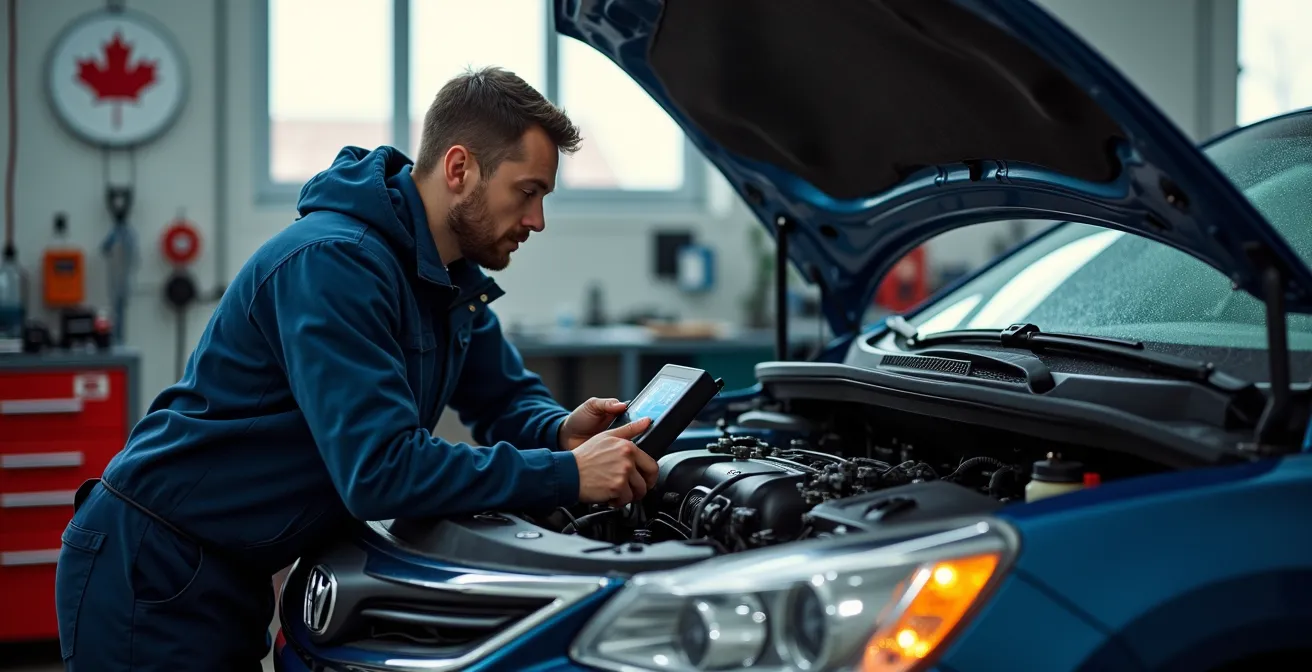
Contrary to popular belief, ECU tuning for fuel economy is not a simple software flip; it’s a calculated trade-off between efficiency gains and significant warranty and mechanical risks.
- Manufacturers can and will detect ECU modifications, creating a “warranty footprint” that instantly voids powertrain coverage.
- Cheap “performance chips” are often scams that can cause severe engine damage, while professional eco-tunes require a substantial initial investment.
Recommendation: Before considering any tune, exhaust all non-invasive options and fully understand Quebec’s specific consumer protection laws and the realities of winter driving conditions.
If you’re a high-mileage commuter in Quebec, clocking kilometres on Autoroute 20, the idea of squeezing a few extra kilometres out of every litre of fuel is incredibly appealing. You’ve likely heard about ECU (Engine Control Unit) tuning or “chipping” as a way to unlock hidden performance and, more importantly, better fuel economy. The internet is filled with promises of instant gains, suggesting it’s as simple as plugging in a device and watching your fuel consumption drop. Many believe these changes are easily reversible, leaving no trace for a dealership to find.
However, this oversimplified view ignores a critical reality. The true path to efficiency through engine management is far more nuanced, especially within our unique climate and legal landscape. But what if the key wasn’t about finding a magic bullet, but about making a series of informed, calculated decisions? What if understanding the risks—the permanent warranty footprint, the danger of the resistor scam, and the impact of our harsh winters—was the most important step towards genuine, sustainable fuel savings?
This guide moves beyond the hype. We will dissect the complex relationship between your ECU, your warranty, and your wallet. We’ll explore why a dealer can spot a tune from a mile away, differentiate a professional eco-tune from a piston-melting scam, and provide practical, safe steps you can take. This is your roadmap to making an intelligent decision about your vehicle’s brain, based on responsible expertise, not just marketing promises.
To navigate this complex topic, we’ve broken it down into key areas. This article will guide you through the critical considerations, from immediate warranty implications to long-term maintenance and specific Quebec driving scenarios.
Summary: The Quebec Commuter’s Guide to ECU Tuning
- Why Does Flashing Your ECU Void Your Powertrain Warranty Instantly?
- How to Reset Your ECU to Fix Rough Idling Issues at Home?
- Factory Settings vs Eco-Tune: Which Actually Saves Money at the Pump?
- The Cheap Performance Chip Scam That Can Melt Your Pistons
- When to Replace Your ECU: 3 Signs It Is Fried, Not Just Glitched
- Why Does Cheap Gas Trigger Your Check Engine Light in Winter?
- The Warranty Loophole That Could Void Coverage on Your Imported Car
- How to Prevent Transmission Overheating When Towing in the Laurentians?
Why Does Flashing Your ECU Void Your Powertrain Warranty Instantly?
The single most critical concept to understand before even thinking about a tune is the “warranty footprint.” Many drivers believe they can simply “flash” their ECU back to its stock settings before a dealer visit, effectively erasing all evidence. This is a dangerous myth. Modern vehicles are equipped with sophisticated logging systems. Every time the ECU is reprogrammed, it increments a flash counter—a digital tally that cannot be reset by external tools. When a warranty claim is made for a major component like the engine or transmission, the first thing a technician does is plug into the OBD-II port and check this counter.
If the number is higher than what’s expected from official dealer updates, your warranty is flagged immediately. It’s an open-and-shut case for the manufacturer. Furthermore, according to tuning specialists, manufacturers can detect modifications through digital logs that record engine parameters. If the ECU has recorded boost pressures, fuel trims, or ignition timings outside of factory specifications, this data is stored and serves as undeniable proof of tampering, even if the stock map is restored.
In Quebec, the legal ground can be tricky. While the Consumer Protection Act provides a legal warranty, a dealer can argue that you were careless with the product. As noted by Éducaloi, the legal warranty doesn’t apply if a consumer is careless, an argument they will certainly make if an unauthorized tune is suspected of causing component failure. Unlike the specific protections of the Magnuson-Moss Warranty Act in the US, the Canadian system often leaves more room for dealer discretion, making an ECU tune a significant financial gamble.
How to Reset Your ECU to Fix Rough Idling Issues at Home?
Before considering an expensive or risky tune, sometimes a simple ECU “soft reset” can resolve minor issues like rough idling, hesitation, or poor fuel economy caused by a temporary sensor error or adaptation to a bad batch of fuel. This process forces the ECU to clear its temporary memory (known as Keep Alive Memory or KAM) and re-learn the engine’s operating parameters. It is a non-invasive procedure that does not leave a warranty footprint. It’s a fundamental first step in diagnostics that any responsible vehicle owner should know, especially when dealing with the variable conditions of Quebec driving.
The process essentially involves a controlled power cycle. By disconnecting the battery, you cut power to the ECU, and internal capacitors that hold the temporary data are allowed to fully discharge. When reconnected, the ECU starts fresh, much like rebooting a computer. It will then enter a “relearning” phase, adjusting fuel trims and idle speed based on real-time sensor inputs. This can often smooth out issues that have developed over time. It’s important to follow a precise sequence to ensure the reset is effective and safe.
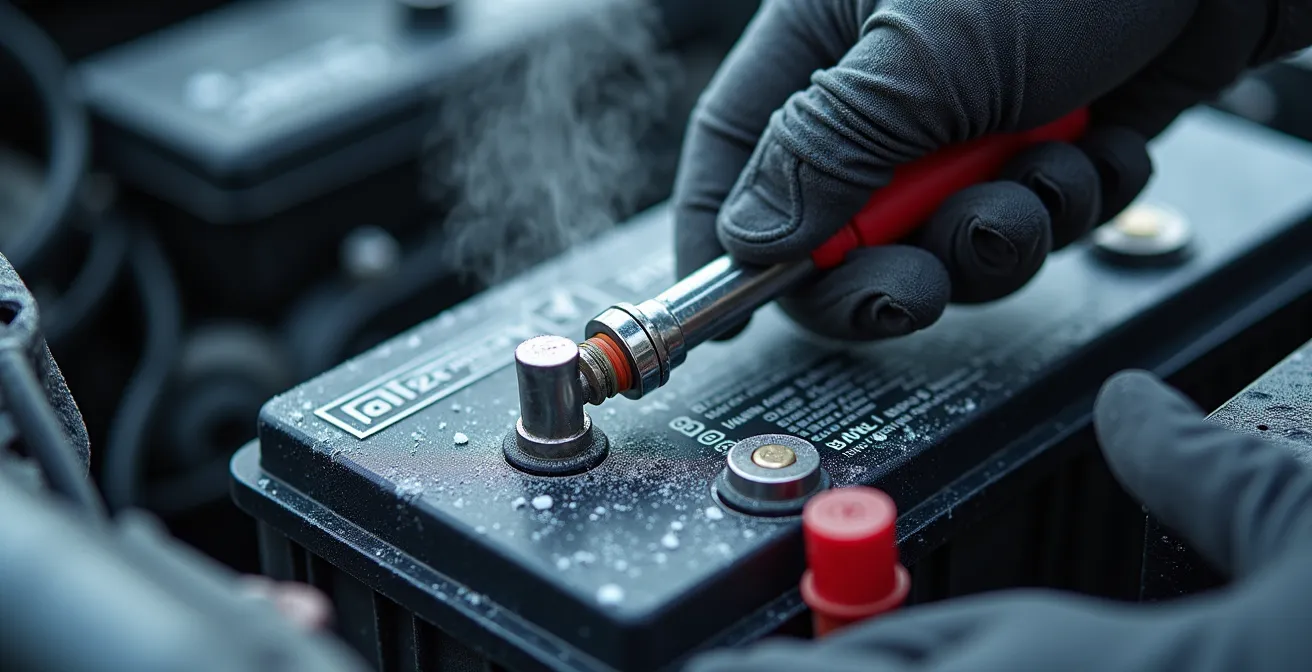
As seen in the image, performing this in a Quebec winter requires care. Here is a safe, step-by-step procedure for a soft reset:
- Disconnect the Power Source: Always disconnect the negative battery terminal first. This prevents accidental short-circuiting. Once disconnected, the ECU loses its power source, initiating the memory clearing process.
- Wait for Full Discharge: Let the vehicle sit for approximately 15 minutes. This waiting period is crucial for the internal capacitors within the ECU to completely discharge, which is what erases the stored error codes and adaptive driving data.
- Reconnect and Initiate On-Position: Reconnect the negative battery terminal. Get in the car and turn the ignition to the “On” position, but do not start the engine. All the dashboard lights should illuminate. If you have an OBD-II scanner, this is the time to clear any old codes.
- Begin the Relearning Phase: Start the engine and let it idle for several minutes. Afterwards, drive the vehicle under a variety of conditions—city traffic, steady highway cruising—for at least 15-20 minutes. The car might behave slightly differently as the ECU recalibrates.
Factory Settings vs Eco-Tune: Which Actually Saves Money at the Pump?
The central question for any commuter is simple: is an eco-tune worth the money and the risk? The answer requires a sober cost-benefit analysis. A professional eco-tune is not a cheap modification. It involves specialized equipment and expertise to remap your ECU’s fuel and ignition tables to prioritize efficiency over peak power, often costing between $700 and $1,000 CAD. The promised benefit is improved fuel economy, but this is not a universal guarantee. The actual savings are heavily dependent on your driving style and conditions.
While some tuners promise significant gains, a realistic expectation is a modest improvement. Some professional tuners report that tweaking a car’s software can achieve an extra 3-4 miles per gallon, which translates to roughly 1.3-1.7 km/L. For a typical Quebec commuter, this means you might need to drive 15,000 to 20,000 km just to break even on the initial cost of the tune. All this, while carrying the 100% risk of a voided powertrain warranty. Furthermore, factory settings are meticulously engineered to perform reliably across a massive range of conditions, from a -30°C cold start in Rouyn-Noranda to a hot summer day in Montreal traffic. An eco-tune optimized for highway cruising may not perform as well in extreme cold, potentially requiring seasonal adjustments.
To make an informed decision, it’s essential to compare the factors side-by-side. The following analysis, based on industry data, lays out the real-world trade-offs for a Quebec driver.
| Factor | Factory Settings | Eco-Tune |
|---|---|---|
| Initial Cost | $0 | $700-$1000 CAD |
| Fuel Economy Improvement | Baseline | Up to 20% increase with appropriate driving habits |
| Break-even Point (avg Quebec driver) | N/A | 15,000-20,000 km |
| Warranty Status | Intact | Potentially voided |
| Winter Performance (-30°C) | Optimized for extremes | May require seasonal adjustments |
The Cheap Performance Chip Scam That Can Melt Your Pistons
In your search for fuel economy, you will inevitably encounter advertisements for “performance chips” that cost $99 and promise incredible gains in both horsepower and MPG. These are, almost without exception, a dangerous resistor scam. These cheap devices are not sophisticated microprocessors; they are often just a simple resistor in a plastic box that plugs into your vehicle’s wiring, typically for the IAT (Intake Air Temperature) or coolant temperature sensor. By adding resistance, the chip fools the ECU into thinking the incoming air is colder or the engine is cooler than it actually is. In response, the ECU dumps more fuel and advances ignition timing, which can lead to catastrophic failure.
Running an engine too lean or with improper timing under load can cause detonation (knocking), which can literally melt holes in your pistons and destroy your engine. This is the polar opposite of a safe, calculated efficiency tune. Professional tuning is a complex process that involves modifying dozens of tables within the ECU’s software, not just tricking one sensor. As tuning expert Earl Schexnayder stated in an interview with National Geographic, when it comes to ECU modification, “It’s definitely not a do-it-yourself deal” for the untrained.
The difference between a professional tool and a scam chip is stark, as illustrated by the approach of reputable companies.
Case Study: Professional Equipment vs. Generic Chips
Professional tuning firms like Austin-based Cobb Tuning sell sophisticated devices that plug into a car’s diagnostic port to properly remap the entire ECU software, with prices ranging from $500 to $1,200. This process involves using dynamometer (dyno) testing to measure engine output and safely adjust parameters. This stands in sharp contrast to the cheap resistor-based chips that simply fool sensors. A professional tune is a customized software overhaul; a scam chip is a blunt instrument that puts your engine in grave danger for a negligible, if any, performance gain.
When to Replace Your ECU: 3 Signs It Is Fried, Not Just Glitched
Sometimes, persistent engine problems aren’t just a glitch that a reset can fix. In rare cases, the ECU itself can fail. This is a far more serious and expensive problem than a simple software issue. In Quebec, environmental factors can play a significant role in ECU failure. Years of exposure to road salt in the winter can lead to salt corrosion on the ECU’s housing and, more critically, its electrical connectors, causing intermittent or total failure. Extreme temperature cycling, from -30°C in winter to high under-hood temperatures, can also stress electronic components over time.
So how do you differentiate between a temporary glitch and a “fried” ECU? The first sign is a complete lack of communication. If an OBD-II scanner cannot connect to the ECU at all, it’s a major red flag. Another symptom is a car that refuses to start or stalls intermittently for no apparent reason, coupled with multiple, unrelated error codes that keep reappearing immediately after being cleared. Finally, if specific components controlled by the ECU, like fuel injectors or ignition coils, stop working despite being tested as functional, the ECU’s internal drivers may have failed. Replacing an ECU is a last resort, as it’s a costly part that requires programming to your specific vehicle.
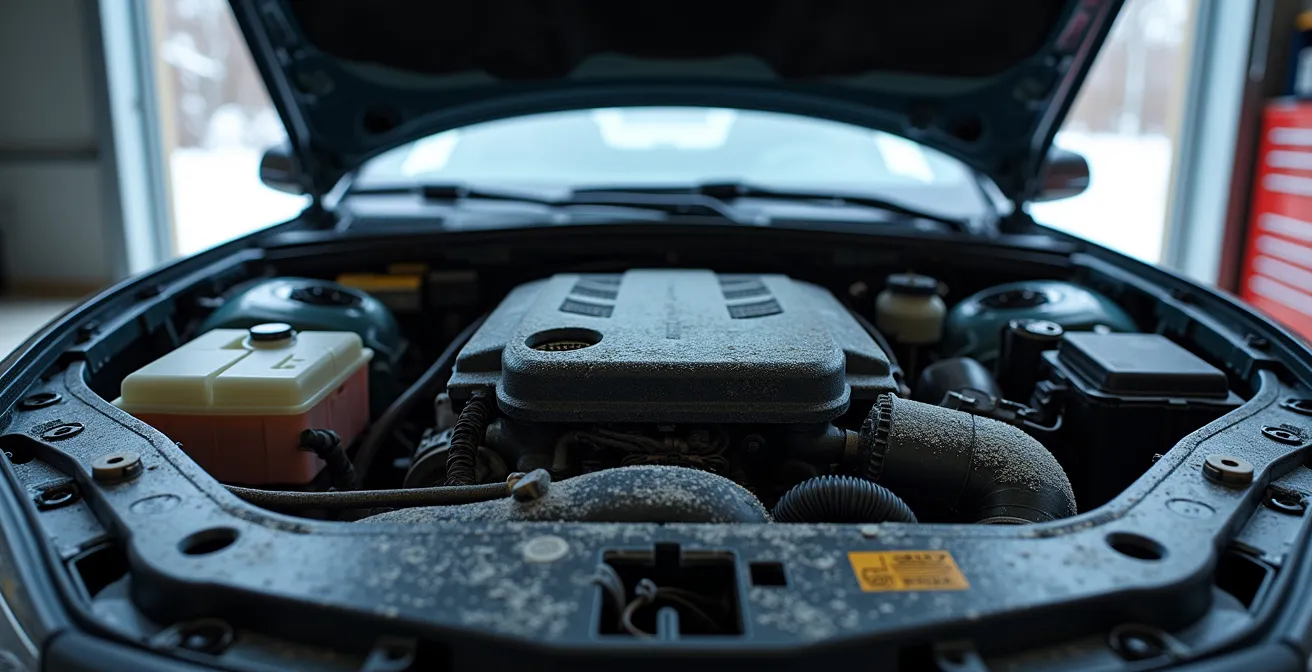
Before condemning the ECU, a thorough diagnostic process is essential. The following checklist helps you systematically rule out other possibilities, with a special focus on issues common in our climate.
Your Diagnostic Checklist: Is the ECU Truly at Fault?
- Inspect for Corrosion: Carefully check the ECU’s housing and all its electrical connectors. Look for a tell-tale green or white crusty buildup, which is a clear sign of salt corrosion damage common after many Quebec winters.
- Test Communication: Plug an OBD-II scanner into the port under the dashboard. With the ignition in the ‘On’ position (engine off), attempt to read stored error codes. A “No Communication” error is a strong indicator of ECU problems.
- Verify Power Supply: Before blaming the ECU, use a multimeter to check the specific fuses and relays that power the ECU. A simple blown fuse can mimic a total ECU failure. Consult your vehicle’s manual for their location.
- Document Persistent Codes: Note if the same critical error codes (e.g., related to sensor reference voltage or internal memory) reappear instantly after a reset. This suggests a hardware fault, not a software glitch.
- Consider Environmental Damage: Look for signs of water ingress around the ECU, which can happen from ice damming in the cowl area. This moisture, combined with temperature swings, is a primary cause of electronic failure.
Why Does Cheap Gas Trigger Your Check Engine Light in Winter?
During a harsh Quebec winter, you might notice your “Check Engine” light coming on more frequently, especially if you’ve been filling up at discount gas stations. This is often not a sign of a major engine problem, but rather an issue with fuel quality and the sophistication of your car’s ECU. All gasoline is not created equal, and this is especially true in winter. Refineries produce different “blends” of gasoline for summer and winter. Winter-blend fuel is formulated to be more volatile (evaporate more easily) to help with cold starts. This volatility is measured by its Reid Vapor Pressure (RVP).
The problem arises when the quality and consistency of this winter blend vary. Your ECU’s primary job during cruising is to maintain a perfect stoichiometric air-fuel ratio of 14.7 parts air to 1 part fuel (14.7:1). It does this using feedback from oxygen (O2) sensors in the exhaust. When you use inconsistent or poor-quality fuel, the O2 sensors detect a burn that is either too rich or too lean. The ECU then tries to compensate by adjusting “fuel trims”—small, learned adjustments to the amount of fuel being injected.
However, if the fuel quality is so poor that the ECU has to make adjustments beyond its pre-programmed acceptable range (e.g., +/- 10%), it will trigger a “Check Engine” light with a code like P0171 (System Too Lean) or P0172 (System Too Rich). As automotive diagnostic experts explain that fuel trim values are stored in volatile memory, a simple battery disconnect can reset them. But if the problem is the fuel itself, the light will just come back on. This issue is often magnified in eco-tuned vehicles, which are calibrated for a specific, consistent grade of fuel and can be more sensitive to variations.
The Warranty Loophole That Could Void Coverage on Your Imported Car
For commuters looking for a good deal, importing a vehicle from the United States can seem like a smart financial move. However, this decision comes with a significant and often overlooked warranty-related risk, which is massively amplified if you consider ECU tuning. The critical point to understand is that a vehicle’s manufacturer warranty is often geographically locked. A car purchased new in the U.S. has a warranty that is typically valid only within the United States. When that vehicle is imported into Canada, the manufacturer is usually under no obligation to honour the original warranty.
This creates a situation of “double jeopardy” for the owner. You have no warranty coverage from the Canadian branch of the manufacturer, and you’ve lost your coverage from the U.S. branch by exporting the vehicle. The Registrar of Imported Vehicles (RIV) program, which all U.S. cars must pass to be registered in Canada, only certifies that the vehicle meets Canadian safety and emissions standards. It has absolutely no bearing on the commercial warranty offered by the manufacturer. You could have a perfectly legal, RIV-certified car with zero powertrain warranty coverage from day one.
Now, imagine adding an ECU tune to this scenario. You are modifying a vehicle that already has a compromised warranty status. If a major component fails, you have no recourse. You cannot make a claim to a Canadian dealer, as the car is a U.S. import. You cannot make a claim to a U.S. dealer, as the car is registered in Canada and has been modified. You are left entirely on your own, facing the full cost of what could be a multi-thousand-dollar repair. This loophole is a financial trap that every prospective importer must be aware of.
Key Takeaways
- ECU tuning always leaves a “warranty footprint” that manufacturers can detect, putting your powertrain warranty at immediate risk.
- Professional eco-tunes cost hundreds of dollars and require significant mileage to break even, while cheap “chips” are dangerous scams that can destroy your engine.
- Environmental factors in Quebec, like winter-blend fuel and road salt corrosion, can cause ECU-related issues and must be considered in any tuning or diagnostic strategy.
How to Prevent Transmission Overheating When Towing in the Laurentians?
ECU tuning isn’t just about fuel economy; it’s about managing engine and transmission parameters for specific tasks. A common challenge for Quebecers is towing—whether it’s a boat to a lake or a trailer up to a cottage in the Laurentians. The long, steep grades on highways like Autoroute 15 north of Saint-Jérôme or Route 117 towards Mont-Tremblant put an immense strain on a vehicle’s transmission. An eco-tune, which is programmed to upshift as early as possible to keep RPMs low, can be particularly dangerous in this scenario. This practice of “lugging” the engine in a high gear while under heavy load causes the torque converter to slip excessively, generating a massive amount of heat that can quickly overheat and destroy your transmission fluid, and then the transmission itself.
Preventing this requires a proactive strategy that often involves overriding the very logic of an eco-tune. The goal is to keep the engine in its powerband and allow the engine to breathe easier, improving volumetric efficiency by maintaining higher RPMs. This allows the torque converter to lock up, creating a solid mechanical connection that dramatically reduces heat generation. A proper towing strategy is a combination of mechanical preparation and smart driving techniques tailored to the demanding Laurentian topography.
Here are essential steps to protect your transmission when towing in mountainous terrain:
- Install an Aftermarket Transmission Cooler: This is the single most effective modification. A larger cooler provides extra capacity to dissipate the intense heat generated during long climbs.
- Always Use Tow/Haul Mode: This button is not optional. It completely changes the transmission’s shift logic, holding gears longer and preventing the early upshifts that lead to overheating. If you have an eco-tune, this mode must be engaged to override it.
- Monitor Temperatures: Install an aftermarket transmission temperature gauge (or use a monitoring app like Torque Pro with an OBD-II dongle). This gives you real-time data, allowing you to back off or pull over before dangerous temperatures are reached.
- Plan for Cooling Stops: On a long, hot day, don’t be afraid to use the truck pull-offs on the A-15 near Sainte-Adèle. A 10-minute stop with the engine idling in park can significantly lower fluid temperatures.
- Maintain Higher RPMs: Manually downshift to a lower gear to keep the engine RPMs up while climbing. It may sound less efficient, but it’s infinitely better for your transmission’s health than lugging in a high gear.
Frequently Asked Questions on ECU Tuning and Imported Cars in Quebec
Does importing a US vehicle to Quebec affect the manufacturer warranty?
Yes, it almost always does. As confirmed by official sources like the Government of Canada’s Office of Consumer Affairs, most vehicle manufacturers refuse to honour warranties on vehicles imported from the United States. Before buying, you must contact the manufacturer directly to confirm their policy, but the default assumption should be that the warranty will be void.
Can ECU modifications void the warranty on imported vehicles?
Absolutely. This creates a “double jeopardy” situation. Since the car’s original warranty is likely already invalid in Canada due to importation, any ECU modification removes any shred of hope for goodwill or exceptional coverage. You would be modifying a vehicle with zero warranty protection, making you solely responsible for any and all subsequent repairs.
What role does the RIV program play in warranty coverage?
None at all. The Registrar of Imported Vehicles (RIV) program is a federal requirement to ensure an imported vehicle meets Canadian safety standards (like daytime running lights) and emissions regulations. Passing the RIV inspection is mandatory for registration, but it is a regulatory compliance check, not a commercial one. It provides no warranty coverage whatsoever.
Ultimately, the decision to tune your ECU is a personal one, weighing calculated efficiency against tangible risks. Now that you are armed with a deeper understanding of the warranty footprint, the dangers of scams, and the specific challenges of our Quebec climate, you can make a truly informed choice. The smartest path to fuel economy may not be a software change at all, but a focus on maintenance, tire pressure, and disciplined driving habits. For those who still choose to proceed, doing so with a reputable, professional tuner who understands our local conditions is the only responsible option. The next logical step is to critically assess your own driving needs and risk tolerance before investing in any modification.