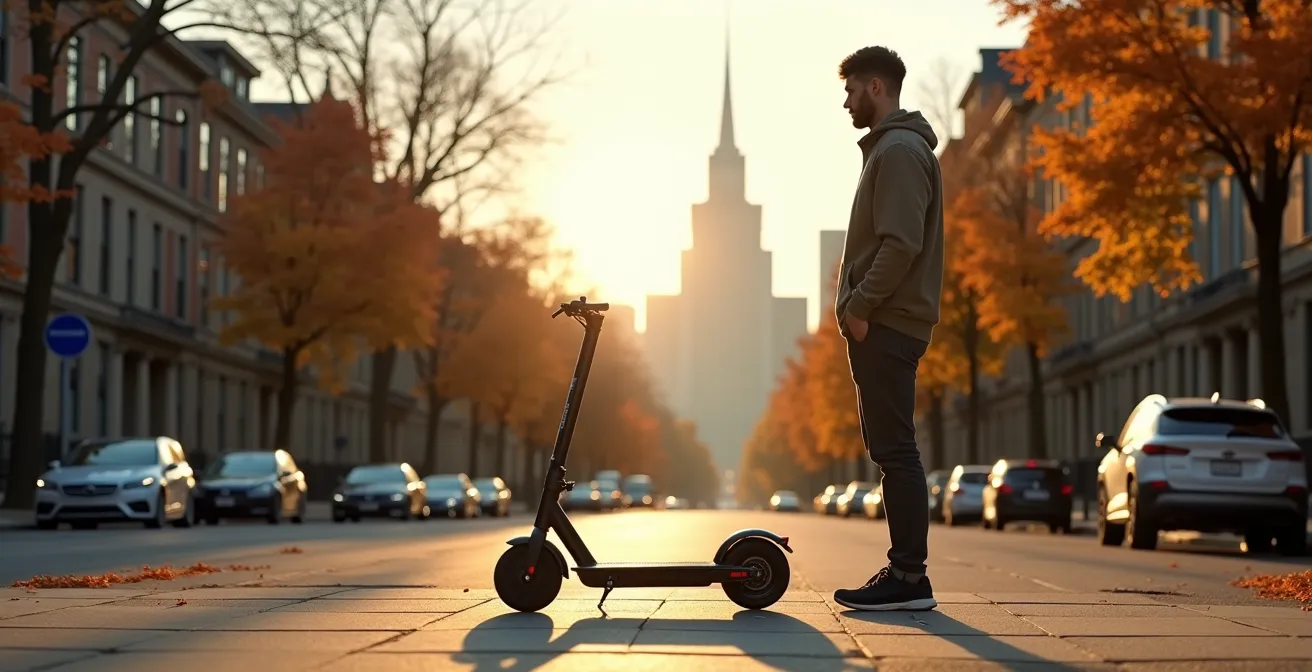
Owning an e-scooter in Montreal is a fantastic mobility solution, but only if you’re prepared for the full 12-month reality, not just the sunny 7-month dream.
- The true cost involves not just the scooter, but mandatory winter transit passes and robust anti-theft gear.
- Success depends on mastering winter battery storage and navigating a complex, evolving legal framework specific to Quebec.
Recommendation: Before buying, honestly assess if you can manage the off-season storage, security routines, and alternative transport needs. This guide breaks down the real cost of ownership.
The vision is alluring: gliding effortlessly down a Montreal bike path, bypassing gridlocked traffic on your sleek e-scooter. It promises a faster, greener, and more enjoyable commute. Many articles will give you a generic list of pros and cons, comparing motor power and battery specs. They’ll tell you to wear a helmet and be careful. But they miss the most critical point for any Montrealer considering this purchase: owning an e-scooter here isn’t a simple transaction, it’s a strategic lifestyle commitment.
The reality of a Montreal commute involves more than just the machine itself. It involves the city’s infamous construction detours, the biting reality of a five-month winter, and a unique legal landscape that’s still finding its footing. The question isn’t just “which scooter to buy?”, but “Am I equipped to handle the specific challenges and unwritten rules of using one in this city?” Forget the generic advice. What you need is a field report from the trenches of urban mobility.
This guide dives deep into the realities I’ve tested in real city conditions. We’re moving beyond the showroom specs to tackle the core issues: the true year-round cost versus BIXI, the critical mistake that gets your expensive ride stolen, and how to keep your battery alive when the temperature plummets. This is the conversation you need to have before you spend your hard-earned money.
To help you make the right choice, this article breaks down the essential factors every prospective e-scooter owner in Montreal must consider. From legal nuances to practical street smarts, here’s what you need to know to decide if this mobility tool truly fits your life.
Summary: Your E-Scooter Reality Check for Montreal
- Why Are E-Scooters Still in a Legal Grey Zone in Many Municipalities?
- How to Maintain Your E-Bike Battery When It Hits -10°C?
- Buying an E-Bike vs Renting Electric BIXI: Which Pays Off in 2 Years?
- The Locking Mistake That Loses You a $2,000 E-Bike in Seconds
- Which Bike Paths Are safest for High-Speed E-Scooters?
- How to Bring Your Bike on the Metro Without Getting Fined?
- How Much Space Must You Give a Cyclist: 1m or 1.5m?
- How to Obey the “Move Over Law” (Corridor de sécurité) Correctly?
Why Are E-Scooters Still in a Legal Grey Zone in Many Municipalities?
The first hurdle for any aspiring e-scooter owner in Montreal isn’t a pothole, but a wall of legal text. The term “legal grey zone” is thrown around, but the reality is more specific: e-scooters are permitted on certain roads under a provincial pilot project. This isn’t a permanent green light; it’s a test. In fact, Quebec’s current pilot project for e-scooters has been extended until 2026, meaning the rules could change again.
Why the caution? Montreal remembers its chaotic 2019 experiment with shared Lime scooters. As one analysis pointed out, major issues with road-sharing conflicts and scooters being abandoned outside designated parking zones led the city to pull the plug. This history makes officials cautious about private ownership, enforcing a strict set of rules to avoid repeating past mistakes. This isn’t just bureaucracy; it’s a direct response to a failed experiment that still shapes policy today.
So, what does this mean for you on the street? To ride legally, you must adhere to a clear list of non-negotiable requirements. Think of this as your license to operate:
- You must be at least 14 years old.
- Wearing a helmet is mandatory for all riders, at all times.
- Your scooter’s speed is capped at 25 km/h and its motor cannot exceed 500 watts.
- You can only ride on roads with a speed limit of 50 km/h or less and on bike paths.
- It’s a solo ride: no passengers are allowed.
Failure to comply can result in fines. This legal framework is the first test of your commitment: you’re not just buying a fun gadget, you’re agreeing to operate a vehicle under a specific, and potentially temporary, set of provincial rules.
How to Maintain Your E-Bike Battery When It Hits -10°C?
Welcome to the biggest reality check for any Montreal e-scooter owner: winter. While your scooter might be your best friend from May to October, it becomes a sensitive piece of equipment that needs careful management once the temperature drops. The heart of the issue is its lithium-ion battery, which simply isn’t designed for Quebec’s harsh cold. Its performance can drop by as much as 30% in cold conditions, drastically cutting your range and power when you might need it most.
Charging a frozen battery is one of the fastest ways to permanently damage it. When you bring your scooter in from the freezing cold, the battery needs to acclimate. You must allow it to warm up to room temperature for at least 30 to 60 minutes *before* plugging it in. This single step can be the difference between a healthy battery and one that loses significant capacity after just one winter.
For the deep-winter months when riding is impossible, long-term storage becomes a critical part of your ownership commitment. Simply leaving it in an unheated ‘cabanon’ or outdoor shed is a recipe for disaster. The extreme cold will degrade the battery cells. Here’s a practical guide for apartment dwellers and homeowners alike:
- Store Indoors: The battery (and ideally the whole scooter) must be stored in a temperature-controlled space, ideally between 15-25°C.
- Charge to 50-60%: Never store a battery at 100% or 0%. A half-charge is the sweet spot for long-term health.
- Monthly Check-up: Don’t just forget about it. Check the charge level monthly and top it up to the 50-60% range if needed.
- Clean Before Storing: Wipe down the scooter and especially the battery terminals to remove any salt residue, which is highly corrosive.
This isn’t just maintenance; it’s a crucial ritual. If you don’t have a suitable indoor space to perform this winter hibernation, the practicality of owning an e-scooter in Montreal is seriously diminished.
Buying an E-Bike vs Renting Electric BIXI: Which Pays Off in 2 Years?
The financial argument for buying an e-scooter seems simple at first glance. But a true cost analysis in Montreal must account for the five-month winter downtime. Let’s break down the real numbers over a two-year period, comparing a private e-scooter purchase with relying on BIXI and the STM.
This split-screen image perfectly captures the core dilemma for a Montreal commuter. On one side, the convenience of a ready-to-go BIXI station; on the other, the personal investment of a private e-scooter stored at home. One offers flexibility, the other, ownership.
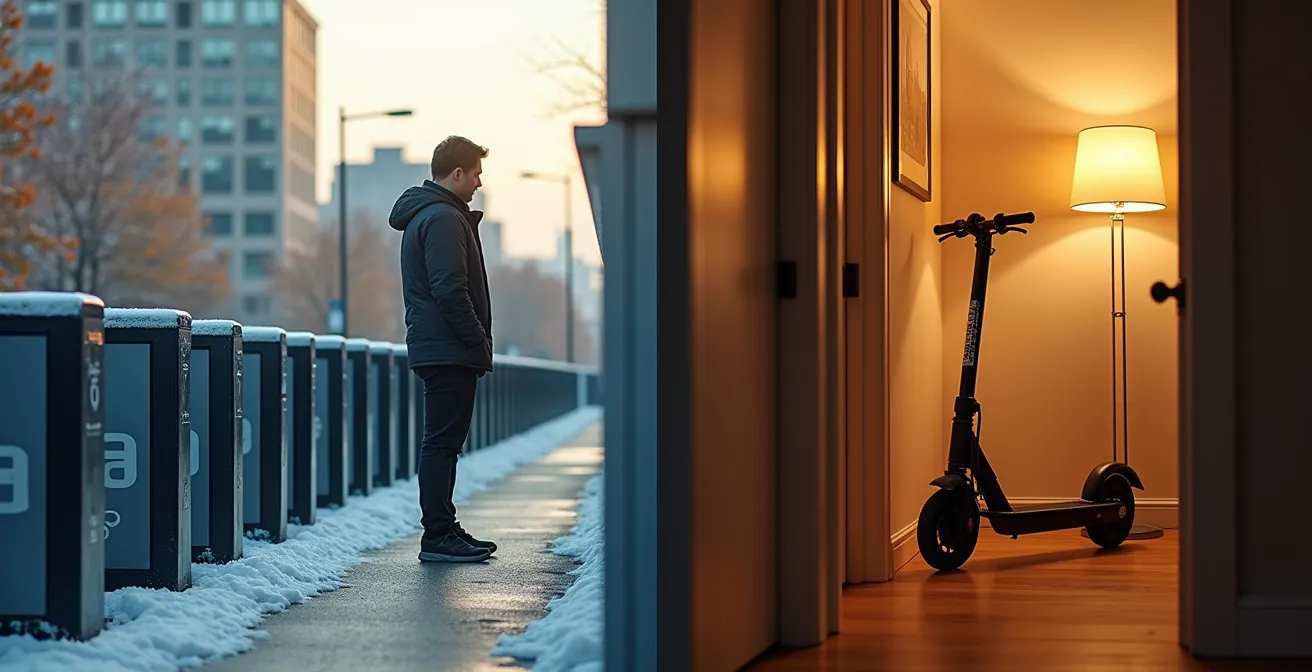
As you can see, the choice isn’t just about initial price, but about the total ecosystem of your year-round transportation. The private e-scooter owner must factor in the “winter tax”—the cost of an STM pass for the months their vehicle is in storage. A seasonal BIXI user faces a similar challenge, but with a lower initial investment. For members, the cost for an electric BIXI is a manageable 18¢ per minute, making it ideal for short, specific trips without the burden of ownership.
The following table lays out the estimated costs, providing a clearer financial picture for your decision. Note that the BIXI calculation is highly dependent on e-BIXI usage frequency and duration, while the private scooter cost assumes the purchase of a mid-range model and factors in the mandatory winter alternative.
| Transport Option | Initial Cost | Monthly Cost | 2-Year Total | Winter Alternative Required |
|---|---|---|---|---|
| Private E-Scooter ($1,500) | $1,500 | ~$10 (electricity + maintenance) | $1,740 + $970 winter STM | Yes (5 months/year) |
| BIXI Seasonal Pass | $0 | $115 (7 months) + usage fees for e-BIXI | $1,610 + usage fees + winter STM | Yes |
| STM OPUS Monthly | $0 | $97 | $2,328 | No |
Ultimately, the financial “winner” depends entirely on your usage pattern. If you plan to make multiple, long daily trips during the 7-month season, buying may pay off. If your needs are sporadic or for last-mile connections, the flexibility and low commitment of BIXI are hard to beat. The key is to see ownership not as a replacement for the STM, but as a supplement that comes with its own hidden costs.
The Locking Mistake That Loses You a $2,000 E-Bike in Seconds
In Montreal, owning an expensive e-scooter or e-bike comes with a harsh reality: theft is rampant, professional, and brutally efficient. The single biggest mistake riders make is underestimating the threat. A flimsy cable lock is an open invitation. Thieves operate with angle grinders and can sever a cheap lock in under 10 seconds. According to reports, e-scooter thefts are concentrated near major metro hubs like Berri-UQAM and Lionel-Groulx, as well as high-traffic areas like the Plateau. These are not opportunistic crimes; they are often carried out by organized rings.
The most common locking mistake is securing the wrong part of the scooter. Locking only the stem or handlebars is useless, as these components can be quickly unbolted, leaving the thief with the valuable deck and motor. Similarly, locking to a signpost is a rookie error; many can be unbolted from their base or lifted out of the ground.
Your defense is not a single lock, but a security strategy. This is another core component of the “lifestyle commitment” of ownership. It’s a routine you must follow every single time you park. It adds a minute or two to every stop, but it’s the price of keeping your investment. Adopting a robust security protocol is non-negotiable.
Action Plan: The Montreal Double-Lock Security Strategy
- Secure the Frame: Always pass a heavy-duty U-lock through the main, non-removable part of the scooter’s frame and attach it to a solid, immovable object (like a proper bike rack).
- Immobilize the Wheels: Use a secondary chain or cable lock to loop through both wheels and connect back to the U-lock. This prevents thieves from stealing valuable components.
- Choose Your Anchor Wisely: Scrutinize your anchor point. Avoid signposts, scaffolding, and small trees. Look for permanently installed, thick metal bike racks.
- Keep Locks Off the Ground: Position your locks so they are difficult to access with tools like bolt cutters or a jack. Don’t let them rest on the pavement where a thief can gain leverage.
- Add a Tracker: For ultimate peace of mind, hide a small GPS tracker like an AirTag inside the scooter’s deck. It won’t prevent theft, but it drastically increases the chances of recovery.
This multi-layered approach makes your scooter a much less attractive target. Thieves look for the easiest score. By making your setup visibly difficult and time-consuming to defeat, you encourage them to move on to the next, poorly secured ride.
Which Bike Paths Are safest for High-Speed E-Scooters?
Once you’ve handled the legal, financial, and security aspects, it’s time to ride. But not all bike paths in Montreal are created equal, especially for a vehicle that can comfortably cruise at 25 km/h. Your safety and enjoyment depend on choosing the right infrastructure. This is what I call “Infrastructure Mastery”—knowing the network’s strengths and weaknesses.
The gold standard is Montreal’s REV (Réseau Express Vélo). These are wide, physically separated, and often bidirectional paths designed for a high volume of cyclists and micromobility users. According to the city’s ambitious plan, the network is expanding rapidly, a testament to its success. These paths are your safest bet for a smooth, fast, and low-stress commute.
Riding on a well-protected lane like the REV on St-Denis gives you the confidence to maintain a steady pace, free from the immediate threats of car doors and turning vehicles. It’s the ideal e-scooter experience.
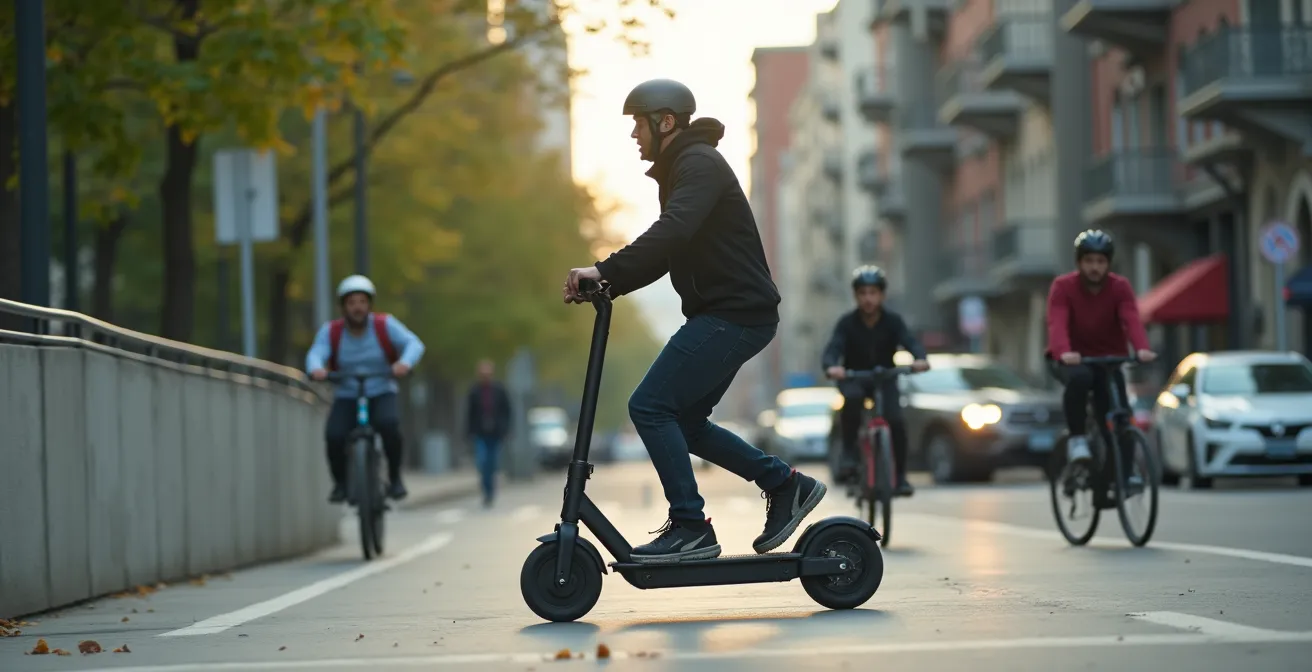
However, you will inevitably have to navigate other types of paths. Based on extensive real-world testing, here is a practical tier list of Montreal’s bike paths for e-scooter riders:
- S-Tier (The Best): The REV network, specifically on arteries like St-Denis, Bellechasse, and Lajeunesse. They offer the best protection and space.
- A-Tier (Excellent, with caveats): The Lachine Canal path is beautiful but can be packed with pedestrians on weekends. The Maisonneuve bike path is a vital downtown corridor but gets extremely crowded during rush hour.
- B-Tier (Use with Caution): Painted lanes on streets like Rachel. The primary danger here is the “door zone” of parked cars. You must ride at least a meter away from parked vehicles.
- Avoid: The Mount Royal path is not suitable due to steep grades that strain scooter motors and high pedestrian density. The cobblestones of the Old Port are a recipe for dangerous vibrations and potential loss of control.
Your daily route planning should prioritize S and A-tier paths whenever possible. This proactive approach to choosing your route is a key defensive riding tactic that minimizes risk before you even start your trip.
How to Bring Your Bike on the Metro Without Getting Fined?
One of the greatest strengths of an e-scooter is its potential for a multimodal commute. A long trip can be shortened by hopping on the metro. However, the STM has very specific rules, and pleading ignorance won’t save you from a fine or being denied access. This is another area where a little knowledge makes a huge difference.
The most important rule is that your scooter must be fully folded *before* you even enter the station. Don’t wait until the turnstiles or the platform. As the official regulations confirm, this is a prerequisite for entry. As noted in the STM’s own rules:
Règlement R-036 allows folded scooters outside of rush hour
– STM Official Regulations, Société de transport de Montréal By-laws
The second critical rule involves timing. E-scooters, like bikes, are strictly prohibited during peak rush hours: 7:00 AM to 9:00 AM and 4:00 PM to 6:00 PM on weekdays. Trying to board during these times will result in a swift refusal from STM staff. Remember, the STM employee on-site always has the final say, regardless of the rules, so courtesy and compliance are key.
Here are the essential rules of etiquette and procedure for a smooth metro journey with your scooter:
- Fold First: Your scooter must be completely folded before you pass the turnstiles.
- Board the First Car: Always use the very first car of the train, as this is the designated space for bikes and other bulky items.
- Hold It Securely: Keep your folded scooter upright and hold onto it at all times to prevent it from falling or rolling.
- Be Mindful of Space: Be considerate of other passengers. Keep your scooter tucked away and avoid blocking aisles or doorways.
- Know the REM is Different: If your journey involves the REM, be aware that it has its own set of regulations. Check their specific rules before you travel.
Mastering these simple rules transforms the metro from a potential point of conflict into a powerful tool in your commuting arsenal, seamlessly connecting the gaps in your journey.
How Much Space Must You Give a Cyclist: 1m or 1.5m?
As an e-scooter rider, you share the road not just with cars, but also with traditional cyclists. Understanding your rights and the space you’re entitled to is crucial for your safety. The Quebec Highway Safety Code is clear on this, and it’s a rule every driver is supposed to know, but many don’t. As a vulnerable road user, knowing the law empowers you to claim your space confidently.
The law dictates the minimum passing distance a vehicle must provide when overtaking a cyclist (and by extension, an e-scooter). The distance depends on the road’s speed limit. Specifically, the Quebec law mandates a minimum passing distance of 1 metre on roads with a speed limit of 50 km/h or less, and 1.5 metres on roads where the limit is over 50 km/h. This isn’t a suggestion; it’s a legal requirement.
However, knowing the law and seeing it respected are two different things. You cannot rely on drivers to always abide by this rule. Your safety strategy must be proactive. This means making yourself as visible as possible and positioning yourself on the road to discourage unsafe passes. Here’s how you can actively claim your safety bubble on Montreal’s streets:
- Use Bright Daytime Lights: A flashing front and rear light, even in broad daylight, significantly increases your visibility.
- Wear High-Visibility Gear: Especially on major arteries like Sherbrooke or René-Lévesque, a bright jacket or vest makes you stand out from the urban visual clutter.
- Take the Lane When Necessary: If a bike lane is blocked, filled with debris, or non-existent, you have the right to occupy the center of the traffic lane. This prevents cars from trying to squeeze by you dangerously.
- Signal Clearly: Use clear hand signals well in advance of any turn or lane change. Make your intentions predictable.
- Document Aggression: While it shouldn’t be necessary, a handlebar-mounted camera can be a powerful tool to document and report dangerously aggressive drivers to the SPVM.
Your presence on the road is legitimate. By combining knowledge of the law with assertive, visible, and predictable riding, you shift from being a passive victim of traffic to an active participant who commands respect and space.
Key takeaways
- E-scooter legality in Montreal is based on a provincial pilot project, not permanent law, requiring strict adherence to rules on age, speed, and location.
- Winter is a deal-breaker: batteries lose significant range and require specific indoor storage protocols to prevent permanent damage.
- The true cost of ownership must include a 5-month winter STM pass, making the 2-year cost comparable to or higher than using seasonal BIXI.
How to Obey the “Move Over Law” (Corridor de sécurité) Correctly?
While the “Move-Over Law” (corridor de sécurité) in Quebec technically applies to drivers creating space for emergency vehicles, the underlying principle of defensive awareness is the single most important skill for an e-scooter rider in Montreal. Your survival depends not on others following the rules, but on you anticipating when they will break them. You must ride as if you are invisible.
Montreal’s streets are a unique obstacle course of construction, aggressive drivers, and distracted pedestrians. The city’s ubiquitous construction zones are a prime example, where bike paths can vanish with little warning, forcing riders into live traffic. In these situations, your best tactic is to dismount and walk your scooter through the hazardous area. Don’t risk a confrontation with a concrete mixer.
Developing a set of defensive “street smarts” is the final, and most crucial, part of your lifestyle commitment. Here are the core tactics I’ve learned from thousands of kilometers on Montreal roads:
- The Montreal Stop: Assume every car at a stop sign will roll through it. Never cross an intersection assuming the driver sees you. Make eye contact and be prepared to brake.
- Watch for the Right Hook: Be hyper-aware of cars turning right across your bike lane, especially at intersections. They are often looking for gaps in car traffic, not for you.
- Master Door Zone Awareness: Always ride at least one full meter away from parked cars. A suddenly opened door is one of the most common and dangerous urban cycling accidents.
- Own Your Lane at Lights: When waiting at a red light, position yourself in the center of the lane. This makes you more visible to the car behind you and prevents cars from trying to turn right in front of you.
- Constant Shoulder Checks: In mixed traffic, you need to know what’s happening around you. Check over your shoulder every 5-7 seconds to maintain situational awareness.
These aren’t just tips; they are survival habits. Integrating them into every ride is what separates a seasoned urban commuter from a statistic. It’s about taking full responsibility for your own safety in a complex environment.
Ultimately, deciding to buy an e-scooter for your Montreal commute is a personal equation. If you’re looking for a simple, plug-and-play solution, the combination of BIXI and the STM might be a better fit. But if you’re ready to embrace the commitment—the maintenance, the security rituals, and the defensive mindset—an e-scooter can be a truly liberating and empowering tool for conquering the city. To take the next step, assess your personal storage options and realistically budget for the total cost of ownership, including security and winter transport.