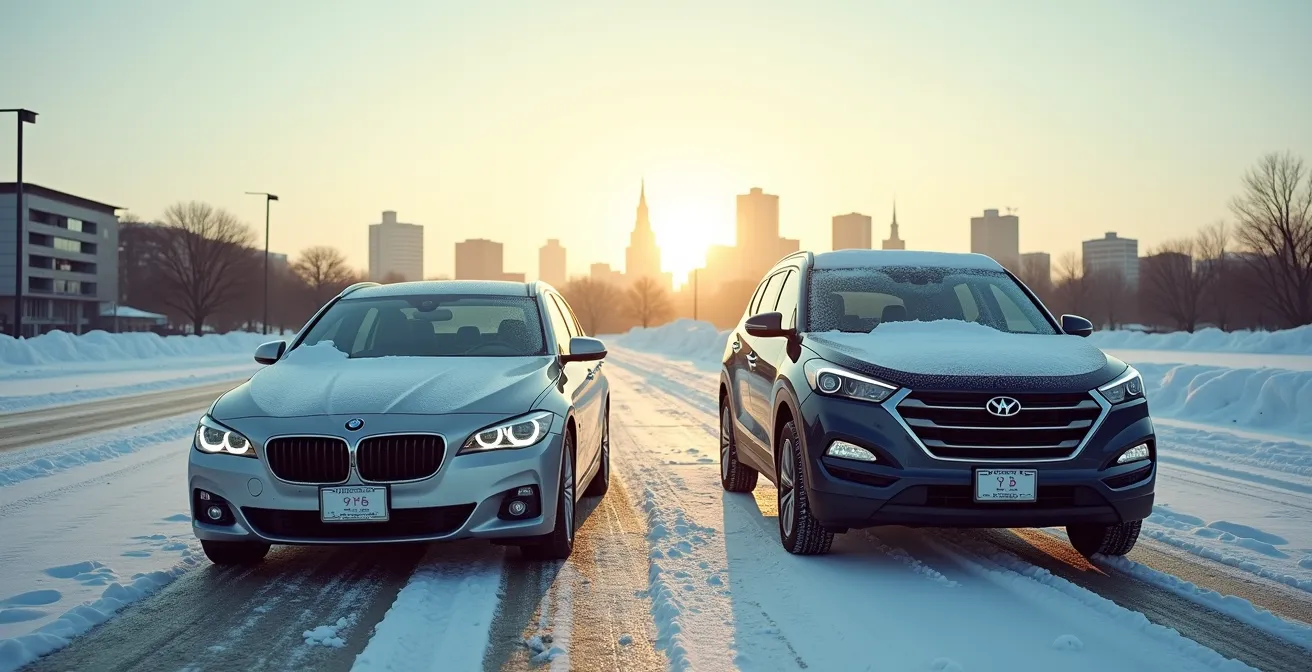
Contrary to popular belief, the best investment for a Quebec family is not automatically an SUV; it’s understanding the specific provincial market forces that truly dictate resale value.
- Market-wide trends show sedans depreciating faster, but compact models retain strong value in urban centres like Montreal due to practicality.
- Quebec-specific factors, such as the Roulez Vert program’s evolution and the stigma against US imports, have a greater impact on a car’s long-term worth than its body type alone.
Recommendation: Shift your focus from the “sedan vs. SUV” debate to analyzing local value triggers—like rebate changes and seasonal inventory cycles—to make a smarter, more profitable vehicle purchase.
For any Quebec family considering a new vehicle, the question of resale value looms large. The conventional wisdom, repeated across North America, is simple: buy an SUV. They’re popular, practical, and perceived as the safest bet for retaining value. Sedans, we’re told, are a dying breed, a relic of a bygone automotive era. This narrative, while compelling, oversimplifies a complex and highly localized market. In Quebec, the calculus of depreciation is not so straightforward.
The decision isn’t just about national popularity contests. It’s about navigating a unique automotive landscape shaped by harsh winters, dense urban centres, and specific provincial regulations. A data-driven approach reveals that the true value of a vehicle isn’t just in its body style, but in its alignment with these powerful local forces. Factors like the usability of sliding doors during a snowstorm, the availability of all-wheel drive, or a model’s eligibility for the Roulez Vert program can dramatically bend the depreciation curve.
This analysis moves beyond the generic advice. It’s designed to equip you with the mindset of a market analyst, focusing on the provincial value modifiers that determine a vehicle’s future worth in Quebec. We will dissect the data, from the hidden costs of discontinued models to the strategic timing for maximum negotiation power, providing a framework for making an informed investment. The goal is to choose a vehicle that not only serves your family today but also protects your finances tomorrow.
text
This guide provides a comprehensive analysis of the key factors influencing vehicle value specifically within the Quebec market. The following sections break down everything from macro trends to local nuances to help you make a financially sound decision.
Summary: Sedan or SUV: A Quebec Buyer’s Guide to Depreciation
- Why Are Manufacturers Killing Sedans Despite Their Fuel Efficiency?
- How to Spot the Next Hot Vehicle Trend Before Prices Spike?
- Crossover vs Minivan: Which Truly Fits a Family of 5 in Winter?
- The Hidden Cost of Buying a Discontinued Car Model in 2024
- When to Buy a New Model Year for Maximum Negotiation Power?
- US Import vs Canadian Car: Which Has Better Resale Value in Montreal?
- When Will Gas Car Values Crash in Quebec: 2028 or 2032?
- Hatchback or Coupe: Which Design Survives the Urban Jungle Better?
Why Are Manufacturers Killing Sedans Despite Their Fuel Efficiency?
From a market analyst’s perspective, the decline of the sedan is a story of shifting consumer preference dictating production, which in turn impacts depreciation. North American buyers have overwhelmingly pivoted towards SUVs and crossovers, valuing higher driving positions and perceived utility. This has forced manufacturers to reallocate resources away from their sedan lineups, with some iconic models being discontinued entirely. This cycle has a direct and measurable effect on resale value.
The data paints a clear picture at the national level. A recent Canadian market analysis shows a 45-55% sedan depreciation over five years, compared to a healthier 41% for the average SUV. This gap is a primary driver for the common advice to favour larger vehicles. Even perennial top-sellers are not immune; models like the Toyota Camry and Honda Civic can lose significant value in their first few years, despite their reputation for reliability and efficiency.
However, this macro trend doesn’t tell the whole story, especially in a market as nuanced as Quebec’s. While the overall category faces headwinds, specific sedan models like the Honda Civic maintain exceptionally strong demand in urban areas. Their smaller footprint, lower fuel consumption, and agility are provincial value modifiers that can partially offset the broader market trend. This demonstrates that while the sedan segment is shrinking, pockets of high demand and slower depreciation persist where practicality aligns with local needs.
How to Spot the Next Hot Vehicle Trend Before Prices Spike?
Anticipating shifts in vehicle value is the hallmark of a savvy buyer. In Quebec, the most powerful tool for this is not a crystal ball, but a close watch on provincial policy, particularly the Roulez Vert program. This government incentive acts as a powerful “value trigger,” directly influencing demand and, consequently, the resale value of electric and plug-in hybrid vehicles. Changes to this program create predictable market movements that an informed buyer can leverage.
For instance, the program is not static. The list of eligible vehicles is updated annually, and the rebate amounts themselves are scheduled to decrease over time. As of 2025, Quebec’s reopened Roulez Vert program offers up to $4,000 for BEVs and $2,000 for PHEVs, but this is a reduction from previous years. Vehicles purchased before these reductions naturally become more valuable on the used market, as they represent a “better deal” that is no longer available. Similarly, when a new model is added to the eligibility list, its demand almost invariably spikes.
Monitoring these changes provides a clear roadmap to future value. Buyers who track program suspension periods, the graduated rebate schedule, and even the purchasing decisions of major Quebec-based company fleets can identify models poised for increased demand. This analytical approach transforms the car buying process from a reactive purchase into a proactive investment, capitalizing on market inefficiencies created by government policy.
Your Action Plan: Identifying High-Value Vehicles in Quebec
- Monitor Quebec’s Roulez Vert program changes: Vehicles newly added to the rebate list often see increased demand and better value retention.
- Track program suspension periods: Note any temporary halts, as vehicles registered immediately after resumption can experience price spikes.
- Check the graduated rebate reduction schedule: The financial assistance for electric vehicles is being reduced, making pre-reduction models potentially more valuable on the used market.
- Review eligible vehicle list updates: Pay close attention to updates (often on January 1 and September 15) for newly added models that could become popular.
- Analyze fleet purchases: Keep an eye on the vehicle choices of major Quebec institutions for early signs of adoption trends.
Crossover vs Minivan: Which Truly Fits a Family of 5 in Winter?
For a Quebec family, the debate between a crossover and a minivan extends far beyond aesthetics; it’s a question of pure winter practicality. While crossovers and SUVs dominate sales due to their image and the widespread availability of all-wheel drive, the minivan often holds a functional advantage in the harshest conditions. This is a classic example where perceived value and practical value diverge, a key insight for any long-term investment.
Consider the daily reality of a Quebec winter. Parking spaces shrink, hemmed in by towering snowbanks. In this scenario, a minivan’s sliding rear doors are a significant ergonomic advantage over a crossover’s wide-swinging doors, making it far easier to get children in and out of car seats without bumping into an adjacent vehicle or a wall of ice. This single feature can be a game-changer for family logistics from December to March.

Furthermore, while crossovers have a clear edge in all-wheel-drive options, minivans typically offer superior and more flexible cargo space. Their boxy shape and flat-floor designs are better suited for hauling bulky items like hockey bags and family luggage. The following table highlights how these practical differences stack up against financial considerations like depreciation, creating a more complete picture for a family’s decision.
The following comparison, based on recent market data analysis, breaks down the key decision points for a Quebec family evaluating these two vehicle types for year-round use.
| Feature | Crossover/SUV | Minivan |
|---|---|---|
| 5-Year Depreciation | 41% | 45-50% |
| Winter Entry (with snowbanks) | Challenging with swing-out doors | Easier with sliding doors |
| AWD Availability | Standard on most models | Limited options |
| Cargo Space (hockey gear) | Good with folding seats | Superior flat floor design |
| Quebec Winter Appeal | High – perceived safety | Lower – stigma factor |
The Hidden Cost of Buying a Discontinued Car Model in 2024
The purchase of a discontinued model presents a classic risk-reward scenario for a value-conscious buyer. The primary reward is immediate: dealerships are highly motivated to clear out old stock, often offering significant upfront discounts. However, these initial savings can be eroded by hidden long-term costs, particularly accelerated depreciation and potential challenges with parts and service.
When a manufacturer ceases production of a model, it sends a strong signal to the used car market that demand has waned, which can cause its value to drop more steeply than its active counterparts. For sedans, which already face market headwinds, discontinuation can amplify this effect. This doesn’t mean every discontinued model is a poor investment, but it requires a strategic approach. The key is to assess the manufacturer’s long-term commitment to parts production and the strength of the local service network.
In Quebec, with its extensive network of independent `garagistes`, parts availability for discontinued models from major brands like Honda or Toyota may remain strong for years. The risk is higher for less common brands or models with unique components. Furthermore, meticulous record-keeping becomes paramount; as one Canadian guide notes, thoroughly documenting the routine maintenance reassures buyers and slows depreciation. By verifying parts availability and maintaining a perfect service history, a buyer can mitigate the risks and potentially turn an end-of-life discount into a genuine long-term value proposition.
When to Buy a New Model Year for Maximum Negotiation Power?
In the automotive market, *when* you buy can be just as important as *what* you buy. While many believe year-end sales are the best time, the Quebec market has its own unique rhythm dictated by weather and cultural events. Understanding these local buying seasons provides significant leverage during negotiations. An astute buyer can time their purchase to coincide with periods of low dealership traffic and high inventory pressure.
The most active period for car buying in Quebec is typically spring and early summer. As market analysis for the region indicates, buyers are numerous after tax season, and clear roads make test drives more appealing. While selection is good, negotiation power is at its lowest. The real opportunities arise during the market’s lulls. The first key window is the August to October period, as dealerships are eager to clear out the current model year’s inventory before the massive logistical and financial undertaking of the winter tire season begins.

A second, often overlooked, window of opportunity occurs in the February-March timeframe. This is the post-Montreal Auto Show slump. Dealerships experience a significant drop in foot traffic after the excitement of the show wears off, yet they are still under pressure to meet first-quarter sales targets. A buyer walking into a quiet showroom during this period is in a much stronger position to negotiate on price, financing, and extras. Aligning your purchase with these Quebec-specific cycles is a core strategy for bending the depreciation curve before you even drive off the lot.
US Import vs Canadian Car: Which Has Better Resale Value in Montreal?
The allure of a lower sticker price on a vehicle imported from the United States can be strong, but this is a significant pitfall for unsuspecting Quebec buyers. In the Montreal used car market, a US-market vehicle carries a distinct stigma that translates into a substantial and often unexpected hit to its resale value. These vehicles are a prime example of a “provincial value modifier,” where an asset’s worth is fundamentally altered by local market perceptions and regulations.
Several factors contribute to this depreciation. Firstly, any vehicle imported into the province must pass a rigorous mechanical inspection by the SAAQ before it can be registered, a process that can be both costly and time-consuming. Secondly, US vehicles come with instrument clusters in imperial units (miles per hour, Fahrenheit), which is a major deterrent for the vast majority of local buyers accustomed to the metric system. This limits the pool of potential future buyers, thus lowering the vehicle’s market value.
Perhaps the biggest issue is the difficulty in verifying a vehicle’s history. While systems like CarProof (now Carfax Canada) are the standard here, a US vehicle’s service and accident history can be opaque and harder to trace, creating uncertainty for buyers. Collectively, these hurdles mean that a US-imported vehicle will almost always have a lower resale value than its identical Canadian-market counterpart. Market experts estimate this penalty can be as high as 15-20%, a significant loss that often negates any initial savings from the purchase.
Key Takeaways
- The “SUV is always better” rule for resale value does not hold true when Quebec-specific factors are considered; context is critical.
- Government policies like the Roulez Vert program and the upcoming EV tax act as powerful “value triggers” that directly influence demand and future prices.
- Practicality in Quebec’s climate (e.g., minivan sliding doors vs. SUV swing-out doors in snow) can be more important for family use than national popularity trends.
When Will Gas Car Values Crash in Quebec: 2028 or 2032?
Predicting the exact moment internal combustion engine (ICE) vehicle values will “crash” is complex, but a data-driven forecast is possible by analyzing government policy timelines and market adoption rates. The transition is not a cliff-edge event but a progressive erosion of value. Currently, a counterintuitive trend persists: current depreciation data shows that EVs depreciate at 49% over five years, slightly faster than comparable gas-powered SUVs at 41%. This is largely due to rapid technological advancements and evolving battery life, making older EVs less desirable.
However, the tide is set to turn, and the timeline is dictated by policy. The first major “value trigger” is set for 2027. According to a report by Electric Autonomy Canada, a new luxury tax threshold will come into effect. Previously, zero-emission vehicles were exempt, but starting in 2027, the tax will apply to all vehicles exceeding a new, lower threshold. This change, combined with the gradual reduction of Roulez Vert rebates, will make new EVs more expensive and, in turn, make well-maintained, late-model ICE vehicles more attractive on the used market in the short term.
The true acceleration of ICE depreciation is expected to begin around 2028-2030, as EV charging infrastructure becomes more ubiquitous and the market approaches maturity. The “crash,” particularly for economy models and less fuel-efficient vehicles, is more likely to be concentrated in the 2031-2032 period as the market anticipates the 2035 ban on new gas car sales. The table below outlines a projected timeline for this market shift in Quebec.
This timeline, informed by changes to programs like Quebec’s own Roulez Vert initiative, provides a strategic outlook on how vehicle values are expected to evolve in the coming decade.
| Year | Gas Vehicle Impact | EV Market Factor |
|---|---|---|
| 2025-2026 | Stable values | Reduced Roulez Vert rebates |
| 2027 | First impact felt | New EV tax threshold at $62,500 |
| 2028-2030 | Accelerated depreciation begins | Infrastructure expansion phase |
| 2031-2032 | Selective crash (economy models) | Market maturity approaching |
| 2035 | New gas car sales ban | Full market transition |
Hatchback or Coupe: Which Design Survives the Urban Jungle Better?
In the dense urban environments of Montreal or Quebec City, the traditional sedan vs. SUV debate becomes less relevant. Here, a different set of “Quebec Practicality Index” criteria comes to the forefront: maneuverability, ease of parking, and cargo flexibility. In this context, the often-overlooked hatchback emerges as a superior choice for urban survival, frequently outperforming both coupes and even larger sedans in both utility and value retention.
A coupe, with its emphasis on style, often sacrifices practicality. Its long doors can be a liability in tight parking spots, and its limited cargo space and passenger access make it a niche choice. A hatchback, by contrast, combines a small footprint with surprising versatility. It offers the agility of a compact car while providing cargo access that rivals that of a small crossover, making it ideal for hauling groceries, sports equipment, or navigating narrow city streets. This practicality is directly reflected in its value.
Market data supports this conclusion. Compact cars, a category where hatchbacks are a dominant force, hold their value remarkably well. An analysis of the Canadian market demonstrates that compacts can depreciate as little as 40% over five years, outperforming the average sedan. This strong performance is driven by sustained demand in major cities. As noted by one insurance analyst:
Urban markets like Montreal and Toronto show stronger demand for compact cars due to parking constraints and city driving conditions, while rural areas typically favor larger vehicles. This geographic variation can create price differences of 10-15% for the same model depending on location.
– Purr Insurance Canada, Understanding Vehicle Depreciation in Canada
For the urban Quebec buyer, this means a hatchback is not a compromise; it’s a strategic investment that aligns perfectly with the demands of its environment.
Ultimately, navigating the Quebec car market requires a shift in perspective. Instead of relying on broad, national trends, a successful investment hinges on a deep understanding of local market dynamics. By analyzing these specific value triggers, from seasonal sales cycles to the nuances of provincial incentive programs, you can make a decision that is not only right for your family’s needs but also for your long-term financial health.