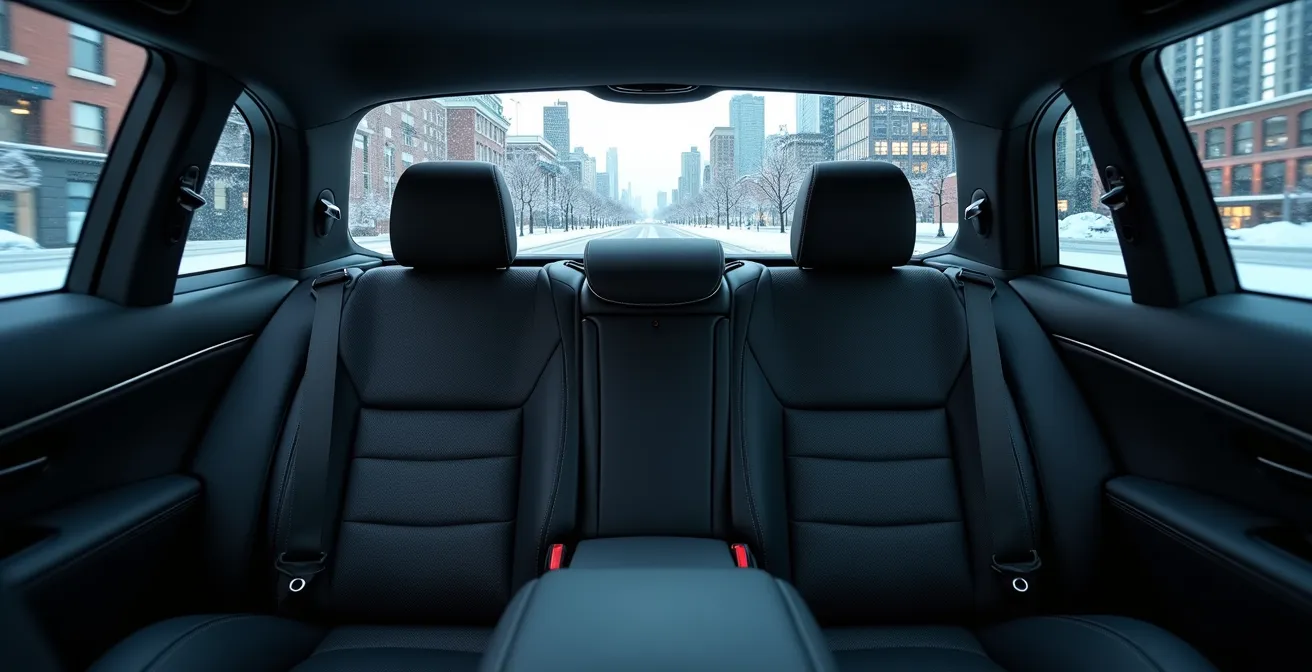
Your new car’s features might not be yours to keep; you could just be renting them, and the trend is already here in Canada.
- Automakers are shifting to “Features on Demand” to create predictable revenue, but this model can devalue your vehicle and severely compromise your personal data privacy.
- Overwhelmingly, Canadian consumers are against this model, with studies showing many would switch brands to avoid paying monthly for hardware already installed in their car.
Recommendation: Reclaim control by actively securing your vehicle’s data, questioning subscription-based features before you buy, and understanding your rights as a consumer in the evolving Canadian automotive landscape.
That comfortable warmth radiating from your heated seats on a frigid Quebec morning feels like a small, essential luxury. But what if that feature could be turned off with the flip of a remote switch in a corporate office thousands of kilometres away? This isn’t a dystopian future; it’s the emerging reality of the automotive industry. The debate ignited by BMW’s attempt to charge a monthly fee for heated seats is just the tip of the iceberg. The real story isn’t about paying for warmth; it’s about a fundamental shift in ownership. Your car is no longer just a product you buy; it’s becoming a “platform on wheels,” a device designed to generate recurring revenue for its manufacturer.
Many argue this allows for greater flexibility and post-purchase upgrades. But as a tech advocate who loves innovation, I’m deeply skeptical. This model introduces a host of problems we’re all too familiar with from our smartphones and smart TVs: engineered obsolescence, relentless data harvesting, and the erosion of true ownership. While some automakers claim they have no plans for such a model in Canada, their actions and the underlying technology tell a different story. We’re already seeing Canadian drivers being asked to pay monthly for remote start functions that were once included for life.
This guide isn’t about fear-mongering. It’s about empowerment. We’ll dissect the hidden mechanics of this new automotive world, from the data your car collects while you sleep to the security vulnerabilities in your key fob. We will explore the real-world financial impacts on resale value in the Canadian market and provide you with the concrete tools and knowledge to navigate this landscape, protect your privacy, and ensure the car you pay for is truly yours.
To navigate this complex topic, we will break down the key issues facing Canadian car owners. This article explores the hidden data economy, security vulnerabilities, planned obsolescence, and the financial ramifications of the subscription model, before offering strategies to reclaim your digital and physical ownership.
Summary: Is the Subscription Model for Heated Seats Coming to Canada?
- Why Does Your Car Know Where You Sleep and Who Is Buying That Data?
- How to Prevent Remote Hacking of Your Keyless Entry Signal?
- Native GPS vs CarPlay/Android Auto: Which Uses Less Data?
- The 3G Shutdown: Will Your older Connected Car Lose Its SOS Feature?
- When to Use Remote Start App vs Key Fob to Save Battery?
- The Resale Value Mistake That Costs Owners $5,000 After 4 Years
- The Privacy Risk of Automated Parking Enforcement Cameras
- How to Integrate Your Connected Car With Your Smart Home to Save Time?
Why Does Your Car Know Where You Sleep and Who Is Buying That Data?
Your connected car is one of the most powerful data collection devices you own. It knows your daily commute, your favourite coffee shop, your children’s school, and yes, where you sleep every night. This isn’t an accident; it’s by design. Every modern vehicle is equipped with a telematics control unit (TCU) that constantly gathers and transmits data: location, speed, acceleration, braking patterns, and even in-cabin audio in some cases. While automakers argue this data is used to improve services and safety, it’s also a highly valuable commodity. This is the currency you pay with for “free” connected services.
Data brokers and insurance companies are major purchasers of this information, using it to build incredibly detailed consumer profiles or to adjust insurance premiums based on driving habits—a practice known as usage-based insurance (UBI). In Quebec, the collection and use of this personal information are governed by Law 25, which imposes strict consent and transparency requirements. However, the complex legal agreements you scroll past when setting up your car’s infotainment system often bury these permissions in dense legalese.
Even when automakers claim to avoid certain business models, the infrastructure for data collection remains. As Barb Pitblado of BMW Group Canada stated, the company’s position is nuanced. In a statement to CBC News, she said:
We do not have a subscription-based business model in Canada, but like the U.S., we give customers the possibility of adding new software-based functionality to their vehicle
– Barb Pitblado, BMW Group Canada Statement
This “possibility” is built on the back of the very data collection systems that create these privacy risks. The core issue of data as currency remains, regardless of whether a feature is a one-time upgrade or a monthly subscription. The vehicle becomes a platform for ongoing transactions, both monetary and data-based, fundamentally changing your relationship with the machine you supposedly own.
How to Prevent Remote Hacking of Your Keyless Entry Signal?
The convenience of keyless entry and push-to-start ignition has a dark side: it has opened the door to a new generation of high-tech car theft. The most common method, known as a relay attack, is shockingly simple. Thieves use two devices; one captures the signal from your key fob inside your house, and the other relays it to your car, tricking the vehicle into thinking the key is present. This allows them to unlock and drive your car away in seconds, without ever breaking a window. This method has become rampant in the Greater Montreal and Toronto areas.
The most effective and affordable defence is a simple piece of technology: a Faraday pouch. These signal-blocking bags are lined with a metallic mesh that creates a cage, preventing any signals from getting in or out. When you’re at home, placing your key fobs inside one of these pouches makes them invisible to thieves’ relay devices. It’s a low-tech solution to a high-tech problem, and an essential first step for any owner of a vehicle with keyless entry.

Canadian insurance companies are taking notice of this trend. In response to the surge in thefts, some major Quebec insurers are now offering discounts for vehicles equipped with approved anti-theft devices. These programs are an acknowledgment that the vulnerability lies with the technology, not just user negligence. However, the very existence of these subscription features is at odds with consumer sentiment. A Cox Automotive study found that 69% would shop elsewhere if their desired features required a subscription, indicating a strong public rejection of the “nickel-and-diming” approach to car ownership.
Native GPS vs CarPlay/Android Auto: Which Uses Less Data?
Navigation is a cornerstone of the connected car experience, but how you access it can have a surprising impact on your monthly mobile phone bill. Drivers essentially have two choices: use the car’s built-in (native) GPS system or mirror a smartphone app like Google Maps, Waze, or Apple Maps via Android Auto or Apple CarPlay. From a data consumption perspective, the difference is stark. Native GPS systems that use pre-loaded or over-the-air (OTA) updated offline maps consume zero megabytes of your personal mobile data plan. The data for map updates is typically covered by the automaker, at least for an initial period.
In contrast, smartphone-based navigation apps continuously stream map data, traffic information, and points of interest, consuming a significant amount of data. This can be especially costly in Canada, where mobile data rates are among the highest in the world. Using an app like Google Maps or Waze can consume 150-200 MB of data per hour. For a driver who navigates for an hour each day, this could add up to 4-6 GB of data usage per month, potentially pushing you into a more expensive mobile plan.
The table below provides a cost breakdown for an hour of navigation using various platforms, based on typical data plans from major Canadian carriers. As you can see, the costs of convenience add up quickly.
| Navigation Type | Data Usage per Hour | Cost with Bell ($75/10GB) | Cost with Rogers ($65/10GB) | Cost with Videotron ($55/8GB) |
|---|---|---|---|---|
| Native GPS (offline maps) | 0 MB | $0 | $0 | $0 |
| Google Maps/Waze | 150-200 MB | $1.13-$1.50 | $0.98-$1.30 | $1.03-$1.38 |
| Apple Maps | 100-150 MB | $0.75-$1.13 | $0.65-$0.98 | $0.69-$1.03 |
This “nickel-and-diming” strategy is precisely what many industry experts warn against. As Lauren Fix, Editor-in-Chief of Car Coach Reports, notes, it can backfire on automakers. She argues, “The idea is that you want repeat customers and if you start nickel-and-diming customers, they’ll go elsewhere.” By offloading data costs to the consumer for a core function like navigation, car companies risk alienating the very customers they hope to retain.
The 3G Shutdown: Will Your older Connected Car Lose Its SOS Feature?
Imagine being in a serious accident on a remote Canadian highway, only to discover your car’s automatic SOS emergency call feature no longer works. This is a real and imminent risk for owners of hundreds of thousands of vehicles in Canada. As mobile carriers like Bell, Rogers, and Telus phase out their older 3G networks to make way for 5G, many connected cars manufactured between roughly 2010 and 2020 will lose their lifeline. These vehicles were built with 3G-only telematics modules, and when the network goes dark, so do all connected features: automatic crash notification, stolen vehicle tracking, remote unlocking, and even some navigation services.
This is a textbook case of engineered obsolescence, where a product’s lifespan is artificially limited by its technological dependencies. For automakers, this isn’t just an unfortunate side effect; it’s a financial opportunity. This trend is part of a larger strategy to boost recurring revenue from software and services. For example, a report highlighted by The Globe and Mail shows GM’s software and in-car subscription service revenue earned US$2-billion in 2021 and is expected to reach US$25-billion by 2030. Forcing customers to pay for hardware upgrades to maintain features they already paid for is a part of this profitable equation.
For Canadian owners of affected vehicles, the path forward is unclear and often costly. Some manufacturers may offer an upgrade to a 4G or 5G module, but rarely for free. If you own a vehicle from the last decade, you need to be proactive to avoid being left without critical safety features. Taking concrete steps now can help you determine your risk and explore your options.
Your Action Plan for the 3G Sunset
- Check your vehicle’s connectivity specifications in the owner’s manual or on the manufacturer’s Canadian website.
- Contact your dealership with your VIN to verify if your model year (typically 2010-2020) is affected by the 3G shutdown in Canada.
- Request detailed information about available hardware upgrade paths and all associated costs for 4G/5G compatible modules.
- Document any advertised SOS or emergency features from your original purchase agreement for potential warranty or consumer rights claims.
- Consider filing a complaint with the Office of Consumer Affairs (federal) or your provincial consumer protection agency if advertised safety features become non-functional without a remedy.
When to Use Remote Start App vs Key Fob to Save Battery?
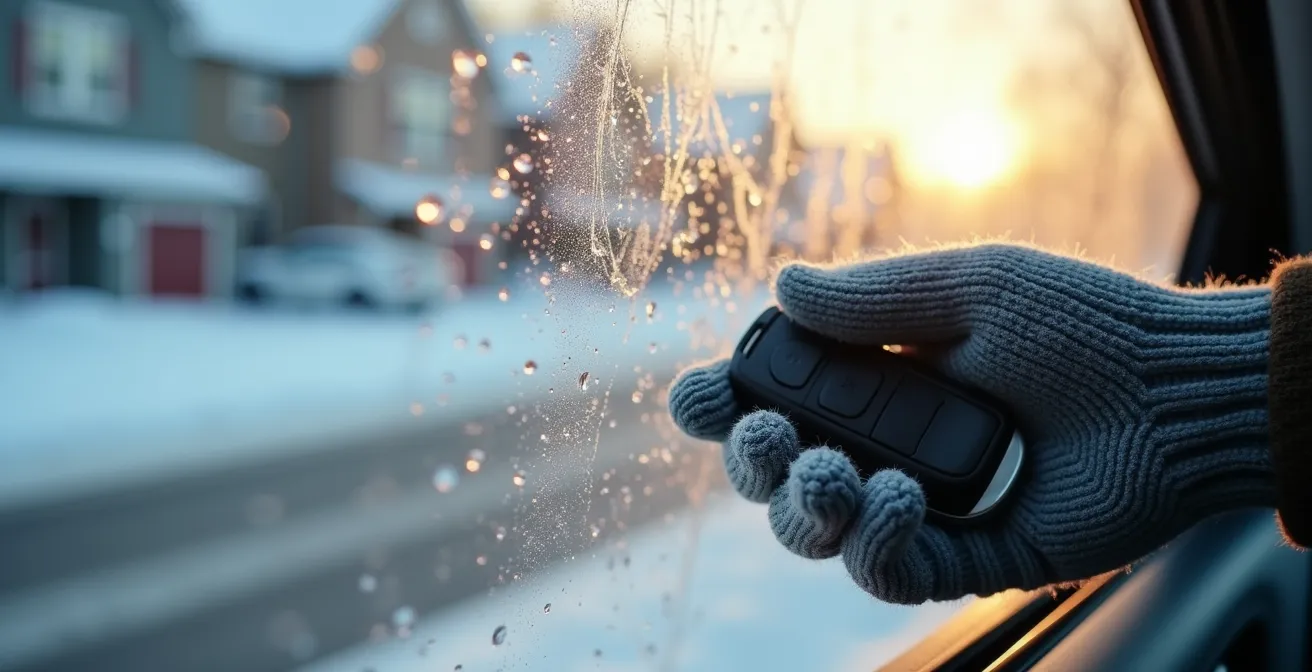
For anyone who has endured a Canadian winter, remote start isn’t a luxury; it’s a near-essential tool for survival. The ability to warm up your engine and cabin from the comfort of your home is a daily ritual. Traditionally, this function was built into the key fob, a one-time hardware purchase. However, automakers are increasingly shifting this feature to a subscription-based smartphone app, a move that has caused significant confusion and frustration among Canadian owners.
A prime example is Toyota Canada’s implementation of its Remote Connect service. As detailed in a case study, many new Toyota models now require a $9.95 per month subscription to use the remote start feature from a smartphone app. This service was previously included for free on many models, and owners who purchased their vehicles expecting lifetime access are now faced with a recurring bill to use a function their car is physically equipped with. This highlights the core of the digital ownership debate: do you own the feature, or just the hardware that enables it?
From a practical standpoint, there’s also the question of battery life—both for your car and your key fob. A key fob uses a small, long-lasting coin battery and transmits a low-energy radio frequency (RF) or Bluetooth signal directly to the car. An app, on the other hand, sends a command over the internet to a server, which then relays it to your car via its cellular connection. This process requires the car’s telematics unit to be constantly powered and listening for a signal, creating a small but continuous parasitic drain on the car’s 12V battery. While negligible for daily drivers, it can contribute to a dead battery if the car is left sitting for extended periods. Using the key fob is always the more direct and energy-efficient method.
The Resale Value Mistake That Costs Owners $5,000 After 4 Years
The single biggest financial mistake a car buyer can make in this new era is underestimating the impact of subscription-based features on resale value. When you sell a used car, its value is determined by its age, mileage, condition, and its set of permanent features. But what happens when core features like heated seats, advanced driver-assist systems, or remote start are not guaranteed to transfer to the next owner? This creates a massive valuation problem, especially in the Canadian market.
The Canadian Black Book (CBB), the leading authority on used car values in Canada, is grappling with this issue. A car might have the physical hardware for a premium cold weather package, but if those features are locked behind a subscription that the second owner must pay for, the car is functionally equivalent to a base model. In Canada’s climate, a used vehicle without guaranteed heated seats or remote start is significantly less desirable and will command a much lower price. The potential loss in resale value after just a few years can easily amount to thousands of dollars, far outweighing any perceived flexibility of the subscription model.
Some automakers are recognizing this risk to their brand. In a notable interview, Lincoln President Dianne Craig stated that her company is rejecting the subscription model for features, saying, “Premium buyers don’t want to be nickel-and-dimed while they own their luxury car, they’d rather pay for everything up-front.” This acknowledges a fundamental truth: a luxury or premium product’s value is tied to the completeness of the ownership experience. A feature that can be remotely disabled undermines the very concept of a premium asset. Ultimately, a car with subscription-locked features is a depreciating asset with an asterisk, a risk many used car buyers will not be willing to take.
The Privacy Risk of Automated Parking Enforcement Cameras
Your connected car’s privacy vulnerabilities don’t just come from the manufacturer. A growing network of third-party systems, like automated parking enforcement cameras, are also collecting your data. These systems, often operated by private companies in malls and parking lots across Canada, use license plate recognition (LPR) cameras to log your vehicle’s entry and exit times. While they seem benign, they create a persistent record of your movements that can be stored, analyzed, or shared, often with little transparency.
In Quebec, the use of this data is subject to Law 25, which provides residents with specific rights regarding their personal information. If you receive a ticket from one of these automated systems, you are not just dealing with a parking infraction; you are interacting with a data collection entity. You have the right to access the evidence they hold on you and to ensure it is handled according to the law. The number of consumers willing to pay for connected services that enable this kind of tracking is dropping; one study shows the number of respondents who would pay for connected services decreased to 68% in 2025, down from 86% in 2024, indicating growing fatigue.
Contesting an automated parking ticket in Quebec is therefore not just about avoiding a fee; it’s an opportunity to exercise your privacy rights. Private operators must be able to prove their compliance with Law 25. If they fail to provide clear evidence, violate data handling protocols, or refuse to delete your data upon request after the matter is settled, you may have grounds to not only have the ticket dismissed but also to file a formal complaint. This process holds private operators accountable and pushes back against the unchecked collection of citizen location data.
If you find yourself with a ticket from an automated system, follow these steps to contest it under Quebec law:
- Request Evidence: Formally request the full evidence package, including all time-stamped camera images of your vehicle entering and exiting.
- Verify Compliance: Scrutinize the operator’s privacy policy and ticketing process for compliance with Quebec’s Law 25 requirements on consent and data use.
- File Contestation: Submit a formal contestation within the legally required 30-day period, citing any procedural or privacy violations you have identified.
- Request Data Deletion: Once the case is resolved (whether you win or pay), formally request the deletion of your personal data from the operator’s system.
- Report Violations: If you believe your privacy rights were violated, report the incident to the Commission d’accès à l’information du Québec.
Key takeaways
- Subscription-locked features create uncertainty for second-hand buyers, potentially costing you thousands in resale value.
- Your connected car is a powerful data-harvesting device; its “free” features are often paid for with your personal information.
- Simple, low-tech tools like Faraday pouches and using native GPS with offline maps can help you regain a surprising amount of control and privacy.
How to Integrate Your Connected Car With Your Smart Home to Save Time?
Despite the significant concerns around subscriptions and data, the “platform on wheels” concept does have an upside: seamless integration with other parts of your digital life. The true promise of a connected car is its ability to act as a bridge to your smart home, automating routines and saving you time. For instance, you can create a “leaving home” routine where locking your car doors automatically turns off the lights, lowers the thermostat, and arms your security system. Conversely, a “coming home” routine, triggered when your car’s GPS gets close to your house, can turn on the porch lights, open the garage door, and adjust the thermostat to a comfortable temperature.
This convenience is made possible through platforms like IFTTT (If This Then That), Amazon Alexa, and Google Assistant, which can link your car’s connected services account to your smart home devices. Major automakers in Canada are building ecosystems to support this. FordPass can integrate with Google Home, while GM’s OnStar works with Alexa. Some integrations are even uniquely Canadian, such as Ford’s compatibility with Hydro-Québec’s Hilo smart home platform, allowing for optimized energy management.
However, this convenience often comes at a price, reinforcing the subscription model. As UBC Sauder School of Business professor Yann Cornil points out, “Businesses love subscription-based services… It’s much easier to predict future revenue.” The most advanced and useful integrations are often bundled into premium subscription tiers, as shown in the table below. The challenge for the tech-savvy consumer is to weigh the genuine time-saving benefits against the recurring costs and the ever-present privacy trade-offs.
| Car Platform | Compatible Smart Home Systems | Canadian-Specific Features | Monthly Cost |
|---|---|---|---|
| FordPass | Google Home, Alexa | Hilo (Hydro-Quebec) integration | Free (basic) |
| GM OnStar | Google Assistant, Alexa | Canadian Tire smart products | $24.95 CAD |
| BMW ConnectedDrive | IFTTT, Alexa | Best Buy Canada ecosystems | $50 CAD (premium) |
| Tesla App | Third-party via API | Cottage mode settings | Free (basic) |
The key is to approach these features with open eyes, leveraging the benefits while consciously mitigating the risks. By demanding transparency from automakers, practicing good digital hygiene with your car’s data, and being a smart consumer in both the new and used markets, you can enjoy the innovations of the modern automobile without sacrificing your ownership or your privacy. The next step is to evaluate any potential vehicle purchase not just on its physical merits, but on the fairness and transparency of its digital ecosystem.