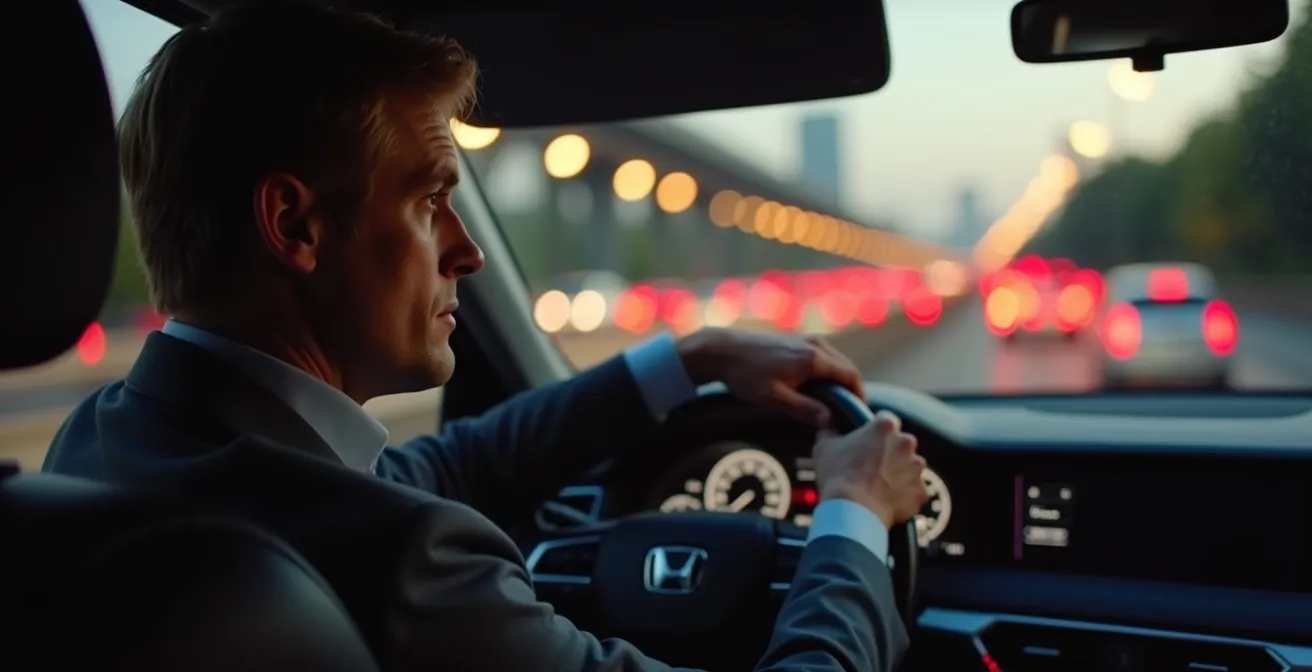
The perceived freedom of solo driving is an illusion that costs Montreal commuters far more than the $800 monthly bill suggests, imposing significant hidden psychological and productivity tolls.
- Your daily battle with traffic actively increases stress hormones, undermining your well-being before the workday even begins.
- Small, un-tracked “convenience” expenses on your commute systematically leak over $1,000 from your annual budget.
Recommendation: Re-engineer your commute from a “cost centre” into a “value asset” by strategically switching to modes like public transit or carpooling that allow you to reclaim time for learning, planning, and well-being.
For the Montreal commuter, the solo drive to work feels like a non-negotiable part of life. It’s a personal bubble, a moment of control, the “freedom” to leave when you want and listen to your own music. We rationalize the hefty price tag—often estimated around $800 per month when factoring in gas, insurance, maintenance, and parking—as the cost of this liberty. But what if this feeling of freedom is a cognitive illusion? What if the real price isn’t just financial, but psychological, temporal, and ultimately, detrimental to our productivity and well-being?
Most analyses stop at a simple comparison: the cost of a car versus an OPUS pass. They list the obvious expenses but fail to account for the hidden variables. As a behavioural economist, I argue that we consistently underestimate the true burden of our commute because we are wired to favour convenience in the short term, even at a great long-term cost. We ignore the slow drip of “cost leakage” from daily coffee stops and the physiological “cognitive toll” that traffic-induced stress exacts on our minds and bodies. We see the time spent in the car as a fixed loss, rather than a potential asset that could be reinvested.
This article moves beyond the balance sheet. We will deconstruct the myth of the “free” solo commute by examining its hidden costs. We’ll explore why traffic literally makes you sick, how to transform dead time into an investment, and how seemingly small daily decisions create a massive financial drain. It’s time to question the subscription you never realized you were paying for and ask if the supposed freedom of the driver’s seat is truly worth the price.
To guide this analysis, we will dissect the commute from multiple angles. The following sections break down the psychological impacts, the opportunities to reclaim time, the hidden financial drains, and the practical alternatives available to every Montrealer looking to make a smarter choice.
Summary: Deconstructing the True Cost of Your Montreal Commute
- Why Does Solo Driving in Traffic Increase Cortisol Levels by 40%?
- How to Turn Dead Commute Time Into Learning Time Safely?
- Audiobooks or Music: Which Keeps You More Alert on Long Drives?
- The Latte Factor of Driving: How Convenience Stops Cost You $1,000/Year
- When to Leave for Work: The 15-Minute Window That Saves 30 Minutes
- Carpooling for Cash: Is It Worth the Wear on Your Car?
- How to Adjust Your Mirrors to Eliminate Blind Spots Completely?
- Should You Buy an E-Scooter for Your Montreal Commute?
Why Does Solo Driving in Traffic Increase Cortisol Levels by 40%?
The daily grind of solo commuting in Montreal is more than just an inconvenience; it’s a chronic physiological stressor. When you’re stuck in traffic on the Décarie or inching towards the Champlain Bridge, your body is in a low-grade “fight or flight” mode. This state is characterized by the release of cortisol, the primary stress hormone. While useful in short bursts, chronic elevation of cortisol from daily traffic jams can lead to a host of negative health outcomes, including anxiety, weight gain, and impaired immune function. You aren’t just losing time; you are actively degrading your well-being.
The feeling of powerlessness is a key trigger. As a solo driver, you have the illusion of control, yet you are completely at the mercy of the traffic ahead. This mismatch between perceived autonomy and actual helplessness is a potent recipe for stress. Research from McGill University provides a fascinating, if counter-intuitive, insight: it suggests that drivers with a lower physiological stress response to stimuli can actually be at higher risk. The study found that drivers with a blunted cortisol response show 40% higher rates of traffic convictions. This may indicate that a lack of acute stress awareness could lead to riskier driving behaviour, highlighting the complex relationship between our biology and our actions behind the wheel.
This cognitive toll is a significant, unbudgeted cost of your commute. Arriving at work already mentally fatigued and physiologically stressed undermines your productivity from the moment you walk in the door. The solo commute doesn’t prepare you for the day; it forces you to recover from it before it has even begun. Understanding this impact is the first step toward recognizing that the “convenience” of driving alone comes at a steep, invisible price.
Your Commute Stress Audit: A 3-Point Checklist
- Heart Rate Tracking: Track your morning heart rate variability (if your wearable supports it) or simply your resting heart rate before leaving home versus immediately after arriving at work. Note the difference over a week.
- Trigger Point Mapping: During your commute, consciously note the specific Quebec traffic points that trigger a physical or mental stress reaction. Is it the approach to the Pont Champlain, the Décarie interchange, or a specific downtown intersection?
- Comparative Stress Analysis: If you occasionally use public transit, compare the chronic, low-grade stress of your daily solo drive with the acute, short-term stress of a metro or bus delay. Which one has a more lasting impact on your mood and energy for the day?
How to Turn Dead Commute Time Into Learning Time Safely?
The solo driver’s time is trapped. Your hands are on the wheel, and your eyes are on the road. This “dead time” represents a massive opportunity cost. For Montrealers, the numbers are stark: commuters spend an average of 56 minutes on their daily commute. Over a year, that’s more than 230 hours—equivalent to six full work weeks. While driving, this time is largely unrecoverable. You can’t safely read, write, or engage in deep work. You are, by definition, a single-tasking operator in an environment that demands your full attention.
This is where a strategic shift in commuting mode becomes an exercise in time value re-engineering. By switching to public transit like the bus, metro, or the new REM, you transform dead time into a recoverable asset. That hour is no longer lost; it’s gifted back to you. It becomes time you can invest in professional development, personal growth, or simply decompressing before and after a demanding workday. You move from being the pilot of a metal box to a passenger with agency over their own time.
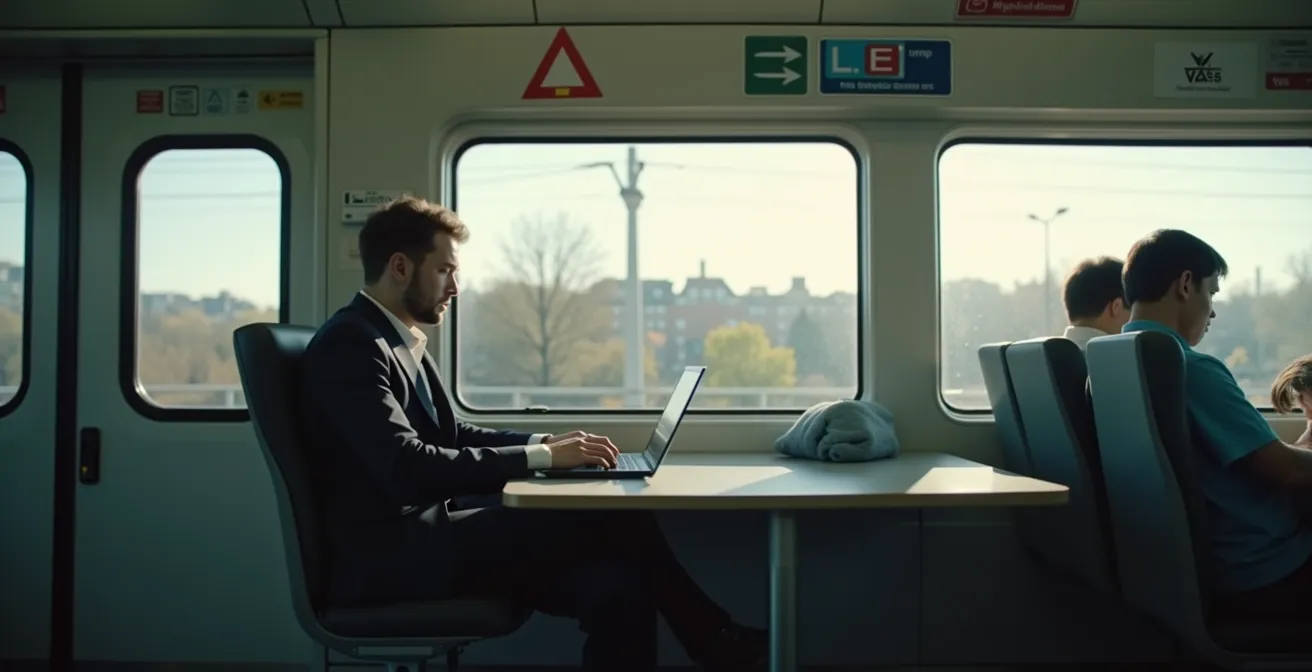
As the image above illustrates, the modern transit environment is a world away from the stressful confines of a car. It’s a space where you can prepare for your first meeting, listen to an entire industry podcast, or get a head start on your emails. To make this tangible, consider these Quebec-specific resources perfect for a transit commute:
- Radio-Canada’s OHdio platform: An excellent source for high-quality French-language podcasts and audiobooks.
- Industry-specific podcasts: Deepen your expertise in Montreal’s key sectors like AI, video games, or aerospace during your ride.
- Language learning apps: Use the time to enhance your bilingual skills, a significant advantage in the Quebec job market.
- Local culture podcasts: Connect more deeply with your city by learning about the history and culture of Montreal and its surrounding regions.
The choice is not just between a car and a bus. It’s between a state of passive time loss and active time investment. The safest way to turn commute time into learning time is to not be the one driving.
Audiobooks or Music: Which Keeps You More Alert on Long Drives?
For the solo driver committed to their vehicle, optimizing the in-car experience is crucial for mitigating the cognitive toll. The choice of audio—music, podcasts, audiobooks, or even silence—is not just a matter of preference; it’s a tool for managing alertness and cognitive load. The wrong choice can lead to distraction or drowsiness, while the right one can maintain engagement and even improve reaction time. The key is to match the audio type to the driving conditions you face on your specific Quebec route.
Different types of audio content engage the brain in distinct ways. Upbeat, familiar music can increase physiological arousal, making it a good choice for navigating the high-stimulus environment of dense urban traffic, like Montreal’s downtown core during rush hour or the Friday night crawl up to the Laurentians. It helps maintain a state of readiness for the stop-and-go demands. In contrast, an engaging audiobook or a complex podcast requires more focused cognitive processing. This can be highly effective at preventing “highway hypnosis” on long, monotonous stretches, such as a drive out to the Gaspésie region on Autoroute 20. The narrative structure keeps the brain active and wards off the mental fatigue that leads to lapses in attention.
However, we often overlook a third, powerful option: strategic silence. In our hyper-connected world, the commute might be one of the few times you are truly alone with your thoughts. Using this time for deliberate problem-solving or planning your day can be incredibly productive. An early morning commute, before the city fully wakes, can be the perfect time for this kind of deep thinking, allowing you to arrive at your destination with a clear plan of action. The goal is to be an active manager of your mental state, not a passive consumer of audio.
This table, based on research into driver alertness, provides a simple framework for choosing your audio strategy based on your route and objective.
| Content Type | Best For | Quebec Route Examples | Alertness Impact |
|---|---|---|---|
| Audiobooks | Long monotonous drives | Highway 20 to Gaspésie | Maintains cognitive engagement |
| Upbeat Music | Dense urban traffic | Montreal rush hour, Laurentians Friday night | Increases arousal and reaction time |
| Strategic Silence | Problem-solving time | Early morning commute | Allows deep thinking and planning |
The Latte Factor of Driving: How Convenience Stops Cost You $1,000/Year
One of the most insidious aspects of the solo driving “freedom illusion” is the way it encourages unbudgeted spending. This phenomenon, which I call cost leakage, is the automotive equivalent of the “latte factor.” Because your car gives you the flexibility to stop anywhere, you’re more likely to make small, impulsive purchases—a morning coffee, a snack, a quick errand. While each transaction seems insignificant, they accumulate into a substantial financial drain that most drivers never track.
The numbers are revealing. In Montreal, these seemingly minor convenience stops can be a major expense. One analysis suggests that these daily purchases can easily add up, with some estimates putting the figure as high as $1,200 per year for daily coffee and convenience stops. Consider the “Tim Hortons Factor”: a Quebec commuter might spend $3.20 on a coffee on the way to work. If they grab another on the way home, that’s over $6 a day, or more than $120 a month, silently added to their commuting bill. This happens because our brains are wired for convenience; the drive-thru is easy, and we fail to mentally connect that small daily cost to the large annual sum.
This contrasts sharply with the experience of a public transit user. When you take the metro, you are in a closed system. There are no opportunities for impulsive detours or drive-thru stops. Your spending is contained. You might buy a coffee near your office, but the commute itself doesn’t present a constant stream of temptations. The structure of the transit system imposes a form of “forced savings” by simply removing the opportunity for cost leakage. The solo driver, in the name of freedom, is constantly exposed to these micro-drains on their finances, paying a premium for a convenience they may not even consciously value.
When to Leave for Work: The 15-Minute Window That Saves 30 Minutes
For the solo commuter, time is the most volatile currency. The “freedom” to leave whenever you want is often negated by the brutal reality of rush hour. However, within this chaos lies an opportunity for optimization that most drivers miss. Traffic doesn’t build linearly; it builds exponentially. This means that small adjustments to your departure time can yield disproportionately large savings in travel time. The key is to identify the tipping point before the system becomes saturated.
In Montreal, this principle is on full display every morning. Traffic data consistently shows that a mere 15-minute difference in departure time can save 30 minutes of travel during peak congestion. Leaving at 6:45 AM instead of 7:00 AM isn’t just leaving 15 minutes earlier; it’s avoiding the phase shift where traffic flow collapses into a gridlock. You are not just getting ahead of a few cars; you are getting ahead of the entire wave of peak congestion. This is the essence of working smarter, not harder, within an inefficient system.
To leverage this, you must become a student of your specific route. Generic advice is useless; you need granular, route-specific knowledge. Here are some examples of these critical time windows for major Montreal arteries:
- Champlain Bridge: Data suggests leaving before 7:10 AM is critical to avoid delays that can quickly add 25 minutes or more to your trip.
- Ville-Marie Tunnel: A 6:45 AM departure can often beat a 7:00 AM departure by a full 20 minutes as downtown access clogs up.
- Décarie Expressway: The 15-minute window between 6:30 AM and 6:45 AM is often the difference between a moving commute and a parking lot experience.
Of course, this game of beat-the-clock has its own cognitive toll. It introduces a new layer of stress and anxiety. This is where alternatives like the REM shine. From the West Island, for instance, the REM offers a consistent 45-minute travel time regardless of departure time or weather, entirely removing this stressful variable from your morning routine. The ultimate time-saving strategy might not be to optimize your drive, but to opt out of the game entirely.
Carpooling for Cash: Is It Worth the Wear on Your Car?
Carpooling presents a compelling middle ground between the isolation of solo driving and the structure of public transit. It offers a way to reduce costs, lessen environmental impact, and potentially reclaim some mental bandwidth. In Quebec, platforms like AmigoExpress have created a robust ecosystem for ride-sharing. The environmental benefits are clear, with one platform quantifying its impact at a saving of 20,500 tons of GHG in a single year. However, for the car owner, the decision is more complex. Is the income potential and cost-sharing worth the accelerated wear and tear on your vehicle?
From a behavioural perspective, carpooling introduces social dynamics and scheduling constraints that erode the “freedom illusion” of solo driving. You are no longer the sole master of your schedule or environment. This loss of autonomy is a real psychological cost that must be weighed against the financial benefits. You must also consider the practical implications for your vehicle, especially in Quebec’s harsh climate. Increased mileage accelerates general maintenance needs, but winter conditions add specific costs, such as corrosion from road salt and increased suspension wear from navigating the region’s notorious potholes.
A purely financial analysis requires a clear-eyed look at both income and expenses. The potential income is attractive, but it must be offset by the tangible costs of increased use. It is also critical to verify insurance coverage. While the SAAQ’s public insurance is generally not impacted by standard carpooling, your private policy may have specific clauses regarding carrying paying passengers. A quick call to your insurer is a necessary step to avoid any potential liability issues. For many, carpooling can be a smart financial and social choice, but it requires a shift in mindset from “my car, my rules” to a more collaborative approach to commuting.
This comparative analysis, sourced from industry data at carpooling service AmigoExpress, breaks down the key financial factors for Quebec drivers.
| Factor | Monthly Income Potential | Monthly Wear Cost | Quebec-Specific Issues |
|---|---|---|---|
| Regular carpooling (Montreal-Quebec route) | $200-300 | $50-75 extra wear | Reserved HOV lane access on Autoroute 15 |
| Winter conditions impact | Higher demand = +20% rates | Salt damage: $30/month | Increased suspension wear from potholes |
| Insurance considerations | No SAAQ impact | Check private policy | Must verify coverage for paid passengers |
How to Adjust Your Mirrors to Eliminate Blind Spots Completely?
While this article questions the fundamental value of solo driving, safety remains a non-negotiable priority for those who do drive. A significant source of both risk and stress is the blind spot—the area around your car that is not visible in your mirrors. Many drivers accept this as an unavoidable flaw, relying solely on shoulder checks. However, a simple, evidence-based adjustment method can virtually eliminate side blind spots, dramatically increasing safety and reducing the cognitive load of wondering what’s lurking just out of sight.
The standard practice of adjusting side mirrors to see the flanks of your own car is inefficient and creates dangerous overlaps in your field of vision. The correct method involves angling the mirrors further outwards so that their view begins where the view of your rearview mirror ends. This creates a continuous, panoramic view of the world behind and beside you. An object leaving the central rearview mirror should immediately appear in the side mirror, and an object leaving the side mirror should simultaneously appear in your peripheral vision. This transforms the mirrors from three disconnected pictures into one seamless information system.
This technique is especially critical in Montreal’s dense urban environment. With the rise of cyclists and e-scooters, particularly on narrow streets with bike lanes like Saint-Denis, maximizing your situational awareness is paramount. A properly adjusted set of mirrors allows you to track cyclists and other vulnerable road users more effectively, reducing the likelihood of a “right hook” turn or a dangerous lane change. While a quick shoulder check remains an essential final verification, this mirror setup ensures you have the most complete information possible at all times, reducing the anxiety that comes from an incomplete view of your surroundings.
Follow these four steps precisely to achieve a near-perfect field of vision:
- Step 1: Adjust your central rearview mirror to frame the entire rear window. You should be able to see the full view without moving your head from your normal driving position.
- Step 2: Lean your head to the left until it almost touches the driver’s side window. From this position, adjust your left mirror so you can just barely see the side of your car.
- Step 3: Lean your head to the right towards the center of the car. From this position, adjust your right mirror so you can just barely see the right side of your car.
- Step 4: When back in your normal driving position, you should not see your own car in the side mirrors. Test this in a safe location and always supplement with a quick shoulder check, especially for cyclist visibility on busy streets.
Key Takeaways
- The daily solo commute is a source of chronic stress that increases cortisol levels, impacting health and productivity.
- Switching from driving to public transit transforms “dead time” into a recoverable asset for learning, work, or relaxation.
- The “freedom” of driving encourages small, un-tracked “cost leakage” expenses that can exceed $1,000 per year.
Should You Buy an E-Scooter for Your Montreal Commute?
As commuters increasingly question the high cost and stress of solo driving, alternative mobility options are gaining traction. The e-scooter represents a compelling solution for the “last-mile” problem and for shorter urban commutes, offering a blend of speed, low cost, and agility. For a Montrealer weighing their options, the e-scooter is no longer a novelty but a legitimate contender in the transit ecosystem, particularly for navigating the city core without being tethered to a car or even a BIXI station.
The financial argument is powerful. Compared to the $800 monthly cost of a car, the upfront purchase of an e-scooter and its minimal electricity costs represent a massive saving. They bypass traffic, and parking is a non-issue. However, the decision is not purely economic. It’s a lifestyle choice that requires an honest assessment of your route, comfort with urban cycling infrastructure, and willingness to adapt to weather conditions. Montreal’s challenging winters significantly limit the e-scooter’s viability to a seasonal solution for most people.
Furthermore, navigating the legal landscape is crucial. In response to their growing popularity, Quebec has established a pilot project with clear rules. As of 2024, the regulations require a maximum speed of 25 km/h, a minimum user age of 14, and mandatory helmets. Riders must use bike paths where available, and stick to the right side of the road otherwise. Understanding and respecting these rules is not just about compliance; it’s about ensuring your safety and the safety of others. As city officials acknowledge their place in the urban fabric, we can expect infrastructure to continue adapting.
One thing is certain, we are in favour of making more room for mobility options and scooters are, in fact, already used on our tracks and roads.
– Sophie Mauzerolle, Montreal Executive Committee on Transportation
Ultimately, the e-scooter isn’t a universal replacement for the car, but for the right commuter and the right route, it’s a powerful tool to break free from the financial and psychological costs of solo driving, at least for part of the year.
By deconstructing the hidden costs and exploring practical alternatives, it becomes clear that the daily commute is a strategic decision, not an unavoidable chore. The next step is to apply this analysis to your own situation and calculate the true value of your time and well-being. Evaluate your options today to design a smarter, cheaper, and less stressful commute for tomorrow.