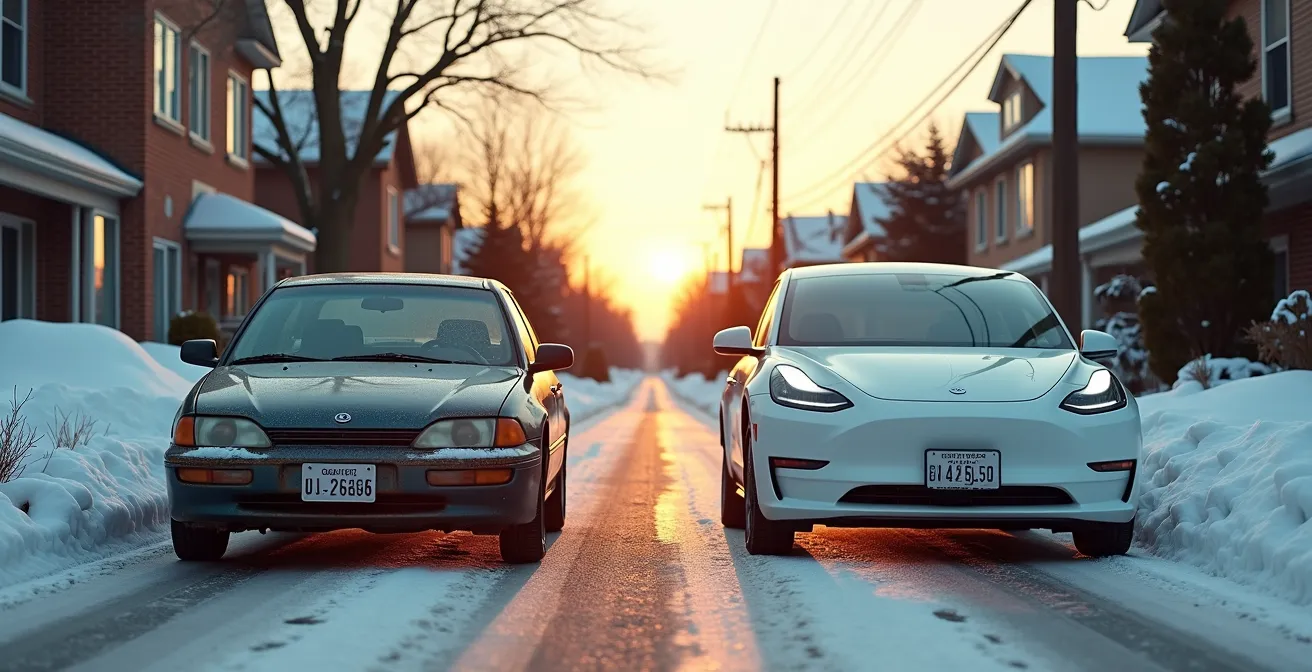
The greenest car isn’t one you buy; it’s one you understand. A new Electric Vehicle (EV) isn’t automatically cleaner than your old car due to its significant manufacturing “carbon debt.”
- The production of a new EV can generate more upfront CO2 than a gasoline car, creating an environmental deficit that must be “repaid” through emission-free driving.
- In Quebec, our clean hydroelectric grid drastically shortens this carbon payback period, making EVs a cleaner long-term option here than almost anywhere else.
Recommendation: Instead of defaulting to a new EV, calculate your personal break-even point by considering your driving habits, charging access, and local infrastructure to determine if repairing your current car, choosing a hybrid, or going car-free is the truly greener choice.
That dreaded check-engine light flickers on in your trusted, but aging, vehicle. The debate begins immediately: pour more money into repairs for this “beater,” or make the leap to a shiny, new, and supposedly “green” electric vehicle? For the environmentally conscious Quebecer, the answer seems obvious. An EV, powered by our abundant hydroelectricity, is the clear winner for the planet. But this common assumption overlooks a critical and inconvenient truth.
The environmental cost of a car doesn’t start when you turn the key; it begins on the factory floor. Every new car, especially an EV with its resource-intensive battery, carries a significant “carbon debt” from its manufacturing process. The real question isn’t *if* an EV is cleaner, but *when* it becomes cleaner. The answer is far more complex than marketing slogans suggest, involving a nuanced calculation of manufacturing emissions, local energy sources, and even the hidden impact of tire wear on our roads.
This article moves beyond the “zero-emission” myth to provide a data-driven framework for Quebecers. We will dissect the true lifecycle impact of your transportation choices, from the carbon cost of building a new car to the surprising benefits of a multi-modal commute in Montreal. Our goal is to equip you not with a simple answer, but with the right questions to ask to make the smartest decision for your wallet and for Quebec’s environment.
To help you navigate this complex decision, this guide is structured to tackle each piece of the puzzle. We will explore the upfront carbon costs, the real-world performance of different vehicle types in our climate, and the financial incentives available, providing a complete picture for your personal transportation strategy.
Summary: The Real Cost of Green Driving: A Quebecer’s Guide
- Why Manufacturing a New EV Generates More CO2 Than Driving a Gas Car for 2 Years?
- How to Effectively Offset Your Car’s Emissions Through Quebec Tree Planting?
- Hybrid or Plug-In: Which Reduces Your Footprint More if You Don’t Charge Daily?
- The ‘Zero Emission’ Lie: What Manufacturers Don’t Tell You About Tire Dust
- When to Switch to Low-Carbon Transport: A 5-Year Roadmap for Families
- When to Sell Your Car: Signs Your Neighborhood Is Ready for Car-Free Living
- How to Claim the Roulez Vert Rebate Before It Decreases?
- How to Combine Cycling and Metro for the Fastest Montreal Commute?
Why Manufacturing a New EV Generates More CO2 Than Driving a Gas Car for 2 Years?
The allure of a “zero-emission” vehicle is powerful, but this label only applies to the tailpipe. The most significant environmental impact of a new EV occurs long before it ever touches pavement. The manufacturing process, particularly the mining of raw materials like lithium, cobalt, and nickel for the battery, is incredibly energy-intensive. A recent lifecycle analysis shows that building an average EV generates around 10 metric tons of CO2, compared to just 6 metric tons for a comparable gasoline car. This initial “carbon debt” means a brand-new EV starts its life with a larger environmental footprint than the new gas car rolling off the line next to it.
This is where your location becomes the most critical factor. The carbon debt of an EV is only paid back by driving it with clean electricity. In a province like Alberta, which relies heavily on natural gas for power, this “break-even point” can take tens of thousands of kilometers. However, in Quebec, the story is completely different. Thanks to our grid being powered almost entirely by hydroelectricity, we have some of the cleanest energy in the world. An EV charged in Quebec is running on electricity that produces less than 2 grams of CO2 equivalent per kilowatt-hour.
This clean energy advantage is transformative. According to a detailed report on vehicle emissions, the total lifecycle emissions of a battery electric vehicle (BEV) in Quebec are astounding. An analysis by TD Economics found that, over its entire life, a BEV’s lifecycle emissions are 78-83% lower than a gasoline SUV’s. This means the initial carbon debt from manufacturing is paid back drastically faster here. While keeping a paid-off, functional older car has zero manufacturing impact, the moment it needs significant, resource-intensive repairs (like a new engine or transmission), the calculation begins to shift in favor of a new EV, especially in Quebec.
The decision isn’t simply “old car vs. new EV.” It’s about comparing the future operational emissions of your current vehicle against the *full lifecycle* emissions of a new one, knowing that in Quebec, you have a massive head start on paying down that initial carbon debt. The carbon cost of your old car’s manufacturing is a sunk cost; it’s already spent and irrelevant to your future decisions.
How to Effectively Offset Your Car’s Emissions Through Quebec Tree Planting?
Whether you keep your old car or buy a new one, your transportation will still generate a carbon footprint—either from the tailpipe or from manufacturing. One proactive strategy to mitigate this impact is carbon offsetting. This involves investing in projects that reduce or capture greenhouse gases, effectively balancing out your own emissions. In Quebec, we are fortunate to have several high-quality, locally-focused programs centered on reforestation, which provides the co-benefit of restoring our natural landscapes.
These programs are not all created equal. Credibility is key. Look for initiatives with transparent methodologies and third-party validation, ensuring your contribution leads to real, measurable carbon sequestration. Programs like Carbone boréal, managed by the Université du Québec à Chicoutimi, offer a high degree of scientific rigor. They focus on planting trees in the boreal forest, a critical carbon sink for the planet. The goal is to create a permanent environmental benefit that directly counteracts emissions.

As the illustration above suggests, these reforestation efforts create a patchwork of new growth, revitalizing ecosystems while pulling CO2 from the atmosphere. Choosing a local Quebec program also means your investment supports local research and ecological health, rather than funding a distant, unverifiable project. While offsetting is not a license to pollute, it is a responsible tool for neutralizing the unavoidable emissions associated with personal transport. It’s an effective way to take ownership of your carbon footprint while contributing to the health of Quebec’s forests.
To help you compare the options, here is a breakdown of some leading carbon offset providers operating within Quebec. This data, compiled from public sources, highlights the differences in cost, certification, and project type, allowing you to choose the program that best aligns with your values and budget.
| Program | Certification | Cost per tonne CO2 | Project Type | Local Impact |
|---|---|---|---|---|
| Carbone boréal | University validated | $35-50 | Boreal forest planting | Northern Quebec reforestation |
| Compensation CO2 Québec | Gold Standard | $25-40 | Mixed forest projects | Multiple Quebec regions |
| Urban greening Montreal | Municipal certified | $40-60 | Urban tree planting | Direct local air quality improvement |
Hybrid or Plug-In: Which Reduces Your Footprint More if You Don’t Charge Daily?
For many urban Quebecers, especially those living in apartments or condos without a dedicated garage, the EV dream hits a practical wall: charging. This is where hybrid vehicles (HEVs) and plug-in hybrids (PHEVs) enter the conversation as compelling alternatives. A PHEV offers a small all-electric range (typically 40-70 km) before a gasoline engine kicks in. A traditional hybrid, like the classic Toyota Prius, uses its electric motor to assist the gas engine, charging its own small battery through braking and deceleration, with no plugging in required.
On paper, a PHEV seems superior. When running on Quebec’s clean electricity, its emissions are near zero. However, real-world performance depends entirely on charging behavior. For a Montreal apartment dweller in Le Plateau who relies on street parking, daily charging is often impossible. This is further complicated by our harsh winters. Cold temperatures can reduce a battery’s efficiency and range by up to 40%, meaning a PHEV will rely on its gasoline engine more frequently. In this scenario, the PHEV effectively becomes a heavier, less efficient hybrid, carrying the dead weight of a large, depleted battery.
Conversely, a traditional hybrid is optimized for this exact situation. It consistently delivers high fuel efficiency without any reliance on external charging infrastructure. While its emissions are never zero, they are significantly lower than a standard gasoline car and can even be lower than a PHEV that is rarely, if ever, charged. The cost is also a major factor. A used Prius can be a fraction of the cost of a new PHEV, even after rebates. Furthermore, the cost of public charging can quickly erode savings. As Hydro-Quebec calculations demonstrate, charging at home costs around $2.50 per 100km, while using public Circuit Électrique stations can cost $8-$12 for the same distance.
For those without reliable home charging, a traditional hybrid often represents a more practical, affordable, and, in many cases, lower-emission choice than a PHEV. It serves as a perfect “bridge” technology, reducing your footprint today while our urban charging infrastructure continues to develop.
Your Action Plan: Choosing Between a Hybrid and PHEV in Quebec
- Assess charging access: Do you have a home garage with a 240V outlet, or only street parking?
- Calculate daily driving distance: If consistently under 40km, a PHEV is viable—but only if you can charge it.
- Factor winter range loss: Be realistic and expect a 30-40% reduction in electric range during Quebec’s coldest months.
- Compare total cost of ownership: A used hybrid (e.g., $15k-$20k) may be financially smarter than a new PHEV ($40k+ minus rebates).
- Consider your ownership timeline: If you plan to keep the car for only 3-5 years until EV tech and infrastructure improve, a used hybrid is often the optimal choice.
The ‘Zero Emission’ Lie: What Manufacturers Don’t Tell You About Tire Dust
The term “zero-emission vehicle” is one of the most effective but misleading marketing phrases in the automotive industry. It narrowly focuses on what comes out of the tailpipe, completely ignoring a significant source of pollution: non-exhaust emissions. The single largest contributor to this is tire and brake dust, which are a growing environmental concern, and EVs may be contributing to the problem more than their gasoline counterparts.
Tires wear down from friction with the road, releasing tiny particles known as microplastics into the air, soil, and waterways. These particles, often classified as PM2.5 (particulate matter smaller than 2.5 micrometers), are a known health hazard, linked to respiratory and cardiovascular diseases. While all cars produce tire dust, EVs have a particular issue. Their heavy batteries make them 20-30% heavier on average than similar-sized gasoline cars. This extra weight, combined with the instant torque from electric motors, can increase the rate of tire wear.
In Quebec, our specific climate and road conditions amplify this issue. The mandatory winter tire law (from December 1 to March 15) means vehicles are often equipped with softer rubber compounds that wear faster. More importantly, the constant freeze-thaw cycles create potholes, and the extensive use of road salt and abrasives like gravel to combat ice creates a much harsher surface for tires. This environment can accelerate tire wear by an estimated 15-25% compared to regions with milder climates. While regenerative braking in EVs can reduce brake dust, the increased tire wear from their higher mass is a lifecycle penalty that is rarely discussed.
This doesn’t mean EVs are “bad,” but it highlights the need for a more honest and holistic conversation about vehicle pollution. The focus must expand beyond CO2 to include all environmental impacts. Choosing low-rolling-resistance tires, maintaining proper inflation, and adopting smoother driving habits can help mitigate this issue for any vehicle, but acknowledging that EVs have their own unique non-exhaust challenges is the first step toward true environmental accountability.
When to Switch to Low-Carbon Transport: A 5-Year Roadmap for Families
Making an economically and environmentally sound vehicle decision is not a single choice but a long-term strategy. For a Quebec family, planning a switch to low-carbon transport requires looking ahead at a rapidly changing landscape of technology, government policy, and infrastructure. Creating a 5-year roadmap can prevent costly mistakes and align your personal finances with provincial and federal climate goals.
The first major factor is the evolution of government incentives. The Quebec Roulez Vert program, a major driver of EV adoption, is being phased out. A new BEV purchased in 2024 was eligible for a combined $12,000 in rebates, but this will drop to $9,000 in 2025, $7,000 in 2026, and will be eliminated entirely at the provincial level by 2027. Your roadmap must account for this. Waiting too long to purchase could mean missing out on thousands of dollars in assistance. This decreasing subsidy should be weighed against the potential for EV prices to drop and battery technology to improve in the coming years.
Secondly, consider the rising cost of carbon. The federal carbon tax is set to increase steadily, rising from $80 per tonne of CO2 in 2024 to $170 per tonne by 2030. This will directly translate to higher gasoline prices, making the operational cost savings of an EV or hybrid even more significant over time. Locking in Hydro-Québec’s current low electricity rates (around $0.073/kWh for the first 40 kWh daily) by installing a home charger now is a smart hedge against future energy price volatility.
Finally, your roadmap must be hyper-local. The expansion of Montreal’s REM (Réseau express métropolitain) between 2025 and 2027 will fundamentally change commuting patterns for many families in the Greater Montreal Area. If a future station is planned near your home or workplace, your need for a second car—or even a primary one—could diminish or disappear entirely. A successful 5-year plan involves budgeting for a potential vehicle purchase in line with rebate changes, calculating the growing “carbon penalty” of gasoline, and realistically assessing whether new public transit infrastructure will make a car-light or car-free lifestyle possible in the near future.
When to Sell Your Car: Signs Your Neighborhood Is Ready for Car-Free Living
The greenest car is often no car at all. For many Quebecers, especially in dense urban centres, the most impactful environmental decision isn’t which car to buy, but whether to own one in the first place. The viability of a car-free lifestyle, however, is not a personal choice alone; it’s almost entirely dependent on your neighbourhood’s “infrastructure readiness.” Evaluating your local area with a critical eye can reveal if you’ve reached the tipping point where selling your car becomes a practical and liberating option.
A direct comparison of Montreal boroughs illustrates this perfectly. A resident of Rosemont-La Petite-Patrie enjoys a high degree of car-free readiness. They likely have access to multiple Communauto car-sharing vehicles within a 5-minute walk, year-round BIXI bike-sharing stations, several Metro stops, and a variety of grocery stores (IGA, Metro, Provigo) and shops accessible on foot. Conversely, a resident of a suburb like Dollard-des-Ormeaux may have access to bike paths but lacks the density of services. A simple grocery run often necessitates a car, making a car-free life impractical despite good intentions. The key threshold appears to be a population density of over 4,000 residents per square kilometer, which supports a rich ecosystem of shared mobility and local services.
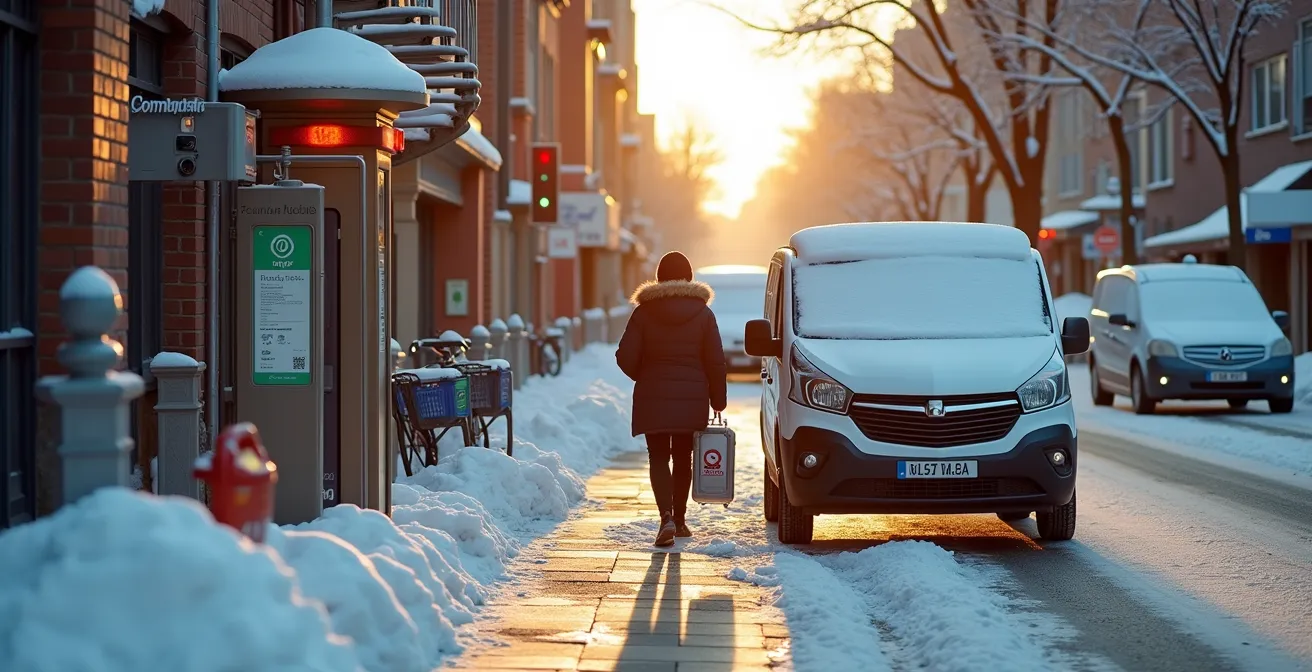
Winter resilience is the ultimate test of a neighbourhood’s car-free readiness in Quebec. As seen in the image, a truly walkable neighbourhood ensures sidewalks are cleared promptly after a snowfall. It means BIXI stations remain operational, and Communauto vehicles are accessible. Before making the leap, perform a “stress test”: try doing your weekly grocery run on foot with a cart after a snowstorm. Check STM bus frequency during a “bombe météo,” as some routes get suspended. Your borough’s efficiency in sidewalk clearing (which can vary from 4 to 12 hours post-snow) is a critical, non-negotiable factor. When the monthly cost of a Communauto membership, an OPUS card, and the occasional taxi is less than your car payment, insurance, gas, and parking, your neighbourhood may be telling you it’s time to sell.
The checklist for readiness is simple: count the number of reliable, year-round transportation and service options within a 10-minute walk. If you have a robust network of car-sharing, public transit, and essential stores, the financial and environmental benefits of letting go of private car ownership are immense.
How to Claim the Roulez Vert Rebate Before It Decreases?
For those who determine that a new EV or PHEV is the right choice, acting decisively is crucial to maximize the available government incentives. Quebec’s generous Roulez Vert rebate program is on a scheduled decline, making timing a key part of the financial equation. Understanding the combined provincial and federal rebates, as well as the application process, is essential.
The total rebate you can receive is a combination of the provincial Roulez Vert program and the federal iZEV (Incentives for Zero-Emission Vehicles) program. As the table below clearly shows, the combined amount decreases significantly each year, with the provincial portion being phased out completely by 2027. For example, the total incentive for a new battery electric vehicle (BEV) drops from $12,000 in 2024 to just $9,000 on January 1st, 2025. This makes a huge difference in the total cost of ownership.
This data, sourced from a comprehensive analysis of Quebec’s EV sales rebates, underscores the urgency for prospective buyers. The rebates apply to both purchases and long-term leases (3 years or more), but the vehicle’s MSRP must be under the program’s cap (currently $65,000 for new vehicles).
| Vehicle Type | 2024 Combined | 2025 Combined | 2026 Combined | 2027 Combined |
|---|---|---|---|---|
| New BEV | $12,000 ($7k QC + $5k Fed) | $9,000 ($4k + $5k) | $7,000 ($2k + $5k) | $5,000 (Fed only) |
| New PHEV | $10,000 ($5k + $5k) | $7,000 ($2k + $5k) | $6,000 ($1k + $5k) | $5,000 (Fed only) |
| Used EV | $3,500 QC only | Program suspended | Unknown | None |
| Lease (3yr+) | Same as purchase | Same as purchase | Same as purchase | Fed only |
The application process itself requires careful documentation. It is not automatic and must be completed accurately to ensure you receive the funds. The key is to be prepared *before* you even visit the dealership.
Here are the essential steps for the Roulez Vert program:
- Register for online services at the official Quebec government website before making your purchase.
- Ensure the vehicle you choose is on the government’s official list of eligible vehicles and its MSRP is under the $65,000 cap.
- Obtain the New Vehicle Information Statement (NVIS) from your dealer at the time of purchase.
- Register the vehicle with the SAAQ (Société de l’assurance automobile du Québec) and keep the “Service receipt” document.
- Submit your online application with all required documents: the signed contract, the NVIS, and the SAAQ receipt.
- If buying from another province, you must also provide a Carfax (or similar) report showing no prior ownership.
- You must keep the vehicle registered in Quebec for a minimum of 12 months as an individual to avoid having to repay the rebate.
Key Takeaways
- A new EV has a significant “carbon debt” from manufacturing that must be “repaid” through driving.
- Quebec’s clean hydro grid dramatically shortens this repayment period compared to other regions.
- The true greenest choice might be a hybrid, car-sharing, or multi-modal transit, not necessarily a new EV, depending on your lifestyle and neighbourhood’s infrastructure.
How to Combine Cycling and Metro for the Fastest Montreal Commute?
Reducing your carbon footprint isn’t just about the vehicle you own; it’s about the trips you don’t take with it. In Montreal, a powerful and often overlooked strategy for a faster, cheaper, and greener commute is combining the Metro with cycling, using a personal bike or the BIXI bike-sharing system. This multi-modal approach, or “transportation ecosystem,” leverages the strengths of each system to overcome their individual weaknesses.
The Metro is fast over long distances but can be slow for the “last mile”—the walk from the station to your final destination. Cycling is perfect for short distances but can be slow or impractical for cross-city journeys. Combining them can lead to significant time savings. A real-world analysis of a commute from Verdun’s De l’Église station to the Mile End illustrates this perfectly. Taking the Metro exclusively takes about 35 minutes with a required transfer at the busy Lionel-Groulx station. However, by taking a BIXI for 7 minutes to Lionel-Groulx, you can hop on a direct train line, cutting the total trip time to just 25 minutes while also getting some exercise.
Mastering this system requires knowing the rules and best practices. The STM (Société de transport de Montréal) has specific regulations for bringing your own bike on the Metro to avoid dangerous overcrowding during peak times.
- Permitted Times: You can bring your bike on weekdays from 10:00 AM to 3:00 PM and after 7:00 PM. On weekends and holidays, bikes are allowed all day.
- Designated Car: You must always use the first car of the train, which is marked with a clear pictograph of a bicycle.
- Elevator Access: Plan your route around stations with elevators to avoid hauling your bike up long flights of stairs. Key accessible stations include Lionel-Groulx, Jean-Talon, and Berri-UQAM.
- BIXI Strategy: For BIXI users, check the app for station availability. Docks at residential stations are often full after the morning rush, while docks in commercial areas empty out.
This hybrid commute is not just about speed. It costs less ($3.75 for a Metro ticket vs. potentially less for a BIXI member trip), reduces your carbon footprint to nearly zero, and integrates physical activity into your daily routine. It’s a prime example of how thinking of transportation as a flexible ecosystem, rather than a single vehicle, can unlock a more efficient and sustainable urban lifestyle.
Ultimately, the decision to repair an old car, buy a new one, or change your transportation habits entirely is a complex calculation. By arming yourself with data on lifecycle emissions, local incentives, and neighbourhood infrastructure, you can make an informed choice that is truly the best for both your personal finances and our shared Quebec environment. The next logical step is to apply this framework to your own life and start building your personal 5-year transportation roadmap.