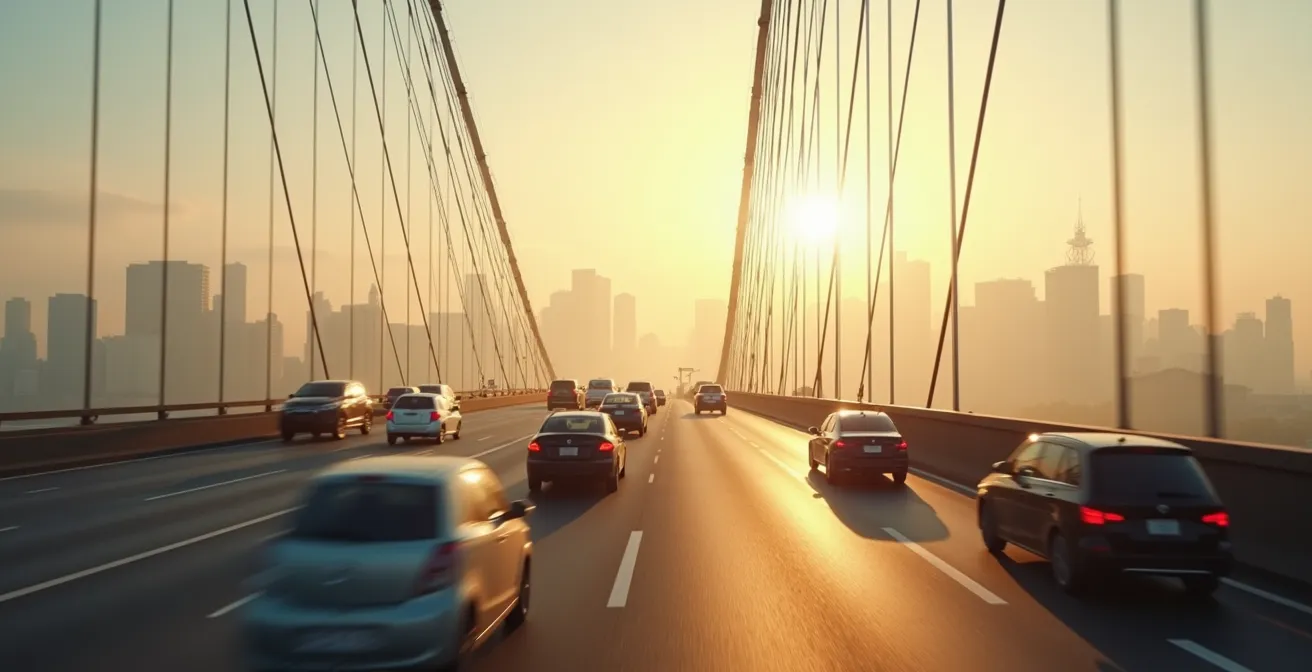
While mega-projects like the Third Link dominate headlines, the true challenges for Quebec drivers lie in the existing, complex infrastructure ecosystem you navigate daily.
- Systemic failures, like the ongoing Hippolyte-Lafontaine renovations, reveal the network’s fragility and have a greater immediate impact than future projects.
- “Navigational intelligence”—proactively using tools like Quebec 511 and understanding specific hazards like black ice—is now a critical driving skill.
Recommendation: Shift focus from the uncertainty of long-term projects to mastering the current system’s rules, risks, and choke points to tangibly improve your daily commute.
For any resident of Quebec City or Levis, the “Troisième Lien” is more than just a political debate; it represents a hope for untangling the region’s notorious traffic congestion. The endless cycle of announcements, studies, and reversals creates a sense of uncertainty, leaving many drivers wondering if relief will ever materialize. This focus on a single, massive solution, however, obscures a more immediate and complex reality. The daily commute is not shaped by one future tunnel or bridge, but by an entire ecosystem of existing challenges that demand a driver’s constant attention.
The common approach is to wait for the government to solve the problem. But what if the key to a better commute isn’t about waiting for a mega-project, but about developing a deeper understanding of the provincial transportation network as it exists today? The true measure of a savvy Quebec driver lies not in their patience for future infrastructure, but in their ability to navigate the present system’s fragility, seasonal hazards, and regulatory friction. This requires a shift in mindset from passive commuter to active navigator.
This article provides a policy analyst’s perspective on the tangible factors that currently define your drive time and safety. We will explore the cascading effects of major repairs, the logistical puzzles of seasonal shutdowns, the life-or-death decisions required by weather hazards, and the often-misunderstood rules of the road. By understanding this infrastructure ecosystem, you can gain more control over your commute than any political promise can offer.
This guide delves into the specific, real-world challenges Quebec drivers face daily. The following sections offer a comprehensive overview of the critical knowledge needed to navigate the province’s roads safely and efficiently.
Summary: A Driver’s Guide to Quebec’s Road Network Challenges
- Why Is the Hippolyte-Lafontaine Tunnel Renovation Taking So Long?
- How to Plan Deliveries Around Quebec’s Construction Holiday Shutdown?
- Ferry or Bridge: Which Crossing Strategy Saves Time at Tadoussac?
- The Moose Collision Risk: Driving Highway 175 at Night
- When to Cancel Your Trip: Interpreting Transports Québec Road Conditions
- How to Spot and Dodge Black Ice on Highway 20 Without Losing Control?
- Why Are Speed Fines Doubled Even When No Workers Are Present?
- How Smart Traffic Lights in Montreal Are Changing Your Drive Time?
Why Is the Hippolyte-Lafontaine Tunnel Renovation Taking So Long?
The extensive delays and ongoing closures at the Hippolyte-Lafontaine Tunnel are a prime example of systemic fragility within Quebec’s infrastructure. What was initially presented as a necessary upgrade has become a multi-year disruption, impacting hundreds of thousands of commuters and the region’s logistics network. The core of the issue lies in the sheer complexity of retrofitting a structure that is over 50 years old while it remains partially operational. Unforeseen structural issues, supply chain disruptions for specialized materials, and the intricate coordination of multiple engineering disciplines contribute significantly to the extended timeline.
The project’s scope goes far beyond simple resurfacing. It involves repairing the concrete vault, upgrading ventilation and lighting systems, and modernizing fire safety protocols. Each step is a monumental task in itself. Financially, the project’s scale is equally massive, reflecting the high cost of specialized labor and materials required for such a critical piece of infrastructure. Official figures already show significant cost overruns, a common symptom of mega-projects facing unexpected geological or structural complications.
According to Quebec’s public infrastructure dashboard, the project has already seen a cost variance, with an increase of $298.7 million, bringing the total estimated cost to $2.796 billion. This financial reality underscores the immense investment needed to maintain—let alone expand—the province’s aging transportation arteries. For commuters, this means the current state of disruption is not a temporary inconvenience but a long-term reality that requires fundamental changes in travel habits, far removed from the abstract debates surrounding future projects.
How to Plan Deliveries Around Quebec’s Construction Holiday Shutdown?
Every summer, Quebec’s economy undergoes a unique, state-mandated pause: the annual construction holiday. For logistics and transport sectors, this two-week period is a critical planning challenge that can either be managed smoothly or result in significant delays and costs. The key is to understand that the shutdown’s impact extends far beyond the construction sites themselves. It creates a domino effect across the entire supply chain, affecting material suppliers, carriers, and even municipal services like inspections and permits.
Proactive planning is non-negotiable. The Commission de la construction du Québec (CCQ) sets the dates well in advance; for instance, the 2025 holiday is scheduled from July 20 to August 2, 2025. Logistics managers must treat the weeks leading up to this period as a peak season, accelerating deliveries and stockpiling necessary materials to avoid being caught short. Conversely, the week immediately following the holiday sees a massive surge in activity, creating new bottlenecks as the system restarts. Scheduling non-essential deliveries for the second or third week after the return can prevent assets from being stuck in yard congestion.
The most effective strategy involves deep collaboration with partners. Communication with suppliers and carriers should begin months in advance to align schedules. Many firms outside the direct construction industry, such as engineering and surveying offices, also operate at a reduced capacity. This means that any project requiring multi-stakeholder coordination must have its administrative and planning phases completed long before July. Failing to account for this broader “administrative slowdown” is one of the most common and costly mistakes in logistical planning during this unique period.

As this image of a busy loading dock suggests, the period just before the shutdown is one of maximum effort. The goal is to ensure that all critical goods are either delivered or strategically warehoused to maintain operational continuity when the majority of the construction and transport sector is on mandatory leave. This strategic foresight is the hallmark of successful logistics management in Quebec.
Ferry or Bridge: Which Crossing Strategy Saves Time at Tadoussac?
The choice between taking the Tadoussac–Baie-Sainte-Catherine ferry or driving the 100-kilometer detour via the Saguenay Bridge is a classic Quebec travel dilemma. There is no single correct answer; the optimal choice depends entirely on a real-time analysis of traffic, season, and time of day. Making the wrong decision can lead to a frustrating 90-minute wait for a 10-minute ferry ride, while the right one can feel like a seamless, scenic shortcut. This decision-making process is a perfect example of the “navigational intelligence” required for efficient travel in the province.
During the off-season or on weekdays, the ferry is almost always the superior choice. The crossing is quick, and wait times are minimal. However, from June to September, particularly during whale watching season and on weekends, the situation changes dramatically. Tourist traffic can create lineups stretching for several kilometers, with wait times easily exceeding an hour. This is where active information gathering becomes crucial. Before committing to the ferry route, drivers should check the Société des traversiers du Québec (STQ) website for any service alerts and, if available, view the live webcam feed to assess the current lineup.
The break-even point is the key calculation. The bridge detour adds approximately 90 minutes of driving time compared to a no-wait ferry crossing. Therefore, a simple rule of thumb is: if the estimated ferry wait time is less than 60 minutes, the ferry remains the more time-efficient option. If the lineup appears extensive or a traffic report on local radio indicates heavy congestion, the bridge detour, while longer in distance, becomes the faster and more predictable route.
The following table breaks down the core factors to consider when making this strategic choice, illustrating the trade-offs between the two routes.
| Factor | Ferry Route | Bridge Route via Saguenay |
|---|---|---|
| Distance | Direct crossing | 100km+ detour |
| Peak Season Wait | 30-90 minutes (June-Sept) | No wait |
| Fuel Cost | Minimal idling | Additional 100km fuel |
| Travel Time Off-Peak | 15 minutes total | 90 minutes |
The Moose Collision Risk: Driving Highway 175 at Night
Highway 175, the vital link between Quebec City and the Saguenay–Lac-Saint-Jean region, is a modern, well-maintained road. However, its path through the vast Laurentian Wildlife Reserve presents a significant and often underestimated danger, especially after dark: the risk of a moose collision. These animals, which can weigh over 500 kilograms, are most active at dawn and dusk, and their dark coats make them incredibly difficult to see against the asphalt until it’s too late. The danger is not abstract; it’s a specific hazard microclimate that demands a unique driving strategy.
Standard defensive driving is insufficient. Drivers on this route must adopt a heightened state of vigilance, actively scanning the ditches and forest edges, not just the road ahead. Reducing speed is the single most effective preventative measure. Driving at 90 km/h instead of the posted 100 km/h can provide the extra seconds needed to react. Using high beams whenever possible is essential, but drivers must be aware that the reflection from a moose’s eyes is often not as bright as a deer’s and can be easily missed.
The most dangerous periods are during the spring, when they are drawn to the road salt, and in the fall (September-October), which is their rutting season. During these times, it’s crucial to be aware that if you see one moose, another is likely nearby. It is also important to know the correct protocol in the unfortunate event of a collision. The first step is always to ensure human safety by moving the vehicle off the road if possible and contacting the Sûreté du Québec at *4141 or 310-4141. Given the remote nature of much of Highway 175, a satellite phone or emergency beacon can be a literal lifesaver in no-cell-service zones.
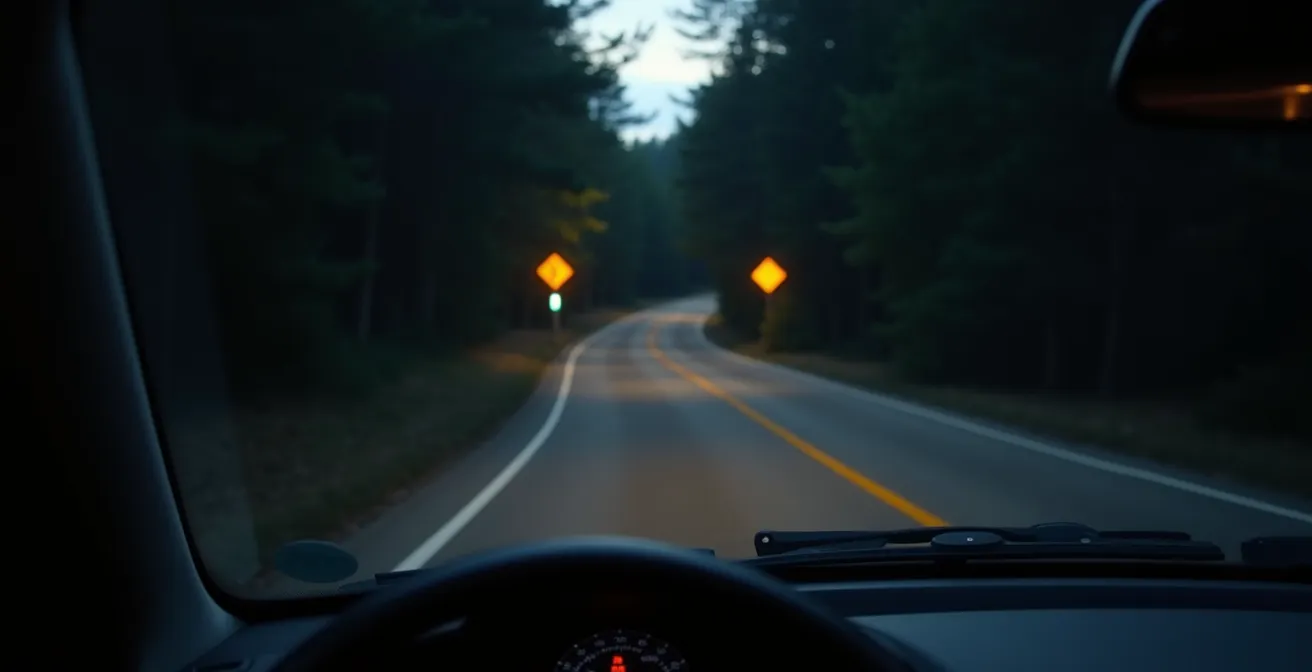
The view from the driver’s seat at night on this highway illustrates the challenge. Headlights create a narrow tunnel of visibility, with the vast, dark forest holding unpredictable hazards. The glowing warning signs are not suggestions; they are critical alerts about a very real and present danger that defines the experience of driving this route.
When to Cancel Your Trip: Interpreting Transports Québec Road Conditions
In Quebec, winter driving safety hinges on more than just having good snow tires; it requires the “navigational intelligence” to accurately interpret road condition reports and make informed decisions, including the crucial one to cancel a trip. The Quebec 511 service is an indispensable tool, but its terminology can be nuanced. Understanding the difference between “partially snow-covered” and “ice-covered” is the difference between a safe journey and a potential catastrophe.
A “chaussée partiellement enneigée” (partially snow-covered road) generally indicates that the main driving tracks are clear, but snow is present on the shoulders and between lanes. For a vehicle equipped with proper winter tires, this condition is manageable with a 20-30% reduction in speed. In contrast, a “poudrerie” (blowing snow) warning is far more severe. This condition, caused by wind blowing existing snow across the road, can create sudden, zero-visibility whiteouts, making it more dangerous than a steady snowfall. When “poudrerie” is forecast, especially with winds over 30 km/h, postponing travel is the wisest course of action.
The most critical distinction is between “chaussée glacée” (icy road) and black ice. The former describes visible, widespread ice, a clear signal to slow down drastically or exit the highway. Black ice, however, is invisible and forms in specific microclimates, typically on bridges and overpasses when the temperature hovers between -4°C and +2°C. A general “risk of black ice” warning on Quebec 511 means drivers must treat all shaded areas and elevated structures as if they are certain to be icy.
This personal risk assessment matrix provides a simple framework for making the go/no-go decision based on the official road conditions reported by Quebec 511 and your vehicle type.
| Condition | Sedan (Winter Tires) | SUV/AWD | Truck/4×4 |
|---|---|---|---|
| Partially Snow-Covered | Moderate Risk | Low Risk | Low Risk |
| Blowing Snow | High Risk | Moderate Risk | Moderate Risk |
| Ice-Covered | Cancel Trip | High Risk | High Risk |
How to Spot and Dodge Black Ice on Highway 20 Without Losing Control?
Black ice is one of the most treacherous hazards on Quebec roads, and Highway 20, with its long, exposed stretches and numerous overpasses, is a frequent location for its formation. The danger of black ice lies in its invisibility. It’s a thin, transparent layer of ice that forms on the road surface, making it look merely wet. The ability to anticipate, spot, and correctly react to it is a critical winter driving skill that goes far beyond simply having good tires.
Anticipation is the first line of defense. Black ice forms when the air temperature is near or just above freezing, but the pavement temperature is below 0°C. This most often occurs on bridges, overpasses, and shaded areas, as these surfaces lose heat faster than the ground. Data from Transports Québec confirms this, showing a significantly higher rate of winter incidents at specific microclimate locations, such as the overpasses near Rivière-Beaudette and Saint-Hyacinthe, where cold air pools beneath the structure. Drivers should treat these areas with extreme caution, reducing speed and avoiding sudden inputs, even if the rest of the highway seems clear.
Case Study: Microclimate Danger Zones on Highway 20
Highway 20’s most dangerous black ice zones consistently occur near St. Lawrence River overpasses between Montreal and Quebec City. The sections around the Rivière-Beaudette and Saint-Hyacinthe bridges are notorious examples. Cold air from the river pools beneath these elevated structures, causing the road surface to freeze even when air temperatures are above zero. Transport Quebec data indicates that these specific microclimate locations experience 40% more winter incidents compared to other sections of the highway, highlighting them as predictable hazard zones requiring heightened driver awareness.
If you do hit a patch of black ice, the vehicle will suddenly feel light and unresponsive. The instinctive reaction is to slam on the brakes, which is the worst possible action as it will lock the wheels and guarantee a loss of control. The correct response is to remain calm and make as few inputs as possible.
Your Action Plan: Emergency Maneuvers for Black Ice Encounters
- Release the accelerator immediately. Do not brake or make sudden steering movements.
- Keep the steering wheel straight. The goal is to let the car glide over the ice with minimal disruption.
- Look where you want the car to go, not at the hazard. Your hands will tend to follow your eyes.
- If the rear of the car begins to slide, make a small, smooth steering correction in the same direction of the slide.
- Once you feel the tires regain traction (you’ll feel a slight “bite”), you can gently apply the brakes or accelerator to stabilize the vehicle.
Why Are Speed Fines Doubled Even When No Workers Are Present?
Driving through an empty construction zone on a Sunday and seeing the “doubled fines” sign can be frustrating. It’s a common misconception that the increased penalties are only to protect the lives of workers on-site. While worker safety is the primary reason, the law remains in effect 24/7 because the zone itself is a hazard, regardless of human presence. This concept of “regulatory friction” reflects how legal frameworks are designed to mitigate inherent risks in the infrastructure ecosystem.
The Quebec Highway Safety Code is explicit about this. The rationale is that a work zone fundamentally alters the normal driving environment, creating risks that persist even when the site is empty. As one official interpretation puts it, the rule exists because the physical changes to the road demand a higher level of driver concentration and a lower speed to navigate safely at all times. The official text from the Quebec Highway Safety Code establishes the legal basis for this enforcement, treating the designated zone as a continuous hazard.
The zone itself is the hazard, not just the physical presence of workers.
– Highway Safety Code Article 331, Quebec Highway Safety Code
These persistent dangers are not always obvious. A SAAQ analysis highlights several “hidden” risks in empty work zones that justify the continuous speed reduction. Understanding them is key to appreciating the logic behind the law:
- Uneven Lanes: Partial paving can create a lip between lanes, which can destabilize a vehicle, especially at higher speeds.
- Conflicting Markings: Temporary lane markings can be confusing and may conflict with old, faded lines, leading to driver error.
- Loose Gravel: Excess gravel or debris on the road surface can significantly reduce tire traction, almost as if driving on marbles.
- Heavy Equipment: Parked machinery often has a wide turning radius or juts out slightly, reducing the effective lane width.
- Narrowed Lanes: Even without barriers, lanes in work zones are often narrower than standard, reducing the margin for error.
Key Takeaways
- Systemic Fragility: A single point of failure, like the Lafontaine Tunnel, reveals the vulnerability of the entire network and has a greater daily impact than any future project debate.
- Navigational Intelligence: Proactively using tools like Quebec 511, understanding specific rules like doubled fines, and making data-driven decisions (e.g., ferry vs. bridge) are now essential driving skills.
- Hazard Microclimates: Safety depends on recognizing and preparing for predictable, localized dangers like black ice on Highway 20 overpasses or moose on Highway 175, which general advice often overlooks.
How Smart Traffic Lights in Montreal Are Changing Your Drive Time?
While much of Quebec’s road infrastructure is aging, pockets of innovation are emerging that aim to optimize traffic flow rather than just add more asphalt. Montreal’s deployment of “smart” traffic light systems is a leading example. Unlike traditional lights that run on fixed timers, these intelligent systems use a network of sensors and artificial intelligence to adapt to real-time traffic conditions. For the daily commuter, this technology promises a smoother, less frustrating drive by reducing unnecessary stops and easing congestion.
The system’s “brain” is a central traffic management center that processes data from various sources. These include: magnetic loops embedded in the pavement to detect vehicle presence, overhead cameras for visual confirmation, and sometimes even anonymized data from navigation apps. This information allows the system to make dynamic decisions, such as extending a green light for a few extra seconds to clear a backlog of cars or coordinating a “green wave” along a major artery during rush hour, allowing for uninterrupted travel through multiple intersections.
The technology behind these systems is a complex interplay of hardware and software. The control boxes at each intersection house sophisticated circuit boards that execute the commands from the central system, adjusting signal timing in a fraction of a second. This move away from static, pre-programmed schedules towards a responsive, adaptive network represents a fundamental shift in urban traffic management. It focuses on maximizing the efficiency of the existing road network, a strategy that can yield significant improvements in drive time without the massive cost and disruption of new construction.

This close-up of a traffic signal’s internal circuitry symbolizes the hidden intelligence powering the city’s traffic flow. While invisible to the average driver, these intricate systems are constantly working to analyze, predict, and optimize the movement of thousands of vehicles. As this technology becomes more widespread, it will play an increasingly important role in shaping the daily urban commute.
To truly master your commute, the next logical step is to integrate this knowledge into your daily driving habits, moving from a passive driver to an active, informed navigator of Quebec’s complex road network. Assess your routes, check conditions before you leave, and drive with an awareness of the specific hazards and regulations that define the road ahead.
Frequently Asked Questions About Quebec Road Conditions
What does ‘chaussée partiellement enneigée’ mean for driving conditions?
This term means the road is partially snow-covered. It is generally considered safe for vehicles equipped with proper winter tires, but it is crucial to reduce your speed by 20-30% to maintain control and account for potentially slick spots.
How dangerous is ‘poudrerie’ (blowing snow)?
Blowing snow is often more dangerous than heavy snowfall because it can cause sudden and complete loss of visibility, creating whiteout conditions. The risk is highest when fresh snow is combined with wind speeds above 30 km/h. Postponing travel is the safest option in these conditions.
What’s the difference between ‘chaussée glacée’ and black ice warnings?
‘Chaussée glacée’ refers to visible, widespread ice on the road, which requires immediate and significant speed reduction. A black ice warning is more nuanced; it alerts drivers to the high probability of invisible ice forming in specific conditions, typically between -4°C and +2°C on bridges and in shaded areas.