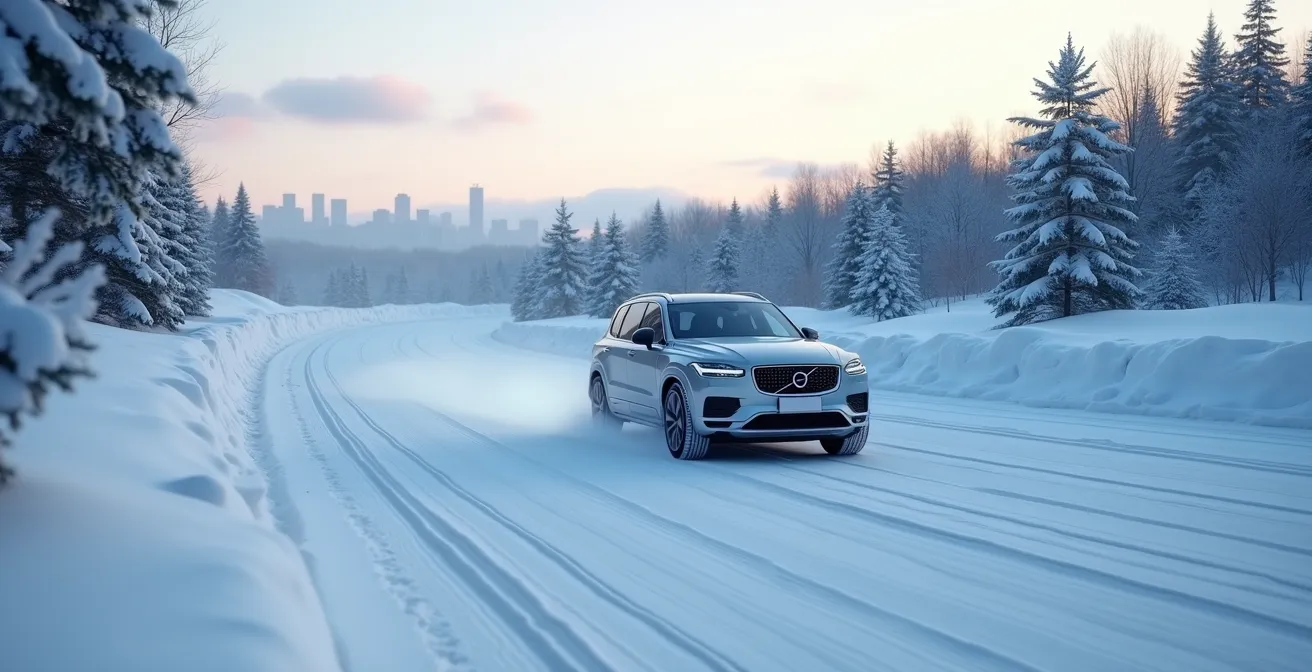
To correct a slide on ice, you must actively collaborate with your car’s Electronic Stability Control (ESC), not just passively trust it.
- ESC works by braking individual wheels to counteract a skid, but its effectiveness is entirely dependent on the grip provided by your winter tires.
- Your steering inputs guide the ESC; look and steer smoothly where you want to go, and the system will use the available traction to follow your command.
Recommendation: Treat the flashing ESC light not as an alarm, but as a communication that you are at the limit of your tires’ grip, and immediately reduce your speed.
It’s a feeling every Quebec driver knows: that heart-stopping lurch when the tires lose their bite on a patch of black ice. Your stomach drops, your knuckles whiten on the steering wheel, and a dozen conflicting pieces of advice flash through your mind. “Steer into the skid.” “Don’t brake!” “Let the car do the work.” But what does that really mean when the dashboard is suddenly flashing, and you can feel a strange grinding vibration through the pedals? You feel a loss of control, and panic starts to set in.
Most modern vehicles are equipped with Electronic Stability Control (ESC), a remarkable safety system designed to prevent these exact situations. Yet, crashes on icy roads remain tragically common. The problem is that we often treat ESC as a magical safety net rather than what it truly is: an active partner in controlling the vehicle. Simply trusting it isn’t enough; you can, and sometimes must, help it do its job better. The key to turning panic into a controlled correction is to learn how to collaborate with your car’s stability systems.
This guide, written from the perspective of a skid control instructor, will teach you to understand the language of your ESC, respect its physical limits, and provide the correct human input that enables it to work effectively. We will decipher what a sliding car is telling you, explore why your winter tires are the true heroes of winter driving, and analyze the common mistakes that even the most advanced All-Wheel Drive (AWD) systems can’t fix. By the end, you won’t just be a driver; you’ll be an informed partner, ready to work with your vehicle to conquer Quebec’s toughest winter conditions.
To help you navigate this essential knowledge, this article is structured to build your understanding from the ground up, starting with the immediate actions to take during a slide and progressing to the underlying principles of winter vehicle dynamics. Let’s begin.
Summary: Mastering Winter Driving with ESC
- Front-End Slide vs Rear-End Slide: How to React to Each?
- Why Is the Traction Control Light Flashing on Your Dashboard?
- Why Do Worn Winter Tires Cause Drifting Even at Low Speeds?
- The Steering Mistake That Turns a Small Drift Into a Spin
- When to Turn Off Traction Control: Getting Unstuck from a Snowbank
- Why Your AWD Crossover Still Slides Into the Ditch on Ice?
- The Parking Brake Mistake: Why You Shouldn’t Use It in Wet Freezing Weather?
- How Much Longer Does It Take to Stop on Black Ice vs Dry Asphalt?
Front-End Slide vs Rear-End Slide: How to React to Each?
A slide is not just a slide. The first step in collaborating with your ESC is to correctly identify what the car is doing. There are two primary types of skids: understeer and oversteer. Your reaction must be different for each. Understeer, or a front-end slide, is when you turn the steering wheel, but the car continues to plow straight ahead. It feels as if the steering has stopped working. This is common in front-wheel-drive cars.
Oversteer, or a rear-end slide, is the classic “fishtail.” The rear of the car loses grip and swings out, trying to overtake the front. This is more typical of rear-wheel-drive vehicles but can happen to any car, especially on a slippery, crowned Quebec road. In both scenarios, the ESC will intervene to help, but your input is the command the system tries to follow. Panic and wrong inputs will fight the system, while calm, correct inputs will enable it.
Case Study: How ESC Turns Driver Intention into Vehicle Correction
ESC systems work to prevent dangerous skids by monitoring vehicle behaviour and comparing it with the driver’s intentions via steering wheel angle. On Quebec’s icy highway ramps, conditions can change from slush to black ice in an instant. When the system detects a mismatch—for instance, the steering wheel is turned but the car is going straight (understeer)—it instantaneously reduces engine power and applies split-second brake pulsations to a specific wheel. For oversteer, it brakes the outer front wheel; for understeer, it brakes the inner rear wheel. The key is that it reacts far more quickly and precisely than any human ever could. When used with proper winter tires, ESC is arguably the single most important weapon against wintertime skids.
Action Plan: How to Collaborate with Your ESC During a Skid
- Identify the Slide: Is the front end plowing straight (understeer) or is the rear end kicking out (oversteer)? Your immediate reaction depends on this.
- Correct for Understeer: Your instinct is to turn the wheel more. Resist! Instead, slightly reduce your steering angle. This allows the front wheels to regain a sliver of grip, which is all the ESC needs to start working effectively.
- Correct for Oversteer: Look and steer smoothly in the direction you want the car to go (the direction of the slide). Maintain a steady throttle. Match your steering input to the severity of the slide—small slide, small correction.
- Trust the Sensations: Recognize ESC intervention through the flashing dashboard light and the pulsing/grinding sensation in the brake pedal. This is normal. Maintain your intended steering direction and let the system work.
- Adapt to the Surface: On Quebec’s varying winter surfaces, adjust your input speed. Be exceptionally smooth on black ice and a bit more deliberate in heavy, wet slush.
Why Is the Traction Control Light Flashing on Your Dashboard?
That little icon of a car with squiggly lines behind it—the Traction Control System (TCS) or ESC light—is one of the most misunderstood signals on your dashboard. When it flashes, it’s not a warning of failure; it’s a notification of success. It’s the system’s language, telling you, “I’ve detected a loss of traction and I am actively working to correct it.” Think of it as a status update from your co-pilot.
This system isn’t just reacting; it’s predicting. Using a network of sensors (monitoring wheel speed, steering angle, vehicle rotation, and lateral acceleration), the ESC is constantly comparing your intended direction with the vehicle’s actual direction. In fact, modern ESC technology uses sensors to monitor this relationship up to 100 times per second. The instant a discrepancy is found that could lead to a skid, it intervenes before you might even sense the slip yourself.
A brief flash while accelerating from a stoplight on a snowy Montreal street is normal; it means the TCS is preventing wheel spin. However, if the light flashes continuously while you’re driving at a steady speed, it’s a critical piece of feedback. It means you are consistently at the very edge of your tires’ grip budget. You are driving too fast for the conditions. The system is working overtime to keep you on the road, and it’s warning you that it has very little margin left to save you if things get worse. Heeding this silent communication by immediately and smoothly reducing your speed is a hallmark of an expert winter driver. A light that stays on constantly (without flashing) typically indicates a system malfunction, which requires a visit to your mechanic.
Why Do Worn Winter Tires Cause Drifting Even at Low Speeds?
We can talk about advanced electronic systems all day, but they all depend on one fundamental thing: the four small patches of rubber connecting your car to the road. The ESC is a brilliant brain, but it’s powerless if its “muscles”—the tires—have no grip to work with. This is the absolute physical limit of your vehicle’s safety systems. Driving on worn winter tires is like asking an Olympic skater to perform on dull blades. It doesn’t matter how skilled they are; the physics won’t allow it.
In Quebec, where winter tires are mandatory, drivers can be lulled into a false sense of security. But not all winter tires are created equal, especially as they wear down. A winter tire’s effectiveness comes from two things: a soft rubber compound that stays flexible in the cold, and a deep tread with thousands of tiny slits called “sipes.” These sipes act like microscopic squeegees, biting into ice and channeling away the thin layer of water that your tire’s friction creates. As the tread wears down, these sipes disappear. For this reason, CAA-Quebec recommends a minimum tread depth of 6/32 inch (4.8mm) at the start of the season for optimal safety, well above the legal minimum.
Case Study: The Physics of “Ice Aquaplaning”
An analysis by CAA-Quebec highlights a terrifying drawback of worn tires. As winter tires wear, they lose their microscopic sipes. Without these channels to bite into ice and evacuate water, the tire can begin to glide on a thin film of meltwater, a phenomenon like aquaplaning but on ice. This leaves the ESC with absolutely no grip to work with. It’s like trying to skate at Montreal’s Bell Centre with completely dull skates. Even the most powerful ESC braking command to an individual wheel is useless if that wheel has no traction. This is why even a cheap new winter tire consistently outperforms a worn premium or any all-weather tire in icy conditions.
The best ESC system can do little if your tires are worn-out, under-inflated, or overloaded.
– Transport Canada, Electronic Stability Control Guidelines
Before you blame your car or the road for a slide, check your tires. They are the foundation of your entire winter safety strategy and the ultimate enabler of your ESC system.
The Steering Mistake That Turns a Small Drift Into a Spin
When a car begins to slide, the most dangerous instrument in the vehicle can be the driver’s own hands. Panic is the enemy of control. The single biggest mistake a driver can make is overcorrection: a sudden, jerky steering input that is too large for the slide. This turns a small, manageable drift into a violent pendulum effect, swinging the car from one side to the other, often too quickly for even the ESC to manage. Smoothness is everything.
The age-old advice, “look where you want to go,” is not a mantra; it’s a neurological hack. Your hands will instinctively follow your eyes. If you stare at the ditch or the telephone pole, you will steer directly towards it—a phenomenon known as target fixation. By forcing your eyes to look far down the road to your intended path, you naturally encourage smoother, more measured steering inputs. Your hands, at the 9 and 3 o’clock positions, should guide the wheel, not wrestle with it.
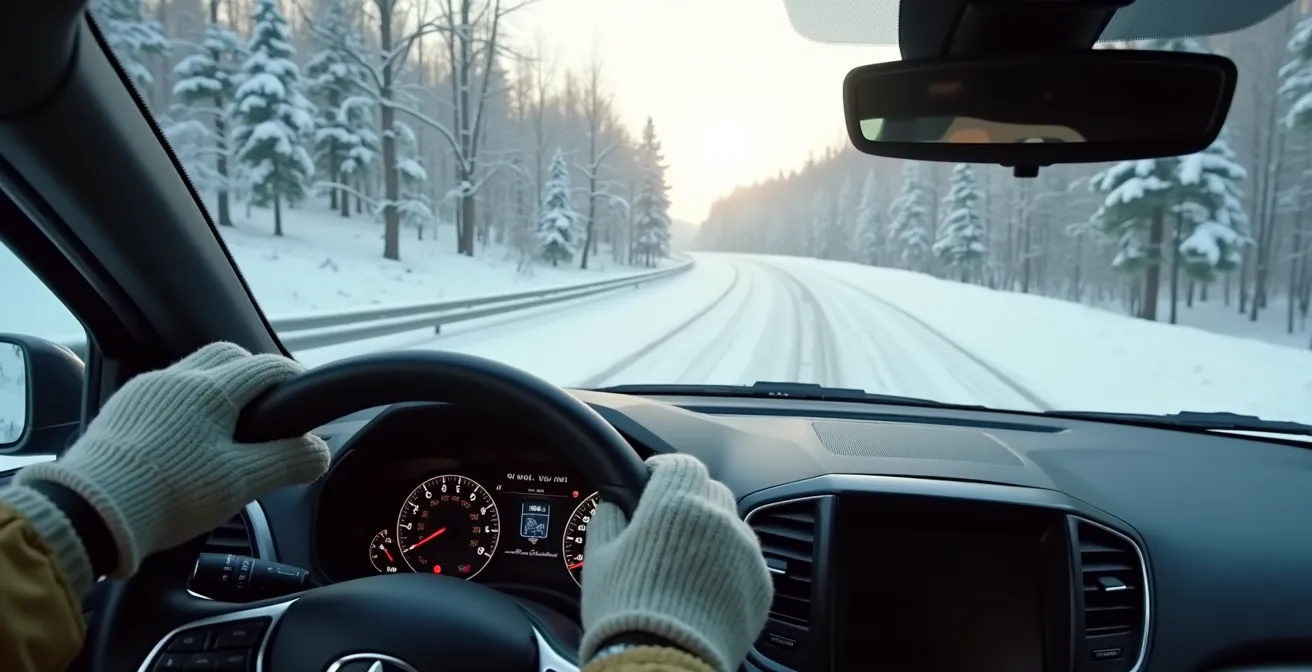
To build this muscle memory, you must practice. However, a public road is not the place to do so. Some advanced driving resources suggest turning off stability control in a safe, controlled area to feel the car’s raw behavior. This is for advanced drivers in a closed, empty parking lot only. Never, ever turn off your ESC on a public road in winter. For the vast majority of drivers, the best practice is simply to make all inputs—steering, braking, and accelerating—as gradually and smoothly as possible. Your ESC is designed to work with a driver who is providing clear, calm instructions, not one who is panicking.
When to Turn Off Traction Control: Getting Unstuck from a Snowbank
As a rule, your ESC and Traction Control System (TCS) should always be on when driving in winter. There is, however, one very specific exception: when you are stuck. Imagine your car is bogged down in a deep snowbank after a Quebec storm. In this situation, the TCS becomes a hindrance. Its primary job is to prevent wheel spin. But to get unstuck, you often need a controlled amount of wheel spin to dig through the deep snow and find a grippier surface underneath.
When you press the TCS/ESC button, the system is designed to allow this. Here is the safe protocol for temporarily deactivating the system:
- Confirm You Are Stuck: Only use this procedure if the vehicle is stationary and cannot move forward or backward.
- Deactivate the System: Locate the button with the icon of a car and squiggly lines, often with the word “OFF” below it. A short press usually deactivates only the TCS. A long press (3-5 seconds) often deactivates both TCS and ESC. Consult your owner’s manual.
- Rock the Vehicle: Gently use the accelerator to spin the wheels, alternating between Drive and Reverse to “rock” the car and build momentum. Do this carefully to avoid digging yourself in deeper.
- Reactivate Immediately: This is the most critical step. As soon as the vehicle is free and back on a drivable surface, press the button again to turn the TCS and ESC back on. Your safety on the road depends on it.
It’s important to remember that this is a manual override of a key safety feature. Fortunately, most manufacturers have built-in a failsafe. The system is designed to reset to “ON” every single time you restart the vehicle. So even if you forget to turn it back on, it will be active the next time you drive. But the best practice is to make it a conscious, immediate action as soon as you’re moving again.
Why Your AWD Crossover Still Slides Into the Ditch on Ice?
The “AWD” badge on the back of a crossover or SUV has become a powerful marketing tool, especially in winter climates like Quebec. It fosters a sense of invincibility, a belief that four driven wheels can conquer any slippery surface. This is a dangerous misconception. All-Wheel Drive provides a significant advantage in only one area: acceleration. It helps you get moving from a stop on a slippery surface. It does absolutely nothing to help you stop or turn on ice.
Braking and cornering are governed by the laws of physics and the grip of your tires, not the number of wheels that receive engine power. All vehicles, whether FWD, RWD, or AWD, use all four tires to brake. When it comes to cornering on ice, the lateral grip is determined by your tires and your speed, not your drivetrain. The false confidence that AWD provides is its greatest danger; it allows drivers to get up to a high speed much more easily, without providing any extra ability to slow down or navigate a turn at that speed.
This table illustrates the stark reality of AWD performance on ice:
| Aspect | AWD Performance | FWD Performance |
|---|---|---|
| Acceleration on Ice | Superior – power distributed to 4 wheels | Limited – only 2 wheels for traction |
| Braking Distance | No advantage – braking is limited by tire-road friction, not driven wheels | Same as AWD – all vehicles brake with 4 wheels |
| Cornering on Ice | No improvement – lateral grip depends on tire compound and surface conditions | Equal to AWD – physics limits apply equally |
| False Confidence Risk | High – higher ‘go’ capability without matching ‘whoa’ capability | Lower – drivers more aware of limitations |
AWD can only help a vehicle accelerate or keep moving: It can’t help you go around a snow-covered turn, much less stop at an icy intersection. ESC can prevent a spinout, but it can’t clear ice from the roads or give your tires more traction. Don’t let these lull you into overestimating the available traction.
– Safety Toolbox Talks Forum, 10 Winter Driving Tips
Your AWD system is a tool for ‘go’, not for ‘slow’ or ‘steer’. It works in concert with your ESC, but it cannot overcome the physical limits of tire grip on ice.
The Parking Brake Mistake: Why You Shouldn’t Use It in Wet Freezing Weather?
Winter vehicle control isn’t limited to when you’re driving. A common mistake made by drivers during Quebec’s unique “slush season” can lead to a dangerous situation before you even start moving. The issue lies with the parking brake. During the freeze-thaw cycles of late winter and early spring (typically March and April), daytime temperatures rise above zero, melting snow into water and slush. This water can seep into the sheaths of traditional, cable-operated parking brake systems.
When the temperature plummets overnight, this water freezes solid, effectively locking the parking brake cable in place. The next morning, you release the lever inside, but the rear brakes can remain partially engaged. Trying to drive with a frozen, dragging brake is not only damaging to your vehicle (causing overheating and expensive repairs) but also extremely dangerous. A partially engaged rear brake can easily induce a skid, especially when turning or braking on a slippery surface.
Case Study: The Dangers of Quebec’s Freeze-Thaw Cycle
During a typical March week in Quebec, temperatures can fluctuate from +5°C during the day to -10°C at night. This creates the perfect conditions for water infiltration into brake mechanisms. A driver who conscientiously uses their parking brake at night after driving through daytime slush risks having the cables freeze. The next day, they might only notice a slight drag or a burning smell, unaware that their vehicle’s braking balance is compromised, making it much more susceptible to a rear-end slide (oversteer) that the ESC will have to fight to control.
Modern Electronic Parking Brakes (EPBs) are far less susceptible to this issue as they don’t rely on long, exposed cables. However, it’s crucial to know which system your car has. The safest winter parking protocol, especially during freeze-thaw periods, is to avoid using the parking brake. Instead, leave your vehicle in gear: “Park” for an automatic transmission, and first or reverse gear for a manual. If parked on a slope, turn your front wheels towards the curb (if facing downhill) or away from the curb (if facing uphill) as an extra precaution.
Key Takeaways
- ESC is a partner, not a savior. You must collaborate with it by providing smooth, correct steering inputs.
- The effectiveness of your ESC is absolutely limited by the grip of your winter tires. Worn tires make ESC powerless.
- AWD helps you accelerate on ice but offers no advantage for braking or cornering. Do not let it create a false sense of security.
How Much Longer Does It Take to Stop on Black Ice vs Dry Asphalt?
Ultimately, all the advanced systems and driving techniques are secondary to the unbending laws of physics. The most critical factor in winter safety is managing your speed to account for drastically increased stopping distances. The difference between stopping on dry pavement and stopping on ice is not small; it is immense and often fatally underestimated. As a rule of thumb, a study from the Ottawa Safety Council indicates it takes up to 10 times longer to stop on snow and ice than on a dry road.
This isn’t a linear increase. The energy your brakes must dissipate increases with the square of your speed. Doubling your speed from 40 km/h to 80 km/h doesn’t double your stopping distance; it quadruples it. On ice, this effect is magnified exponentially. A car that can stop in 70 meters from 90 km/h on a dry Autoroute might need over 400 meters—the length of four football fields—to stop on a patch of black ice. At that point, no amount of ESC intervention or driver skill can save you.
The following table, with data adapted for typical Quebec highway speeds, puts these numbers into terrifying perspective:
| Speed | Surface | Stopping Distance | Comparison |
|---|---|---|---|
| 50 km/h | Dry Asphalt | 25 meters | Baseline |
| 50 km/h | Wet Road | 35 meters | 1.4x longer |
| 50 km/h | Packed Snow | 60 meters | 2.4x longer |
| 50 km/h | Black Ice | 150+ meters | 6x+ longer |
| 90 km/h | Dry Asphalt | 70 meters | Baseline |
| 90 km/h | Black Ice | 400+ meters | A full-length football field and then some |
Furthermore, tire choice remains paramount. Even among winter-rated tires, performance varies. As CAA experts note, at -10°C, a car with all-season tires can take up to 30% longer to stop than one equipped with proper winter tires. This difference can easily be the margin between a close call and a serious collision. The only way to manage these extreme distances is through anticipation and radically reduced speed. Your vision and your judgment are the most important safety systems you have.
Frequently Asked Questions About Vehicle Stability in Winter
What does it mean when the TCS light flashes briefly?
A brief flash of the activation light while accelerating indicates that one or more tires are losing traction and the Traction Control System (TCS) or ESC is actively working to manage it. This is normal operation on slippery surfaces.
What if the TCS/ESC light stays on continuously?
If the light remains on continuously while you’re driving (and doesn’t show the “OFF” indicator), it’s warning of a system malfunction. This means the TCS and potentially the ESC are not operating, and you should have your vehicle serviced.
Should I be concerned about frequent flashing in winter?
Yes. Constant flashing while driving at a steady speed indicates you are at the absolute limit of your tires’ grip. Even with Quebec’s mandatory winter tires, this means your speed is too high for the current road conditions. You must reduce your speed immediately.
Why does Quebec’s freeze-thaw cycle create parking brake problems?
During the “slush season” (typically March-April), daytime melting allows water and slush to seep into the protective sheaths of parking brake cables. When temperatures drop below freezing overnight, this water turns to ice, freezing the cable and locking the brake in place.
Is my Electronic Parking Brake (EPB) at risk of freezing?
Modern Electronic Parking Brakes (EPBs) are sealed units and are far less likely to freeze than traditional cable-operated handbrakes. However, it is crucial to know which system your vehicle is equipped with by checking your owner’s manual.
What’s the safe winter parking protocol?
To be safe, especially during freeze-thaw conditions, avoid using the parking brake. Leave the car in “Park” for an automatic transmission, or in First/Reverse for a manual. On a slope, always turn your wheels toward the curb (downhill) or away from the curb (uphill) as a mechanical backup.