
With gas prices stubbornly high, cutting your fuel bill by 20% is not about finding shortcuts, but about mastering your vehicle’s physics and behaviour in Quebec’s specific driving conditions.
- Small, consistent habits like eliminating winter idling and managing tire pressure correctly offer significant, measurable dollar savings.
- Advanced techniques and a clear understanding of your car’s technology (Eco Mode, ACC) are key to maximizing efficiency on highways like the Décarie or Autoroute 20.
Recommendation: Start by tackling the single biggest source of waste in your daily commute, whether it’s idling, aerodynamics, or driving style, and build from there.
Watching the numbers climb past $1.70 per litre at the pump has become a painful ritual for Quebec commuters. You have a long daily drive, and that cost adds up, fast. You’ve likely heard the usual advice: drive less, check your tires, and don’t speed. While not wrong, this advice often feels generic and fails to address the unique challenges of driving in Quebec—from our harsh winters and fluctuating temperatures to the specific demands of our highways and city traffic.
The common solutions touch on the surface but rarely explain the ‘why’ or quantify the actual savings. They tell you to avoid idling but don’t calculate the “thermal penalty” of warming up your car. They suggest smooth driving but don’t teach you how to “bank momentum” on a busy expressway. But what if the key to a 20% reduction in your fuel bill wasn’t found in broad generalizations, but in a series of precise, data-backed strategies tailored specifically for you, the Quebec driver?
This guide moves beyond the platitudes. We will act as your personal eco-driving instructor, breaking down the behaviours and physics that directly impact your fuel consumption. We’ll explore the real cost of common habits, master techniques for local roads, demystify your car’s technology, and even tackle the big question of when it’s financially smarter to switch vehicles. It’s time to stop just paying for gas and start outsmarting the pump.
To give you a comprehensive overview of these strategies, we’ve put together a visual guide that complements the detailed advice in this article. It offers a glimpse into the world of vehicle optimization and the precision involved.
In the following sections, we will break down eight critical areas where you can make immediate and long-term savings. This structured approach will provide you with a clear roadmap to becoming a more efficient driver and significantly reducing your transportation costs.
Summary: Your Roadmap to Fuel Efficiency in Quebec
- Why Idling Your Car to Warm Up Costs You $100 Per Winter?
- How to Master the ‘Pulse and Glide’ Technique on the Decarie Expressway?
- Eco Mode vs Normal: Does It Actually Save Gas on Highway Trips?
- The Aerodynamic Mistake That Increases Your Consumption by 15%
- How to Adjust Tire Pressure to Save $50/Year Without Ruining the Ride?
- Factory Settings vs Eco-Tune: Which Actually Saves Money at the Pump?
- Adaptive vs Standard Cruise: Which Saves More Gas in Heavy Traffic?
- Is Keeping Your Old ‘Beater’ Greener Than Buying a New EV?
Why Idling Your Car to Warm Up Costs You $100 Per Winter?
That winter morning ritual of starting your car and letting it run for 10-15 minutes “to warm up” feels like a necessity in Quebec. However, this habit comes with a significant and often underestimated “thermal penalty.” Modern fuel-injected engines don’t require long warm-up periods. In fact, driving gently for the first few minutes is the most effective way to bring your engine and cabin up to temperature. The cost of standing still is surprisingly high.
The math is stark. Data from Quebec’s own eco-mobility program reveals that a typical 3.5-litre engine burns up to 2 litres of fuel per hour while idling. If you idle for just 10 minutes every workday morning for the four coldest months (approximately 80 days), you’re wasting over 13 hours of engine run time. At $1.70/L, that’s over 26 litres of gasoline and nearly $45 vanished into thin air. Add in idling while waiting for passengers or in drive-thrus, and that figure can easily double, costing you $100 or more each winter.
The solution is simple and requires a small shift in habit. Limit your stationary warm-up to 30-60 seconds—just enough time for the oil to circulate. Then, start driving gently, keeping RPMs low for the first 5-10 minutes. Your engine will warm up faster, you’ll get heat in the cabin sooner, and you’ll keep that $100 in your pocket instead of sending it out your exhaust pipe.
How to Master the ‘Pulse and Glide’ Technique on the Decarie Expressway?
The Décarie Expressway during rush hour is a masterclass in inefficient driving: constant, jerky stop-and-go that burns fuel for minimal progress. The common reaction is aggressive acceleration to close gaps, followed by hard braking. This is a fuel-wasting nightmare. The secret to surviving it efficiently is a technique called “Pulse and Glide,” or what can be thought of as Momentum Banking. You treat your car’s momentum like a resource to be spent wisely.
The “Pulse” phase is a gentle, steady acceleration to a target speed (e.g., 70-80 km/h on the highway). The “Glide” phase is where you take your foot completely off the gas, allowing the car to coast and use its stored momentum to cover distance for free. The goal is to anticipate traffic flow far ahead, leaving a large gap so you can glide for as long as possible instead of braking. On the Décarie, this means looking a dozen cars ahead, not just at the bumper in front of you. When traffic slows, you glide. When it opens up, you pulse gently.
According to Natural Resources Canada, aggressive driving with rapid speed fluctuations can increase fuel use by as much as 20%. Pulse and Glide is the direct antidote. It’s a conscious, proactive driving style that smooths out these fluctuations, turning wasted kinetic energy into forward progress. It requires focus but can yield savings of 10-15% in mixed highway driving.
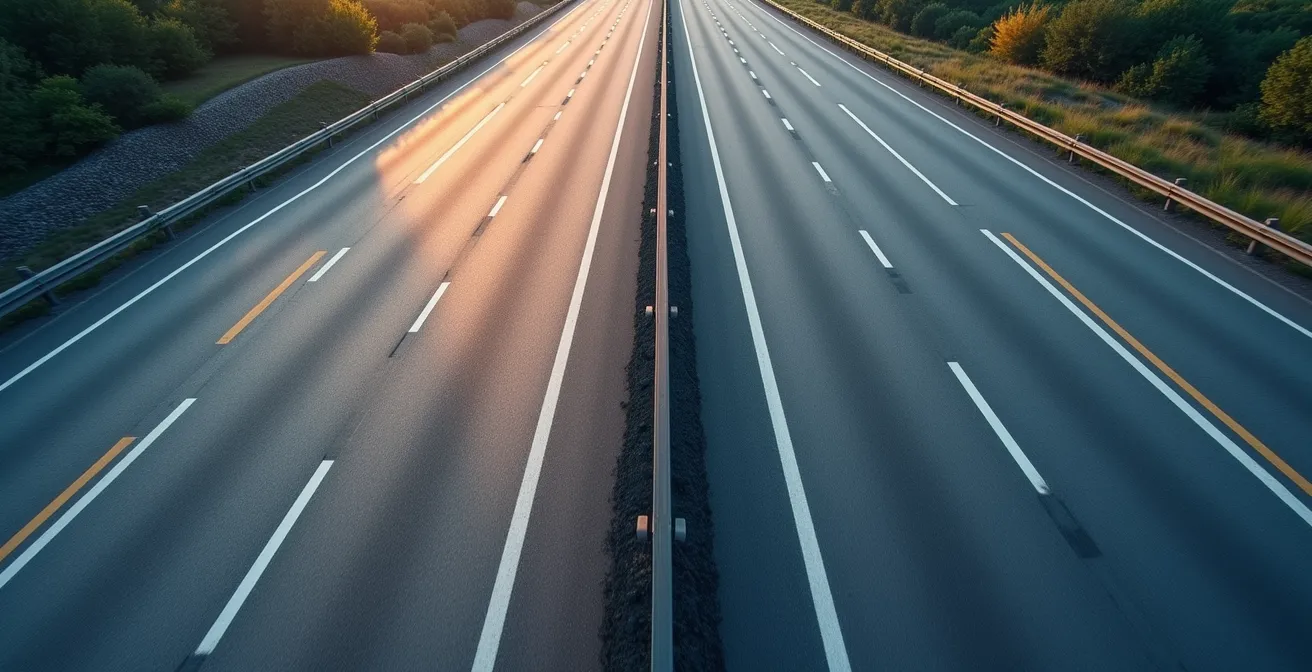
As the visualization shows, the technique is a rhythmic exchange between controlled power and strategic coasting. Mastering this on your daily commute transforms you from a reactive driver into a strategic operator, actively managing your fuel consumption one glide at a time. It’s not just for expressways; it works wonders on boulevards with timed traffic lights as well.
Eco Mode vs Normal: Does It Actually Save Gas on Highway Trips?
Most modern cars come with an “Eco” button, a seemingly simple fix for high gas prices. But does it actually work, or is it a placebo? The answer is: it depends entirely on where and how you’re driving. Eco Mode is not a magic bullet; it’s a tool that’s highly effective in some situations and nearly useless in others. Its primary function is to dull the throttle response, encouraging smoother acceleration, and to program the transmission to shift into higher gears sooner.
As the Mitsubishi Canada Engineering Team states in their fuel efficiency guide, the goal is clear:
Eco mode adjusts the engine, transmission, and all-wheel-drive system’s operation for maximum efficiency to get the most kilometres out of every litre of gas.
– Mitsubishi Canada Engineering Team, Mitsubishi Motors Canada Fuel Efficiency Guide
This dampened response is fantastic for the stop-and-go of Montreal city driving or crawling along Taschereau Boulevard, where it can improve efficiency by up to 20% by preventing jerky starts. It’s also beneficial in winter, as the gentler throttle can help reduce wheel spin on icy surfaces. However, on a clear stretch of Autoroute 20 at a steady 100 km/h, the benefit diminishes significantly because you’re not accelerating frequently. The following table breaks down its effectiveness.
| Driving Scenario | Eco Mode Savings | Best Application |
|---|---|---|
| City (0-50 km/h) | 15-20% improvement | Stop-and-go traffic |
| Highway (80-100 km/h) | 5-8% improvement | Steady cruising |
| High Speed (120+ km/h) | 2-3% improvement | Limited benefit |
| Winter conditions | 10-12% improvement | Gentle throttle helps on ice |
The takeaway for Quebec drivers is to be strategic. Engage Eco Mode for your city commute and during winter storms. On the open highway for a trip to Quebec City, you can leave it off, especially if you need full power for passing. Using it correctly means understanding it’s a tool for managing acceleration, not for maintaining speed.
The Aerodynamic Mistake That Increases Your Consumption by 15%
Your car is designed to be slippery, cutting through the air with minimal resistance. Any object you attach to the outside, especially on the roof, disrupts this airflow and creates parasitic drag. This drag acts like a small parachute, forcing your engine to work harder—and burn more fuel—just to maintain highway speed. For Quebec families, the biggest culprits are often ski racks and cargo boxes left on all year round.
The impact is far greater than most people realize. A simple empty ski rack can increase fuel consumption by 5-10%. A large, bulky rooftop cargo box can increase it by up to 25% at highway speeds. Even the weight of these accessories matters. Natural Resources Canada confirms that for every 25 kg of extra weight, your fuel consumption can increase by 1%. While that seems small, it’s the combination of weight and, more importantly, terrible aerodynamics that devastates your mileage.
Think of it this way: leaving your ski rack on from April to November is like accepting a permanent 5% gas price hike. Over a year of commuting, this single mistake can cost you hundreds of dollars. The solution is to treat these accessories like specialized tools: use them when you need them, and remove them immediately after. Before any long trip, run through a quick aerodynamic check.
Your pre-trip aerodynamic savings checklist
- Is the ski/snowboard rack necessary for this trip? If not, remove it.
- Is the rooftop cargo box essential? Could items fit inside the vehicle instead?
- Are bug deflectors or other non-essential accessories installed? Consider removing them for long highway drives.
- If you have a truck, are the towing mirrors extended when not towing? Fold them in.
- In winter, is there significant snow or ice buildup on the roof, undercarriage, or in wheel wells? Clear it off.
By minimizing parasitic drag, you’re allowing your car to operate as its engineers intended. This is one of the easiest ways to secure a significant, permanent reduction in your fuel consumption without changing how you drive at all.
How to Adjust Tire Pressure to Save $50/Year Without Ruining the Ride?
You’ve heard it a million times: “check your tire pressure.” But in Quebec, this advice is incomplete. Our wild temperature swings, from a mild +5°C afternoon to a frigid -25°C morning, wreak havoc on tire pressure. For every 6°C drop in temperature, your tires can lose about 1 PSI of pressure. A sudden cold snap can leave your tires dangerously underinflated overnight, and this directly impacts your wallet and your safety.
Driving on underinflated tires increases their rolling resistance, which is the friction between the tire and the road. This is another form of parasitic drag. Your engine has to work harder to overcome it. According to Natural Resources Canada, driving with tires underinflated by just 8 PSI can increase your fuel consumption by 4%. For the average commuter, that’s over $50-$60 wasted per year. Furthermore, as Manitoba’s public insurance guide notes, it can reduce the life of your tires by as much as 15,000 km.
The key for Quebecers is frequency. Don’t just check your tires once a month. Check them after every major temperature drop. The correct pressure is not on the tire’s sidewall; it’s on the sticker inside your driver’s side door jamb. This is the “cold tire pressure,” meaning you should check it before you’ve driven or after the car has been sitting for at least three hours. Overinflating is also bad, as it reduces grip and causes a harsh ride. The goal is precision.
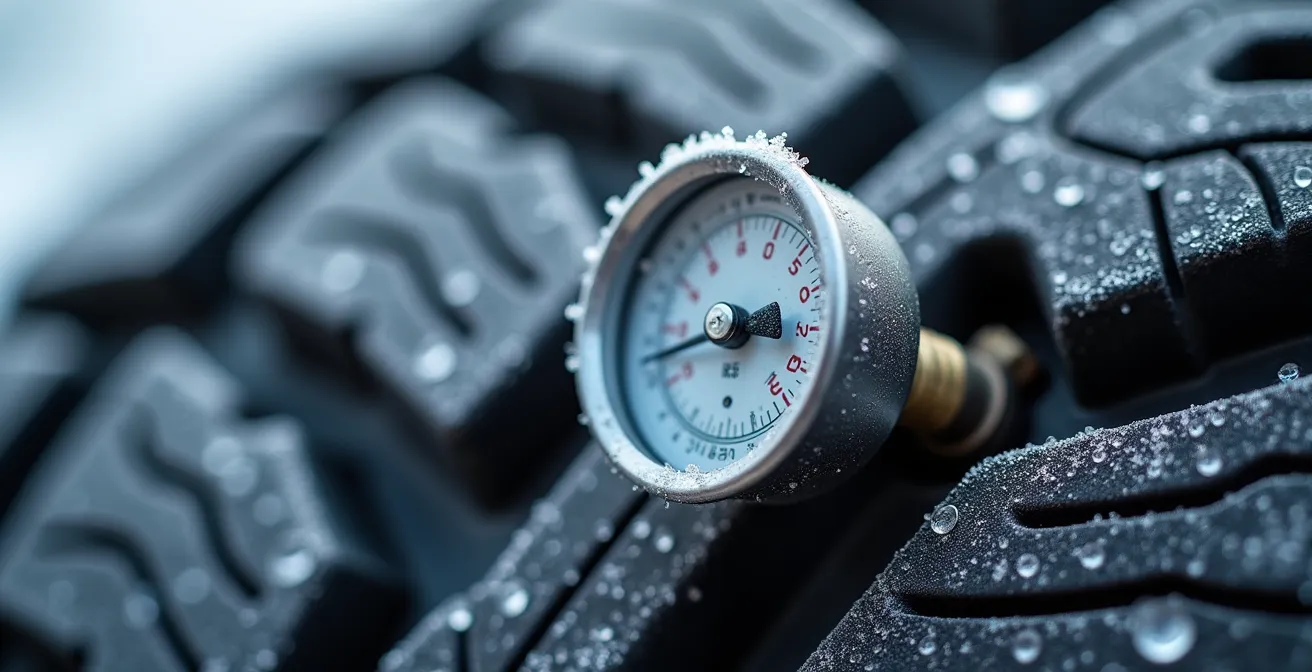
Investing in a good quality digital pressure gauge is a small price to pay for the savings and safety it provides. Making this a regular part of your routine, especially from October to April, is a non-negotiable for any cost-conscious Quebec driver. It’s a simple, five-minute task that yields a guaranteed return.
Factory Settings vs Eco-Tune: Which Actually Saves Money at the Pump?
For those looking to go beyond behavioural changes, modifying the car’s computer, or ECU (Engine Control Unit), seems like a promising option. An “eco-tune” is a software remap that changes the engine’s fuel and ignition timing to prioritize efficiency over maximum power. But does the high upfront cost justify the potential savings for a daily commuter in Quebec?
An eco-tune is a significant investment, but it offers a permanent change to your vehicle’s fuel mapping. The trade-off is often a slight reduction in peak horsepower, which is unnoticeable in 99% of daily driving situations. A much more accessible and risk-free alternative is an OBD-II (On-Board Diagnostics) monitor. This is a small device that plugs into your car’s diagnostic port and provides real-time fuel consumption data to your smartphone. It turns driving into a game where the goal is to keep your consumption as low as possible. This creates a powerful feedback loop between your actions and the car’s fuel use—the core of the driver-machine interface.
In fact, Natural Resources Canada has found that many drivers consume 15% less fuel simply by acting on the feedback that these displays provide. The table below compares the options.
| Option | Initial Cost | Fuel Savings | Break-even Point | Warranty Impact |
|---|---|---|---|---|
| Factory Settings | $0 | Baseline | N/A | Full warranty |
| ECO Tune | $500-900 | 8-12% | 25,000-40,000 km | Void powertrain |
| OBD-II Monitor | $100-150 | 5-15% (driver dependent) | 5,000-8,000 km | No impact |
For most commuters, the OBD-II monitor offers the best return on investment. It’s inexpensive, has no impact on your warranty, and empowers you to become a better driver through data. An eco-tune can be a valid option for high-mileage drivers who plan to keep their vehicle long-term, but the risk and cost make it a decision that shouldn’t be taken lightly.
Adaptive vs Standard Cruise: Which Saves More Gas in Heavy Traffic?
Cruise control is the classic fuel-saving tool for long highway drives. By maintaining a constant speed, it avoids the inefficient micro-adjustments humans make. However, the advent of Adaptive Cruise Control (ACC), which automatically maintains a set distance from the car ahead, has complicated the equation. Is newer always better for your gas bill?
In the right conditions—a flat, open highway like Autoroute 20 between Montreal and Drummondville—standard cruise control is generally more efficient. It holds a perfectly steady speed, which is the most economical way to travel. ACC, on the other hand, can be prone to unnecessary braking and acceleration when other cars cut in, disrupting the smooth flow. However, in moderate to heavy traffic, a well-implemented ACC system can be more efficient than a human driver by reacting more smoothly and consistently.
The key is knowing when to use each tool. Experts, like those behind the Manitoba Driver’s Handbook, note that on hilly terrain, like Autoroute 15 heading into the Laurentians, even standard cruise control can be inefficient. It will fight to maintain speed uphill, burning excess fuel, whereas a human driver can allow the speed to drop slightly. For optimal ACC use, strategy is everything:
- Set a long following distance: Use the 3-4 second setting. This gives the system more room to coast and avoid sudden braking when someone merges.
- Disengage in dense traffic: Below 30-40 km/h, ACC systems can be jerky. Manual control is more efficient in true stop-and-go situations.
- Avoid it on hills: On steep grades, turn off cruise control entirely and use your momentum, allowing your speed to vary slightly.
- Never on slippery roads: In winter, never use any form of cruise control. You need to be in full control of your vehicle’s acceleration and deceleration.
The bottom line is that neither system is a “set it and forget it” solution. Standard cruise is for open, flat roads. ACC is for moderate, flowing traffic. And your own right foot, guided by the principle of momentum banking, is best for hills and heavy congestion.
Key takeaways
- Driving behaviour (idling, smoothness) has a greater and more immediate impact on fuel costs than almost any vehicle feature.
- Environmental factors unique to Quebec, like cold snaps and hilly terrain, require active management of tire pressure and driving technique.
- Technology like Eco Mode and Adaptive Cruise Control are tools, not magic solutions; their effectiveness depends entirely on being used in the correct context.
Is Keeping Your Old ‘Beater’ Greener Than Buying a New EV?
With significant government rebates and the promise of escaping high gas prices, trading in your aging gasoline car for a new Electric Vehicle (EV) is tempting. The operational savings are undeniable. As a joint analysis by CAA-Quebec and Hydro-Québec found, the cost of “fueling” an EV is dramatically lower. They state that driving 100km in a gas-powered car costs roughly four times more than in an electric vehicle.
However, the financial calculation isn’t just about fuel. The single biggest factor is depreciation. A new car, even an EV, loses a significant portion of its value the moment you drive it off the lot. Your old paid-off “beater,” while less fuel-efficient, has a total cost of ownership that is often surprisingly low. Its depreciation is almost zero. The real question is: at what point do the fuel savings of an EV overcome the massive upfront cost and depreciation of buying new?
From a purely environmental standpoint, the “embedded carbon” from manufacturing a new vehicle is substantial. Keeping a reasonably efficient older car on the road for a few more years can sometimes be the greener choice, especially when considering the 2.3 kg of CO2 produced by every litre of gasoline burned. The following table provides a simplified 5-year total cost comparison for a typical Quebec driver, including purchase price, fuel/energy, maintenance, and factoring in current rebates.
| Vehicle Type | Purchase Cost | 5-Year Fuel/Energy | Maintenance | Total After Rebates |
|---|---|---|---|---|
| 2013 Honda Civic (kept) | $0 | $12,500 | $4,500 | $17,000 |
| New Chevy Bolt (after rebates) | $30,000 | $2,500 | $2,000 | $34,500 |
| Used 2020 Nissan Leaf | $18,000 | $2,500 | $2,500 | $23,000 |
The numbers suggest that for many, the most financially sound decision is to keep the old car running efficiently. The sweet spot might be a used, recent-model EV, which combines low running costs with a much lower purchase price, having already undergone its steepest depreciation. The ultimate decision depends on your annual mileage and personal financial situation, but buying new is rarely the cheapest path.
By implementing these eight strategies, you transform from a passive consumer of fuel into an active manager of your resources. The power to reduce your bill by 20% is already in your hands—and your right foot. Start today by choosing one of these techniques for your daily commute and watch the savings accumulate.