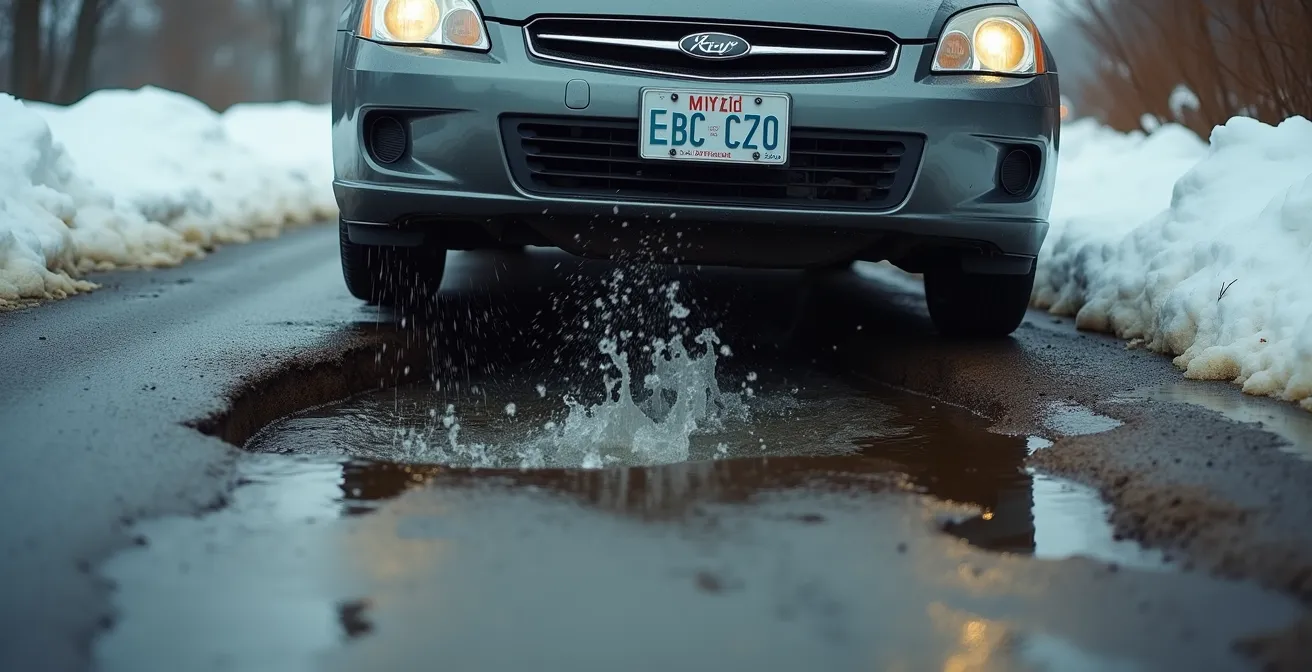
The jarring impacts from potholes are just the visible symptom; the real damage to your vehicle is a silent “degradation cascade” caused by Quebec’s unique road conditions.
- Road salt initiates a corrosive attack that weakens your car’s structure long before the first pothole hits.
- Impacts don’t just damage one part; they trigger a chain reaction, starting with your tires and alignment and moving deep into your suspension.
Recommendation: Shift from a reactive “pothole-dodging” mindset to a proactive maintenance philosophy focused on interrupting this destructive cycle at key moments in the season.
That sudden, violent *thud* followed by the sinking feeling in your stomach—it’s a grim rite of passage for every driver in Quebec. You grip the steering wheel, listen for new rattles, and wonder, “How much is this one going to cost me?” Year after year, Montreal drivers replace tie rods, repair bent rims, and fight with alignments that won’t hold. The common advice is always the same: drive slower, keep your tires inflated, and try to swerve. But as a suspension specialist who sees the aftermath daily, I can tell you this is a losing battle.
Simply trying to avoid potholes is like trying to stay dry in a rainstorm without an umbrella. You might dodge a few, but you’re going to get soaked eventually. The real issue isn’t the individual crater in the road. It’s a systematic assault on your vehicle, a perfect storm of conditions unique to our province. What if the key to protecting your car wasn’t just about reactive driving, but about understanding and interrupting a hidden chain reaction I call the degradation cascade? This is a destructive cycle where road salt, freeze-thaw cycles, and impact forces work together to dismantle your vehicle from the tires up.
This guide isn’t another list of tips on how to swerve. It’s a proactive maintenance philosophy. We will dissect this degradation cascade piece by piece, from the corrosive effects of salt to the surprising reason your rear brakes seize. By understanding this process, you can move from being a victim of our roads to a savvy owner who knows exactly when and where to act to protect your investment.
To navigate this complex topic, we’ve broken down the key challenges and solutions you’ll face as a Quebec driver. The following sections will guide you through the essential knowledge needed to shield your vehicle from the annual onslaught of our roads.
Summary: A Specialist’s Guide to Surviving Quebec Roads
- Why Do Quebec Cars Rust 3x Faster Than Those in British Columbia?
- How to Spot and Dodge Black Ice on Highway 20 Without Losing Control?
- Low Profile vs Standard Tires: Which Survives Montreal Streets?
- The Alignment Error That Destroys Winter Tires in Less Than 5,000 km
- When to Schedule Your Suspension Check: The Post-Thaw Sweet Spot
- Studded Tires vs Standard Winter: Which Is Better for Rural Living?
- Why Is the Hippolyte-Lafontaine Tunnel Renovation Taking So Long?
- Why Do Rear Brakes Seize More Often Than Front Brakes in Quebec?
Why Do Quebec Cars Rust 3x Faster Than Those in British Columbia?
The first step in the degradation cascade begins long before you hit your first spring pothole. It starts with a chemical assault. Each winter, Canadian roads are treated with about 5 million tonnes of road salt annually, and Quebec is a prime user of this corrosive mixture. But it’s not just the salt (sodium chloride); it’s often mixed with calcium chloride, which is effective at lower temperatures but even more aggressive on metal. This mixture turns the water on the road into a highly conductive electrolyte, dramatically accelerating the process of rust.
Furthermore, as detailed in studies on our climate, Quebec’s air contains significantly more pollutants like sulfur dioxide and nitrogen oxide than it did 50 years ago. When these pollutants mix with precipitation, they create acid rain, which etches away at your car’s protective clear coat. Once the paint is compromised—even by a tiny stone chip—the metal is exposed. The wheels then act as violent applicators, flinging this slushy, salty, and acidic cocktail into every crevice of your undercarriage, suspension components, and brake lines. This isn’t just surface rust; it’s a deep, structural weakening that makes every subsequent pothole impact more damaging.
To fight back, you need a multi-pronged defense:
- Apply Annual Rustproofing: An oil-based treatment is your best defense. It creates a self-healing barrier that creeps into seams and protects against Quebec’s aggressive salt mix.
- Wash Your Vehicle Frequently: In winter, this isn’t for aesthetics; it’s for survival. Use high-pressure wands to blast salt and grime from the wheel wells, undercarriage, and rocker panels.
- Install Protective Film: A clear plastic film on high-impact areas like door edges, the hood line, and rocker panels can prevent the initial paint chips that give rust a foothold.
- Inspect After Impacts: After hitting a significant pothole or a chunk of ice, check the area for paint damage. A quick touch-up can prevent a major rust problem down the line.
Think of this as the “salt tax” of driving in Quebec. Proactively managing it is the foundational step to ensuring your vehicle’s longevity.
How to Spot and Dodge Black Ice on Highway 20 Without Losing Control?
The same freeze-thaw cycles that create potholes also produce one of winter’s most treacherous hazards: black ice. It’s most common on bridges, overpasses, and shaded areas, but on a route like Highway 20, it often forms in the slight depressions and ruts of the road surface, sometimes disguising a pothole beneath. Spotting it is less about seeing the ice itself and more about recognizing the conditions and visual cues that signal its presence. Look for a glossy, wet-looking patch on the road when the surrounding pavement is dry. In low light, it can appear as a dark, dull spot.
This illustration highlights a classic scenario: a seemingly innocent puddle in a road depression that is actually a sheet of black ice hiding a pothole. The textural difference between the rough asphalt and the smooth, reflective ice is the critical visual tell.
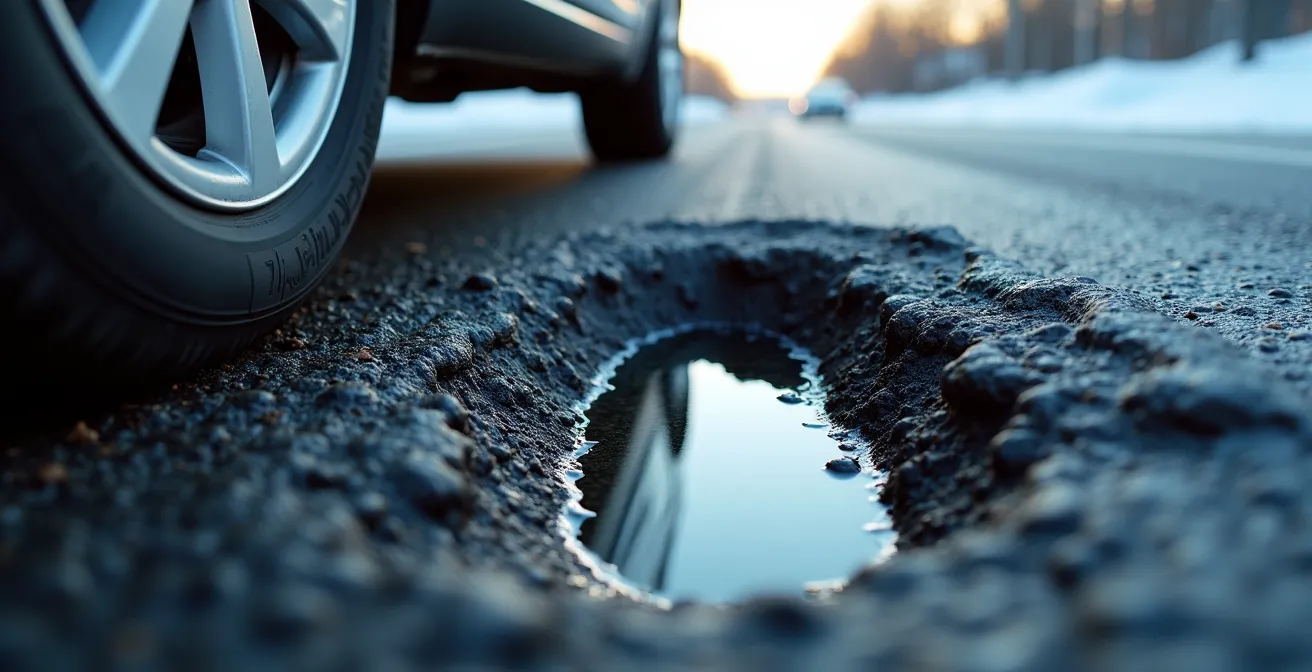
If you encounter a patch, the golden rule is to do as little as possible. Do not slam on the brakes. Do not jerk the steering wheel. Keep the wheel straight and ease off the accelerator until you feel the tires regain traction. Maintaining a firm grip on the wheel is crucial to resist the pull when your tire hits the edge of the ice or the hidden pothole. Your best defense is always anticipation and maintaining a safe following distance, giving you the time and space to react smoothly.
Here are key techniques for navigating these hidden threats:
- Watch for puddles that could be hiding ice-filled potholes, especially when temperatures are near freezing.
- Maintain a generous following distance to react if the vehicle ahead hits a hidden patch.
- Avoid sudden braking or steering movements on suspicious-looking surfaces.
- Be extra cautious during freeze-thaw cycles when black ice is most likely to form.
Low Profile vs Standard Tires: Which Survives Montreal Streets?
The second stage of the degradation cascade happens at the point of impact, and your tires are your first and only line of defense. The trend toward larger rims and low-profile tires on modern cars looks great in the showroom, but it’s a recipe for disaster on Montreal’s pockmarked streets. A low-profile tire has a short, stiff sidewall. When it hits the sharp edge of a pothole, there’s very little rubber and air to absorb the force. That energy is transferred directly to the wheel, often resulting in a bent or cracked rim, and to the suspension components behind it.
As the experts at CAA-Quebec state, the risk is significant. Their research confirms this vulnerability:
Low-profile tires—more and more late-model cars are equipped with them—can sustain severe damage from this kind of impact.
– CAA-Quebec Research, CAA-Quebec Vehicle Damage Report
A standard tire, with its taller, more flexible sidewall, acts like a crucial part of your suspension. It has more “component sympathy.” It can deform, absorb a significant portion of the impact energy, and protect the rim and suspension. This is why a common strategy for savvy Quebec drivers is to downsize their wheels for the winter, for instance, switching from 18-inch summer wheels to 17-inch winter wheels with higher-profile tires. The improved ride quality and impact resistance are well worth the change in aesthetics.
The following table, based on an analysis of pothole damage by CAA-Quebec, breaks down the stark differences:
| Aspect | Low Profile Tires | Standard Tires |
|---|---|---|
| Pothole Impact Resistance | Poor – Stiff sidewalls transfer force directly to rim | Good – Flexible sidewalls absorb impacts |
| Damage Risk | High – Increased rim damage and tire rupture | Moderate – Better cushioning protects components |
| Replacement Cost (Montreal) | $250-400 per tire + potential rim damage | $150-250 per tire |
| Winter Performance | Reduced – Less compliance on rough surfaces | Better – More forgiving on pothole-damaged roads |
| Recommended Strategy | Avoid for winter driving | Downsize for winter (e.g., 18″ to 17″) |
The Alignment Error That Destroys Winter Tires in Less Than 5,000 km
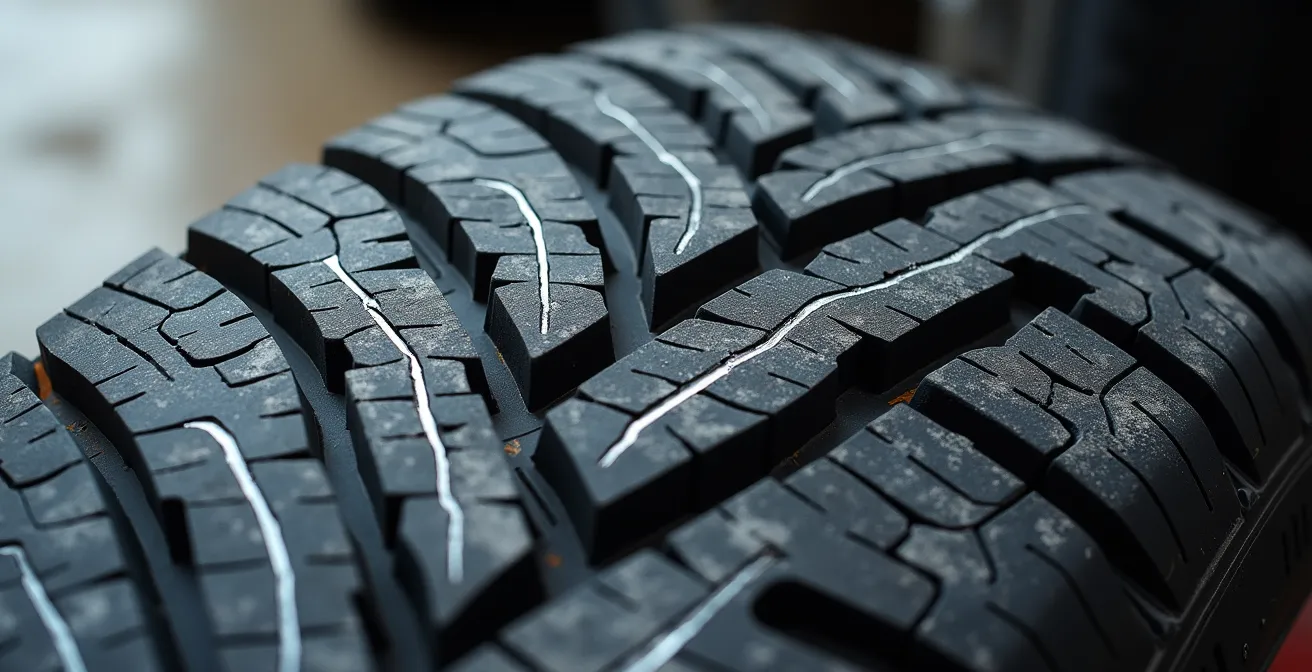
Every pothole impact, even minor ones, sends a shockwave through your suspension geometry. The most common and immediate casualty is your wheel alignment. When a wheel is knocked out of alignment, it no longer runs perfectly straight. It might be angled slightly inward (toe-in) or outward (toe-out). This means that as you drive, the tire is essentially being dragged sideways, scrubbing rubber off one edge continuously. The effect is devastatingly fast; statistics show that improper alignment can decrease tire life by up to 25%, but in Quebec’s harsh conditions, I’ve seen a brand new set of winter tires destroyed in under 5,000 km due to a bad post-pothole alignment.
The visual evidence is undeniable. A tire with a “toe-out” issue, as depicted below, will show severe, feathered wear on its inside edge while the outside edge looks almost new. This uneven wear not only ruins an expensive tire but also compromises your vehicle’s handling and stability, especially on slippery surfaces. The cost of a $120 alignment check is insignificant compared to the $1,200+ cost of premature tire replacement.
Because of this, alignment checks in Quebec should not be an afterthought. They must be a scheduled, non-negotiable part of your seasonal routine. Ignoring this is throwing money away, guaranteed. A proactive schedule is your best insurance policy against this rapid, costly wear.
Your Action Plan: The Quebec Seasonal Alignment Schedule
- November Inspection: When installing your winter tires, get the alignment checked. This catches any issues developed from summer driving and construction zones, ensuring your winter tires start on a perfect footing.
- April/May Mandatory Check: After the worst of pothole season is over and before you mount your summer tires, this is the most critical check of the year. This corrects the damage from winter’s assault.
- Visual Inspection Signs: Periodically, look at your front tires. Do you see uneven wear on the inside or outside edges? Is one side more worn than the other?
- Hands-On Test: Carefully run your hand over the tread surface. If you feel jagged or feathered edges on the tread blocks, your alignment is likely off.
- Cost-Benefit Analysis: Always weigh the cost. A $120 alignment check is a small investment to protect a $1,200 set of tires.
When to Schedule Your Suspension Check: The Post-Thaw Sweet Spot
If tires and alignment are the immediate victims of potholes, the suspension system is where the deep, expensive damage accumulates. Components like ball joints, tie rods, struts, and shocks form a complex network designed to keep your tires on the road and absorb imperfections. In Quebec, these parts live a brutal life. Each impact sends a jolt through the system, accelerating wear. After a long winter, your car’s suspension is fatigued and likely compromised.
The “post-thaw sweet spot”—typically from late April to early June—is the ideal time for a professional suspension inspection. The snow is gone, the roads are (mostly) dry, and the full extent of winter’s damage has been revealed. Don’t wait for a catastrophic failure. Listen to your car. It will tell you when things are wrong. Before you even see your mechanic, you can perform a self-diagnosis by being attentive to new sounds and feelings. A “clunk” over a speed bump, a “floating” feeling on the highway, or the car “nose-diving” during braking are all classic signs of worn suspension components.
The costs of ignoring these signs are significant. As outlined in data from CAA-Quebec on common pothole damage, replacing a single suspension arm costs between $150 and $350, plus the mandatory wheel alignment afterward. Letting one worn part go can cause a domino effect, putting extra stress on other components and leading to a much larger repair bill.
Use this checklist to document your car’s symptoms before your appointment:
- Listen for “clunking” or rattling sounds when driving over bumps or uneven roads.
- Feel for a “floating” or disconnected sensation on the highway, a sign of worn shocks.
- Notice if the front of the car “nose-dives” when you apply the brakes firmly.
- Check for excessive swaying or rolling when you take corners.
- Look at your tires for cupping or scalloping patterns, which indicate bouncing from bad shocks.
- Test for excessive bounce: push down hard on a corner of the car. If it bounces more than once or twice, your shocks are likely worn.
Studded Tires vs Standard Winter: Which Is Better for Rural Living?
For drivers outside the main urban corridors of Montreal or Quebec City, the “degradation cascade” has another layer: ice-covered gravel and poorly plowed secondary roads. In these conditions, the debate between studded and modern studless winter tires becomes critical. While studless winter tires offer fantastic performance on most winter surfaces thanks to advanced rubber compounds and siping, they can be overwhelmed by the sheer ice found in hilly regions like the Eastern Townships or Charlevoix.
Studded tires provide a mechanical advantage. The small metal studs physically dig into ice, providing superior grip during acceleration, braking, and cornering on icy surfaces. This is especially true on ice-filled potholes or frozen gravel roads where a rubber compound alone struggles to find purchase. However, this advantage comes with trade-offs: significant road noise on dry pavement, accelerated wear when driven on clear highways, and legal restrictions on their use (typically allowed from October 15 to May 1 in Quebec).
The choice is highly dependent on your specific location and driving habits. If your daily commute involves steep, icy hills or unpaved rural roads, the safety margin provided by studs can be a lifesaver. If you primarily drive on well-maintained urban or suburban roads, a high-quality studless tire is often the quieter, more comfortable, and equally safe choice. This decision requires an honest assessment of your real-world driving conditions.
This comparative table, drawing on information from the Quebec government’s winter driving guidelines, clarifies the decision:
| Factor | Studded Tires | Standard Winter Tires |
|---|---|---|
| Legal Period | October 15 – May 1 (Quebec) | December 1 – March 15 (mandatory) |
| Ice-filled Pothole Grip | Excellent – Studs bite through ice layer | Good – Relies on rubber compound |
| Gravel Road Performance | Superior traction on icy gravel | Adequate but less grip |
| Highway Noise | Significant – Metallic clicking | Quiet operation |
| Dry Pavement Wear | Accelerated stud wear | Normal wear patterns |
| Best For | Hilly regions (Eastern Townships, Charlevooix) | Flat areas with paved road access |
Why Is the Hippolyte-Lafontaine Tunnel Renovation Taking So Long?
It’s easy to curse the potholes and the endless construction, but as a specialist, it’s important to provide context. The state of your suspension is a direct reflection of the state of our infrastructure. Quebec faces the monumental challenge of managing 325,000 km of roads. In a city like Montreal, decades of aging infrastructure, coupled with insufficient maintenance budgets and our brutal freeze-thaw cycles, have created a perfect storm for road degradation. The massive, multi-year renovation of the Hippolyte-Lafontaine tunnel is a symptom of this larger issue: we are playing catch-up on decades of wear.
This has a direct impact on the degradation cascade affecting your vehicle. The detours and increased traffic on surrounding arteries concentrate wear and tear. More stop-and-go driving puts stress on your brakes and transmission, while the detour routes themselves, often not designed for such heavy volume, degrade faster and become riddled with their own potholes. This creates a feedback loop: aging infrastructure causes construction, which in turn accelerates the wear on both alternate routes and the vehicles forced to use them.
While you can’t repave the roads yourself, you can adapt your strategy to minimize the accelerated wear during these major construction periods. Avoiding peak traffic hours (7-9 AM, 4-6 PM) reduces the constant braking and accelerating that wears down components. Maintaining proper tire pressure becomes even more critical with extended driving times. Most importantly, if your commute is regularly impacted by major detours, you must factor in more frequent maintenance checks for brakes, tires, and suspension. Acknowledging this systemic issue allows you to plan for it, rather than be surprised by it.
Key Takeaways
- Quebec’s combination of heavy road salt use and freeze-thaw cycles creates a uniquely corrosive environment that is the first step in damaging your vehicle.
- Your tire choice is critical; low-profile tires significantly increase the risk of damage to rims and suspension components from pothole impacts.
- A bad alignment is the fastest way to destroy a set of tires. Seasonal alignment checks are non-negotiable for any Quebec driver.
Why Do Rear Brakes Seize More Often Than Front Brakes in Quebec?
Here we arrive at the final, and often most surprising, stage of the degradation cascade: the seized rear brake caliper. Many drivers are shocked when their mechanic tells them their rear brakes need a major, costly service, even though the pads are still thick. The reason is a combination of physics and our corrosive environment. During normal driving, your front brakes do the vast majority of the work. Due to weight transfer under deceleration, they are responsible for handling 70-80% of the braking force, leaving the rear brakes to do very little.
Because they are used so little, the components—specifically the caliper slider pins—don’t move much. Now, add in the salty slush that’s constantly being sprayed onto the undercarriage all winter. This corrosive mixture works its way into the caliper assembly. While the front brakes generate enough heat to burn off some of this moisture, the cooler rear brakes do not. The moisture and salt sit there, causing the slider pins to rust and seize in place. When the pins are seized, the brake pads are held lightly against the rotor at all times, causing drag, overheating, and rapid wear. It’s a classic case of a part failing not from overuse, but from a combination of disuse and corrosion.
Preventing this is simple and far cheaper than replacing a seized caliper and warped rotor. It requires a specific, proactive maintenance step that should be part of your seasonal routine.
- Request a Rear Brake Service: Every time you change your tires (twice a year), ask your mechanic to service the rear brakes. This involves disassembling the calipers, cleaning all the salt and corrosion, and lubricating the slider pins. It’s a low-cost service ($40-$60) that prevents a high-cost repair.
- Avoid the Parking Brake in Deep Winter: In freezing, slushy conditions, moisture can freeze the parking brake cable or components, causing the rear brakes to stick. Use wheel chocks if parking on an incline.
- Inspect for Salt Buildup: After driving through heavy slush, take a moment to look at your wheels. If you see them caked in salty residue, a quick rinse can help mitigate the corrosive effects.
This is the final piece of the puzzle—a perfect example of how the Quebec environment silently attacks the parts of your car you’re not even thinking about.
By adopting this proactive philosophy—from rustproofing and choosing the right tires to scheduling regular alignment and brake servicing—you can break the expensive cycle of pothole damage. Your vehicle is an investment; it’s time to give it the strategic defense it needs to survive on Quebec roads.