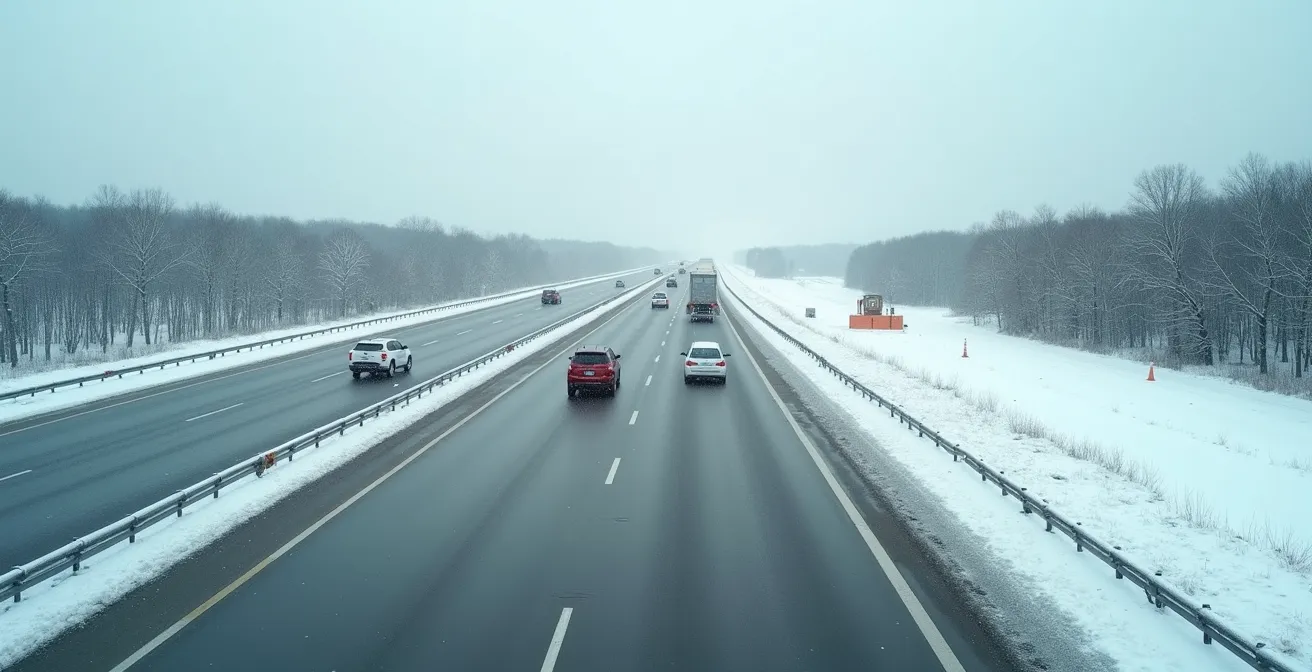
The key to avoiding accidents isn’t just following traffic laws; it’s developing a predictive mindset that anticipates errors before they happen.
- Most collisions are preventable by reading the “road story”—observing cues that signal another driver’s next move.
- Managing your “traction budget” is more critical than just slowing down, especially on Quebec’s icy winter roads.
Recommendation: Shift your focus from simply reacting to threats to actively predicting them by looking 15 seconds ahead and understanding the physics of your vehicle.
As a senior driving instructor in Quebec, I’ve heard it all. The roads feel more crowded, the construction on the Décarie is endless, and every winter brings a fresh wave of drivers who seem to forget how to handle a little “poudrerie.” You follow the rules, you keep your distance, but you still have that nagging feeling that someone else’s mistake is going to become your problem. It’s a common and justified anxiety for any conscientious driver.
Most defensive driving advice revolves around a simple checklist: check your mirrors, don’t speed, stay off your phone. While these are essential, they are merely the baseline. They teach you to react. But what if the true secret to safety wasn’t about reacting faster, but about not having to react at all? What if the key was to see the accident brewing five, ten, even fifteen seconds before it happens?
This is the core of the predictive mindset. It’s a shift from being a passive participant obeying signs to an active observer reading the road like a story. You learn to spot the subtle clues—the wavering car, the driver whose head is turned, the truck hugging the line—that tell you the next chapter might be a sudden lane change or a panic brake. It’s a skill, and like any skill, it can be learned.
This guide is designed to teach you that skill. We will move beyond the basic rules to explore the specific techniques and mental models that allow you to anticipate and neutralize threats, with a special focus on the unique challenges we face on Quebec roads, from treacherous black ice to the colossal blind zones of a snowplow.
By exploring each of these specific scenarios, you will build a complete system for proactive driving. The following sections break down the essential skills, from mastering your vehicle’s visibility to making the critical ‘no-go’ decision in a winter storm.
Summary: A Proactive Guide to Navigating Quebec’s Driving Challenges
- How to Adjust Your Mirrors to Eliminate Blind Spots Completely?
- Why Looking 15 Seconds Ahead Saves You From Panic Braking?
- Truck Blind Zones: Where Not to Hang Out on the Highway?
- The 2 AM Danger: Recognizing Microsleep Before You Crash
- The 3-Second Rule: How to maintain space in Heavy Traffic?
- When to Cancel Your Trip: Interpreting Transports Québec Road Conditions
- The Reaction Time Trap: Trusting ACC Too Much in Stop-and-Go
- How Much Longer Does It Take to Stop on Black Ice vs Dry Asphalt?
How to Adjust Your Mirrors to Eliminate Blind Spots Completely?
The term “blind spot” is a misnomer; it’s not a flaw in your car, but a flaw in your setup. A properly adjusted set of mirrors creates a seamless, panoramic view around your vehicle, where a car leaving your rearview mirror appears simultaneously in your side mirror. Yet, many drivers set their mirrors to see the side of their own car, creating a massive, dangerous overlap and leaving the adjacent lanes invisible without a shoulder check. This isn’t a minor issue; a SAAQ survey revealed that a staggering 62% of Quebec drivers don’t know where truck blind spots are, a problem that starts with misunderstanding their own.
Eliminating blind spots is the first step in building your predictive mindset. It gives you the raw data you need to start reading the road story. The SAAQ-endorsed method is simple but requires you to break an old habit. The goal is to pivot your side mirrors outward until the view of your own car almost disappears.
Follow this precise method, especially crucial before heading out in Quebec’s challenging winter conditions:
- Clear Your View: Before any adjustment, completely clear all snow and ice from every mirror and window. A heated mirror is useless if it’s covered in grime.
- Set Your Position: Sit in your normal driving position with your seatbelt on and your seat adjusted correctly. This is your reference point.
- Adjust the Rearview Mirror: Set your center rearview mirror to frame the entire rear window. You should be able to see out the back without moving your head.
- Adjust the Left Side Mirror: Lean your head to the left until it touches the driver’s side window. Now, adjust the left mirror so you can just barely see the side of your vehicle.
- Adjust the Right Side Mirror: Lean to your right toward the center console. Adjust the right mirror so you can just barely see the right side of your vehicle from this position.
When you return to your normal driving position, you will no longer see the sides of your car in your side mirrors. This is correct. Test it: watch a car pass you in an adjacent lane. It should flow smoothly from your rearview mirror, to your side mirror, and then into your peripheral vision without ever disappearing. Even with this setup, a quick shoulder check is non-negotiable, especially when winter road salt and slush can obscure sensors and windows in an instant.
Why Looking 15 Seconds Ahead Saves You From Panic Braking?
Most drivers look at the car directly in front of them. Their entire world is the bumper ahead, reacting to its brake lights. This is not driving; it’s following. A predictive driver, however, is looking 15 seconds down the road. At 100 km/h on the highway, that’s about 400-450 metres ahead—the distance of several overpasses. This isn’t about seeing details; it’s about seeing the story unfold. You’re not just seeing cars; you’re seeing patterns, slowdowns, and potential conflicts long before they become emergencies.
Looking this far ahead transforms you from a reactor to a planner. You see the cluster of brake lights two kilometres away and ease off the gas now, instead of slamming on the brakes in 30 seconds. You see the transport truck beginning to merge far ahead and proactively adjust your lane or speed to create space. According to defensive driving programs, this scanning technique gives you the crucial time to anticipate and plan your next move calmly. The method involves a systematic pattern: check far ahead (12-15 seconds), check near (4-5 seconds), and glance at your instruments, constantly updating your mental map of the situation.
This driver’s-eye view of a Quebec highway demonstrates the concept. Your immediate focus isn’t the car 50 metres ahead, but the flow of traffic near the next overpass, hundreds of metres away. That is where the next part of the road story is being written.
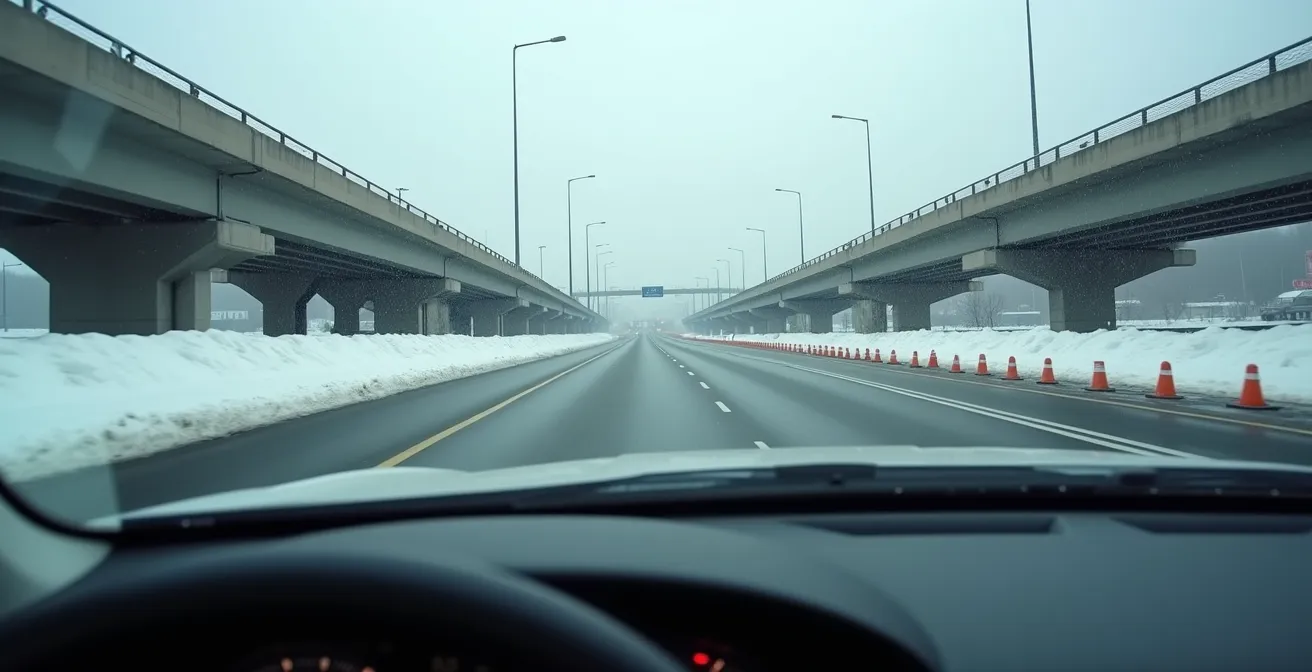
This technique is your defense against panic. A panic stop is a failure of prediction. By looking far ahead, you see the hazard, recognize the pattern, and can react with a gentle release of the accelerator or a smooth, controlled application of the brakes. You replace the adrenaline of a near-miss with the calm confidence of a pilot who saw the weather changing and altered course miles ago. This is the essence of a predictive mindset.
Truck Blind Zones: Where Not to Hang Out on the Highway?
If you can’t see a truck driver’s face in their mirrors, they absolutely cannot see you. This simple rule could prevent thousands of collisions. The blind spots around a large tractor-trailer are not small; they are vast “No-Zones” where a car can completely vanish. These zones are directly in front, directly behind, and along both sides of the truck, with the right-side blind spot being significantly larger. The danger is severe; data shows that nearly 30% of fatal truck accidents involved the truck’s front end striking vehicles that were hidden in these blind spots.
For a Quebec driver, this danger is amplified. Consider a logging truck on its way to the Mauricie region or a massive snowplow with its wings extended on Autoroute 40. Their blind zones are even more extensive and unpredictable than a standard transport. Lingering in these areas, or “hanging out,” is one of the most dangerous gambles you can take on the road. Your predictive mindset must include a constant awareness of these zones whenever you are near a heavy vehicle.
The goal is to pass through these No-Zones as quickly and efficiently as possible. Do not cruise alongside a truck. When you pass, do it decisively on the left side where the blind spot is smaller. The following table gives a general idea of the size of these No-Zones, which can vary based on the specific truck and its load.
| Vehicle Type | Front Blind Spot | Rear Blind Spot | Left Side | Right Side |
|---|---|---|---|---|
| Standard Tractor-Trailer | 20 feet | Up to 200 feet | 1 lane wide, 1/3 trailer length | 2-3 lanes wide, full trailer length |
| City Bus | 10-15 feet (flat front) | Shorter due to rear window | Significant area despite mirrors | Larger for articulated buses |
| Snowplow with Wings | 20+ feet | Variable with equipment | Extended by side wings | Extended by side wings |
| Logging Truck | 20 feet | Up to 30 feet beyond load | Standard truck zones | Obscured by load overhang |
Remember that a truck driver has a job to do, which includes navigating traffic, monitoring gauges, and communicating on the radio. They are managing 80,000 pounds of momentum. It is your responsibility as a driver of a smaller, more agile vehicle to stay visible and give them the space they need to operate safely. Assume you are invisible, and act accordingly.
The 2 AM Danger: Recognizing Microsleep Before You Crash
You can be the most skilled driver in the world, but fatigue is the great equalizer. It impairs your judgment, slows your reaction time, and can lead to a state of “microsleep”—a brief, involuntary episode of sleep that can last for a fraction of a second or up to 30 seconds. If you’re driving at 100 km/h, a four-second microsleep means you’ve travelled the length of a football field completely blind. The consequences are devastating; in Canada, The International Transport Forum reports that 1,768 fatalities were caused by driving accidents, with fatigue being a major contributing factor in many of them.
The danger of microsleep is its subtlety. It’s not like falling asleep in bed. It’s a creeping fog that dulls your senses. The “2 AM danger” isn’t just about the time on the clock; it’s about a state of being that can occur after a long day at work, during a monotonous drive on the 20 between Montreal and Quebec City, or when you’re feeling unwell. Your predictive mindset must also be turned inward, recognizing the signs of fatigue in yourself before you become a statistic.
Your body sends clear warning signals before a microsleep episode. The problem is that many drivers either ignore them or fail to recognize their severity. A feeling of a “second wind” is particularly deceptive; it’s often a sign of extreme fatigue, not recovery. Be honest with yourself and watch for these critical indicators:
- Difficulty focusing, frequent blinking, or heavy eyelids.
- Daydreaming or having thoughts that are disconnected from the task of driving.
- Trouble remembering the last few kilometres driven or missing your exit.
- Repeated yawning or rubbing your eyes.
- Drifting from your lane, hitting the rumble strips, or tailgating unintentionally.
- The most critical sign: your head starts bobbing. This is not just tiredness; this is your body on the verge of shutting down.
If you experience any of these signs, the only safe response is to pull over. Not in five minutes, but now. Find a safe place like a rest stop or a well-lit parking lot. A 20-minute nap, a short walk, or a caffeinated beverage can make a life-or-death difference. Fighting through fatigue is a battle you will eventually lose.
The 3-Second Rule: How to maintain space in Heavy Traffic?
Space is the most valuable commodity on the road. It gives you time to think, time to react, and room to maneuver. The most common mistake I see every day in heavy traffic is tailgating. Drivers believe that by staying close to the car in front, they will get there faster or prevent others from cutting in. In reality, they are simply erasing their safety margin and setting themselves up for a rear-end collision. The foundational rule for managing this space is the 3-second rule.
The concept is simple: when the vehicle in front of you passes a fixed object (like a sign, an overpass, or a distinct mark on the road), you should be able to count “one-thousand-one, one-thousand-two, one-thousand-three” before your vehicle passes the same object. If you arrive sooner, you are following too closely. This isn’t a suggestion; it’s a minimum safety buffer under ideal, dry conditions. It gives you enough time to perceive a hazard and apply the brakes to avoid a collision.
However, in Quebec, “ideal conditions” are a seasonal luxury. Rain, slush, snow, and ice drastically reduce the friction between your tires and the road. This means you have a smaller “traction budget” to spend on stopping, turning, or accelerating. When your traction budget is low, your following distance must increase proportionally. The 3-second rule becomes the 4, 6, or even 10-second rule. The SAAQ provides clear guidelines for adjusting this distance based on road conditions.
This table is not just advice; it’s a critical adjustment protocol. As a predictive driver, you must constantly assess the road surface and adjust your following distance accordingly, as shown in this analysis of winter driving safety.
| Road Condition | Minimum Following Distance | Speed Adjustment | Visibility Factor |
|---|---|---|---|
| Dry Summer Asphalt | 3 seconds | Posted limit safe | Clear visibility |
| Wet Roads/Light Rain | 4-5 seconds | Reduce by 10-15 km/h | Good visibility |
| Heavy Rain/Slush | 6 seconds | Reduce by 20 km/h | Moderate visibility (250-500m) |
| Fresh Snow | 8 seconds | Reduce by 30 km/h | Variable visibility |
| Ice/Potential Black Ice | 10+ seconds | Reduce by 40-50% | Watch for black ice zones |
Maintaining proper following distance is an active, not a passive, task. It requires you to resist the pressure from drivers behind you and prioritize your own safety buffer. Remember, the person who rear-ends another vehicle is almost always at fault. By maintaining your space, you protect yourself both physically and legally.
When to Cancel Your Trip: Interpreting Transports Québec Road Conditions
Sometimes, the smartest defensive driving move is to not drive at all. In Quebec, winter storms can transform a routine commute into a high-risk expedition. The ability to correctly interpret the information provided by services like Québec 511 is a critical skill for any predictive driver. It’s not just about knowing if there’s snow; it’s about understanding what the official terminology truly means for your vehicle’s ability to grip the road.
The official road condition terminology is very specific. “Partly Snow-Covered” (partiellement enneigée) is one of the most misunderstood and dangerous conditions. It means one side of your car has good traction on bare pavement while the other is on slippery, hard-packed snow. This differential traction can cause your vehicle to pull unexpectedly or even spin out during a lane change or on a curve. “Ice-Covered” (chaussée glacée) is an unambiguous red flag representing maximum danger.
Visibility is the other half of the equation. “Poor” visibility is defined as being able to see less than 250 metres ahead. Driving on an ice-covered road is dangerous. Driving on an ice-covered road when you can’t see 250 metres in front of you is reckless. A predictive driver doesn’t just look at one factor; they combine the data. They see “Partly Snow-Covered” plus “Poor Visibility” plus a forecast of freezing rain and make the ‘No-Go’ decision. Postponing a non-essential trip is not an inconvenience; it’s an intelligent risk assessment.
Furthermore, icons showing accidents or stalled vehicles are not just points on a map. In a storm, one accident on a major artery can create hours of gridlock with no escape routes, leaving you stranded in a dangerous situation. Seeing multiple warning icons on your planned route is a strong signal to stay home. Your car’s advanced safety systems are remarkable, but they cannot defy the laws of physics on a sheet of ice.
The Reaction Time Trap: Trusting ACC Too Much in Stop-and-Go
Modern vehicles are packed with incredible driver-assistance technologies like Adaptive Cruise Control (ACC). These systems can reduce driver workload, especially in stop-and-go traffic. However, they also create a new, subtle danger: automation complacency. Drivers can become so reliant on the system to manage speed and distance that their own attention begins to wander. They stop actively scanning the road and effectively become passengers in their own car.
The problem is that ACC is not a substitute for an engaged driver. It sees the car in front of you, but it cannot see the child about to run into the street, the car two lanes over about to make a sudden cut-off, or the patch of black ice on the road ahead. An insurance provider study warns that Canadian weather can fool these sensors, particularly during heavy snowfall or the low sun glare on wet roads common in Quebec winters. The system is a tool, not a co-pilot.
Case Study: The ‘Engaged Co-Pilot’ Strategy
To combat automation complacency, Canadian insurance provider Optiom promotes an “Engaged Co-Pilot” strategy. This approach encourages drivers to use ACC to manage the monotonous task of maintaining speed but requires them to remain fully mentally engaged. This means keeping your foot hovering over the brake pedal in heavy traffic, ready to intervene instantly. It also means continuing to actively scan the entire environment for threats the system is blind to, such as pedestrians, cyclists, or vehicles making abrupt moves. This strategy is especially critical in the unpredictable stop-and-go traffic approaching major Quebec bottlenecks like the Lafontaine Tunnel or the Champlain Bridge, where sudden stops are frequent.
Your predictive mindset must account for the limitations of your own technology. Trusting ACC to handle everything is a trap. It can lull you into a false sense of security, lengthening your true reaction time because you first have to recognize the system is failing, then re-engage with the situation, and finally take action. By adopting the Engaged Co-Pilot strategy, you get the benefits of the technology without surrendering your ultimate responsibility as the vehicle’s commander.
Key Takeaways
- The ultimate goal of defensive driving is to cultivate a predictive mindset, allowing you to see and neutralize hazards before they become emergencies.
- Your vehicle’s ability to stop is determined by a finite “traction budget,” which is drastically reduced by water, snow, and ice, requiring a proportional increase in following distance.
- A core skill is making the “No-Go” decision: knowing when road conditions, as reported by official sources like Québec 511, make travel too risky to be worthwhile.
How Much Longer Does It Take to Stop on Black Ice vs Dry Asphalt?
The most terrifying experience for any driver, seasoned or novice, is the moment they hit black ice. The steering goes light, the road noise disappears, and you feel a profound sense of disconnection from the vehicle. This is because your “traction budget” has just dropped to nearly zero. Understanding the physics of this situation is key to surviving it. The question isn’t just if it takes longer to stop, but how much longer. The answer is: almost infinitely longer if you panic.
On dry asphalt, a good set of tires provides a high coefficient of friction, allowing you to stop from 50 km/h in about 14 meters. On black ice, that same stop can take up to 10 times longer, over 120 meters. This is a staggering difference. The problem is that by the time you realize you’re on ice, it’s often too late to brake in the traditional sense. Slamming on the brakes on ice is the worst possible reaction. It locks the wheels (even with ABS, effectiveness is minimal), guarantees a skid, and relinquishes what little control you had.
The predictive driver’s defense against black ice happens *before* they hit the patch. It involves recognizing high-risk zones—bridges, overpasses, and shaded areas, especially during freeze-thaw cycles around 0°C—and reducing speed proactively. If you do find yourself in a slide, you must fight every instinct to brake and instead follow a strict protocol.
Action Plan: Black Ice Detection and Response
- Detect the Signs: A sudden feeling of lightness in the steering or a complete loss of tire noise are your primary cues that you’ve lost traction.
- Ease Off the Accelerator: Your first action is to immediately and smoothly take your foot off the gas. Do not touch the brake pedal.
- Look and Steer Where You Want to Go: Your car will tend to go where your eyes are looking. Focus on your intended path, not the guardrail or ditch. Keep the steering wheel straight or make only small, gentle corrections.
- Wait for Traction: Be patient. The slide will end when your tires find a surface with more grip. Do not attempt to accelerate or brake until you feel the tires bite again.
- Prevent It: The best response is prevention. Slow down significantly *before* entering high-risk areas like bridges or overpasses when temperatures are near freezing.
Mastering your reaction to black ice is the ultimate test of a predictive driver. It requires replacing panic with a calm, practiced procedure. It reinforces the most important lesson: the most critical safety feature in any car is a driver who understands and respects the laws of physics.
By cultivating a predictive mindset and applying these specific techniques, you transform yourself from a potential victim of circumstance into the master of your own safety. The next step is to make these practices an ingrained habit every time you get behind the wheel.
Frequently Asked Questions About Interpreting Québec 511
What does ‘Chaussée glacée’ mean and should I drive?
‘Chaussée glacée’ means ice-covered roadway – the most dangerous condition. Unless you have proper winter tires, AWD/4WD, and extensive winter driving experience, this is a strong ‘No-Go’ signal, especially if combined with poor visibility or freezing rain warnings.
How do I interpret multiple warning icons on the same route?
Multiple warnings compound risk exponentially. One accident icon during a snowstorm can create hours of gridlock with no escape routes. If you see accident icons plus weather warnings plus ‘partly covered’ roads or worse, postpone non-essential travel immediately.
When is ‘Partiellement enneigée’ actually dangerous?
‘Partiellement enneigée’ (partly snow-covered) creates differential traction where one side of your vehicle has different grip than the other. This becomes critically dangerous during lane changes, on curves, or when combined with ice patches. Add any freezing precipitation warning and it becomes a ‘No-Go’ for most drivers.