
Passing the SAAQ inspection for a modified car in Quebec isn’t about hiding your mods; it’s about strategically proving they meet minimum safety standards.
- The SAAQ inspector’s job is to check for legal compliance, not to judge your build’s performance or aesthetics.
- A pre-inspection with a knowledgeable mechanic is not a cost, but an investment against a mandatory, more expensive re-inspection.
Recommendation: Treat your car’s documentation and modification history as a critical part of your ‘legality profile’ to present to the inspector.
There’s a specific, sinking feeling every modified car owner in Quebec knows. It’s the flash of police lights in the rearview mirror, not because you were speeding, but because your car simply *looks* different. That lowered stance, the deep rumble of a new exhaust, or the sleek look of tinted windows can all trigger unwanted attention and the dreaded 48-hour notice for a SAAQ mechanical inspection. The common advice, “just make sure it’s legal,” is frustratingly vague when you’ve invested time and money into personalizing your vehicle.
The world of automotive modification is vast, from ECU tunes promising more power to suspension adjustments for the perfect fitment. Yet, many enthusiasts approach the mandatory inspection with a mix of hope and fear, crossing their fingers that the inspector is having a good day. This is a flawed strategy. The key to passing isn’t luck; it’s about shifting your perspective. You must stop thinking like an owner and start thinking like the inspector.
This guide abandons the guesswork. We’re going to build your car’s “legality profile” by dissecting the SAAQ’s criteria from a consultant’s point of view. It’s not about what’s cool or what’s fast; it’s about understanding the non-negotiable safety and compliance points that determine a pass or a fail. By mastering the inspector’s mindset, you transform the inspection from a threat into a manageable checkpoint.
This article will guide you through the most common inspection pitfalls for modified vehicles in Quebec. From window tints and exhaust noise to lift kits and rebuilt titles, you will learn the specific rules and, more importantly, the strategy to navigate them successfully. The following sections provide a clear roadmap to ensure your vehicle is not just a reflection of your passion, but also fully compliant with Quebec law.
Table of Contents: Passing the SAAQ Inspection for Modified Cars
- Is Your Window Tint Legal in Quebec: The 70% Light Rule?
- How to Measure Your Exhaust Decibels to Avoid a Fine?
- Lifted Trucks: What Height Is Legal on Quebec Roads?
- The 48-Hour Notice: What Happens If Police Send You for Inspection?
- When to Inspect a Stored Car Before Putting It Back on the Road?
- SAAQ Inspection vs General Check-Up: What Is the Difference?
- The Cheap Performance Chip Scam That Can Melt Your Pistons
- How to Buy a “Rebuilt” (VGA) Car Without Getting Scammed?
Is Your Window Tint Legal in Quebec: The 70% Light Rule?
Window tint is one of the most common modifications and, consequently, one of the most frequent reasons for a fine or inspection failure in Quebec. The rule is straightforward but often misunderstood. The core principle is not about how dark the tint *film* is, but how much light passes through the entire window assembly. The law mandates that the front side windows (driver and front passenger) must allow at least 70% of light to pass through. This is known as 70% Visible Light Transmission (VLT). In practice, this means you can only apply a very light tint, as factory glass itself is not 100% transparent.
The windshield is even more restrictive: tint is only permitted on a 15 cm (6-inch) strip at the top. Any tint below this line is illegal and will result in an immediate failure. Fortunately, for the rear side windows and the rear windshield, there are no VLT restrictions. You can apply any level of darkness you prefer, from a light smoke to a full “limo” tint. This discrepancy is a source of confusion, leading many to incorrectly assume the same rules apply to all windows.
Failing to comply with these regulations can be costly. Fines for illegal window tint in Quebec can range from $154 to $274 for a standard passenger vehicle. If a police officer deems your tint too dark, they can issue a ticket on the spot and may also give you a 48-hour notice to have the tint removed and the vehicle inspected. To avoid this, understanding and verifying your tint’s legality is a crucial part of managing your car’s legality profile.
Action Plan: Your 4-Step Window Tint Compliance Checklist
- Verify Front Windows: Ensure your front driver and passenger side windows allow a minimum of 70% VLT. This effectively means a maximum of 30% tint can be applied to standard glass.
- Check Windshield Strip: Measure the tinted strip at the top of your windshield. It must not extend more than 15 cm (6 inches) down from the top edge.
- Confirm Rear Windows: Check that any dark tint is restricted to the rear side windows and the rear windshield only. Any level of darkness is acceptable here.
- Get a Professional Measurement: If you have any doubt, visit a certified inspection center or a reputable tint shop. They can measure your VLT with a photometer to give you a definitive pass or fail reading.
How to Measure Your Exhaust Decibels to Avoid a Fine?
The sound of your car is a defining feature, but an aftermarket exhaust is a primary target for police attention. The Quebec Highway Safety Code is subjective on this point, stating an exhaust system must not be “likely to disturb the peace.” However, during a SAAQ inspection, the test is objective and precise. The inspector uses a sonometer (decibel meter) to measure the noise level. The key is to understand this testing protocol to anticipate the result.
The official SAAQ procedure involves placing the meter 50 cm from the exhaust tip at a 45-degree angle. The test is performed at a specific RPM—typically a high idle or around 2,500 RPM, depending on the vehicle. While there isn’t a single, universally published decibel limit that fits all cars and situations, the unwritten rule among inspectors and tuners hovers around 95-100 dB as the absolute maximum. Anything significantly over 100 dB is almost certain to fail.
This is a classic example of the “Inspector’s Mindset.” They are not concerned with how good the exhaust sounds or the brand name; they are concerned with a single, measurable number. Systems with removable silencers or baffles are a grey area. While a silencer might help you pass the test, if it’s easily removable, an officer can still ticket you if they believe the intent is to drive without it. Your best strategy is to have a high-quality system that is engineered to be sporty yet compliant, or to know for a fact that your setup with a silencer installed passes the 50 cm test.
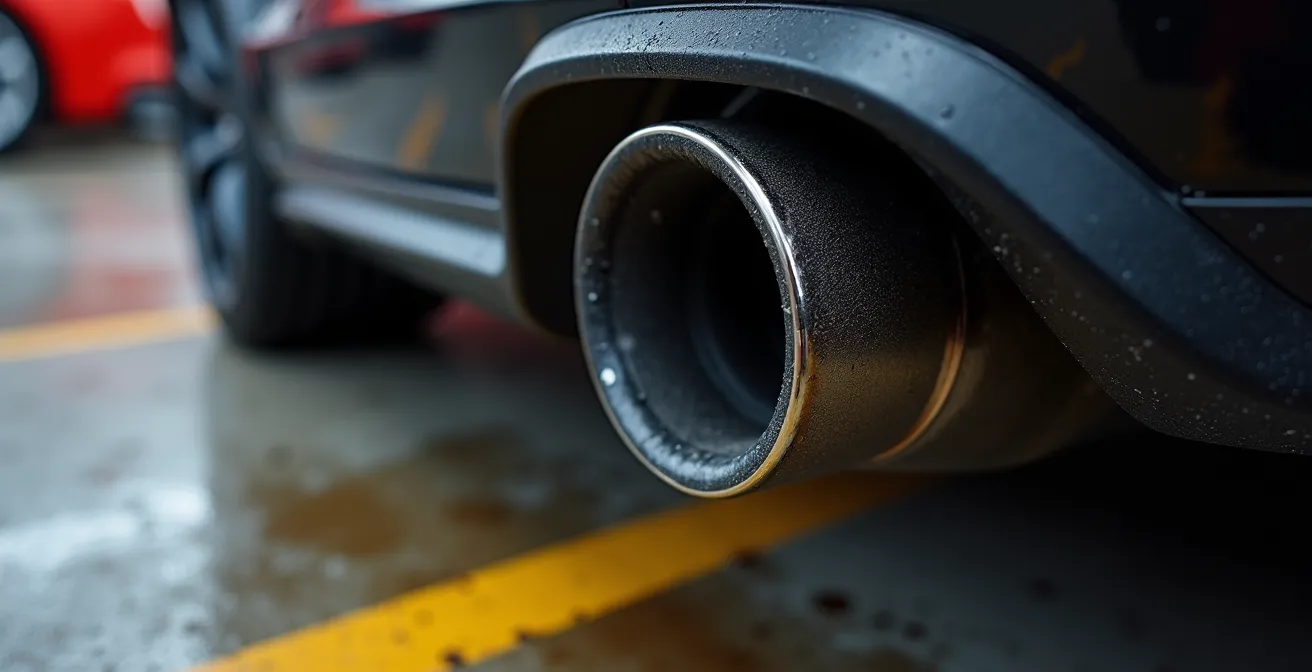
As the image illustrates, the process is clinical and data-driven. The texture of the carbon buildup on the exhaust tip is irrelevant to the inspector; only the reading on the decibel meter matters. Investing in a quick test at a performance shop before your official inspection can save you the headache and cost of a failure.
Lifted Trucks: What Height Is Legal on Quebec Roads?
For truck enthusiasts, a lift kit is a transformative modification, providing both aesthetic appeal and off-road capability. However, it also brings the vehicle under strict scrutiny from the SAAQ regarding safety dimensions. The primary concern is bumper height, which is critical for ensuring compatibility with other vehicles’ safety structures in the event of a collision. An overly high bumper can override a smaller car’s crash protection, leading to catastrophic consequences.
The regulations are clear on this point. Canadian vehicle modification standards specify a maximum bumper height, which is enforced in Quebec. For trucks, the bumper’s lowest point cannot exceed 750mm (approximately 29.5 inches) from the ground. It’s crucial to remember that this measurement is affected by both the suspension lift and the size of your tires. A 4-inch lift kit combined with 35-inch tires will have a much greater impact on bumper height than the lift kit alone.
Headlight height is another critical factor. The law requires headlights to be positioned between 56 cm and 137 cm (22 to 54 inches) from the ground. A significant lift can easily push your headlights above the maximum legal height, which not only guarantees an inspection failure but also creates a dangerous situation by blinding oncoming drivers. To maintain a compliant legality profile, every lifted truck owner must verify these measurements. A simple tape measure is your best tool for a pre-emptive audit.
Here are the key points to verify on your lifted truck:
- Bumper Height: Measure from the ground to the bottom edge of your front and rear bumpers. It must not exceed 750mm.
- Headlight Height: Measure from the ground to the center of your headlight bulb. It must be between 56cm and 137cm.
- Mud Flaps: Ensure you have mud flaps installed that cover the full tread width of your tires to prevent projecting rocks and debris.
- Total Lift Calculation: Always document your total height gain by adding the lift kit height to the increase in tire radius (half the diameter increase).
- Modification Documents: Keep all receipts and specification sheets for your lift kit and tires. This paper trail is invaluable if an inspector questions your setup.
The 48-Hour Notice: What Happens If Police Send You for Inspection?
Receiving a “Formulaire de vérification mécanique” from a police officer, commonly known as the 48-hour notice, is one of the most stressful events for a car enthusiast. This document is a legal order: you have exactly 48 hours to have your vehicle inspected at a SAAQ-certified centre. This is not a suggestion; it is a hard deadline, and failure to comply has severe consequences. The clock starts ticking the moment the officer hands you the form.
Your first instinct might be to rush home and start removing modifications, but this is a critical mistake. The officer has documented the state of your car, often with photos. If you show up to the inspection with a car that has been significantly altered from its state during the traffic stop, the inspector will note the discrepancy, which can lead to further penalties. The goal is to address the cited issues, not to erase all evidence of modification. Your best course of action is an immediate and strategic response.
The most effective emergency plan is as follows:
- Do NOT Modify Further: Do not touch the car. Any changes will be noticed and will work against you.
- Book an Immediate Pre-Inspection: Call a trusted mechanic who understands SAAQ rules *that day*. Have them perform a pre-inspection to identify all potential failure points, not just the one the officer noted.
- Gather All Documents: Collect your vehicle registration, proof of insurance, and any receipts or documentation for your modifications.
- Schedule the SAAQ Inspection: Book your official appointment immediately. You cannot afford to miss the 48-hour window.
- Consider Temporary Reversion: Based on your mechanic’s pre-inspection, you may need to temporarily revert a specific, non-compliant part (like a “test pipe” exhaust) back to the stock component *just for the inspection*. This is a last resort.
Case Study: The High Cost of Ignoring a 48-Hour Notice
The consequences of inaction are severe. In a documented case, a Quebec driver who received a 48-hour inspection notice but failed to comply faced an immediate suspension of their vehicle’s registration, making the car illegal to drive. To get the car back on the road, the owner had to pay all outstanding fines, complete the mandatory inspection at a cost of $300 (the rate for modified vehicles), and pay administrative fees that brought the total cost to over $500. The entire reinstatement process took three weeks, all of which could have been avoided by meeting the initial deadline.
When to Inspect a Stored Car Before Putting It Back on the Road?
For many Quebec enthusiasts, winter means tucking the modified car away in the garage and waiting for the snow to melt. When spring arrives, it’s tempting to simply reconnect the battery and hit the road. However, depending on how long the vehicle has been stored, the SAAQ may require a full mechanical inspection before it can be legally driven again. This rule is designed to ensure that vehicles that have been off the road for an extended period are still safe.
The key determining factor is time. According to SAAQ regulations, a mechanical inspection is only mandatory if the vehicle’s registration has been cancelled or has not been renewed for more than 12 consecutive months. If you have kept your registration active (“plaque”) while the car was stored, you generally do not need a new inspection. However, if you cancelled your registration to save money and more than a year has passed, you will be required to pass an inspection before you can re-register it.
Regardless of the 12-month rule, bringing a car out of long-term storage requires a thorough pre-drive check. The harsh Quebec winter can be tough on a stationary vehicle. Brake calipers can seize, tires can develop flat spots, and wiring can become a tempting nest for rodents. A pre-emptive audit of the car’s health is not just good practice; it’s a critical safety measure. Before you even think about turning the key, a comprehensive checklist should be followed to prevent a mechanical failure on your first drive of the season.
Here is a crucial post-storage checklist before driving:
- Check for Seized Brakes: This is extremely common after a damp Quebec winter. Gently try to roll the car in neutral to ensure the wheels spin freely.
- Inspect Tires: Look for visible flat spots and check that the tire pressure is back to the manufacturer’s specification.
- Assess Fuel Quality: If the car was stored for over 6 months with fuel in the tank, it’s wise to drain it and replace it with fresh fuel. Old gasoline can cause poor performance and engine damage.
- Look for Rodent Damage: Carefully inspect all visible wiring and hoses in the engine bay for any signs of chewing.
- Reactivate Insurance: Before you drive to a gas station or mechanic, you must contact your insurance provider to reactivate your policy.
SAAQ Inspection vs General Check-Up: What Is the Difference?
One of the most critical concepts to grasp is that a SAAQ mechanical inspection is not the same as a general check-up at your local garage. Mistaking one for the other is a frequent and costly error. Your mechanic’s goal is to ensure your car’s overall health and longevity. The SAAQ inspector’s goal is to verify that your vehicle meets the absolute minimum legal safety standards required to be on the road. This difference in focus is everything.
For example, a good mechanic might recommend replacing your brake pads when they reach 3-4mm of thickness, ensuring you have plenty of life left. The SAAQ inspector, however, will pass the same brakes as long as they have at least 2mm of pad remaining. The SAAQ isn’t concerned with what’s optimal; they are concerned with what is legally sufficient at that exact moment. Understanding this distinction is fundamental to the “Inspector’s Mindset.” You must learn to see your car through their black-and-white, pass/fail criteria.
This is why a “pre-inspection” with a knowledgeable mechanic is so valuable. You must be clear with them: “I need you to check my car specifically for SAAQ failure points.” This directs them to look for issues like play in a ball joint, a crack in the windshield, or a leaking shock absorber—things that might be minor annoyances in daily driving but are automatic failures at the inspection centre. The cost of a pre-inspection is an investment to avoid the much higher cost and inconvenience of a failed official inspection and a mandated re-check.
The following tables clearly break down the differences in both purpose and cost.
| Aspect | SAAQ Inspection | General Check-Up |
|---|---|---|
| Focus | Minimum legal safety standards | Overall vehicle health & longevity |
| Brake Assessment | Pass if 2mm pad remaining | Recommend replacement at 3-4mm |
| Result | Pass/Fail certificate | Detailed health report with recommendations |
| Legal Weight | Mandatory for registration | Advisory only |
The financial implications are also stark, as this analysis of costs from a certified Quebec inspection centre shows. A strategic pre-inspection is far more economical than paying for a failure. According to data from Certicentre, a Quebec SAAQ inspection agent, the cost for a full modified vehicle inspection is significantly higher than a standard one.
| Inspection Type | Cost (CAD) | Purpose |
|---|---|---|
| Light Vehicle Standard | $130 | Regular mechanical inspection |
| Modified Vehicle | $300 | Comprehensive modified car inspection |
| 48H CRQ Recheck | $50 | Follow-up after police notice |
| Photometry (Tint) | $45 | Window tint measurement |
The Cheap Performance Chip Scam That Can Melt Your Pistons
In the quest for more horsepower, many enthusiasts are tempted by “performance chips” or “tuning boxes” sold online for under $100. These devices often plug into the OBD-II port or splice into sensor wiring, promising significant gains in power and fuel economy. The reality is that most of these are scams. They do not reprogram your car’s Engine Control Unit (ECU); they simply manipulate sensor signals, tricking the ECU into running dangerously lean or rich. This not only fails to produce real power but can lead to catastrophic engine damage, including melted pistons.
From an inspection standpoint, these cheap devices are a guaranteed failure. They often trigger a permanent Check Engine Light (CEL) on the dashboard. In a SAAQ inspection, an illuminated CEL is an automatic fail, no questions asked. The inspector is not required to diagnose the cause; the light itself signifies a fault in the engine management or emissions system, rendering the vehicle non-compliant.
A proper ECU tune from a reputable professional is entirely different. A real tuner uses specialized software to remap the fuel and ignition tables directly within your factory ECU. This custom tuning is tailored to your specific vehicle and its modifications. When done correctly, it is completely invisible to a SAAQ inspector. There is no physical device to find, and a well-tuned car will not have a Check Engine Light. This is the only safe and legal way to electronically enhance your engine’s performance.
Case Study: The $400 Cost of a “Cheap” Tune
A Quebec Subaru WRX owner learned this lesson the hard way. After installing a cheap eBay “performance chip,” his Check Engine Light came on and would not turn off. During his mandated SAAQ inspection, the illuminated CEL resulted in an immediate failure. To pass the re-inspection, the owner had to pay to have the chip removed, the ECU reset by a professional, and then pay for the re-inspection itself. The total cost was over $400—a significant portion of the price of a proper, professional tune that would have passed without issue.
To avoid this scam, you must be able to identify a legitimate Quebec tuner. Look for these four criteria:
- A Physical Shop: A real business has a physical location in Quebec with proper registration, not just an online store.
- Professional Equipment: They use a dynamometer (“dyno”) to measure horsepower and torque before and after the tune, providing you with proof of the results.
- Vehicle-Specific Knowledge: They should be able to discuss the specifics of tuning your exact car model and year.
- Warranty and Proof: They should offer a warranty on their work and be able to show you before-and-after dyno sheets from similar cars.
Key Takeaways
- The SAAQ inspection prioritizes minimum legal safety standards, not your vehicle’s optimal health or performance.
- A proactive pre-inspection and a well-maintained “modification paper trail” are your most powerful tools for passing the first time.
- Ignorance of specific, measurable rules for window tint, vehicle height, and exhaust noise is a common and easily avoidable cause of failure.
How to Buy a “Rebuilt” (VGA) Car Without Getting Scammed?
The “VGA” (Véhicule gravement accidenté) or “rebuilt” title is a classification in Quebec for a vehicle that was previously declared a total loss by an insurance company. While these cars can offer a significant discount, they also carry substantial risk. Buying a VGA car requires an even higher level of due diligence than buying a standard used car, as you are not just assessing wear and tear, but the quality and safety of major structural repairs.
Before a VGA vehicle can be put back on the road, it must undergo a specific, rigorous SAAQ inspection to certify that it has been repaired to meet safety standards. However, “passing” this inspection does not mean the car is as good as new. It only means it meets the minimum threshold for safety. Poor quality bodywork, hidden frame damage, or improperly deployed airbags can still be present. Your job as a buyer is to look beyond the shiny paint and the pass certificate.
The most critical step is to hire an independent mechanic who specializes in post-accident inspections to evaluate the car *before* you buy it. They can spot signs of poor repair that a normal inspection would miss, such as inconsistent panel gaps, paint overspray, or non-factory welds on the frame. You must also obtain a full vehicle history report to understand the nature of the original accident—was it a flood, a front-end collision, or a side impact? This context is vital.
Finally, be aware of the long-term implications. Insurance companies are wary of rebuilt vehicles. Experts in the Quebec insurance market report that premiums for VGA vehicles can be significantly higher, sometimes by 25-50%, and some companies may refuse to offer full coverage altogether. While the initial purchase price is lower, the total cost of ownership can quickly erase those savings. A VGA car is not just a used car; it’s a project with a history that you must be fully prepared to inherit.
Now that you are armed with the inspector’s mindset, the next logical step is to perform a pre-emptive audit of your own vehicle. Use this guide as your checklist to build a robust legality profile and approach your next SAAQ inspection not with fear, but with confidence.