In summary:
- Slowing down and moving over for emergency vehicles is just one of many misunderstood Quebec road rules that lead to heavy fines.
- Touching a mounted phone at a red light, not giving cyclists enough space (1-1.5m), and leaving snow on your roof are common “ticket traps”.
- Fines automatically double in work zones, even with no workers present, because the area itself is considered a hazard.
- Knowing when to contest a ticket involves calculating the total cost (fine + insurance hike) against your demerit point balance.
- The unwritten rule at confusing intersections is “Defensive Priority”: prioritize safety over having the legal right-of-way.
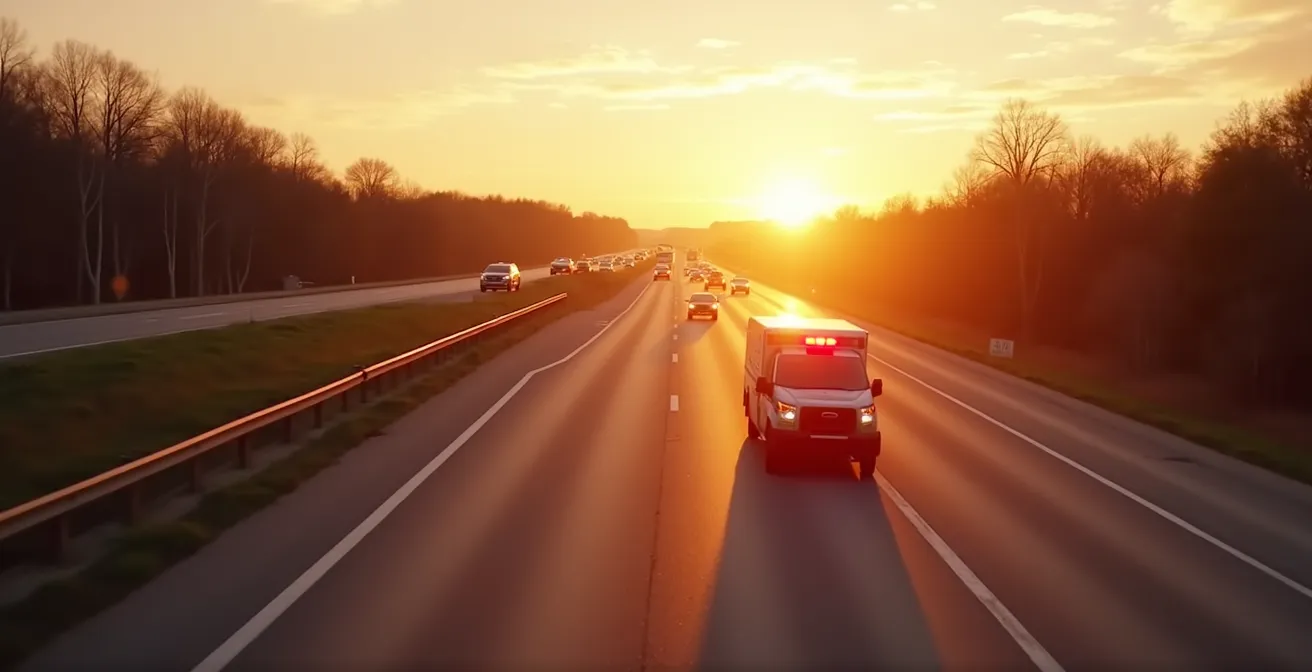
You see the flashing lights in your rearview mirror. That familiar knot forms in your stomach. You pull to the shoulder, and an emergency vehicle screams past. You did the right thing, but were you sure it was the *only* thing to do? The “Move Over Law,” or corridor de sécurité, is something most drivers think they understand. Just slow down and get out of the way, right? In my 30 years as a traffic officer in Quebec, I can tell you that “close enough” is what keeps the ticket book busy. The law is precise, and the mistakes are common.
But the “Move Over Law” is just the tip of the iceberg. It’s one of dozens of rules where drivers operate on assumptions, outdated knowledge, or “common sense” that doesn’t align with the Highway Safety Code. From your phone mount to that pile of snow on your roof, there are fines waiting for well-intentioned drivers who simply don’t know the specific details. We all know the basics of speed limits and stop signs, but the nuances are where the points and penalties add up.
Forget the dry legal text. I’m not here to recite the code. I’m here to take you on a patrol through the most common ticket traps I’ve seen on Quebec roads. We’ll look at the situations you face every day and I’ll give you the officer’s perspective—why the rule exists, where the mistake happens, and exactly what you need to do to keep your money in your wallet and your demerit points off your record. This is about moving from being a reactive driver to one who understands the road’s legal landscape.
This guide breaks down the most frequently misunderstood traffic situations in Quebec. We will dissect the rules that trip up even experienced drivers, providing clear, actionable advice to help you navigate the province’s roads with confidence and compliance.
Summary: Navigating Quebec’s Tricky Traffic Rules
- Is It Legal to Touch Your Phone in a Phone Mount at a Red Light?
- How Much Space Must You Give a Cyclist: 1m or 1.5m?
- Why Are Speed Fines Doubled Even When No Workers Are Present?
- The “Igloo” Fine: Getting Ticketed for Snow on Your Car Roof
- When to Contest a Speeding Ticket vs Just Paying It?
- How to Check Your Demerit Points File Online to Avoid Suspension?
- Why Are E-Scooters Still in a Legal Grey Zone in Many Municipalities?
- Who Actually Has Priority at a 4-Way Stop?
Is It Legal to Touch Your Phone in a Phone Mount at a Red Light?
This is probably the most common source of confusion—and tickets—I saw on the road. The short answer is no. The moment you are in control of a vehicle on a public roadway, even stopped at a red light, you are considered to be “driving.” The law is crystal clear: you cannot handle a handheld device that displays telephone functions, emails, or other information. A mounted phone is no exception if you’re interacting with it for anything other than displaying information “useful for driving.”
Here’s the ticket trap: many drivers think that if the phone is in a cradle, they can tap it to change a song or check a notification. This is illegal. The only permissible screen interaction is with functions integrated into the vehicle by the manufacturer (like CarPlay or Android Auto) or displaying GPS navigation. Anything else, and you’re at risk. From an officer’s perspective, seeing a driver’s head down and a finger tapping a screen is an immediate red flag. The penalties are severe, as, according to Quebec traffic law specialists, fines for illegal phone use while driving now range from $300 to $600, plus a significant number of demerit points.
To be perfectly safe, you must be legally and safely parked off the roadway to use your phone. As the legal experts at Solution Ticket clarify:
A person who legally and safely stops his or her vehicle at the side of the road to use a cell phone is no longer driving, even if the vehicle engine is still running, and therefore should not receive a ticket
– Solution Ticket Legal Team, Solution Ticket Quebec
Think of it as an on/off switch. If you’re in a travel lane, your phone is off-limits. If you’re parked, you’re free to use it. There is no grey area when you’re stopped in traffic.
How Much Space Must You Give a Cyclist: 1m or 1.5m?
Another daily point of friction on Quebec roads is passing cyclists. Many drivers know they need to give space, but the exact distance is often guessed. The rule is not a single number; it depends on the speed limit of the road you’re on. This nuance is crucial and often overlooked. It’s a simple mental checklist: check the speed limit sign, then adjust your passing distance accordingly.
The Highway Safety Code is specific to prevent ambiguity and protect vulnerable road users. In zones with a speed limit of 50 km/h or less, you must leave a minimum of 1 meter between your vehicle and the cyclist. In zones where the speed limit is over 50 km/h, that distance increases to 1.5 meters. It’s important to note that a recent CAA-Quebec analysis confirms Quebec law requires vehicles to maintain these specific distances. This isn’t a suggestion; it’s a legal minimum. From my experience, most violations happen in 60 or 70 km/h zones where drivers incorrectly apply the 1-meter urban rule.
Visualizing this space is key to compliance. A meter is roughly the width of a car door fully opened. One and a half meters is significantly more. If you cannot provide this space safely, you must slow down and wait behind the cyclist until you can. Overtaking too closely, even if you don’t make contact, can create a dangerous wind vortex for the rider and result in a ticket.
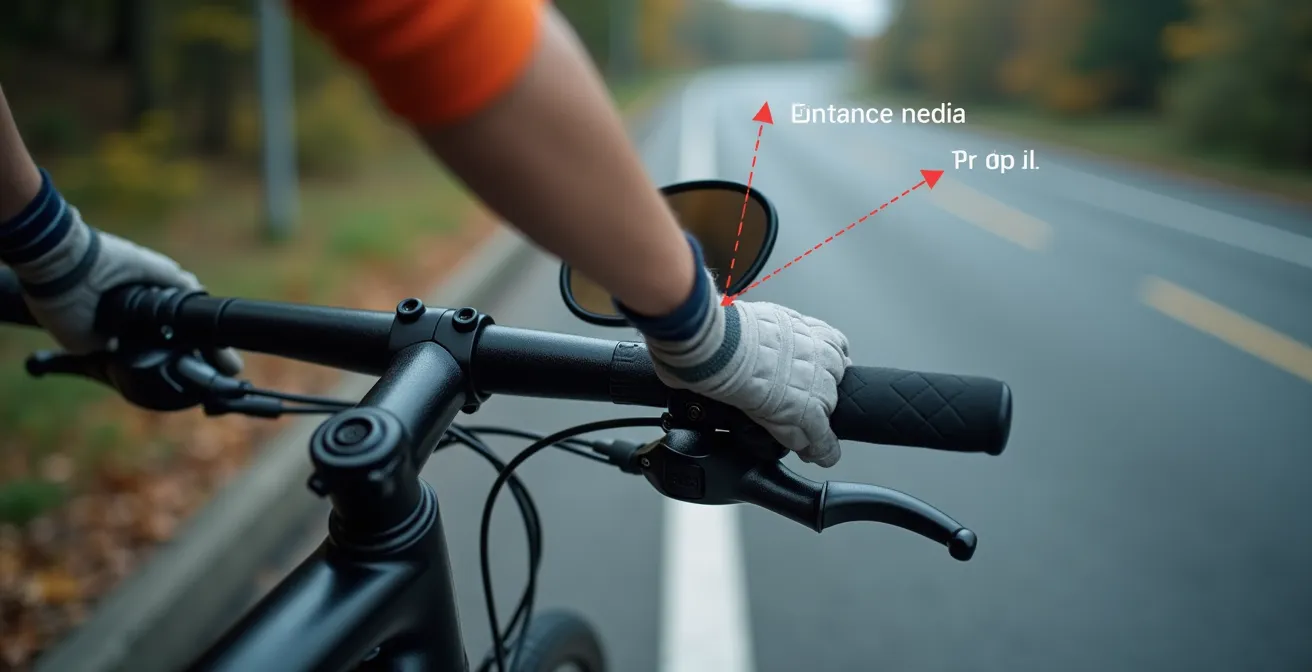
As this image demonstrates, the required gap is substantial and requires a conscious effort from the driver. It’s about sharing the road safely and legally, not just squeezing by. The best practice is always to give as much room as possible, far exceeding the minimum when you can.
Why Are Speed Fines Doubled Even When No Workers Are Present?
Pulling into an empty construction zone on a Sunday evening and getting a ticket for going the normal speed limit feels unfair to many drivers. I’ve heard the excuse a thousand times: “But there was no one working!” This misses the entire point of the law. The doubled fines aren’t just to protect workers; they’re in place because the road itself is more dangerous.
An official road work zone, marked by the familiar orange signs, can have numerous hidden hazards. These include:
- Uneven or grooved pavement
- Narrowed lanes with no shoulders
- Abrupt pavement edges or drop-offs
- Heavy equipment left nearby
- Temporary lane markings that can be confusing
These conditions don’t disappear when the work crew goes home. The reduced speed limit is calculated to allow a driver to react safely to these potential dangers. The doubled fine is a powerful deterrent to ensure you take that reduced limit seriously. In Quebec, fines double automatically in road work zones and school zones, making these the most expensive places to get a speeding ticket.
The key is to train your eyes to see the orange signs as an absolute trigger. Once you pass the sign indicating the start of a work zone (“DEBUT”), the lower speed limit and doubled fines are in effect 24/7 until you see the “FIN” sign. It doesn’t matter if the sun is shining, the road looks clear, and not a single orange cone is in sight. The signs define the zone, and the law within that zone is absolute.
The “Igloo” Fine: Getting Ticketed for Snow on Your Car Roof
Every winter in Quebec, drivers are pulled over for something that seems trivial: failing to clear snow and ice from their vehicle. This is known as the “igloo” fine, and it’s no joke. From a police perspective, a car driving down the highway with a thick slab of snow on its roof is a public safety menace. That snow can—and will—fly off, either blinding the driver behind you or, if it’s a sheet of ice, smashing their windshield.
The law requires your vehicle to be clear of any substance that could obstruct your view or be a danger to other road users. This isn’t just about the windshield; it covers the entire vehicle. Quebec takes winter driving seriously, which is also why it’s a legal requirement to equip your car with proper winter tires for the season. The obligation to clear your car is part of that same safety-first mindset. Forgetting this step can lead to a significant fine and demerit points.
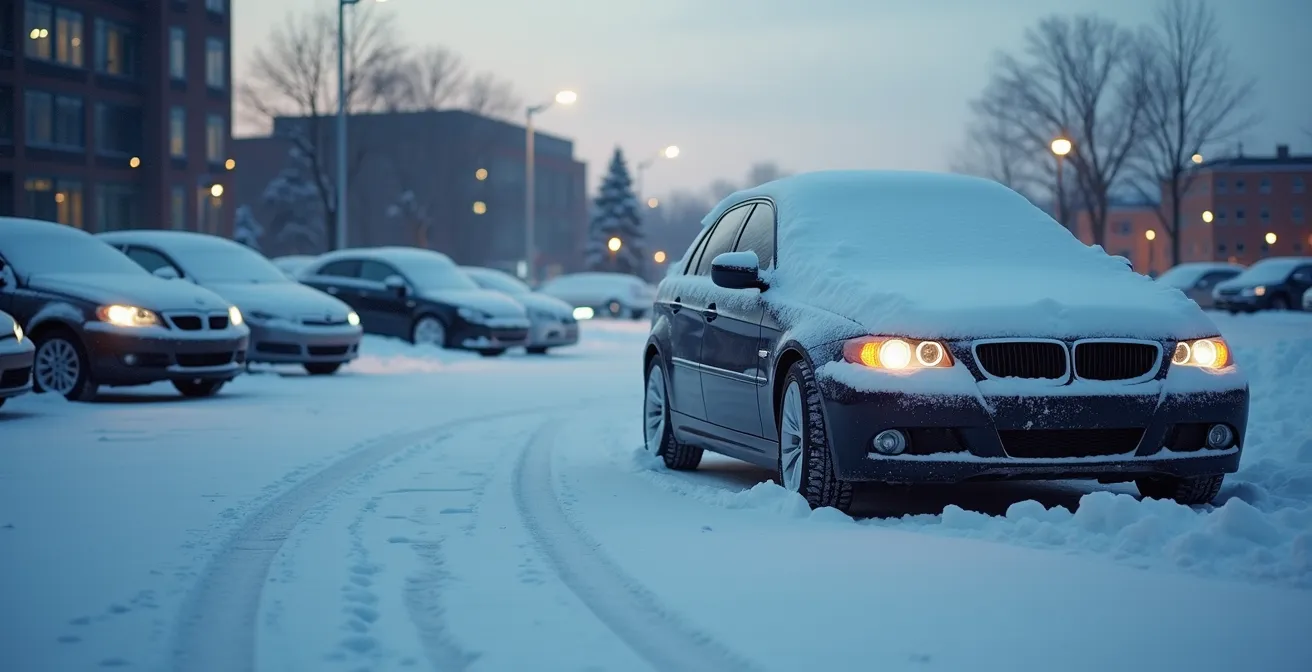
Proper preparation is non-negotiable. It means taking a few extra minutes before you even start the engine. A telescopic snow brush is an essential tool for any Quebec driver, especially for taller vehicles like SUVs and trucks where the roof is hard to reach.
Your Action Plan: Complete Winter Vehicle Clearing
- Clear all snow and ice from the vehicle roof to prevent dangerous flying debris.
- Clean all windows completely for full 360-degree visibility.
- Remove snow from all mirrors (side and rear).
- Clear headlights, taillights, and turn signals for proper visibility.
- Ensure license plates are completely visible and readable.
When to Contest a Speeding Ticket vs Just Paying It?
Getting a speeding ticket brings an immediate question: is it worth fighting this, or should I just pay it and move on? As a former officer, I can tell you that simply paying the fine is an admission of guilt, and the consequences go far beyond the initial dollar amount. You need to do the full math before you decide.
The true cost of a ticket includes three components: the fine itself, the demerit points added to your record, and the subsequent increase in your insurance premiums for years to come. For example, even a minor ticket can lead to a significant hike in your SAAQ license renewal insurance, with license renewal insurance costs ranging from $68 to $391 depending on your record. You should always contest a ticket for a “Grand Excès de Vitesse” (GEV), which is typically 40-50 km/h or more over the limit, as this carries severe penalties, including potential immediate license suspension.
Your decision should be based on your current demerit point situation. Every driver has a threshold. If a new ticket pushes you over that limit, your license will be suspended. You must know where you stand. Commercial drivers, whose livelihoods depend on a clean record, should almost always consider contesting a ticket.
Here is a breakdown of the demerit point thresholds in Quebec. Find your category and see how close you are to a suspension.
This table from driving school Tecnic provides a clear overview of the demerit point system that every Quebec driver must understand.
| Driver Category | Maximum Points Before Suspension | Point Duration |
|---|---|---|
| Learner’s/Probationary License | 4 points | 2 years |
| Drivers under 23 | 8 points | 2 years |
| Drivers aged 23-24 | 12 points | 2 years |
| Drivers 25 and over | 15 points | 2 years |
How to Check Your Demerit Points File Online to Avoid Suspension?
Ignorance is not a defence in traffic court. Many drivers I encountered were genuinely surprised to learn their license was being suspended because they had lost track of their demerit points. Your driving record is your responsibility, and in Quebec, it’s incredibly easy to check online via the SAAQ’s portal. This should be a yearly habit, like checking your credit score.
The points from a ticket are not added to your record the moment an officer hands it to you. They are only applied after you plead guilty (by paying the fine) or are found guilty in court. Points remain on your file for exactly two years from the date of conviction. A serious offence like excessive speeding can have a major impact; for instance, some excessive speeding over 50 km/h can result in up to 10 points, which could be enough for a suspension for many drivers.
Here is the simple, step-by-step process for checking your official driving record:
- Visit the official SAAQclic online portal at saaq.gouv.qc.ca.
- Navigate to the “Online Services” section and find the option for your “Driving Record.”
- You will need to log in using the clicSÉQUR identity verification service. Have your driver’s license and other personal information handy.
- Once authenticated, you can view a detailed statement of your record.
- Carefully review your current demerit point total, conviction dates, and types of infractions. This allows you to see when old points are scheduled to be removed.
Doing this simple check allows you to know exactly where you stand. It informs your decision-making if you receive a new ticket and helps you avoid the shock of a suspension notice in the mail.
Why Are E-Scooters Still in a Legal Grey Zone in Many Municipalities?
Electric scooters have popped up in cities across Quebec, but the rules governing them can change drastically from one side of a street to the other. This isn’t an accident; it’s a direct result of how the law has been structured. The situation is a classic case of provincial guidelines meeting municipal control, creating a patchwork of regulations that can be a nightmare for riders to navigate.
The core of the issue lies in the province’s approach. Quebec initiated a pilot project to legalize and regulate the use of e-scooters, setting a baseline of rules for the entire province. These universal rules include a minimum age of 14, a mandatory helmet for all riders, and a strict prohibition on riding on sidewalks. However, the pilot project also gave individual municipalities the power to add their own bylaws or ban e-scooters entirely.
This has led to the current state of confusion.
Case Study: Quebec’s E-Scooter Pilot Project and Municipal Fragmentation
The provincial pilot project allows e-scooters but grants municipalities the power to add bylaws or ban them. This creates inconsistent rules across the province. For example, the city of Montreal allows them but has very strict rules about where they can be ridden and parked. Meanwhile, an adjacent municipality like Westmount has banned them completely. This means a rider can be legally operating one moment and illegally the next, simply by crossing a municipal boundary, creating significant confusion and risk of fines.
For any rider, the only safe approach is to assume nothing. Before riding an e-scooter in any new town or borough, you must check the local municipal bylaws. The provincial rules are just the starting point; the local rules are what will ultimately determine if your ride is legal.
Key Takeaways
- The “unwritten rule” on Quebec roads should be Defensive Priority: prioritize safety over being technically right, especially at confusing intersections.
- The true cost of a ticket is the fine plus demerit points and a multi-year insurance increase; always calculate this before pleading guilty.
- Proactive vehicle maintenance, especially complete snow removal in winter, is a legal obligation, not just a suggestion.
Who Actually Has Priority at a 4-Way Stop?
The 4-way stop is a simple concept that somehow creates daily moments of confusion, hesitation, and occasional danger. I’ve seen more near-misses at these intersections than almost anywhere else. While the rules are straightforward, human behaviour makes them complicated. The official rule is simple: the first vehicle to arrive and come to a complete stop has priority. If two vehicles arrive at the same time, the one on the right goes first.
But the real world is messy. What happens in the “Quebec Stare-Down,” where three or four cars arrive at once? This is where the written rules give way to the unwritten ones. It becomes a brief, silent negotiation involving eye contact and hand gestures. The most important rule in this scenario is to make your intentions clear and ensure others see you. A hesitant driver is a dangerous driver.
However, the most critical concept I taught new officers, and one every driver should adopt, is what Quebec driving instructors call “Defensive Priority.”
The Principle of ‘Defensive Priority’ at Quebec Intersections
Even when you legally have the right-of-way at a 4-way stop, yielding to an aggressive, impatient, or inattentive driver is the safest course of action. The goal is to prevent an accident, not to prove a point. In busy urban centres like Montreal, this principle is often the de facto rule. An officer would much rather see a driver yield priority safely than insist on their right-of-way and cause a collision. Safety always trumps strict legal priority in the real world.
Adopting this mindset of Defensive Priority is the ultimate pro-driver move. It means you’re always scanning, anticipating the mistakes of others, and prioritizing a safe outcome over being “right.” It’s the final piece of the puzzle in moving from a reactive driver to a truly aware one.
Staying informed about these nuances isn’t just about avoiding the financial sting of a fine; it’s about contributing to a safer, more predictable road environment for everyone. Make it a habit to periodically review these rules, check your demerit point status, and most importantly, drive with awareness and a defensive mindset.
Frequently Asked Questions about Quebec’s Road Rules
What if two vehicles arrive at exactly the same time?
The vehicle on the right has priority. If the two vehicles are directly opposite each other and one is turning left, the vehicle proceeding straight has the right-of-way.
How do I handle the ‘Quebec 4-way dance’ when multiple cars arrive simultaneously?
Use non-verbal communication to establish order. Make eye contact with other drivers, use a clear hand gesture to yield or take priority, or give a quick flash of your headlights to signal to another driver to proceed. The goal is to break the stalemate safely and clearly.
What does the SAAQ look for during a road test at 4-way stops?
Examiners look for a sequence of correct actions: a full and complete stop behind the white line (no “rolling stops”), a systematic check of traffic (looking left, straight, right, then left again), and confident, safe decision-making when it is your turn to proceed. Hesitation is penalized as much as being too aggressive.