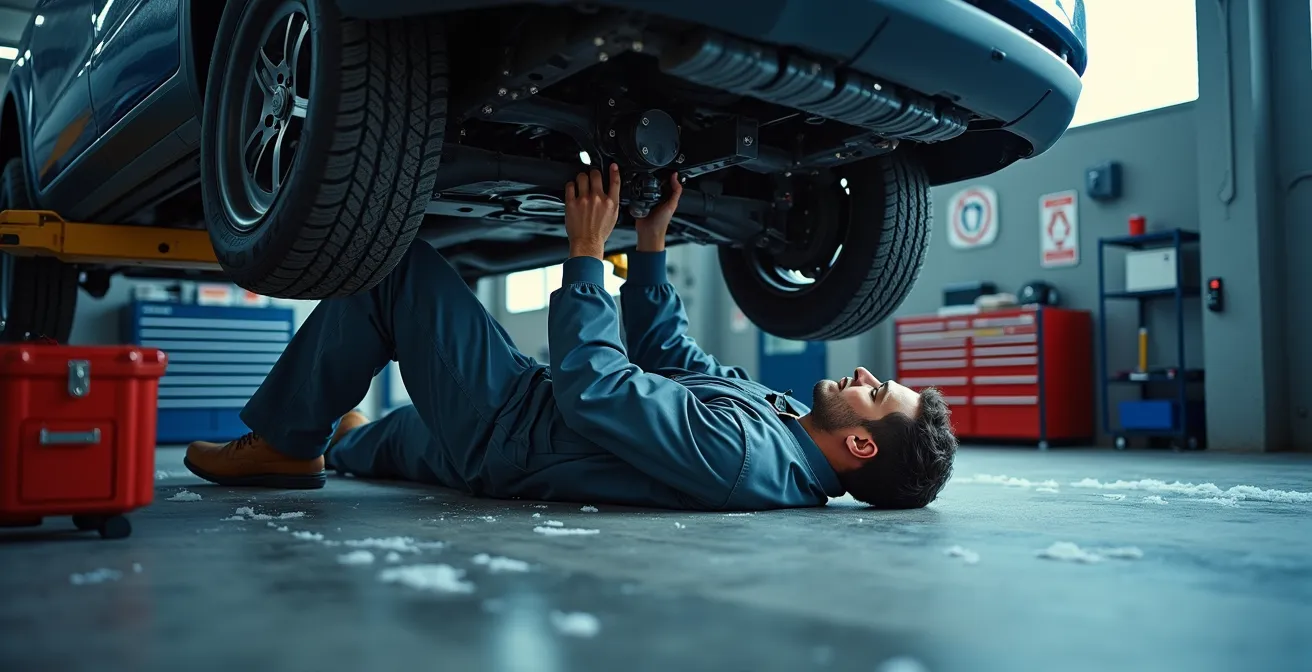
Contrary to popular belief, avoiding bad mechanics in Quebec isn’t about finding the cheapest price—it’s about understanding the specific economic and regulatory system they work in.
- Mechanic rates and diagnostic fees are shaped by Quebec’s consumer protection laws and the high cost of specialized tooling.
- Quebec’s harsh climate dictates a “severe service” maintenance schedule, making standard manufacturer recommendations risky and costly in the long run.
Recommendation: Shift your mindset from a one-time transaction to a long-term partnership. Start by asking a potential mechanic *why* they recommend a certain service, not just how much it costs.
The dreaded check-engine light. For many Quebec car owners, it’s not just a sign of car trouble; it’s the start of an anxiety-filled journey into the world of auto repair. That feeling of suspicion, the fear of being overcharged, and the confusion over what’s truly necessary is a shared experience. You’ve probably heard the standard advice: ask friends for recommendations, check online reviews, and get a quote in writing. While not wrong, this advice only scratches the surface and fails to address the core of the problem.
What if the real key to finding a trustworthy mechanic isn’t just about comparing prices or reading reviews? What if it’s about understanding the very system they operate in? The secret lies in becoming an empowered partner, not just a suspicious customer. This requires looking beyond the invoice to grasp the logic behind their pricing, the reason for their maintenance schedules, and the specific pressures the Quebec climate puts on your vehicle. This is not just another list of tips; it’s a veteran service advisor’s guide to demystifying the garage.
By understanding the ‘why’ behind the ‘what,’ you can learn to spot a good mechanic from a bad one, prioritize repairs intelligently, and build a relationship based on trust, not fear. This approach will not only save you from being ripped off but will help you build a maintenance strategy that prevents catastrophic failures down the road, saving you thousands in the long term.
This article will guide you through the essential knowledge every Quebec driver needs. We will break down the real costs, explain the critical differences in maintenance schedules, and provide a clear framework for making informed decisions about your car’s health. Let’s look at the key areas you need to master.
Summary: How to Find a Trustworthy Mechanic in Quebec Who Won’t Rip You Off?
- Dealer vs Local Garage: Which Is Best for Post-Warranty Maintenance?
- Why Do Mechanics Charge “Diag Time” Even If They Don’t Fix the Car?
- The “Clunk” Sound: Why Ignoring Suspension Noise Costs Double Later?
- Severe Service Schedule: Why Quebec Cars Need Oil Changes Sooner?
- How to Prioritize Repairs: What Can Wait and What Is Urgent?
- SAAQ Inspection vs General Check-Up: What Is the Difference?
- Why a Weak Canadian Dollar Delays Your Car Parts by Weeks?
- Why Skipping Your Fall Oil Change Can Kill Your Engine in January?
Dealer vs Local Garage: Which Is Best for Post-Warranty Maintenance?
Once your manufacturer’s warranty expires, the question inevitably arises: stick with the dealership or find a good local independent garage? Many people assume the dealer is always a rip-off, but the reality is more nuanced. Dealerships invest heavily in manufacturer-specific training and proprietary diagnostic equipment. This is their strength. For a complex, brand-specific electronic issue on a newer car, they can often be more efficient. However, that specialization comes at a price.
The primary difference you’ll feel is in the hourly labour rate. It’s not uncommon to see rates $145/hour at dealerships vs lower rates at independent shops. For routine post-warranty maintenance like brakes, suspension, and oil changes, a trusted independent garage can offer significant savings. They have lower overhead and often provide more personalized service, which is ideal for building that long-term partnership you’re seeking. The key is finding a *trustworthy* one.
In Quebec, you have a powerful tool at your disposal: the Office de la protection du consommateur (OPC). Before committing to any garage, dealer or independent, you must do your homework. The OPC allows you to investigate a merchant’s history, giving you a glimpse into their business practices that goes far beyond anecdotal online reviews. Using this tool is a non-negotiable first step in vetting a potential long-term automotive partner.
Your Action Plan: Vetting a Garage with the OPC’s “Se renseigner sur un commerçant” Tool
- Visit the OPC website and navigate to the merchant search tool. The tool is available in English for your convenience.
- Enter the exact business name or Quebec Enterprise Number (NEQ) of the garage or dealership.
- Carefully review the complaint history. Note not just the number of complaints, but also their nature (e.g., billing disputes, poor workmanship).
- Check for any formal notices, sanctions, or judgments issued against the business by the OPC.
- Use this data to compare several potential garages, creating a shortlist of those with a clean or minor record.
Why Do Mechanics Charge “Diag Time” Even If They Don’t Fix the Car?
This is one of the most common points of friction between customers and garages. You bring your car in for a problem, the mechanic spends an hour looking at it, and then hands you a bill for “diagnostic time” without having fixed anything. It feels unfair, but from the service advisor’s desk, it’s a necessary part of the process. You aren’t paying for the mechanic to guess; you’re paying for their expertise and the use of very expensive equipment to accurately pinpoint a fault.
Modern vehicles are rolling computers. A vague symptom like “it’s making a weird noise” can have dozens of potential causes. A technician’s job is to follow a logical, systematic process to eliminate possibilities and isolate the root cause. This involves more than just plugging in a scanner; it requires test-driving, checking service bulletins, using scopes to analyze sensor data, and physically inspecting components. This is skilled labour, and diagnostic time is compensation for that work, separate from the repair itself.
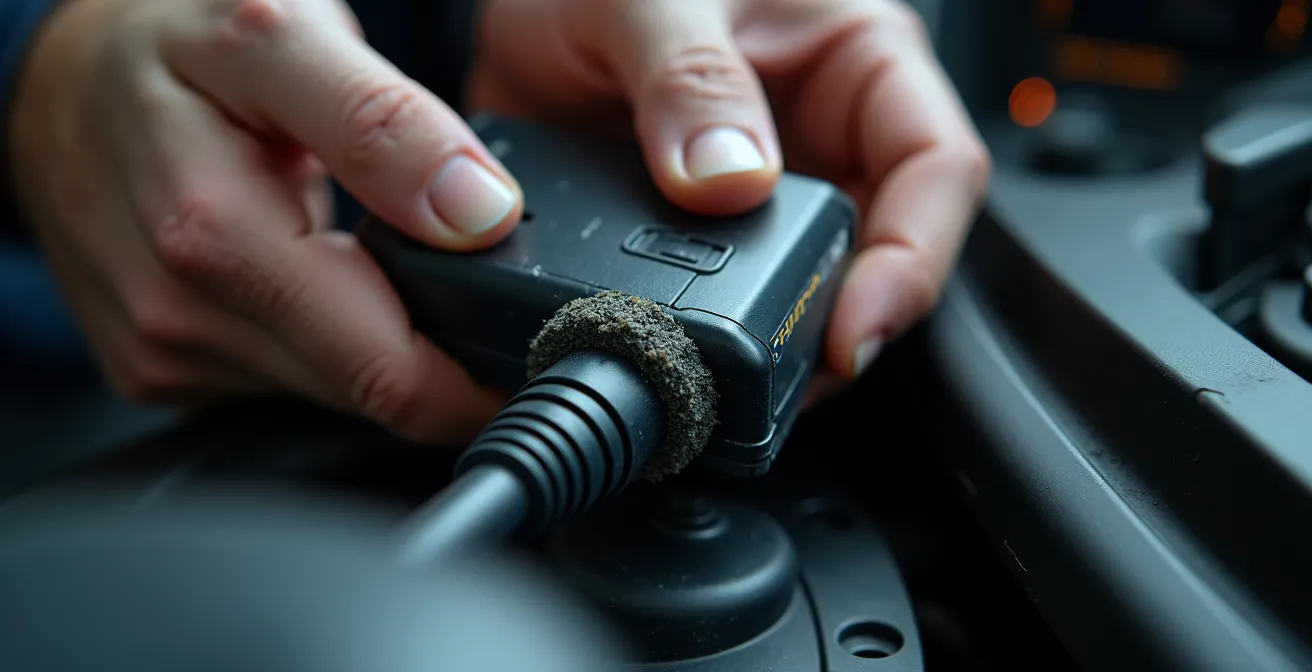
In Quebec, consumer rights are well-protected in this area. A garage cannot surprise you with a diagnostic fee. As the OPC clarifies, before making repairs that will cost more than $100, garages must provide you with a written evaluation. They must do this free of charge, *unless* they tell you the exact fee for the evaluation beforehand. A trustworthy shop will always be transparent about this. They will say, “To find the source of this issue, it will require one hour of diagnostic time at $X. Do you approve that charge?” This gives you control and sets clear expectations. A shop that is vague or refuses to provide a written estimate is a major red flag.
The “Clunk” Sound: Why Ignoring Suspension Noise Costs Double Later?
That subtle “clunk” or “knock” you hear when going over one of Quebec’s infamous potholes is easy to ignore. You turn up the radio and hope it goes away. As a service advisor, I can tell you this is one of the costliest mistakes a car owner can make. That noise is your car’s suspension system telling you that a component is worn out and failing. Ignoring it doesn’t just lead to a bigger repair bill; it’s a serious safety risk.
Quebec’s roads and harsh climate are brutal on suspension components like ball joints, tie rods, and shock absorbers. The constant freeze-thaw cycles, road salt, and crater-sized potholes accelerate wear and tear. When a small component fails, it puts immense stress on the entire suspension and steering assembly. This is where the costs multiply. What starts as a simple, relatively inexpensive fix can quickly cascade into a catastrophic failure.
The Real Cost of Deferred Suspension Repairs in Quebec’s Climate
The challenging weather in Quebec, in both winter and summer, speeds up wear on key components. A common example is a worn ball joint, which might initially cost around $250 to replace. If ignored, that worn joint can separate completely after hitting a pothole, causing the wheel to detach from the suspension. The driver loses steering control, and the car is immediately disabled. The resulting damage is no longer just a ball joint; it can include a broken control arm, a damaged axle, bent steering components, and even body damage from the detached wheel. The repair bill can easily jump to thousands of dollars, not to mention the risk of an accident. Specialized dealership labour for this kind of work can be up to $150+ per hour.
Think of that clunking sound as an early warning system. Addressing it promptly is the most financially responsible and safest course of action. When a mechanic tells you a suspension component is worn, they’re not trying to upsell you; they’re trying to prevent a much larger and more dangerous problem from occurring a few thousand kilometers down the road.
Severe Service Schedule: Why Quebec Cars Need Oil Changes Sooner?
Many drivers diligently follow the oil change interval printed in their car’s owner’s manual—often 10,000 km or even 15,000 km. Then, they’re shocked when a Quebec mechanic recommends a change at just 5,000 or 8,000 km. Is the mechanic trying to rip them off? Absolutely not. They are treating your car based on its real-world operating conditions, which, in Quebec, fall squarely under the “severe service” category.
Your owner’s manual has two maintenance schedules: “normal” and “severe.” Severe conditions include frequent short trips (under 10 km), extensive idling in traffic (hello, Décarie Expressway), driving in dusty or salty conditions, and operating in extreme cold. A Quebec driver’s daily reality ticks almost every single one of these boxes. These conditions are incredibly hard on your engine oil. Short trips don’t allow the engine to get hot enough to burn off moisture and fuel contaminants, leading to sludge formation. Cold starts are when most engine wear occurs, and old, thick oil provides poor protection.
The standard oil change interval is every six months or 8000km, whichever comes first. However, this depends on how you use your vehicle—frequent idling in winter and cold weather, dusty road conditions, or stop-and-go city driving can all have an impact.
– CAA-Quebec Maintenance Advisory, CAA-Quebec Car Maintenance Guide
A good mechanic understands this. They are not ignoring the manufacturer; they are correctly applying the manufacturer’s own severe service schedule to your vehicle’s environment. To determine your ideal schedule, honestly assess your driving habits. Are you a highway commuter or a city dweller?

Here’s a simple breakdown based on typical Quebec profiles:
- Montreal Stop-and-Go Commuter: Frequent idling and short trips are brutal on oil. Your target should be every 5,000-6,000 km.
- Gaspésie Highway Driver: Mostly long-distance driving is easier on the engine. You can safely stick to the standard 8,000 km interval using a quality synthetic oil.
- Eastern Townships Hilly Roads: Constant elevation changes put more stress on the engine. An interval of around 6,000-7,000 km is prudent.
- Quebec City Winter Commuter: Extreme cold and short trips are a deadly combination. Change your oil before winter starts and again mid-winter, regardless of mileage.
How to Prioritize Repairs: What Can Wait and What Is Urgent?
One of the most stressful situations is when a mechanic presents you with a list of recommended repairs totaling hundreds or even thousands of dollars. As a suspicious owner, your first instinct might be to assume it’s all an upsell. A trustworthy mechanic, however, will not just give you a list; they will help you triage it. They will explain what is a critical safety issue, what needs to be addressed soon to prevent bigger problems, and what can safely wait until your next visit.
Your job as an empowered car owner is to understand this triage system. Repairs can generally be broken down into three categories:
- Immediate Safety Risks: These are non-negotiable and must be fixed immediately. This includes anything related to brakes, steering, tires, and major suspension failure. Driving with these issues puts you and others at risk.
- Progressive Damage Risks: These are issues that will get significantly worse and more expensive if ignored. Examples include minor oil or coolant leaks, small exhaust leaks, and early-stage suspension noises. Delaying these repairs is a costly gamble.
- Low-Priority/Maintenance Items: These are things that are worn but not critical, or items that can be scheduled for a later date. This might include a cabin air filter, a minor cosmetic issue, or a fluid flush that is approaching its due date but not yet overdue.
In Quebec, the SAAQ’s inspection standards add another layer to this decision-making process. Certain issues, while not immediately catastrophic, will cause your vehicle to fail a mandatory inspection. For example, a minor exhaust leak might not seem urgent, but the risk of carbon monoxide entering the cabin and the certainty of failing an inspection make it a high-priority fix, especially before winter. A good mechanic will factor this into their recommendations. This is particularly true for minor defects found during an inspection; as the SAAQ states, in the case of a minor defect, a 48-hour deadline is granted to have the repairs made. This short timeline underscores the importance of addressing even “minor” issues promptly.
This table provides a general framework for how a service advisor might help you prioritize common Quebec-related issues.
| Repair Type | Immediate Safety Risk | Future Rust/SAAQ Risk | Priority |
|---|---|---|---|
| Small Oil Leak | Low | High | Fix within 1 month |
| Worn Brake Pads | High | Medium | Fix immediately |
| Minor Exhaust Leak | Low | Very High | Fix before winter |
| Suspension Clunk | Medium | High | Fix within 2 weeks |
| Cracked Windshield | Medium | Low | Fix before SAAQ inspection |
SAAQ Inspection vs General Check-Up: What Is the Difference?
Many Quebec drivers mistakenly believe that if their car passes the mandatory SAAQ (Société de l’assurance automobile du Québec) inspection, it must be in good shape. This is a dangerous misconception. The SAAQ inspection and a comprehensive general check-up from your mechanic are two entirely different things with different goals. Understanding this distinction is key to a proper maintenance strategy.
The SAAQ mandatory mechanical inspection is a pass/fail safety test. Its sole purpose is to ensure a vehicle meets the absolute *minimum* legal requirements to be on the road in Quebec. Inspectors check a specific list of components—brakes, steering, suspension, tires, lights, and structural integrity (for rust)—against a set of government-defined minimum standards. It is not designed to assess the overall health of your vehicle, its remaining component life, or its long-term reliability. A car can pass the SAAQ inspection with worn-out engine components, old fluids, and a transmission that’s on its last legs, as long as the core safety systems meet the minimum threshold.
A general check-up or seasonal inspection from your trusted mechanic is a proactive, diagnostic process. Its goal is to assess the complete health of your vehicle, identify wear *before* it becomes a safety issue, and plan for future maintenance. Your mechanic will look at everything the SAAQ inspects, but they’ll also check fluid levels and conditions, engine performance, battery health, belts, hoses, and look for developing issues like minor leaks or early signs of corrosion. This is where you get the valuable information that allows you to budget for future repairs and prevent unexpected breakdowns. For many commercial vehicles, SAAQ inspections are required every 12 months or 60,000 km, but a personal vehicle should have a general check-up at least once or twice a year, typically when swapping seasonal tires.
Why a Weak Canadian Dollar Delays Your Car Parts by Weeks?
You’ve approved a repair, but your service advisor tells you the necessary part is on backorder for three weeks. The frustration is understandable, but often, the garage is at the mercy of complex supply chains heavily influenced by factors far beyond their control—like the strength of the Canadian dollar. This is especially true for European and Asian vehicle brands.
Most car parts, even for domestically assembled vehicles, are sourced internationally. When the Canadian dollar is weak against the US dollar or the Euro, the cost for Canadian distributors to import these parts increases. To manage costs, distributors may order less inventory, preferring to place orders from the overseas manufacturer only when they have a confirmed sale. This “just-in-time” approach saves them money but eliminates the stock buffer that used to exist. The result for you? What used to be a 2-day wait for a part from a Toronto warehouse can now become a 2-week (or longer) wait for it to be shipped from Germany or Japan.
A good mechanic in Quebec understands and anticipates this. They build relationships with local parts suppliers who are known for stocking common wear items for the vehicles they service. For non-urgent but critical jobs, like a timing belt replacement on a Volkswagen, a proactive service advisor might recommend ordering the parts kit a month or two in advance of the scheduled service. This proactive planning is a hallmark of a great shop that respects your time and minimizes your vehicle’s downtime.
As a car owner, you can also be proactive. Here are a few strategies:
- Review your maintenance schedule: Look 3-4 months ahead to identify major services (like timing belts) and discuss parts ordering with your mechanic in advance.
- Consider remanufactured parts: For components like alternators, starters, and AC compressors, high-quality Quebec-based remanufactured parts can be a reliable and readily available alternative.
- Engage with your community: Join online forums for your specific vehicle model. Owners often share real-time information about parts shortages or availability issues, giving you a valuable heads-up.
Key Takeaways
- Trust is built on understanding the ‘why’ behind a mechanic’s recommendations, not just the ‘what’ and ‘how much’.
- In Quebec, the “severe service” schedule is the *normal* schedule. Ignoring it leads to premature engine wear and costly repairs.
- Proactive maintenance is always cheaper. Addressing small issues like leaks and suspension noises promptly prevents them from cascading into catastrophic, expensive failures.
Why Skipping Your Fall Oil Change Can Kill Your Engine in January?
As fall arrives, it’s tempting to put off that oil change. Your mileage sticker might say you have another 2,000 km to go, so what’s the harm in waiting until spring? In Quebec, this seemingly small decision can have devastating consequences for your engine when the temperature plummets to -20°C or -30°C in January. The oil change you get in the fall is arguably the most important service of the year.
Over the summer, your engine oil accumulates contaminants—unburnt fuel, moisture, and microscopic particles. At the same time, the heat causes the oil’s viscosity-improving additives to break down. This “tired” summer oil is not prepared for the shock of a Quebec winter. Temperature has a dramatic effect on fluid viscosity. Just as tire pressure drops in the cold, oil becomes significantly thicker. A key CAA-Quebec finding states that tire pressure can drop by 1 psi for every 6°C drop in temperature. An even more dramatic thickening effect happens to your oil.
When you try to start your car on a frigid January morning, that old, thick, contaminated oil flows like molasses. The oil pump struggles to circulate it, and for the first critical seconds (or even minutes) of operation, vital engine components like bearings, camshafts, and pistons can be starved of proper lubrication. This is when the vast majority of engine wear occurs. A fresh, clean batch of winter-grade synthetic oil, on the other hand, is designed to stay fluid at low temperatures, providing instant protection during those brutal cold starts. Skipping your fall oil change is like sending a soldier into battle without their armour. You might get away with it once or twice, but eventually, it will lead to catastrophic failure.
A trustworthy mechanic will insist on this fall service not to pad their sales, but because they have seen the consequences firsthand: engines seized, turbos destroyed, and repair bills in the thousands, all of which could have been prevented by a simple, timely oil change.
Frequently Asked Questions About Quebec Vehicle Inspections
When is a mandatory SAAQ inspection required?
SAAQ inspections are mandatory for rebuilt vehicles, vehicles being brought into Quebec from other provinces or the USA, vehicles over 8 years old that are being sold, as well as for commercial vehicles like taxis, driving school cars, and heavy vehicles with a GVWR over 4,500 kg.
What does the SAAQ inspection actually check?
The inspection focuses exclusively on minimum safety requirements and covers 11 key systems. This includes brakes, steering, suspension, the lighting system, tires, and the structural integrity of the frame and body. It does not evaluate the overall health or reliability of the engine or transmission.
What happens if my vehicle fails the SAAQ inspection?
If the vehicle has minor defects, you are given a 48-hour window to complete the repairs and have it re-inspected to get the compliance sticker. If the vehicle has major defects that make it unsafe, it is immediately prohibited from being used on the road until it is repaired and passes a full re-inspection.