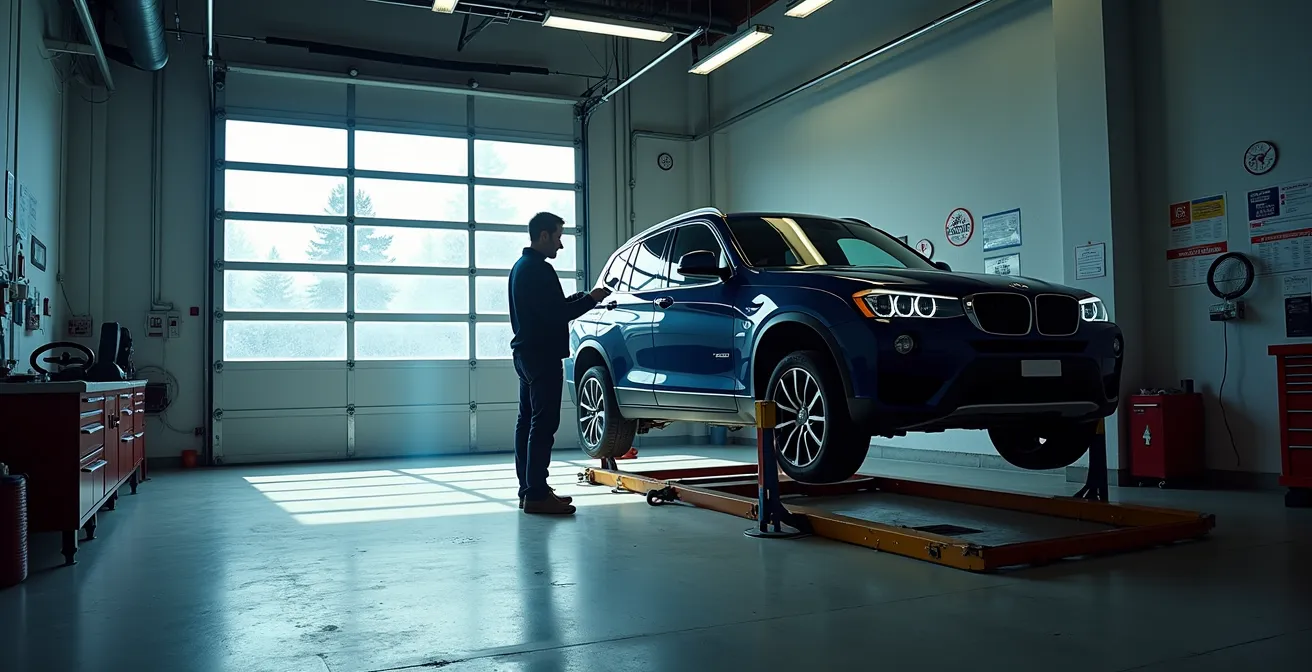
The biggest mistake buyers make is thinking the mandatory SAAQ inspection guarantees a good car; it only confirms minimum safety, often after you’ve already bought a lemon.
- A “clean” CARFAX report is meaningless for many US imports; always search the VIN on auction sites for crash photos.
- Fresh undercoating often hides catastrophic frame rust, a common tactic to pass a superficial viewing.
- Insist on a full rebuilding record, including original damage photos and repair invoices, not just the final certificate.
Recommendation: Hire a reputable body shop (carrossier), not just a general mechanic, for a pre-purchase inspection. They specialize in spotting the structural and cosmetic red flags specific to accident-repaired vehicles.
The sticker price on a “Véhicule Gravement Accidenté” (VGA), or rebuilt car, is tempting. In a market where every dollar counts, it feels like a shortcut to a newer, better vehicle. This is the first and most dangerous assumption. Many buyers believe the government-mandated SAAQ inspection is a seal of approval, a guarantee of quality. It is not. It is a basic safety check, performed *after* you’ve already committed your money, and it’s a net designed to catch only the most glaring safety violations.
Thinking like a seasoned inspector means looking past the shiny paint and the clean interior. It means understanding that a VGA car has a hidden history—a story of trauma and repair that is not always told accurately in the paperwork. The real work isn’t just checking boxes on a generic used-car list; it’s a forensic investigation. You need to hunt for the subtle clues of a poor repair: mismatched paint texture, uneven panel gaps, and the tell-tale signs of electrical gremlins.
This guide isn’t about the obvious steps. It’s about adopting the critical mindset of an inspector. We will move beyond the platitudes of “get a vehicle history report” and dive into the specific, high-stakes checks that separate a smart buy from a financial nightmare in the unique Quebec market. You will learn to spot the critical rust that leads to an automatic SAAQ failure, identify the electrical scams that hide deployed airbags, and understand why a US import with a “clean” record can be the riskiest purchase of all. This is your playbook for uncovering the truth before you buy.
To navigate this complex process, this article breaks down the essential checks, the differences in inspections, and how to find a truly trustworthy expert. Here is a look at what we’ll cover, giving you a complete framework for making an informed decision.
Summary: Your Guide to Inspecting a Rebuilt (VGA) Car in Quebec
- What to Check Before Buying a Used Car From a Private Seller?
- SAAQ Inspection vs General Check-Up: What Is the Difference?
- The Rust Hole That Will Fail Your SAAQ Safety Inspection
- How to Pre-Check Your Lights and Brakes to Pass Inspection First Try?
- When to Schedule Inspection When Moving From Ontario to Quebec?
- How to Spot Electrical Lemons Before Buying a Used Car in Montreal?
- US Import vs Canadian Car: Which Has Better Resale Value in Montreal?
- How to Find a Trustworthy Mechanic in Quebec Who Won’t Rip You Off?
What to Check Before Buying a Used Car From a Private Seller?
When dealing with a private seller for a VGA vehicle, you are the first and last line of defense. The seller’s only obligation is to deliver the car as described; its hidden history is your problem to uncover. The first step is to verify the car’s identity and legal status. A mismatch between the Vehicle Identification Number (VIN) on the dashboard, the door jamb sticker, and the registration documents is an immediate, non-negotiable red flag for fraud. It suggests the car may be stolen or its identity has been illegally swapped.
Beyond basic identity, your investigation must become forensic. Do not accept the “VGA” title at face value. You must demand the complete rebuilding record. This is not just the final certificate; you need the original insurance damage estimate, all invoices for parts and labour during the repair, and—most importantly—before-and-after photos. A seller who is hesitant or unable to provide this “forensic documentation” is likely hiding the severity of the original accident or the poor quality of the repairs. Your role is to be a skeptical detective, not a hopeful buyer.
This is where you physically inspect the repair quality. Run your hand along panel edges to feel for rough, sandy textures—a sign of overspray from a careless paint job. Look at the gaps between the hood, fenders, and doors; they should be tight and uniform. Any significant variations indicate the frame may not have been straightened correctly. Finally, pull back rubber seals around doors and the trunk to look for a different paint colour or sloppy masking tape lines. These are the small tells that betray a big, poorly repaired problem.
As this image highlights, the VIN is physically stamped or affixed in multiple locations for a reason. Verifying that they all match is the foundational check upon which all other inspections are built. It confirms the vehicle’s legal identity before you invest any more time or money. Your inspection should be methodical, starting with these non-negotiable legal and identity checks before moving to mechanical and structural assessments.
Your Action Plan: The Essential VGA Pre-Purchase Checklist
- Lien Check: Use Quebec’s RDPRM (Registre des droits personnels et réels mobiliers) with the VIN to check for outstanding loans. It costs only a few dollars and can save you thousands.
- Document Collection: Request the complete rebuilding file: original damage estimate from the insurer, all repair invoices, and comprehensive before-and-after photos. No photos, no deal.
- VIN Verification: Physically match the VIN on the dashboard, door jamb sticker, and all registration documents. Any discrepancy is a sign of potential fraud.
- Seller Interview: Ask pointed questions. Which body shop did the repairs? Can you see the original damage photos? When did it pass the SAAQ inspection? Gauge their transparency.
- Quality Inspection: Assess panel gaps for uniformity, check for paint texture differences, look for overspray on rubber seals, and identify non-OEM (Original Equipment Manufacturer) parts.
SAAQ Inspection vs General Check-Up: What Is the Difference?
This is the single most critical distinction a VGA buyer in Quebec must understand. Many assume the mandatory SAAQ technical appraisal for a rebuilt vehicle is a comprehensive pre-purchase inspection (PPI). It is not. Conflating the two is a catastrophic financial mistake. The SAAQ’s goal is public safety; they are certifying that the car won’t fall apart on the highway and endanger others. Your goal is financial protection; you need to know if the car is a reliable investment or a money pit.
The SAAQ inspection is performed by an authorized agent, a ‘mandataire en vérification’, who follows a strict government checklist called the ‘Guide de reconstruction’. Their scope is narrow and specific: verifying structural integrity, frame measurements, and compliance with repair standards. They are not looking for a slow oil leak, worn-out transmission fluid, or predicting the lifespan of your A/C compressor. These are crucial elements for your ownership experience but are completely outside the SAAQ’s mandate.
A general pre-purchase check-up, on the other hand, is performed by a licensed mechanic of your choosing. Their loyalty is to you, the buyer. Their job is to assess the vehicle’s overall mechanical health, identify current problems, and forecast future repair needs. This is the inspection that tells you whether the “great deal” you’re getting will be wiped out by a $3,000 transmission job in six months. It is an optional but non-negotiable investment in your financial security.
The following table, based on information from the SAAQ, breaks down the fundamental differences between these two critical but separate evaluations.
| Aspect | SAAQ VGA Inspection | General Pre-Purchase Check |
|---|---|---|
| Purpose | Legal compliance & public safety certification | Financial protection & value assessment |
| Who Performs | Only authorized ‘mandataire en vérification’ | Any licensed mechanic |
| Scope | Structural integrity, frame measurements, compliance with ‘Guide de reconstruction’ | Mechanical condition, future repair needs |
| Cost | $150+ (non-refundable if failed) | $150-$250 (investment, not requirement) |
| Legal Status | Mandatory for VGA registration | Optional but highly recommended |
Case Study: The Real Cost of a Failed SAAQ Inspection
The financial consequences of failing the SAAQ technical appraisal are severe. When a VGA vehicle fails, the owner is responsible for the non-refundable inspection fee (often over $150). They must then cover all mandated repairs, which can easily range from a few hundred to several thousand dollars. Afterward, they must pay for a complete re-inspection. According to an official SAAQ outline of the process, the vehicle cannot be registered or legally driven until it passes. One Montreal buyer shared their experience of spending over $3,500 in unexpected repairs after buying a “ready-to-pass” VGA that ultimately failed due to improper frame repairs. Their $8,000 “deal” instantly transformed into an $11,500 nightmare, illustrating the immense risk of not performing a proper pre-purchase inspection beforehand.
The Rust Hole That Will Fail Your SAAQ Safety Inspection
In Quebec, rust isn’t just a cosmetic issue; it’s a structural killer and a primary reason for SAAQ inspection failures. Winter road salt is relentless, and for a VGA vehicle that has already sustained structural trauma, rust can be the final nail in the coffin. An inspector doesn’t just glance for surface spots; they are trained to hunt for perforations in critical zones. A hole the size of a coin in the wrong place means an automatic fail, leaving you with a car you can’t register and a massive repair bill.
The most critical areas are the vehicle’s skeleton. Rocker panels (bas de caisse), located beneath the doors, are the first place to check. Any visible hole or even severe bubbling that suggests perforation underneath is a failure. Next, examine the subframe mounting points, where the engine and suspension are bolted to the car’s body. Rust here compromises the entire vehicle’s integrity. The same goes for the strut towers in the engine bay and trunk; any cracks or significant rust where the suspension mounts is an immediate rejection. Finally, pull back carpets and floor mats to check the floor pans for rust holes, a sign of water ingress and deep structural decay.
Be extremely wary of a car with fresh, thick undercoating. While it can be a legitimate form of protection, it’s also a common scam in the Montreal VGA market. Unscrupulous sellers will spray a thick layer of black coating to hide shoddy weld repairs and rusted-out frame parts. To an unsuspecting buyer, the undercarriage looks clean and new. However, an SAAQ inspector will not hesitate to scrape away the coating to see what lies beneath. A smart pre-purchase tactic is to bring a small magnet; it won’t stick to areas filled with plastic body filler. Tapping along the frame rails should produce a consistent metallic sound, not the dull thud of hidden rust or filler.
According to the official SAAQ mechanical inspection guide, any perforation of a key structural element is grounds for failure. Your pre-purchase inspection must replicate this level of scrutiny. The critical rust zones to check are:
- Rocker panels (bas de caisse): The entire length must be solid. Any perforation is an automatic fail.
- Subframe mounting points: Look for rust swelling or cracks around bolts and welds, indicating structural weakness.
- Strut towers: Inspect for rust bubbles or cracks where the suspension system connects to the body. This is a critical safety component.
- Floor pans: Check under all carpets and mats for rust holes. Water entry points signify deeper structural damage.
- Frame rails: Any hole caused by rust or even a visible repair that itself shows rust is an immediate failure.
How to Pre-Check Your Lights and Brakes to Pass Inspection First Try?
While structural integrity is the main event, failing an SAAQ inspection for something as simple as a burned-out bulb or a misaligned headlight is both frustrating and costly. These “low-hanging fruit” items are easy to pre-check and can save you the hassle and expense of a re-inspection. An inspector’s approach is systematic, covering every light and function according to strict standards.
Start with the lights. Have a friend help you. Verify that all five brake lights are working: the left, the right, and the third (center) brake light. Crucially, they must be noticeably brighter than the regular tail lights when the pedal is pressed. For headlights, the rule is simple: they must be white and compliant with DOT/SAE standards. Any aftermarket LED or HID bulbs installed in a housing designed for halogen bulbs is an automatic fail due to improper beam patterns that blind other drivers. Turn signals must flash at a steady rate, typically between 60 and 120 times per minute, on all four corners. A “hyperflash” indicates a burned-out bulb or an electrical issue.
Next, move to the dashboard. When you start the engine, all warning lights (ABS, Airbag, Check Engine) should illuminate for a moment and then turn off. A light that stays on, especially the ABS or Airbag light, is an automatic failure. A light that never comes on at all is even more suspicious, as it may indicate a removed bulb or a fraudulent bypass to hide a serious fault. For the brake system itself, look for obviously corroded brake lines and check for seized caliper pins. The parking brake must be able to hold the vehicle completely still on a slight incline when the car is in neutral.
Don’t underestimate the timeline. Once you fail an inspection for a brake or lighting issue, the pressure is on. The SAAQ grants only a 48-hour deadline to complete the required repairs and have the vehicle re-inspected. This tight window leaves no room for ordering parts or dealing with a busy mechanic, making a thorough pre-check absolutely essential.
- Lights: Verify all 5 brake lights (L, R, 3rd) work and are brighter than the tail lights.
- Headlights: Must be white and DOT/SAE compliant. Aftermarket LED/HID bulbs in halogen housings are an automatic fail.
- Dashboard Warning Lights: Start the engine and confirm the ABS, Airbag, and Check Engine lights illuminate briefly and then turn off.
- Brake System: Visually inspect for seized caliper pins and corroded brake lines. Ensure no ABS warning lights remain on.
- Parking Brake Test: On a slight hill, engage the parking brake with the car in neutral. It must hold the vehicle completely without slipping.
- Turn Signals: All four corner signals must flash at a normal rate (60-120 flashes per minute). Also, check that the license plate light is functional.
When to Schedule Inspection When Moving From Ontario to Quebec?
Moving a rebuilt vehicle from Ontario to Quebec introduces a layer of bureaucracy that can trap even the most organized person. The most critical error is assuming an Ontario “Rebuilt” title will transfer cleanly. It will not. The SAAQ system automatically flags it and treats the vehicle as a VGA (Véhicule Gravement Accidenté), subjecting it to the full, rigorous Quebec inspection process. This “title translation” issue catches many newcomers by surprise and can lead to significant delays and costs.
Your timeline is paramount. Do not wait until your Ontario registration or plates are about to expire. The wait time for a VGA inspection appointment with an SAAQ-authorized ‘mandataire’ can be several weeks, especially in busy seasons. You must call and book this appointment as soon as you have proof of Quebec residency, such as a signed lease, a utility bill, or a newly issued Quebec driver’s license. Arriving in Quebec with an expired Ontario registration and no inspection appointment is a recipe for disaster, as your car will be legally undrivable.
Before the inspection, you must secure Quebec-based auto insurance. When getting quotes, you must explicitly declare that the vehicle has an Ontario “Rebuilt” status. Failure to do so can be considered misrepresentation and could void your coverage in the event of a claim. Insurers view rebuilt vehicles with greater caution, and your premium will reflect this increased risk. Arrive at your inspection with a complete file: your Ontario ownership, proof of your new Quebec insurance, your Quebec license, and all the original rebuild documentation from Ontario, including repair bills and photos if you have them.
The process is strict and sequential. One forum user reported the cautionary tale of an owner who had to sell their desirable Acura NSX simply because of the complications in registering the Ontario rebuilt car in Quebec. They were unable to produce the extensive documentation required by the SAAQ, including original repair photos, and were left with a car they legally could not register or drive in the province. The key steps are:
- Establish Quebec residency with proof (lease, utility bill, Quebec driver’s license).
- Call an SAAQ mandataire immediately to book your VGA inspection, anticipating a 2-4 week wait. Do this before your Ontario registration expires.
- Obtain a Quebec auto insurance quote, explicitly mentioning the Ontario “Rebuilt” status.
- Pass both the SAAQ technical appraisal and the subsequent mechanical inspection. Bring all Ontario rebuild documentation.
- Visit an SAAQ service center with your passed inspection report, Ontario ownership, Quebec insurance proof, and Quebec license to complete the registration.
How to Spot Electrical Lemons Before Buying a Used Car in Montreal?
In the world of VGA cars, some of the most dangerous flaws are invisible. While an inspector can spot a bad weld or a rusted frame, electrical issues require a deeper level of investigation. The dashboard warning lights are supposed to be your first alert system, but in the cutthroat Montreal used car market, they are often the first thing to be tampered with. Simply seeing no warning lights is not a sign of a healthy car; it’s a reason for suspicion.
The most dangerous electrical scam involves the airbag system. After a collision where airbags deploy, a proper repair involves replacing the airbag modules, sensors, and control unit—a repair that costs thousands. A fraudulent and alarmingly common shortcut is to bypass the deployed airbag entirely. A dishonest seller will solder a small resistor into the airbag’s wiring harness. The car’s computer sees the resistor and thinks a healthy airbag is present, so it turns off the dashboard warning light. The driver believes they are protected, but in the event of a second accident, the airbag will not deploy.
How do you spot this? You can’t with a simple visual check. This is why a professional pre-purchase inspection must include a full diagnostic scan with an advanced OBD2 tool. A basic code reader might show no “current” faults, but a professional scanner can access the Supplemental Restraint System (SRS) module directly and pull “historical” or “permanent” codes. These are crash codes that are stored in the computer’s memory and often cannot be cleared. A mechanic in Montreal reported a case where a buyer’s car showed no warning lights, but a deep scan revealed historical codes for both front airbags deploying. The car had been in a severe frontal collision, but the seller had used the resistor trick to hide the evidence.
Insist that your inspecting mechanic performs a full system scan that specifically checks the SRS module for historical data. This is non-negotiable for any VGA vehicle. This is the only reliable way to uncover the electrical ghosts of a car’s past and ensure the safety systems you’re counting on are actually present and functional.
US Import vs Canadian Car: Which Has Better Resale Value in Montreal?
When shopping for a VGA vehicle in Montreal, you’ll often encounter cars imported from the United States. They can seem like a great deal, but it’s crucial to understand the long-term financial implications. In the Quebec used car market, a US-import VGA carries a double stigma that significantly impacts its resale value. Not only is it a rebuilt vehicle, but its US origins add another layer of uncertainty for future buyers, resulting in steeper depreciation.
The “clean CARFAX illusion” is a major trap. A vehicle can be severely damaged in the US, sold at a salvage auction like Copart or IAAI, and still show a clean history on a standard CARFAX report. The “Salvage” or “Rebuilt” brand is often only applied when the car is first registered in Quebec and branded VGA. By then, an unsuspecting buyer may have already purchased it, believing it had a clean history. Expert buyers in Montreal now bypass CARFAX as a primary tool and instead search the VIN directly on US auction websites. These sites often retain the original auction listings with photos, revealing the full extent of the crash damage for anyone willing to look. One Montreal buyer discovered their “clean CARFAX” BMW had extensive, visible frame damage in Copart auction photos from just six months prior.
This history, combined with practical differences, hurts its value. In Montreal’s used car market, US-import VGA vehicles are valued 10-15% lower than a Quebec-origin VGA, and 25-40% below a clean-title Canadian car. This additional discount accounts for several factors that make them less desirable to local buyers, as detailed in the table below.
| Aspect | US Import VGA | Quebec Origin VGA |
|---|---|---|
| Speedometer Display | Primary in MPH (confusing for resale) | Primary in km/h |
| Insurance Premium | Often higher, as insurers are more cautious | Standard VGA rates |
| Parts Availability | May have different emissions or safety equipment | Standard Canadian-spec parts |
| Resale Value | Subject to an additional 10-15% discount | Standard VGA depreciation |
| Documentation | Often incomplete US history and rebuild records | Full Quebec rebuild record should be available |
Key Takeaways
- The SAAQ inspection is a minimum safety standard, not a quality guarantee. Always get a separate, comprehensive pre-purchase inspection.
- Structural rust in rocker panels, frame rails, or strut towers is an automatic SAAQ failure. Beware of fresh undercoating used to hide it.
- Electrical scams are common. Insist on a deep OBD2 scan to check for historical crash codes in the airbag (SRS) module, even if no warning lights are on.
How to Find a Trustworthy Mechanic in Quebec Who Won’t Rip You Off?
Knowing what to look for in a VGA car is half the battle; finding a trustworthy expert to perform the inspection is the other half. Not all mechanics are created equal, especially when it comes to the unique challenges of a rebuilt vehicle. Choosing the wrong person can give you a false sense of security and lead you directly into the traps you’re trying to avoid. Your goal is to find a specialist who thinks like an SAAQ inspector and a forensic investigator combined.
A brilliant insider tip from experienced Montreal buyers is to prioritize an experienced body shop (‘carrossier’) over a general mechanic for a VGA pre-purchase inspection. While a mechanic is excellent at diagnosing engine and transmission issues, a ‘carrossier’ lives and breathes structural repair. They know exactly what to look for regarding frame straightness, weld quality, panel alignment, and paint finish because it’s their area of expertise. They are far more likely to spot the subtle signs of a poor accident repair that a general mechanic might miss. One buyer reported that their regular mechanic missed critical frame damage that a body shop identified immediately, saving them from a $15,000 mistake for the same $200 inspection fee.
When vetting any potential inspector, whether a mechanic or a body shop specialist, you need to ask targeted questions that prove their familiarity with the VGA process in Quebec. Don’t just ask if they do inspections; ask if they are familiar with SAAQ’s specific criteria. Inquire about their experience with frame straightness verification and weld quality assessment. Ask if they are, or work closely with, a certified ‘mandataire en vérification de véhicules routiers’. A true specialist will be able to answer these questions confidently and even show you examples of previous VGA inspection reports they’ve completed.
A trustworthy inspector will provide a detailed written report with photos and estimated repair costs, giving you a clear, unbiased picture of the vehicle’s condition. This document is your most powerful negotiation tool or your definitive reason to walk away from the deal.
- Are you familiar with SAAQ’s specific inspection criteria for VGA (Véhicule Gravement Accidenté) vehicles?
- Do you have experience with frame straightness verification and weld quality assessment for rebuilt vehicles?
- Can you provide a detailed written inspection report complete with photos and estimated repair costs?
- Are you a certified ‘mandataire en vérification de véhicules routiers’ or do you work closely with one?
- Can you show me examples of previous VGA pre-purchase inspections you have performed?
By adopting an inspector’s mindset, focusing on forensic documentation, and hiring a true specialist, you transform the purchase of a VGA vehicle from a blind gamble into a calculated risk. Your best protection is not a government form, but your own diligence and the expertise of the professionals you choose to hire. To ensure you make the right choice, the next logical step is to start researching and contacting local body shops with proven experience in VGA pre-purchase inspections.