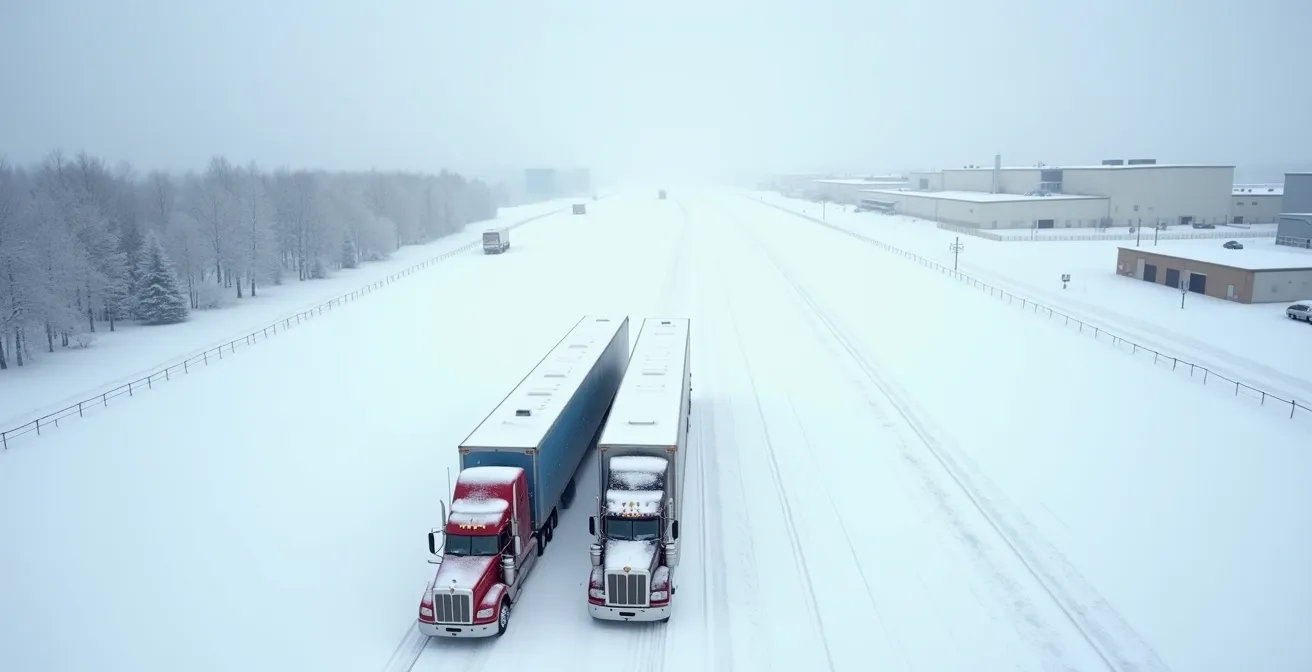
A resilient Quebec supply chain isn’t built by reacting to blizzards, but on a proactive operational framework that de-risks every seasonal bottleneck.
- Success depends on mastering Quebec-specific regulations, from SAAQ logbook rules to spring thaw zone weight restrictions.
- Strategic decisions on driver compensation, fuel planning, and business models (owner-operator vs. employee) are your best defense against disruption.
Recommendation: Shift from a reactive, weather-watching mindset to a systematic, year-round strategy of regulatory foresight and operational resilience.
When a major winter storm bears down on Quebec, the rookie logistics manager panics. They stare at weather apps, frantically call drivers, and react to problems as they cascade through the system. The veteran coordinator, however, has already won the battle. They know that keeping the supply chain moving isn’t about managing a single weather event; it’s about having a robust, proactive system that anticipates not just snow, but the full spectrum of Quebec’s unique operational challenges.
Most advice focuses on the basics: winter tires, emergency kits, and checking the forecast. While essential, this is driver-level tactical advice, not a manager-level strategy. A truly resilient operation is built months in advance. It involves understanding the financial incentives that attract top drivers, the precise fuel consumption penalties of a blizzard on the Trans-Labrador Highway, and the subtle electronic logbook errors that can trigger a crippling SAAQ audit.
But what if the key to surviving a winter storm was actually mastering the province’s construction holiday shutdown? The core insight of a seasoned professional is that all major disruptions, predictable or not, stress the system in similar ways. By building a framework that handles the annual two-week construction shutdown, you inadvertently build the muscle to handle a three-day blizzard. This is the shift from reactive problem-solving to systemic de-risking.
This guide will walk you through that veteran framework. We will dissect the strategic decisions that create operational resilience, moving beyond the platitudes to give you the tools to manage profitability, compliance, and on-time delivery KPIs, no matter what the forecast says.
This article explores the key pillars of a proactive logistics framework for Quebec. You will find a detailed breakdown of the strategic elements that transform a reactive operation into a resilient, profitable, and compliant one, prepared for any seasonal challenge.
Summary : The Veteran Coordinator’s Playbook for Quebec Logistics
- Why Are Quebec Trucking Companies Paying Bonuses to New Drivers?
- How to Plan Fuel Stops on the Trans-Labrador Highway Without Running Dry?
- Owner-Operator or Employee: Which Path Earns More in Quebec Trucking?
- The Electronic Logbook Error That Leads to Huge SAAQ Fines
- When Do Thaw Zones Start restricting Load Weights in Spring?
- How to Plan Deliveries Around Quebec’s Construction Holiday Shutdown?
- How to Fill Out a Circle Check Logbook Without Errors?
- How to Survive a SAAQ Audit of Your Commercial Fleet?
Why Are Quebec Trucking Companies Paying Bonuses to New Drivers?
In the face of a chronic driver shortage, paying signing and performance bonuses seems like a purely reactive cost to secure talent. For the strategic logistics manager, however, it’s a calculated investment in operational resilience. A reliable driver is not a commodity; they are your front-line defense against the chaos of a winter storm. Paying a premium for a proven, safe, and efficient operator is a form of systemic de-risking that pays for itself the first time a blizzard hits and your freight moves while your competitor’s is sitting on the shoulder of the 20.
The logic is simple: a top-tier driver is less likely to have accidents, more efficient with fuel, and better at navigating complex situations, including SAAQ compliance. The bonus isn’t just for signing on; it’s for the peace of mind that comes with knowing your asset is in capable hands. Companies are increasingly structuring these incentives around concrete metrics like fuel mileage targets, productivity, and, most importantly, safety records during the critical December to March period.
This isn’t just about throwing money at the problem. It’s about a fundamental shift in calculating ROI. What is the cost of a three-day delay on a critical shipment? What is the cost of an accident, a failed SAAQ inspection, or a damaged client relationship? When compared to these potential losses, a structured winter performance bonus or a referral program for attracting other reliable drivers is a small price to pay for predictability and stability in an unpredictable environment. It’s an investment in your company’s reputation for on-time delivery, regardless of the weather.
How to Plan Fuel Stops on the Trans-Labrador Highway Without Running Dry?
Planning fuel stops on a route like the Trans-Labrador Highway in winter is the ultimate test of a logistics coordinator. It’s not just about mapping out gas stations; it’s about modeling a worst-case scenario. A veteran manager knows that a truck’s fuel consumption isn’t a fixed variable. Cold weather itself is a significant drain, but blizzard conditions can be catastrophic to your range calculations. This is where data-driven planning replaces hopeful guesswork.
The first step is to discard the vehicle’s standard MPG or L/100km rating. Cold temperatures thicken engine oil and transmission fluid, increasing friction and fuel burn. Cold air is denser, increasing aerodynamic drag. Add in the rolling resistance from snow or slush and the need to idle the engine for heat during unplanned stops, and your fuel consumption can skyrocket. As the illustration below captures, monitoring fuel becomes a critical, high-stakes task in extreme cold.

This isn’t just an abstract concern. A proactive plan requires building specific fuel consumption penalties into your trip planning software. You must operate with a dynamic range buffer that adjusts based on the forecast. Relying on the dashboard’s “distance to empty” reading is a rookie mistake that can lead to a stranded driver and a failed delivery. A robust plan has primary, secondary, and even tertiary fueling options mapped out, with clear protocols for the driver on when to deviate from the plan if conditions worsen.
The following data provides a concrete framework for this planning. As this analysis of winter fuel penalties demonstrates, failing to account for weather severity is not a risk—it’s a certainty of failure.
| Weather Condition | Fuel Consumption Increase | Planning Buffer Required |
|---|---|---|
| Normal Winter (-10°C) | 10-15% | Add 100km range buffer |
| Severe Cold (-30°C) | 25-35% | Add 200km range buffer |
| Blizzard Conditions | 30-50% | Add 300km range buffer |
Owner-Operator or Employee: Which Path Earns More in Quebec Trucking?
From a logistics manager’s perspective, the question isn’t just about a driver’s earnings, but about structuring your fleet for maximum financial resilience during disruptions. The choice between relying on owner-operators (camionneurs-artisans) versus employee drivers is a core strategic decision that directly impacts your P&L when a storm hits. While the median hourly wage for trucking jobs in Quebec is around $22.08 but varies from $16 up to $30 per hour, the financial reality during a shutdown is vastly different for each model.
An employee driver offers predictability. They are covered by CNESST, and many contracts include guaranteed pay, even during weather-related downtime. This creates a stable, though potentially higher, fixed cost. An owner-operator, on the other hand, introduces variability. During a three-day blizzard, they bear 100% of the revenue loss and must still cover their own truck payments and insurance. This seems like a saving for the company, but the risk is transferred, not eliminated.
The veteran manager sees the other side of the coin. A skilled owner-operator has the incentive and ability to charge a significant winter risk premium, often 15-25% higher, for taking on hazardous routes. They are entrepreneurs who manage their own risk. By contracting with them, you gain access to a flexible, highly motivated workforce that can be deployed for critical, high-margin runs. The key is to build a hybrid fleet: a core of employee drivers for standard routes and a network of trusted owner-operators for specialized, high-risk, high-reward scenarios.
The financial trade-offs are significant. A breakdown of financial risks shows a stark difference in how each model absorbs the shock of a shutdown.
| Financial Factor | Owner-Operator Impact | Employee Driver Impact |
|---|---|---|
| 3-Day Storm Shutdown | 100% revenue loss | Potential guaranteed pay |
| Winter Risk Premium | Can charge 15-25% higher rates | Overtime pay opportunities |
| Insurance Coverage | Private disability insurance required | CNESST coverage included |
| Fixed Costs During Downtime | Must cover truck payments/insurance | No equipment costs |
The Electronic Logbook Error That Leads to Huge SAAQ Fines
During a winter storm, a driver’s focus is on the road, not the nuances of their Electronic Logging Device (ELD). However, a simple logbook error made under stress can lead to massive SAAQ fines long after the snow has melted. The most common and costly mistake is the improper use of the “Yard Move” status. When stuck at a truck stop or waiting for a road to reopen, drivers may select “Yard Move” to reposition their truck without eating into their driving hours. This is a red flag for SAAQ’s Contrôle Routier, as it’s often misinterpreted as an attempt to circumvent Hours of Service (HOS) regulations.
The correct procedure during unforeseeable delays is to use the “adverse driving conditions” exemption. This allows a driver to extend their driving time by up to two hours if they encounter conditions that were not known or could not have been reasonably known before dispatch. However, invoking this exemption requires meticulous documentation to prove it was justified. Without proof, it’s just the driver’s word against the auditor’s interpretation of the log.

This is where regulatory foresight becomes a manager’s best tool. Your drivers must be trained to become evidence collectors. When a storm hits, their job is not only to drive safely but also to build a defense file. This means taking timestamped photos of road closures, screenshotting Quebec 511 alerts, and making detailed annotations directly in the ELD explaining every stop and delay. A driver who proactively notifies dispatch and documents everything provides the company with the ammunition it needs to defend their HOS decisions during a future audit. Failing to build this documentation system is leaving your company exposed to significant financial and compliance risk.
Your Action Plan: SAAQ Compliance During Adverse Conditions
- Document unforeseeable conditions with timestamped photos of road closures and hazards.
- Collect evidence by screenshotting all Quebec 511 alerts, roadwork notifications, and accident reports relevant to your route.
- Proactively notify dispatch and, if company policy dictates, SAAQ Contrôle Routier when invoking the adverse conditions exemption during declared storms.
- Avoid using the ‘Yard Move’ status when stuck at truck stops or in traffic due to weather; use appropriate on-duty, non-driving statuses.
- Maintain detailed, contemporaneous annotations in the ELD for all storm-related delays, stops, and operational adjustments to build a clear narrative for auditors.
When Do Thaw Zones Start restricting Load Weights in Spring?
A veteran logistics manager in Quebec knows that winter’s impact doesn’t end when the snow melts. The severity of the winter directly influences the timing and strictness of the spring thaw period (période de dégel), when the SAAQ imposes drastic load weight restrictions on secondary roads to protect them from damage. A winter with deep frost penetration and a rapid thaw can lead to earlier, longer, and more extensive restrictions, creating a massive logistical bottleneck that can be even more disruptive than a blizzard.
This is the essence of a proactive, year-round framework. Your winter operational data—frost depth reports, number of freeze-thaw cycles—should be feeding directly into your spring load planning models. Relying on the official announcements from the Ministère des Transports is reactive; anticipating the restrictions based on winter conditions is strategic. This allows you to reroute heavy loads, communicate with clients about potential delays or split-shipments weeks in advance, and adjust your pricing to account for the reduced efficiency.
Furthermore, this is where investment in technology provides a competitive edge. Real-time vehicle tracking combined with predictive weather analytics and digital maps of the official thaw zones allows for dynamic rerouting. Instead of halting operations, you can navigate the complex patchwork of restricted and unrestricted roads to keep freight moving. As research on seasonal regulations shows, these predictable changes can have a major impact, and forward-thinking companies leverage technology to turn this regulatory challenge into a competitive advantage. They aren’t just complying with the thaw; they are outmaneuvering it.
How to Plan Deliveries Around Quebec’s Construction Holiday Shutdown?
At first glance, Quebec’s annual two-week construction holiday (vacances de la construction) seems unrelated to managing a winter storm. For the strategic coordinator, they are two sides of the same coin: a predictable, large-scale capacity crunch. The principles used to manage the holiday shutdown build the exact operational muscles needed to weather an unpredictable blizzard. Both events cause a significant reduction in shipping capacity, a spike in demand for the remaining available slots, and a surge in premium rates.
The key difference is predictability. The holiday is 100% predictable, whereas a storm has a 3-7 day forecast window. By treating the holiday as a training exercise for your system, you perfect your response. The strategy is the same: ramp up deliveries pre-event to build up a buffer, prioritize clients based on strategic importance, and implement “guaranteed slot” services at a premium for those who absolutely cannot tolerate a delay. You develop client communication templates that clearly explain the capacity limitations and manage expectations proactively.
When a winter storm warning is issued, you simply execute the same playbook, but on a compressed timeline. The systems for prioritizing freight, the communication channels with clients, and the pricing models for premium services have already been tested and refined during the holiday. While your competitors are scrambling to invent a plan, your team is executing a well-rehearsed drill. This approach transforms a seasonal headache into a powerful strategic advantage, proving your company’s reliability under pressure and justifying your premium service rates.
How to Fill Out a Circle Check Logbook Without Errors?
The daily circle check is a routine task, but in winter, it transforms from a compliance formality into a critical mission of asset preservation. A pencil-whipped logbook in July might go unnoticed; in January, it can be the direct cause of a catastrophic failure. The main cause of many winter accidents isn’t just slippery roads, but equipment failure that could have been caught by a thorough, winter-specific pre-trip inspection. Your system must treat the winter circle check as a fundamentally different and more intensive process.
Standard checks are not enough. Drivers must be trained to look for winter-specific failure points. For example, at -30°C, a good battery has only about 25% of its starting capacity, making a battery condition check paramount. Air brake lines must be inspected for any sign of moisture that could freeze and cause a total loss of braking. It’s not enough to check tire pressure; the driver must verify that the winter tires are still flexible and haven’t hardened in the extreme cold, as proper winter tires can reduce braking distance by up to 25% compared to all-seasons on icy surfaces.
A truly proactive system supplements the standard checklist with a mandatory winter addendum. This includes verifying the concentration of wiper fluid to ensure it’s rated for -40°C, checking that anti-gel additives have been put in the fuel tanks, and ensuring snow chains are present and in good condition if the route requires them. Furthermore, every check must be documented with timestamped photos. This creates an invaluable liability shield. In the event of an incident or a SAAQ inspection, you have irrefutable proof that you took every reasonable precaution to ensure the vehicle was winter-ready. It moves the circle check from a driver’s task to a key part of the company’s risk management strategy.
Key takeaways
- Proactive Planning Beats Reaction: A resilient supply chain is built on year-round strategic planning, not last-minute responses to weather forecasts.
- Quebec-Specific Compliance is Key: Mastering the nuances of SAAQ regulations, thaw zones, and HOS exemptions is critical to avoiding fines and downtime.
- Disruptions are Opportunities: Use predictable events like the construction holiday to stress-test and refine the systems you’ll need for unpredictable events like blizzards.
How to Survive a SAAQ Audit of Your Commercial Fleet?
A SAAQ audit is the final exam for your entire operational framework. It’s where your systemic de-risking and regulatory foresight are put to the ultimate test. Surviving an audit, especially one that scrutinizes your performance during winter storms, isn’t about having perfect operations—it’s about having perfect documentation. The auditor’s default assumption is that any undocumented action was a violation. Your job is to prove them wrong with an overwhelming amount of evidence.
This is where the concept of a “Systematic Defense File” comes into play. For every single storm event, your system should automatically compile a dedicated file. This file must contain every piece of relevant data: weather reports from multiple sources for the entire route, all Quebec 511 alerts, records of all communication with the driver (calls, text messages, dispatch notes), and all ELD annotations. This file tells a story that justifies every decision made.
When an auditor questions why a driver used the adverse conditions exemption, you don’t just give an answer; you present the file. You show them the blizzard warning, the photo of the jackknifed truck blocking the highway, the screenshot of the road closure on Quebec 511, and the driver’s real-time note in the ELD. This transforms the conversation from one of suspicion to one of proven professionalism. An audit is not a threat to a well-run operation; it is an opportunity to demonstrate your commitment to safety and compliance, reinforcing your reputation as a top-tier carrier.
Ultimately, a storm-proof logistics operation is a compliant, well-documented, and proactive one. The final step to ensuring your fleet is ready for any challenge is to implement these strategies consistently, turning theory into daily practice and building a culture of regulatory foresight across your entire team.
Frequently asked questions about How to Survive a SAAQ Audit of Your Commercial Fleet?
Why did this driver use the adverse conditions exemption for 4 hours?
The adverse conditions exemption is used when unforeseeable weather or traffic makes it impossible to complete a run within the standard 13 hours of driving time. To justify its use, documentation is key. This includes showing that stopping would be unsafe and that the delay was unexpected. For example, since it takes longer to stop on a slippery road, a driver must leave more distance than normal between their vehicle and the vehicle in front, which can extend travel times beyond initial forecasts.
How do you demonstrate proactive winter risk management?
Proactive risk management is demonstrated through documented policies and actions. This includes providing evidence of winter-specific driver training, maintaining records of enhanced winter circle checks, and investing in the right equipment. As Transport Canada recommends, using winter tires on all wheels for driving in cold, snowy, or icy conditions is a critical measure, as they provide significantly better traction and control than all-season tires.
What documentation proves compliance during storm operations?
The key to proving compliance is to compile weather reports, route changes, driver communication logs, and ELD annotations in a systematic “Defense File” for each event. This file should create a clear, chronological narrative that justifies every operational decision, such as invoking an HOS exemption or rerouting a vehicle. It shows the auditor that your actions were based on real-time data and a commitment to safety, not an attempt to bend the rules.