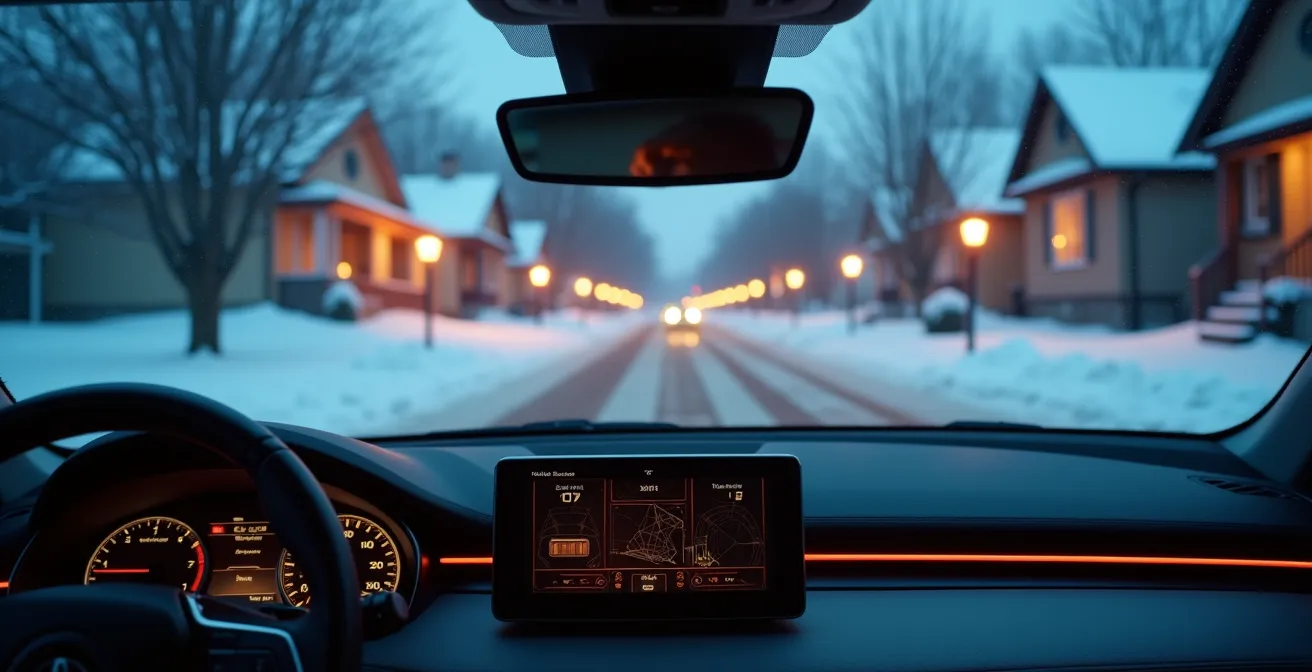
True smart home and car integration in Quebec isn’t about convenience; it’s about building a resilient ecosystem to survive the winter.
- Extreme cold is the primary failure point, directly impacting your car’s battery and remote systems. Proactive management is key.
- A successful integration focuses on vehicle health, energy optimization, and preventing common winter frustrations before they happen.
Recommendation: Shift your mindset from simple commands (like remote start) to creating automated, proactive routines that manage battery health and energy consumption for both your home and vehicle.
The piercing cold of a -25°C January morning in Quebec. You tap your remote start app, expecting the comforting rumble of your engine, but you’re met with silence and an error message. This frustration is the reality of basic connected car technology in a harsh climate. For years, the promise of the “smart car” has been sold as a luxury: using geofencing to turn on your living room lights or asking Alexa for your fuel level. While these features are neat, they miss the point entirely for anyone who has battled a Canadian winter.
Most guides focus on these surface-level conveniences, treating your car and home as two separate gadgets to be loosely linked with generic IFTTT applets. They fail to address the fundamental challenges posed by our environment: severe battery degradation in the cold, the unique power demands of EV charging, and sensors failing under a barrage of salt and ice. This approach is fragile and reactive, leaving you stranded when you need the technology most.
But what if the true purpose of this integration wasn’t just trivial convenience, but building a robust, resilient ecosystem? The real opportunity lies in shifting from reactive commands to proactive, automated vehicle health management. It’s about creating a system where your home doesn’t just welcome your car, but actively prepares it to face the elements, optimizes its energy consumption, and anticipates failure points before they occur. This is the difference between a gadget and a tool.
This guide will walk you through building that Quebec-proof ecosystem. We’ll deconstruct the most common winter failure points and show you how to create smart, automated solutions that go far beyond turning on the lights, ensuring your vehicle is as ready for a winter morning as you are.
Explore the key strategies below to transform your connected car from a novelty into a reliable winter partner. The following sections break down the most critical challenges and provide concrete, Quebec-focused solutions.
Summary: How to Build a Quebec-Proof Smart Home and Car Ecosystem
- Why Do Remote Start Apps Fail When It Hits -25°C?
- How to Schedule OTA Updates Without Draining Your 12V Battery?
- Factory Nav vs Phone Projection: Is the $15/Month Subscription Worth It?
- The Bluetooth Glitch That Drains Your Battery While Parked
- When to Buy In-Car Wi-Fi: Road Trip Season vs Daily Commute
- Why Your Dashboard Sensors Fail Faster in Winter Conditions?
- When to Upgrade Your Electrical Panel for a Level 2 Charger?
- Is the Subscription Model for Heated Seats Coming to Canada?
Why Do Remote Start Apps Fail When It Hits -25°C?
The most common reason your remote start fails in deep cold is elegantly simple: your car’s 12V battery is fighting a losing battle against physics. The chemical reactions inside a lead-acid battery slow dramatically in extreme cold, crippling its ability to deliver the high amperage needed to crank a frigid engine. In fact, at 0°C and below, a battery can lose a significant portion of its strength. At -25°C, that loss can exceed 50%. Most remote start systems have a built-in safety feature: if they detect the battery voltage is too low to guarantee a successful start and subsequent recharge, they won’t even try, leaving you in the cold.
This isn’t just a battery issue; it’s an ecosystem failure. The cold also thickens your engine oil, making the engine harder to turn over and demanding even more power from the already weakened battery. Furthermore, the signal strength of your key fob or the cellular connection for an app can also be reduced by the cold, adding another potential point of failure. The solution isn’t to just buy a new battery, but to build a more resilient system.
Proactive vehicle health management is the core principle. Instead of just hoping the car starts, you need to ensure it’s always in a state of readiness. This involves not only maintaining the battery but also considering all the interconnected factors that the cold affects. For most drivers, 80% of cold weather remote start failures are battery-related, so addressing this primary weakness is the most critical step you can take.
How to Schedule OTA Updates Without Draining Your 12V Battery?
Over-the-air (OTA) updates are a fantastic feature of modern vehicles, delivering new functionalities and security patches while you sleep. However, they can be silent killers of your 12V battery, especially during winter. An OTA update can take anywhere from 20 minutes to over an hour, during which the car’s computer systems are fully awake and drawing significant power. If your 12V battery is already weakened by the cold, a lengthy update overnight can be the final straw, leaving you with a dead car in the morning.
This is where true smart home integration demonstrates its value through energy-aware scheduling. Instead of letting the car decide when to update, you can create a proactive automation that ensures the battery is supported during the process. The simplest and most effective method is connecting a battery tender or maintainer to your car via a smart plug. This small investment creates a powerful automation opportunity.

You can then create a smart home routine (in Google Home or Alexa) named “Prepare for Update.” When you know an update is pending, you can trigger this routine. It would turn on the smart plug, activating the battery tender to provide a steady stream of power. This ensures that no matter how long the update takes, it’s drawing from the tender, not draining your crucial 12V battery. For EV owners, this can be even more sophisticated, linking to the main traction battery’s charging schedule to ensure all power-intensive activities happen at optimal, low-cost times.
Case Study: Smart Home Integration for Vehicle Management
By creating smart home routines that trigger based on vehicle status, users can automate battery management. Setting up a routine that activates a smart-plug-connected battery tender whenever the vehicle is parked at home and the outdoor temperature drops below freezing ensures the 12V battery remains topped off. This simple geofence and weather-based automation prevents the slow drain caused by cold and system updates, guaranteeing vehicle readiness.
Factory Nav vs Phone Projection: Is the $15/Month Subscription Worth It?
With the ubiquity of Apple CarPlay and Android Auto, paying a monthly subscription for a car’s built-in navigation system can feel like a ripoff. For city driving, phone projection is often superior, with access to real-time traffic from Waze or Google Maps. However, in the specific context of Quebec, the value proposition for factory navigation, especially in EVs, becomes much more compelling and is a key part of an integrated vehicle ecosystem.
The primary advantage is reliability in areas with spotty cell service. A road trip through Gaspésie or Charlevoix can quickly reveal the limitations of phone-based maps. Factory navigation systems use pre-loaded maps and a dedicated GPS signal, meaning they work flawlessly even in complete cellular dead zones. For an EV, this is not just a convenience; it’s a critical safety feature. As an industry analysis in the Canadian Automotive Technology Review notes, “Factory navigation often integrates with the battery management system for superior range prediction and can route you to chargers.” This deep integration allows the system to accurately predict your remaining range based on topography and driving style, and automatically add necessary charging stops at `Circuit Électrique` locations into your route.
Phone projection apps lack this level of vehicle data integration. They can navigate you to a charger, but they can’t intelligently manage your battery consumption to get you there. When you consider the deep integration with vehicle systems, especially for EV range management, the monthly fee can be seen as an insurance policy for stress-free travel outside of major urban centres.
To clarify the trade-offs, here is a direct comparison based on data relevant to Canadian drivers:
| Feature | Factory Navigation | Phone Projection |
|---|---|---|
| Offline Maps | Yes – Pre-loaded maps work in dead zones | Limited – Requires cached data |
| Smart Home Integration | Deep integration (Mercedes MBUX, BMW iDrive) | App-dependent |
| Quebec Coverage | Complete including rural areas | Gaps in Gaspésie, Charlevoix |
| Monthly Cost | $15-20/month | Data plan dependent |
| EV Integration | Battery management, Circuit Électrique routing | Basic navigation only |
The Bluetooth Glitch That Drains Your Battery While Parked
You park your car for a few days, and when you return, the battery is dead. You blame the cold, but the culprit might be a digital ghost: a parasitic draw caused by a faulty Bluetooth module. A parasitic draw is any electrical component that continues to draw power from the battery after the ignition is turned off. While a small draw is normal (for the clock, security system, etc.), it should be under 50 milliamps (mA). Some vehicle Bluetooth modules, however, fail to enter “sleep” mode properly, constantly searching for a paired phone and drawing ten times that amount or more.
This issue is notoriously difficult to diagnose because it’s intermittent and often doesn’t throw a fault code. It’s a prime example of where bi-directional integration between car and home can provide a solution. While you might not be able to fix the faulty module yourself, you can use smart automation to mitigate its impact and gather data for your mechanic.
The solution again involves a battery tender and a smart plug, but with a new layer of intelligence. By adding a smart home energy monitoring plug, you can track exactly how much power your car is drawing when it’s supposed to be “off.” If you see a consistent, high draw, you’ve found your parasitic drain. You can then create an automation that, if the draw exceeds a certain threshold for more than an hour, sends you a notification and automatically turns on the battery tender to counteract the drain.
Case Study: Cerence Connect’s Bi-Directional Integration
Systems like Cerence Connect show how a car’s location and sensor data can trigger smart home events, and vice-versa. A practical application for preventing battery drain is a geofenced automation. When your car leaves a designated “home” zone, the smart home system can send a command to the vehicle to ensure all non-essential systems, including a potentially glitchy Bluetooth module, are fully powered down. This bi-directional communication helps prevent battery drain by automating system shutdowns based on real-world context, as highlighted by an analysis from Cerence which details how contextual data can trigger automations.
When to Buy In-Car Wi-Fi: Road Trip Season vs Daily Commute
In-car Wi-Fi, which turns your vehicle into a mobile hotspot, is often marketed as a must-have for the modern connected family. However, for the average daily commute in a city like Montreal or Quebec City, it’s largely redundant. Your smartphone already provides a personal hotspot, and your data plan likely covers your needs. The real value of a dedicated in-car Wi-Fi plan emerges not in the daily grind, but during specific seasons: the summer road trip and the winter ski weekend.
During these trips, you often have multiple passengers with multiple devices (tablets, laptops, gaming systems) all vying for connectivity. A dedicated in-car hotspot provides a stronger, more stable connection for everyone, using a more powerful external antenna than a smartphone. This is especially true in the Laurentians or the Eastern Townships, where cell coverage can be inconsistent between towns. A car’s built-in system can often hold a signal where a phone cannot.

The smart financial move is to treat in-car Wi-Fi as a seasonal subscription. Most Canadian carriers like Bell and Rogers offer flexible data plans for connected cars that can be activated and deactivated on a monthly basis. Instead of paying year-round, you can enable the service in July for the family vacation to the Maritimes, and then again in February for ski trips. This approach provides maximum benefit when you need it most, without the unnecessary cost during your daily commute.
Case Study: Bell’s Connected Car Seasonal Plans
An analysis of Canadian carrier offerings shows that families can achieve significant savings by activating in-car Wi-Fi on a seasonal basis. By subscribing only during peak travel months, such as summer holidays or the ski season, a family can save hundreds of dollars per year compared to a continuous subscription. This strategy provides superior connectivity for multiple devices in areas with poor cell coverage during road trips, without paying for a redundant service during months of routine urban commuting.
Why Your Dashboard Sensors Fail Faster in Winter Conditions?
Modern vehicles are packed with sensors—for parking, blind-spot monitoring, adaptive cruise control, and more. And in a Quebec winter, they are under constant assault. The combination of road salt, slush, ice buildup, and extreme temperature fluctuations creates a perfect storm for premature failure. It’s not that the sensors themselves are necessarily low quality; it’s that their environment is exceptionally hostile.
The primary culprits are salt film and thermal shock. The grimy, salt-laden spray from the road coats the plastic sensor covers, obstructing their view and causing false readings or complete failure. Even when clean, the repeated cycle of freezing and thawing, often aided by caustic de-icing chemicals, can cause microscopic cracks in the plastic, allowing moisture to seep in and damage the sensitive electronics within. Furthermore, the electrical connectors for these sensors are vulnerable to corrosion from salt spray, leading to intermittent or permanent faults.
Since you can’t change the weather, the solution lies in diligent, proactive maintenance. Just as you prepare your home for winter, you must prepare your vehicle’s electronic senses. A regular cleaning and inspection routine is not optional; it’s essential for ensuring these critical safety systems function correctly when visibility is already poor. Integrating these tasks into your regular winter habits, such as when you refuel or wash your car, is the key to reliability.
Your Quebec Winter Sensor Care Checklist
- Weekly Cleaning: Gently wipe all external sensors (in bumpers, mirrors, and grille) with a soft microfiber cloth and a plastic-safe cleaner to remove the salt film. Avoid abrasive brushes.
- Pre-Winter Coating: Before the first snowfall, apply a quality plastic-safe hydrophobic coating (similar to Rain-X, but for plastic) to sensor surfaces. This helps ice and slush slide off more easily.
- Visual Inspection: When installing your winter tires, take a moment to closely inspect each sensor for signs of physical damage, like pitting or cracks from gravel and road debris.
- Connector Check: At least once per winter, check the battery terminals and, if accessible, visible sensor wiring harnesses for any signs of green or white corrosion.
- Minimize Battery Strain: Keep unnecessary electronic accessories off when not in use. A healthy battery provides stable voltage, which is crucial for sensitive electronics to function correctly in the cold.
When to Upgrade Your Electrical Panel for a Level 2 Charger?
For new EV owners in Quebec, installing a Level 2 (240V) charger at home is a game-changer, drastically reducing charging times. However, the excitement can quickly turn to frustration when the electrician informs you that your home’s main electrical panel needs an expensive upgrade. Understanding when this is necessary is key to budgeting and planning your EV transition.
The decision hinges on your panel’s total capacity, measured in amps, and your existing electrical load. Most Level 2 chargers require a dedicated 40-amp or 50-amp circuit. An electrical load calculation determines if your panel can handle this new, heavy draw in addition to your other major appliances (stove, dryer, air conditioning). In many older Montreal homes, such as those in the Plateau or Verdun with original 100-amp panels, there is often not enough spare capacity. Adding a powerful EV charger could overload the system, creating a fire hazard. In this case, an upgrade to a 150-amp or 200-amp service is non-negotiable. According to recent Canadian installation data, the electrical system upgrade cost can range from $1,500 to $3,000, a significant addition to the charger installation itself.
Newer suburban homes or recent constructions are typically built with 150-amp or 200-amp panels as standard, and usually have sufficient capacity to add a Level 2 charger without a full panel upgrade. The best first step is to consult a licensed master electrician in Quebec. They can perform a proper load calculation and tell you definitively if your current setup is sufficient.
This table from Quebec-based installer BEQ Technology provides a general guideline for what to expect based on your home’s existing service:
| Panel Size | Typical Home Type | EV Charger Compatibility | Upgrade Cost |
|---|---|---|---|
| 100 Amp | Older Montreal homes (Plateau, Verdun) | May require upgrade | $1,500+ |
| 150 Amp | Standard suburban homes | Usually sufficient | N/A |
| 200+ Amp | Newer construction | Full compatibility | N/A |
Key takeaways
- True smart integration is about resilience, not just convenience, especially in a Quebec winter.
- Focus on proactive vehicle health by automating battery maintenance and monitoring for parasitic drains.
- In Quebec, factory navigation and seasonal in-car Wi-Fi offer tangible value that outweighs their cost for many drivers.
Is the Subscription Model for Heated Seats Coming to Canada?
The automotive industry has been experimenting with “features on demand”—a subscription model where hardware is pre-installed in a vehicle, but owners must pay a monthly or yearly fee to “unlock” it. The most controversial example has been heated seats. While manufacturers see this as a new revenue stream, the idea has been met with fierce consumer backlash, particularly in cold-weather markets like Canada.
The simple answer is that it’s highly unlikely to become mainstream for essential winter features in Canada. The cultural and legal hurdles are significant. In a country where temperatures routinely drop below -20°C, heated seats are not a luxury; they are widely considered a core feature for comfort and even safety, helping drivers stay limber and focused. The attempt by brands like BMW and Mercedes to test this model was perceived not as an innovative offering, but as a greedy cash grab, holding a fundamental feature hostage.
This perception is a public relations nightmare that automakers are keen to avoid. Furthermore, such a practice could face legal challenges in Quebec. The province’s robust Consumer Protection Act is designed to protect buyers from unfair or misleading practices. An argument could easily be made that selling a car with the physical hardware for heated seats, but locking it behind a recurring paywall, is a deceptive practice, especially if not made explicitly clear at the time of purchase. The potential for class-action lawsuits and negative rulings from the consumer protection office makes it a risky proposition for automakers in this market.
Case Study: Consumer Backlash to Feature Subscriptions
When automakers like Mercedes-Benz and BMW floated the idea of subscription-based access to features like heated seats and steering wheels, the response from Canadian consumers was overwhelmingly negative. Automotive forums and social media lit up with criticism, framing the move as anti-consumer. The backlash was so strong that it forced many brands to reconsider the strategy for winter-essential features, recognizing that what might work for a software upgrade in a temperate climate is unacceptable for a core comfort feature in a market like Canada.
By moving beyond generic advice and focusing on building a resilient, proactive, and context-aware ecosystem, you can unlock the true potential of your connected vehicle. The goal is a system that not only saves you time but also provides peace of mind, knowing your technology is built to handle the worst a Quebec winter can throw at it. For a personalized assessment of how these strategies can be applied to your specific vehicle and home setup, consulting with a home automation specialist is the logical next step.