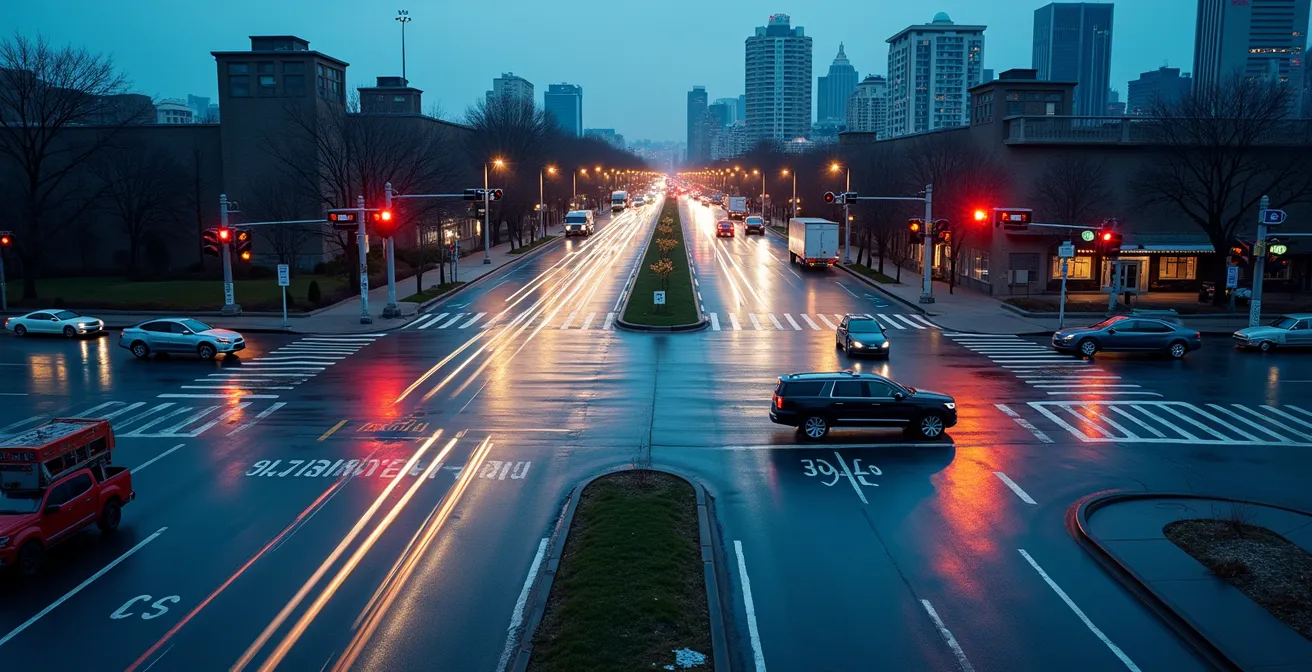
Contrary to popular belief, Montreal’s smart traffic lights aren’t just about going faster; they are part of a complex ‘Urban Operating System’ making constant, invisible compromises between speed, safety, and city logistics.
- The system intentionally desynchronizes lights to prioritize critical operations like snow removal convoys.
- Every digital interaction, from your parking app to your car’s GPS, is governed by Quebec’s strict Law 25 privacy regulations.
Recommendation: Understanding this hidden logic, rather than just knowing the streets, is the new key to mastering your daily commute.
If you’re a Montreal driver, you’ve felt it. That uncanny wave of green lights on a clear Tuesday, followed by inexplicable, maddeningly unsynchronized reds during a light snowfall. You might blame it on city planning or random chance, but the reality is far more deliberate. You’re interacting with an invisible, city-wide intelligence—an Urban Operating System (Urban OS) that is constantly making decisions, prioritizing tasks, and managing resources. It’s an intricate web of algorithms that controls far more than just traffic signals; it influences where you park, how you pay, and even what your car knows about you.
Most discussions about smart cities focus on the simple promise of efficiency: less traffic, easier parking. But this misses the crucial point. The ‘smartness’ of Montreal’s infrastructure isn’t about creating a perfect, frictionless commute for every individual. It’s about managing a series of calculated, algorithmic compromises. The system is programmed to decide, in real-time, what is most important: Is it the flow of individual cars? The progress of a bus on a tight schedule? The path of an emergency vehicle? Or the critical convoy of plows clearing a street after a storm?
This article will pull back the curtain on that hidden logic. We won’t just tell you that AI manages traffic; as an engineer who designs these systems, I will explain *why* it makes the choices it does. We will explore the trade-offs behind snow removal chaos, the data privacy implications of your digital parking payment, and why trusting the AI sometimes means accepting a slower route. By understanding the ‘why’ behind the system’s behavior, you’ll move from being a passive user of the city’s streets to an informed navigator of its complex digital nervous system.
This guide breaks down the invisible forces shaping your Montreal drive, from the logic of the traffic grid to the data flowing from your dashboard. Below is a summary of the key areas we will demystify.
Summary: How Montreal’s Smart Traffic Lights Are Rewriting Your Daily Commute
- Why Do Traffic Lights Desynchronize During Major Snow Operations?
- How to Find Free Parking Spots Using Montreal’s Open Data Apps?
- App or Meter: Which Payment Method Avoids More Tickets?
- The Privacy Risk of Automated Parking Enforcement Cameras
- When to Trust AI Traffic Predictions vs Your Own Knowledge?
- Why Does Your Car Know Where You Sleep and Who Is Buying That Data?
- Why Is the Hippolyte-Lafontaine Tunnel Renovation Taking So Long?
- How to Use the STM Network Like a Local Without speaking French?
Why Do Traffic Lights Desynchronize During Major Snow Operations?
It’s a classic Montreal winter experience: the first major snowfall hits, and the coordinated flow of traffic lights you’re used to dissolves into chaos. This isn’t a system failure; it’s a deliberate, programmed decision. The city’s Urban OS shifts its primary objective from “traffic fluidity” to “logistical support for snow removal.” This is the first and most visible example of an algorithmic compromise. The system must make a choice, and the efficient movement of snowplows and salt trucks takes precedence over your commute time.
The sheer scale of this task is immense. The system has to coordinate the clearing of over 10,000 kilometers of city streets. Managing this involves giving convoys of trucks priority, which means holding cross-traffic for extended periods. Synchronized green waves, which are designed for typical vehicle speeds, are useless for slow-moving, heavy-duty plows. Therefore, the system often reverts to a simpler, localized timing plan or even manual control to create clear paths for these essential vehicles.
Think of it as a priority cascade. In normal conditions, the system balances the needs of cars, pedestrians, and public transit. During a snowstorm, the priority list is rewritten: emergency vehicles are at the top, followed by snow removal operations. Individual cars are temporarily demoted. The desynchronization you experience is the direct consequence of the Urban OS executing this new, temporary directive to ensure the city remains functional and safe.
How to Find Free Parking Spots Using Montreal’s Open Data Apps?
The city’s intelligence extends beyond traffic flow and into the static, yet often frustrating, world of parking. Gone are the days of endlessly circling the block. Montreal’s commitment to open data means the Urban OS feeds real-time parking information directly to a suite of mobile applications. These apps aren’t just for payment; they are your window into the city’s parking inventory, allowing you to find available spots more efficiently.
The primary tool in your arsenal is Mobicité, the official app from the Agence de mobilité durable. It centralizes payment and information for all on-street parking. However, the ecosystem is broader. Third-party apps and even the city’s own Info-Neige app tap into this data stream to provide a more complete picture. For instance, Info-Neige is crucial for knowing when a street is scheduled for snow removal, helping you avoid a tow. For private lots, especially if you want to reserve a spot in advance, apps like ClicknPark offer another layer of planning.
This table compares the key applications that form Montreal’s digital parking ecosystem:
| App Name | Service Fee | Key Features | Coverage |
|---|---|---|---|
| Mobicité | 7¢ per transaction | Official city app, digital receipts, session reminders | All Montreal street parking & city lots |
| ClicknPark | Variable | Reserve spots in advance, modify bookings | Private lots in Montreal, Toronto, Quebec City |
| Info-Neige | Free | Snow removal schedules, parking restrictions | All Montreal boroughs |
Using these tools in combination transforms parking from a game of chance into a strategic exercise. You can check Mobicité for availability, cross-reference with Info-Neige to ensure you won’t be towed overnight, and have a plan B with a reserved spot in a private lot via another app.
App or Meter: Which Payment Method Avoids More Tickets?
The choice between feeding a physical meter and using a payment app seems like one of mere convenience. However, from an engineering perspective, the app offers a distinct advantage in avoiding fines by integrating you directly into the Urban OS’s notification layer. While both methods register your payment in the central system, only the app can communicate back to you in real-time.
The single most powerful feature for ticket avoidance is the reminder system. The Mobicité app, for instance, is designed to provide a 10-minute advance notification before your parking session expires. This digital tap on the shoulder is something a physical meter can never offer. It bridges the gap between your memory and the enforcement agent’s schedule, effectively buying you a crucial buffer to extend your session remotely or return to your vehicle. This feature alone drastically reduces the risk of “human error” tickets issued just minutes after expiry.
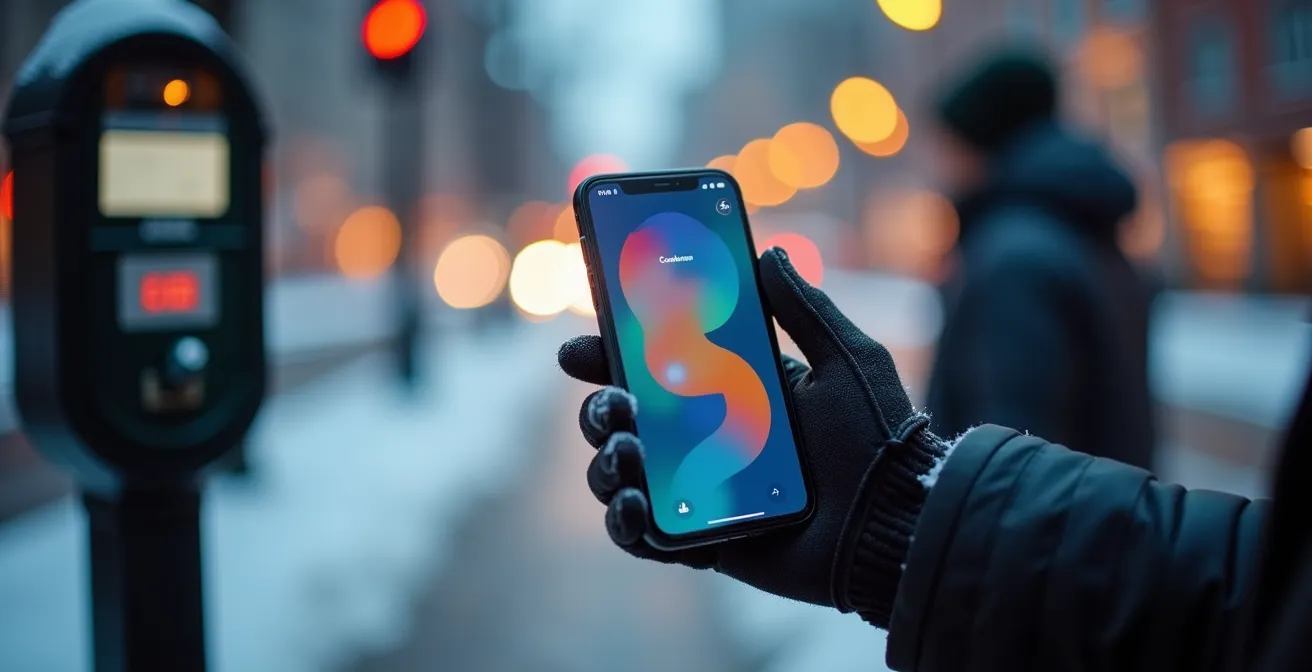
Furthermore, using an app creates an indisputable digital receipt with a precise timestamp, location, and payment record. While meter receipts can be lost or disputed, the app’s log is a permanent, easily accessible record in case of a ticketing error. This shifts the dynamic from your word against an agent’s to a simple verification of data. The system is designed to trust its own data telemetry above all else. By using the app, you are speaking the system’s native language.
The Privacy Risk of Automated Parking Enforcement Cameras
The same Urban OS that offers the convenience of payment apps also powers the city’s enforcement mechanisms, including automated license plate recognition (ALPR) cameras. These systems are incredibly efficient, but they introduce a significant privacy consideration: they collect vast amounts of data, including the location of your vehicle at specific times. In Quebec, this data collection is not a free-for-all. It is strictly governed by Quebec’s Law 25, one of the most stringent data privacy regulations in North America.
This law mandates that any organization using such automated systems must adhere to strict principles. According to compliance experts, a key requirement is the designation of a Privacy Officer responsible for overseeing activities like conducting privacy impact assessments (PIAs) before deploying new technology. This means the city can’t simply install cameras; it must first formally analyze and mitigate the potential risks to citizens’ privacy. The system must be designed with privacy as a core feature, not an afterthought.
The consequences for non-compliance are severe, creating a powerful incentive for organizations to protect your data. As the OneTrust Privacy Compliance Team highlights in their analysis of the regulation:
Fines can range between $15,000 and $25,000,000 or 4% of worldwide turnover for the previous year, whichever is greater.
– OneTrust Privacy Compliance Team, Quebec’s Law 25: What Is It and What Do You Need to Know?
This legal framework acts as a critical safeguard. While the cameras do track your vehicle for enforcement purposes, Law 25 ensures this data is collected for a specific, limited purpose and must be protected accordingly. It transforms what could be a surveillance tool into a regulated enforcement utility with defined boundaries.
When to Trust AI Traffic Predictions vs Your Own Knowledge?
Your favourite navigation app says to take the Décarie, but your gut, honed by years of driving, screams to stick to the side streets. Who do you trust? The answer lies in understanding what the AI knows and what it doesn’t. Montreal’s traffic management system is built on a powerful AI that uses data from over 2,500 smart traffic lights and detectors to create a predictive flow model.
This system isn’t just reacting to current traffic; it’s constantly predicting what the traffic will look like in the near future. As a case study from the system’s developer, Fujitsu, explains, the AI crunches data from sensors and detectors to predict traffic flows for the following 15 minutes. Based on these predictions, it can adjust traffic light synchronization to smooth out anticipated congestion before it even becomes critical. The AI’s strength is its global view; it sees the entire chessboard, not just the pieces in front of you. It knows about an accident three kilometers ahead that your local knowledge can’t account for.

However, the AI has limitations. Its predictions are based on historical patterns and real-time sensor data. It cannot predict a sudden, un-sensed event, like a delivery truck double-parking on a narrow street or a minor fender-bender that hasn’t registered on its sensors yet. This is where your own knowledge becomes invaluable. You know that on a sunny Saturday, Jean-Talon Market will create a local traffic jam that the AI might underestimate. You know that a particular side street is a reliable shortcut *unless* school has just let out. The optimal strategy is to use both: trust the AI for large-scale, network-level predictions (like choosing a highway), but temper it with your hyper-local, real-world knowledge for the last-mile decisions.
Why Does Your Car Know Where You Sleep and Who Is Buying That Data?
The data collection doesn’t stop with city cameras and traffic sensors. Your own vehicle has become one of the most powerful data-gathering devices you own. Modern cars, with their integrated GPS, infotainment systems, and connected apps, generate a constant stream of data telemetry. This includes your frequent destinations (like your home and workplace), driving habits (speed, braking patterns), and location history. The question is not *if* this data is being collected, but who controls it and for what purpose.
In Quebec, the answer again lies with Law 25. This legislation extends far beyond government agencies and applies to any business handling the personal information of Quebec residents, including car manufacturers and app developers. A core principle of the law is the need for explicit and specific consent. According to a legal analysis by SecurePrivacy, this is a high bar for businesses to meet:
Businesses will have to obtain explicit, free, informed, and specific consent for each processing purpose, which stretches out the standards set by PIPEDA. In addition, businesses have to obtain express consent for the secondary use of sensitive personal data.
– SecurePrivacy Legal Team, Quebec’s Law 25: A Comprehensive Guide to Data Privacy Compliance in 2024
This means a car company cannot legally collect your location data for “service improvement” and then sell it to a third-party marketing firm without obtaining a separate, explicit consent from you for that specific purpose. Law 25 empowers you with the right to know what data is being collected and the right to refuse its secondary use. It shifts the power dynamic from the collector to the individual, giving you legal tools to protect your digital footprint.
Your Action Plan: Protecting Your Vehicle Data Under Quebec Law 25
- Request your data: Contact your car manufacturer and formally request a copy of all collected telemetry data. They are legally obligated to respond.
- Access privacy settings: Navigate to your vehicle’s infotainment system and find the privacy or data-sharing menu. Scrutinize every option.
- Disable location history: Turn off continuous GPS tracking. Only enable location services when actively using navigation features.
- Review app permissions: Check what data your car’s companion app, as well as third-party parking and toll apps, are collecting on your phone.
- Exercise deletion rights: Submit formal data deletion requests to all mobility service providers you no longer use.
Why Is the Hippolyte-Lafontaine Tunnel Renovation Taking So Long?
For any South Shore commuter, the multi-year renovation of the Hippolyte-Lafontaine Tunnel is a source of immense frustration. The delays feel endless, and the resulting congestion seems to cripple the entire network. While the physical work—repairing concrete, upgrading lighting, and modernizing safety systems—is inherently slow, what prevents total gridlock is the same centralized traffic management system we’ve been exploring. The Urban OS is working overtime to mitigate a crisis.
During a large-scale project like this, the system’s goal shifts from optimization to damage control. The primary tool is the Advanced Traffic Management System (ATMS) that provides centralized control over traffic signals on all major arteries leading to the tunnel. As described by TransCore, the system’s provider, this allows operators to respond in real time to incidents affecting the arterial network. This is crucial. When a lane is closed in the tunnel, the system doesn’t just see the backup; it sees the ripple effect spreading across the network.
In response, operators can remotely reprogram traffic lights for miles around the tunnel’s approach. They might extend green light times on detour routes, adjust timings on the Jacques-Cartier Bridge to absorb more traffic, or prioritize bus lanes to encourage public transit use. It’s a massive, dynamic re-routing effort happening invisibly. The reason the renovation feels so slow is because even with this sophisticated management, the network’s capacity is fundamentally and drastically reduced. The ATMS isn’t a magic wand; it’s a tool that makes an impossible situation merely very difficult, rather than catastrophic. Without it, the “endless” delays you experience would be significantly worse.
Key Takeaways
- Montreal’s “smart” traffic system is an ‘Urban OS’ that makes constant algorithmic compromises, prioritizing logistics like snow removal over individual commute times.
- Digital tools like the Mobicité app offer a direct advantage in avoiding parking tickets by providing advance notifications, a feature impossible with physical meters.
- Quebec’s Law 25 provides strong protections for your personal data, requiring explicit consent before car manufacturers or apps can collect and use your location and driving habits.
How to Use the STM Network Like a Local Without speaking French?
Understanding Montreal’s Urban OS also means knowing when to opt out of driving altogether. The STM’s transit network is an efficient and integral part of the city’s mobility plan, and it’s designed to be accessible even if you don’t speak a word of French. The system relies heavily on universal design principles, colors, and pictograms, complemented by bilingual digital tools.
The fear of a language barrier is often the biggest hurdle for visitors or new residents, but technology has rendered it largely irrelevant. Modern navigation apps are your universal translator. Apps like Transit (a Montreal-born success story) and Google Maps integrate real-time STM data and offer step-by-step navigation in English. They will tell you which metro to take, which bus to transfer to, and how many stops are left until your destination.
The physical network itself is designed for intuitive navigation. By focusing on these universal cues, you can navigate with confidence:
- Pay with a tap: Use any contactless credit card directly at the metro turnstiles or bus fare boxes, bypassing the need to use a ticket machine.
- Follow the colors: Each metro line is identified by a distinct color (Orange, Green, Blue, Yellow), which is the primary way locals refer to them.
- Look for pictograms: The universal arrow symbol for “Exit” (Sortie) is your guide in every station.
- Listen for the chimes: A unique musical chime plays just before the metro doors close, a universal audio warning that is distinct for each line.
Navigating the STM like a local isn’t about language proficiency; it’s about trusting the system’s design and leveraging the right digital tools. It’s the final piece of the puzzle in mastering Montreal’s integrated mobility network.
Frequently Asked Questions on How Smart Traffic Lights in Montreal Are Changing Your Drive Time?
Can I pay for the metro without speaking French?
Yes, use a contactless credit card directly at the turnstile or buy tickets from machines that have English language options
How do I know which direction the metro is going?
Each platform shows the terminus station name – trains go toward that final stop. Maps at each station show all stops in order
What’s the best app for real-time STM updates?
Transit app or Google Maps both integrate live STM data and work fully in English with step-by-step navigation