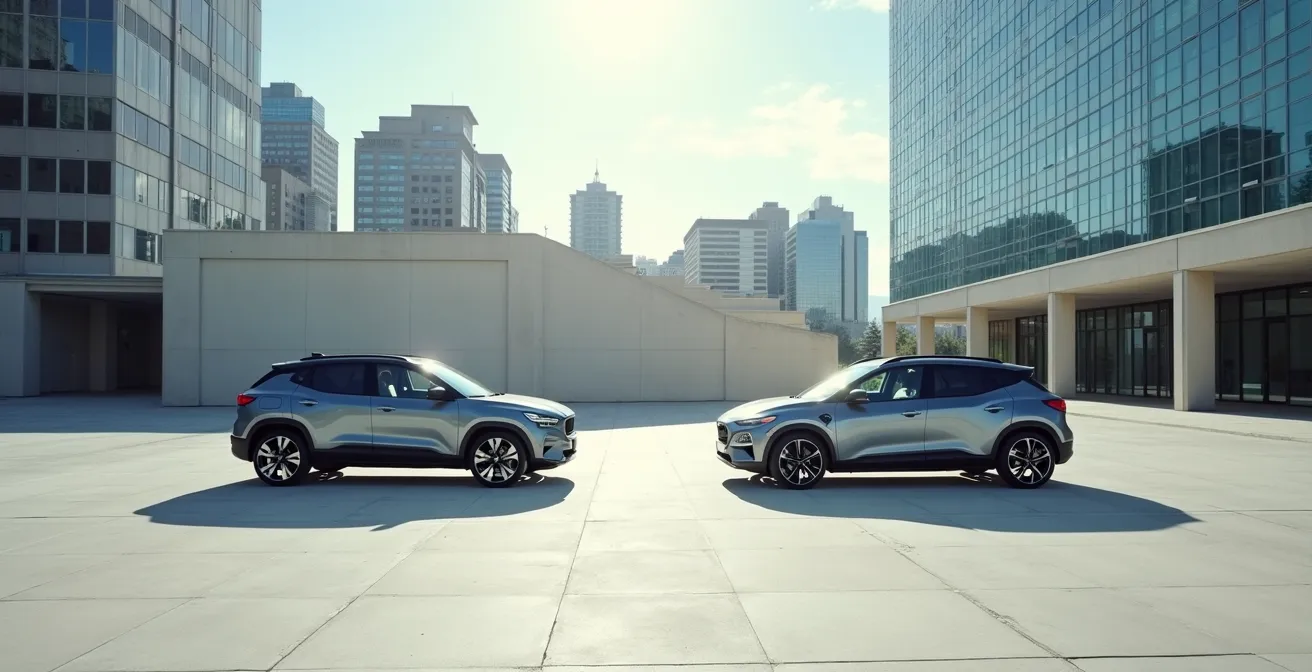
The right car for Quebec isn’t about brand or power; it’s about matching vehicle geometry to the province’s unique landscape of tight city streets and harsh winters.
- A hatchback’s vertical cargo opening and compact footprint offer superior spatial efficiency for urban life and recreational gear.
- Hidden costs unique to Quebec, like mandatory winter tires, high registration fees (SAAQ), and rust-proofing, make smaller, efficient vehicles a smarter financial choice.
Recommendation: Prioritize a vehicle’s length, turning radius, and cargo flexibility over horsepower or style to truly conquer the Quebec driving experience.
For a young professional in Quebec City, the choice of a new car often feels like a tug-of-war. You need a vehicle nimble enough to navigate the historic, narrow streets of Old Quebec, yet spacious enough to haul ski gear for a weekend trip to Mont-Sainte-Anne. The debate often boils down to two classic forms: the sporty, stylish coupe versus the practical, versatile hatchback. The common advice you’ll hear revolves around generic ideas of “fun-to-drive” coupes and “family-friendly” hatchbacks. Many will insist that all-wheel drive is the only answer for a Quebec winter, often overlooking more critical factors.
But what if this conventional wisdom misses the point entirely? The real challenge isn’t just surviving the urban jungle; it’s thriving within Quebec’s specific set of rules, both written and unwritten. The decision goes far beyond aesthetics. It involves a strategic calculation of vehicle geometry against the realities of snowbanks that shrink parking spots, SAAQ registration fees that penalize larger vehicles, and the need for true four-season versatility. The key isn’t simply choosing a car, but choosing a shape that is fundamentally compatible with the Quebec lifestyle.
This guide moves beyond the showroom floor to analyze which vehicle design—hatchback, coupe, or even their larger cousins like wagons and crossovers—truly makes sense here. We will break down the practicalities of cargo space, the physics of winter safety, the economics of ownership in the province, and the spatial awareness required for city living. By the end, you’ll have a clear framework for selecting a car that doesn’t just look good but works brilliantly from the Plateau Mont-Royal to the shores of the Gaspésie.
To help you navigate this important decision, this article breaks down the key considerations for Quebec drivers. Explore the sections below to find the answers that fit your specific needs.
Summary: Hatchback or Coupe: Which Design Survives the Urban Jungle Better?
- Why Do Quebecers Buy More Hatchbacks Than the Rest of North America?
- How to Fit a 65-Inch TV in a Compact Car Without Breaking It?
- Wagon vs SUV: Which Offers the Best Highway Comfort for Gaspésie Trips?
- The Rollover Risk 90% of First-Time Truck Buyers Ignore
- How to Choose a Car Length That Fits Old Montreal Street Parking?
- Crossover vs Minivan: Which Truly Fits a Family of 5 in Winter?
- Why Does Owning a Car Cost $10,000/Year vs $1,000 for Transit?
- Are Crossovers Really Safer in Deep Snow Than Sedans?
Why Do Quebecers Buy More Hatchbacks Than the Rest of North America?
Quebec’s automotive landscape is distinct from the rest of the continent. While large trucks and SUVs dominate sales in many parts of North America, Quebec has long shown a strong preference for smaller, more efficient compact cars and hatchbacks. This isn’t a coincidence; it’s a reflection of a unique blend of cultural, economic, and practical factors. The province’s closer cultural ties to Europe, where hatchbacks have reigned for decades, play a significant role. This affinity for European design sensibilities naturally steers many buyers toward manufacturers that excel in the hatchback format.
Economically, the incentives are built into the system. Provincial policies, such as the SAAQ’s vehicle registration fee structure, make owning a smaller vehicle financially advantageous. For example, Montreal residents face higher registration costs, which encourages the adoption of more fuel-efficient and compact cars. This trend is accelerating with the shift to electric vehicles; Statistics Canada data reveals that 30.1% of new vehicles sold in Quebec in 2024 were zero-emission, a market segment where compact and hatchback models are prevalent. Furthermore, the popularity of these models creates a strong secondary market, meaning popular hatchbacks often command a premium resale value in Quebec compared to elsewhere.
Ultimately, the hatchback preference is a pragmatic choice rooted in the realities of daily life in Quebec’s urban centres. Here are the driving factors:
- European Heritage Factor: Quebec’s cultural affinity for European brands naturally favors hatchback-dominant manufacturers.
- SAAQ Registration Economics: Higher registration costs in Montreal incentivize smaller, more efficient vehicles.
- Urban Density Advantage: Hatchbacks excel in Montreal and Quebec City’s compact streets and limited parking.
- Resale Value Premium: Popular hatchback models maintain stronger resale values in Quebec’s unique market.
How to Fit a 65-Inch TV in a Compact Car Without Breaking It?
The true test of a car’s practicality isn’t its spec sheet; it’s how it handles real-world challenges, like bringing home a large, fragile purchase from Best Buy. This is where the fundamental difference in vehicle geometry between a hatchback and a coupe becomes starkly apparent. A coupe, with its traditional trunk, offers a narrow, horizontal opening. It’s designed for luggage, not bulky boxes. A 65-inch TV box simply won’t fit through the opening, regardless of the trunk’s total volume.
A hatchback, by contrast, is a master of spatial efficiency. Its rear door, or hatch, incorporates the rear window and opens vertically, creating a massive, square-shaped aperture. When the rear seats are folded down, the car transforms into a mini cargo van. This flexibility allows you to slide large, awkwardly shaped items like flat-screen TVs, small furniture, or multiple hockey bags with sticks straight into the vehicle. It’s this superior cargo flexibility that makes the hatchback the undisputed champion of the “urban cargo challenge.” The design prioritizes not just volume, but accessibility and versatility.
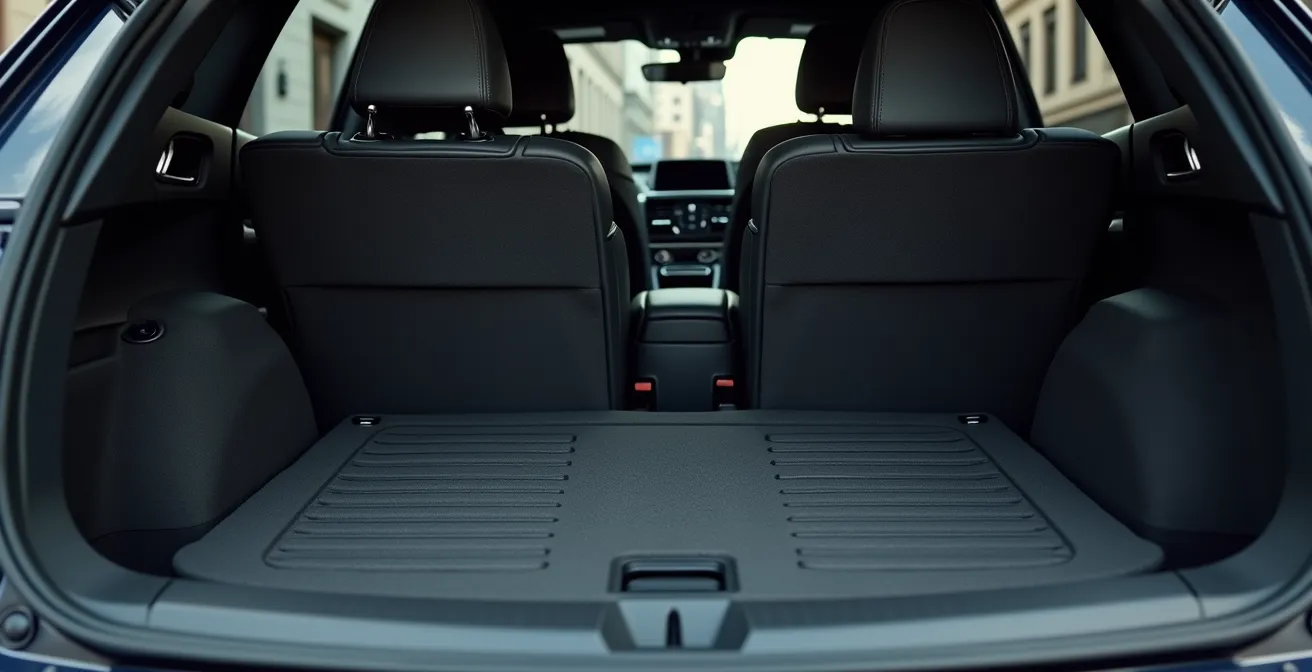
The table below, based on an analysis of typical models available in Canada, highlights the dramatic difference in cargo capability—a crucial factor for anyone balancing an active lifestyle with city living. As the data shows, a wagon takes this principle even further, but the hatchback provides the best balance for tight urban parking.
This comparative data, derived from a Kijiji Autos guide for Canadian buyers, illustrates the stark contrast in practicality.
| Vehicle Type | Cargo Opening | Max Cargo Volume | Hockey Bag Capacity |
|---|---|---|---|
| Hatchback | Wide vertical opening | 52.7 cubic feet | 2 bags + sticks |
| Coupe | Narrow horizontal trunk | 13.5 cubic feet | 1 bag (no sticks) |
| Wagon | Wide rear hatch | 66.5 cubic feet | 3+ bags + sticks |
Wagon vs SUV: Which Offers the Best Highway Comfort for Gaspésie Trips?
For those long, scenic drives from Montreal to the Gaspésie peninsula, highway comfort becomes a top priority. The popular choice is often an SUV, prized for its commanding view of the road and perceived roominess. However, a less common but often superior option for highway cruising is the station wagon. The key difference lies in their fundamental physics. An SUV’s height, which provides that high seating position, also results in a higher center of gravity. This can lead to more body roll in corners and a greater sensitivity to crosswinds on open stretches of highway.
A wagon, on the other hand, is essentially a stretched-out sedan. It shares a car’s low profile and lower center of gravity. As the experts at Car and Driver note, this translates directly to a better driving experience.
Compared with SUVs, hatchbacks have a lower center of gravity and often weigh less, which means they tend to have better handling characteristics
– Car and Driver Editorial Team
This enhanced stability means the car feels more planted and secure at speed, reducing driver fatigue over long distances. It handles sweeping curves with more confidence and is less affected by gusts of wind, making the journey more relaxing.
Furthermore, wagons often hold an efficiency advantage. Their more aerodynamic profile creates less drag than the boxy shape of a typical SUV. This translates directly into better fuel economy, a significant benefit on a multi-day road trip. For instance, some analyses show that a modern mild hybrid wagon can be remarkably efficient; an analysis of the Volvo V60 Cross Country shows a 20% better fuel economy than a comparable SUV. For the Quebec professional who enjoys long-distance exploration, a wagon offers the cargo space of a small SUV with the superior comfort and efficiency of a sedan, making it an ideal choice for conquering Route 132.
The Rollover Risk 90% of First-Time Truck Buyers Ignore
The allure of a big pickup truck or a large SUV is powerful, especially for a first-time buyer seeking a sense of safety and command on the road. However, what many new owners fail to consider is the inherent physical trade-off that comes with a high ride height: an elevated center of gravity. This single factor dramatically increases a vehicle’s susceptibility to rollovers in an emergency swerve or a collision, a risk that is often underestimated. While modern electronic stability control systems have mitigated this danger, they cannot defy the laws of physics. A taller, narrower vehicle is simply less stable than a lower, wider one.
This physical reality has financial consequences in Quebec. The Société de l’assurance automobile du Québec (SAAQ) and insurance companies are well aware of these risk profiles. Vehicle registration costs in the province are not uniform; they are structured to reflect, in part, the vehicle’s characteristics. For instance, in Montreal, annual registration costs can climb to $299.32, and insurance providers apply additional premiums to vehicles with a higher statistical risk of being involved in costly accidents, including rollovers. This differentiated pricing model is a subtle but clear incentive from the SAAQ to choose vehicles with inherently safer design geometry.
For a young professional, choosing a large truck for its perceived toughness might lead to unexpected financial burdens and a higher-risk driving dynamic they are unprepared for. Opting for a vehicle with a lower center of gravity, such as a hatchback, wagon, or sedan, not only provides better handling in emergency situations but also aligns with a more favorable risk profile in the eyes of insurers and the SAAQ. It’s a crucial consideration that moves the conversation from style to a more profound understanding of safety and financial responsibility.
How to Choose a Car Length That Fits Old Montreal Street Parking?
In the dense, historic boroughs of Montreal and Quebec City, parking is more than a convenience—it’s a competitive sport. The charming, narrow streets of Old Montreal or the Plateau Mont-Royal were not designed for modern vehicles. Here, a car’s overall length and turning radius are far more critical than its horsepower. A difference of just 30 centimeters can determine whether you can squeeze into that last available spot or are forced to circle the block for another 20 minutes.
This challenge is amplified tenfold in winter. The infamous bancs de neige (snowbanks) created by city plows can reduce the usable length of a parking space by two to three feet, making compact spots utterly inaccessible for larger vehicles. A car that fits perfectly in July might be impossible to park in January. This is why choosing a vehicle with a small footprint—ideally under 4.5 meters in length—is a strategic necessity for urban Quebecers. It’s not about compromise; it’s about maintaining your sanity. Beyond length, a tight turning radius is essential for navigating the city’s tight ruelles (alleys) and the steep, narrow ramps of underground garages.
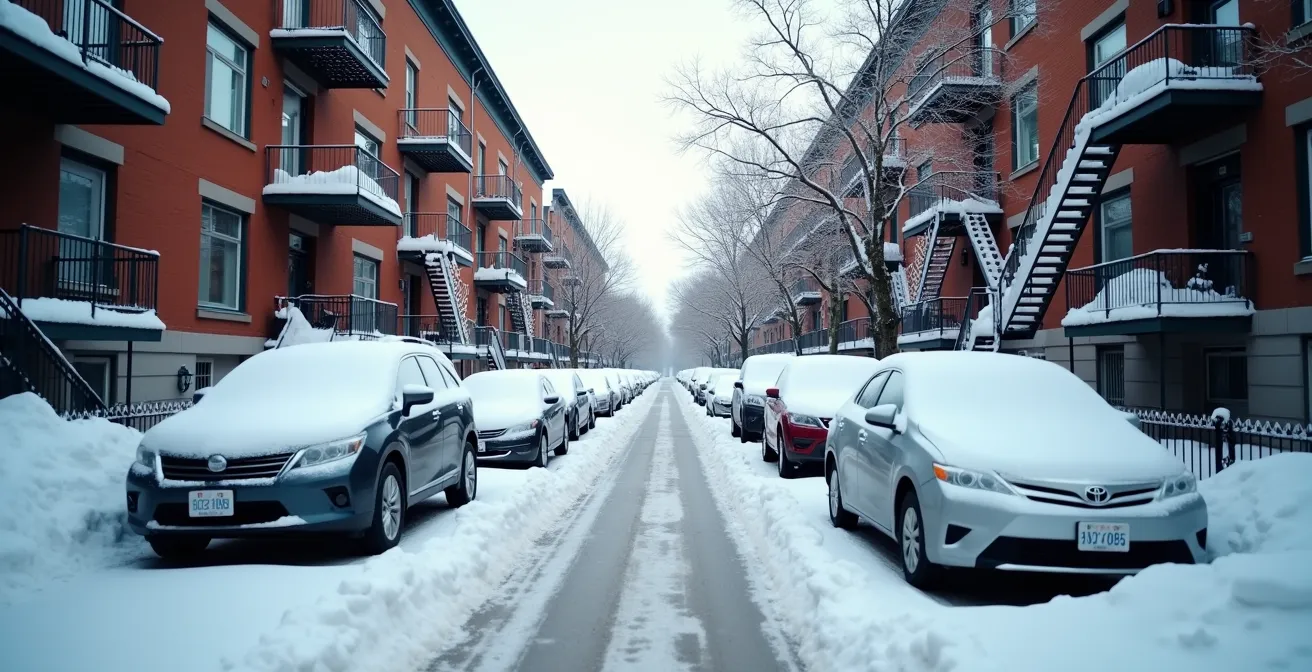
Successfully navigating urban parking in Quebec requires a conscious strategy. Before you even visit a dealership, you should assess your environment and choose a vehicle dimension that fits the city’s real-world constraints, not the wide-open spaces of a suburban mall parking lot.
Your Action Plan: The Old Montreal Parking Test
- Measure your territory: Take a tape measure to the typical parking spaces in your neighborhood. Old Montreal spots average 15-18 feet (4.5-5.5 meters).
- Factor in winter shrinkage: Mentally subtract 2-3 feet from every space to account for snowbanks. This is your true available length.
- Prioritize a sub-4.5m vehicle: For permit zones in the Plateau and Rosemont, a car under 4.5 meters in length dramatically increases your parking opportunities.
- Check the turning radius: This spec is vital for navigating tight alleys and underground garage ramps without performing a three-point turn.
- Mind the curbs: Old Montreal’s high granite curbs require good ground clearance at the doors to avoid costly scrapes when parallel parking.
Crossover vs Minivan: Which Truly Fits a Family of 5 in Winter?
For a growing Quebec family, the default choice has become the three-row crossover SUV. It promises the utility of a minivan with a more rugged, stylish image. However, when faced with the realities of a Quebec winter, the minivan often proves to be the more practical and thoughtful choice, especially for a family of five. The crossover’s biggest design flaw for families is third-row access. In most models, reaching the rearmost seats requires flipping and sliding the second row—a clumsy, difficult maneuver for kids bundled in snowsuits, and nearly impossible to do while the second row is occupied by car seats.
A minivan, with its characteristic second-row captain’s chairs, offers a simple walk-through aisle to the third row. This is a game-changer in winter. Another critical advantage is the door design. A crossover’s traditional swing-out doors require significant clearance, a luxury you don’t have when parked next to a snowbank or squeezed into a tight spot at the grocery store. A minivan’s power-sliding doors open with the push of a button and require almost no side clearance, preventing dings and making it vastly easier to get kids in and out in tight winter conditions.
This comparison table highlights the practical advantages a minivan holds for family logistics in a snowy climate.
| Feature | 3-Row Crossover | Minivan |
|---|---|---|
| 3rd Row Access Winter | Requires climbing over seats | Walk-through aisle |
| Cargo with 3rd Row Up | Minimal (groceries only) | Deep well (stroller + groceries) |
| Door Type in Snow | Swing-out (space needed) | Sliding (minimal clearance) |
Finally, there is the issue of tires. As Quebec law mandates the use of winter tires by December 1st, the drivetrain debate becomes more nuanced. A front-wheel-drive minivan equipped with high-quality winter tires will almost always outperform an all-wheel-drive crossover running on mediocre all-seasons in real-world braking and cornering on ice. For a family, predictable and safe handling is far more important than a false sense of security from AWD.
Why Does Owning a Car Cost $10,000/Year vs $1,000 for Transit?
The sticker price of a car is just the down payment on its true cost of ownership, especially in Quebec. While the convenience of a personal vehicle is undeniable, the annual financial commitment can be staggering compared to using public transit. A young professional in Montreal might pay around $1,000 for an annual OPUS pass, providing unlimited access to the metro and bus network. In contrast, the tally for car ownership can easily climb to ten times that amount, due to a unique stack of provincial expenses that go far beyond the monthly car payment.
The costs start with fixed fees. SAAQ registration in Montreal includes a $59 public transit tax on top of the base fee, bringing the total to nearly $300 annually before you even drive a kilometer. Insurance premiums in Quebec are consistently among the highest in Canada. Then come the winter-specific expenses: a set of quality winter tires can cost $800-$1200, and the biannual changeover adds another $150 each year. The province’s heavy use of road salt to combat ice makes annual rust treatment (around $150) not a luxury, but a necessity to preserve your vehicle’s value.
This list of specifically Quebec-related costs demonstrates how quickly the expenses add up, even before accounting for gas, maintenance, or parking.
- SAAQ registration: $240-$300/year, with higher rates and added taxes in the Montreal metropolitan area.
- Mandatory winter tires: An initial investment of $800-$1200, plus around $150 per year for seasonal changeovers.
- Quebec insurance premiums: Consistently higher than the Canadian national average.
- Annual rust treatment: An essential $120-$150 expense to combat corrosion from road salt.
- Residential parking permits: Can range from $100 to $300 per year in boroughs like the Plateau.
- Gasoline: With Quebec’s higher fuel taxes, the average driver can easily spend $2000-$3000 a year.
When all these costs are tallied, the financial argument for a lifestyle less dependent on a personal vehicle becomes compelling for any urban dweller on a budget.
Key Takeaways
- Vehicle geometry—length, height, and center of gravity—is more important than horsepower for navigating Quebec’s urban and winter conditions.
- All-Wheel Drive (AWD) is not a substitute for high-quality winter tires, which are legally mandated and crucial for braking and turning on ice.
- The true cost of car ownership in Quebec includes unique expenses like high SAAQ fees, mandatory rust-proofing, and winter tire changeovers, making smaller, efficient cars more economical.
Are Crossovers Really Safer in Deep Snow Than Sedans?
There’s a pervasive belief that a crossover or SUV is inherently safer in a Quebec snowstorm than a traditional sedan. This assumption is built on one key advantage: ground clearance. A crossover’s higher ride height certainly helps in avoiding getting stuck in an unplowed laneway or powering through a deep drift. However, this single benefit comes with a significant trade-off in stability, a factor that is often more critical on icy highways.
While a crossover’s clearance helps avoid getting stuck in an unplowed laneway, a sedan’s lower center of gravity provides more stability in emergency swerves on icy highways
– Quebec Winter Driving Analysis
This quote captures the core of the debate. A sedan, with its lower center of gravity, is more stable and less prone to rolling during a sudden, evasive maneuver on a slippery surface. This stability provides the driver with more control when it matters most—not when accelerating from a standstill, but when trying to avoid an obstacle or correct a slide at speed. This leads to what many Quebec driving instructors call the “AWD trap.” Drivers in AWD crossovers feel a deceptive sense of grip during acceleration, leading them to drive faster than conditions warrant. The trap is sprung when they need to brake or turn; AWD provides no advantage for stopping or cornering on ice. In these critical moments, a vehicle’s stability and the quality of its winter tires are the only things that matter.
Therefore, safety in snow is not a simple question of ground clearance. It’s a complex balance of factors. For deep, unplowed city streets, a crossover has an edge. But for the high-speed unpredictability of a winter highway, a sedan’s inherent stability offers a different, arguably more important, form of safety. The safest choice is not necessarily the tallest car, but the one driven by a motorist who understands the limits of their vehicle and the paramount importance of good winter tires.
Ultimately, the best vehicle is one that aligns with your personal lifestyle and budget. By evaluating your needs against the practical realities of parking, cargo, and true winter performance, you can make a choice that serves you well through all four of Quebec’s distinct seasons. Start by assessing your most common trips and cargo needs to determine the vehicle geometry that will make your daily life easier.