
For a suburban Quebec family, ditching the second car is the single most powerful financial decision you can make, freeing up over $10,000 annually.
- The true cost of a second vehicle far exceeds gas and insurance, representing a major depreciating asset.
- A strategically managed “mobility portfolio” (EXO, REM, Communauto) offers superior flexibility for a fraction of the cost.
Recommendation: Before buying a home or a second vehicle, perform a transit accessibility audit of the neighbourhood. Your financial future depends on it.
For generations, the sprawling suburbs of Montreal’s Couronne Nord and Sud have been synonymous with a specific vision of family life: a house, a yard, and two cars in the driveway. This two-car standard is often seen not as a choice, but as a prerequisite for managing school runs, commutes, hockey practice, and grocery shopping. The conventional wisdom dictates that suburban logistics are simply impossible without a dedicated vehicle for each adult. Consequently, family financial planning often revolves around accommodating the significant expense of a second car, treating it as an unavoidable cost of living outside the city core.
But what if this deeply ingrained assumption is no longer valid? The conversation is starting to shift from simply “how can we afford a second car?” to a more strategic question: “Is owning a second depreciating asset the smartest way to manage our family’s mobility and finances?” This isn’t about sacrificing convenience; it’s about making a calculated shift from being a passive car owner to an active manager of a diversified mobility portfolio. With the arrival of transformative infrastructure like the REM and the maturation of services like Communauto and EXO, the tools available to suburbanites are more powerful than ever.
This analysis will act as your guide, moving beyond surface-level comparisons to provide a realistic framework for this major decision. We will deconstruct the true, all-in cost of vehicle ownership in Quebec, evaluate the performance of your new mobility options, identify the critical signs that your neighbourhood is ready for a one-car lifestyle, and explore how major infrastructure debates could impact your long-term planning. It’s time to look at your driveway not just as a parking spot, but as a major item on your family’s balance sheet.
To navigate this complex decision, this article breaks down the key financial, logistical, and real estate factors you must consider. The following sections provide a complete roadmap for evaluating a one-car future in the Quebec suburbs.
Summary: A Suburban Family’s Guide to a One-Car Lifestyle in Quebec
- Why Does Owning a Car Cost $10,000/Year vs $1,000 for Transit?
- How to Optimize Your Commute Using the EXO Train Park-and-Ride?
- REM or Car: Which Gets You Downtown Faster During Rush Hour?
- The Real Estate Trap: Buying Cheap Where Transit Will Never Go
- When to Sell Your Car: Signs Your Neighborhood Is Ready for Car-Free Living
- Why Is AmigoExpress Safer Than Hitchhiking or Craigslist?
- Communauto vs Traditional Rental: Which is Best for a Weekend at Mont-Tremblant?
- How Will the “Troisième Lien” Debates Affect Your Commute in Quebec City?
Why Does Owning a Car Cost $10,000/Year vs $1,000 for Transit?
The most significant barrier to ditching a second car is a fundamental misunderstanding of its true cost. Most families budget for the obvious expenses: monthly payments, insurance, and gas. However, this is like judging an iceberg by its tip. The total cost of ownership (TCO) includes a host of “invisible” expenses that quietly drain your budget. These include depreciation (the single largest cost), maintenance, repairs, tire changes, license and registration fees, and parking. When calculated comprehensively, the $11,000 average annual cost for car ownership in Quebec, according to CAA-Quebec’s analysis, becomes a stark financial reality.
In contrast, building a “mobility portfolio” for a second adult is dramatically more affordable. This isn’t about relying on a single bus route; it’s about layering different services. A typical suburban portfolio might include an ARTM monthly pass for Zone ABC ($180/month or $2,160/year) for regular commuting on the EXO train or REM. Add a Communauto Value membership ($30-45/month) for occasional errands or appointments where a car is necessary. Factor in a seasonal BIXI membership ($95/year) for last-mile connections or leisure, and a buffer for occasional winter Uber trips. Even with generous usage, this portfolio rarely exceeds $2,500 annually.
The financial equation is clear: you are swapping a single, inflexible, and rapidly depreciating asset that costs over $11,000 a year for a flexible, multi-faceted service package that costs less than a quarter of that. This isn’t just savings; it’s capital that can be redirected towards investments, RESPs, or mortgage payments, fundamentally altering a family’s financial trajectory. The choice is between funding a metal box that loses value every day or funding your own financial freedom.
How to Optimize Your Commute Using the EXO Train Park-and-Ride?
For many residents of the Couronne Nord and Sud, the EXO commuter train network is the backbone of a one-car lifestyle. The “park-and-ride” model—driving the single family car to a station and taking the train downtown—is a well-established strategy. However, simply showing up and hoping for the best is a recipe for frustration. Optimizing this experience requires treating it with the same logistical rigour as planning a road trip. Success hinges on understanding the specific patterns of your local station and having the right tools at your disposal.
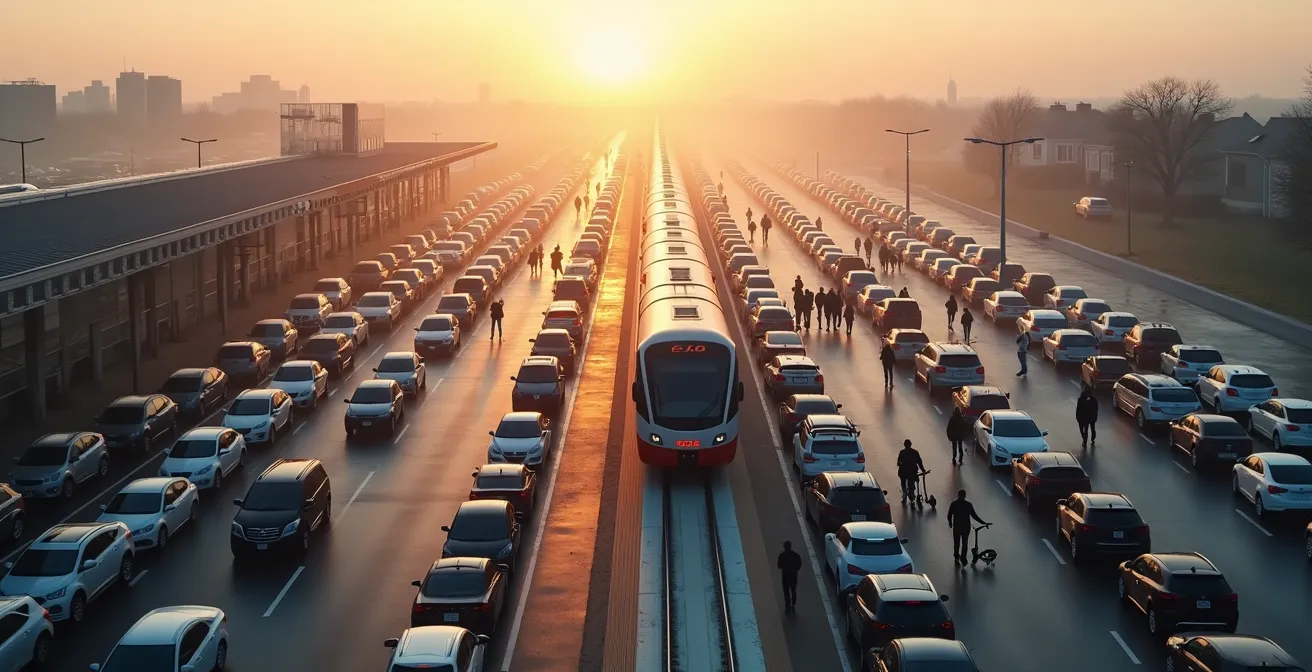
The most critical factor is timing. High-demand stations like those on the Candiac, Vaudreuil-Hudson, and Saint-Jérôme lines see their parking lots fill up remarkably early. Arriving after 7:00 AM can mean a long walk from a distant spot or, on some days, no spot at all. To avoid this, an effective strategy involves a combination of digital tools and practical preparation. Technology is your greatest ally here; real-time tracking apps can save you from waiting on a cold platform for a delayed train.
To transform the park-and-ride from a daily gamble into a reliable system, consider these key actions:
- Arrive Early: At high-demand stations like Candiac, Brossard, and Sainte-Thérèse, aim to arrive before 6:45 AM to guarantee a good parking spot.
- Use the Chrono App: Download EXO’s official app for real-time train schedules, service alerts, and delay notifications.
- Plan for the Last Mile: Keep a foldable e-scooter or a quality lock for a bike in your trunk. This gives you the flexibility to park further away without stress.
- Enroll in Guarantees: Register for programs like EXO’s guaranteed ride home program, which offers a safety net in case of major evening service cancellations.
REM or Car: Which Gets You Downtown Faster During Rush Hour?
The arrival of the Réseau express métropolitain (REM) is the single biggest disruption to the suburban commuting equation in decades. For residents along its corridors, particularly on the South Shore, it fundamentally changes the calculation of time, cost, and stress. The debate between taking the REM or driving over the Champlain Bridge during rush hour is not a fair fight; it’s a landslide victory for the automated light rail system on almost every metric. The key difference lies in one word: predictability.
A car commute is subject to a staggering number of variables: accidents, construction, weather events, or just sheer volume. A 35-minute drive can easily become a 65-minute ordeal with zero warning. In contrast, the REM, being fully automated and grade-separated (running on its own dedicated tracks), offers a fixed travel time. An 18-minute trip from Brossard to Gare Centrale is always an 18-minute trip. This reliability allows for precise planning that is impossible with a car. Furthermore, that travel time is no longer “dead time.” It’s 36 minutes of productive or relaxing time per day—time to answer emails, read a book, or simply decompress.
When you factor in the full costs, the comparison becomes even more one-sided. The financial burden of driving extends far beyond gas, including the high cost of downtown parking and the accelerated wear and tear on your vehicle. As this commute comparison from REM officials shows, the monthly savings are substantial.
| Factor | REM | Car via Champlain Bridge |
|---|---|---|
| Morning commute time | 18 minutes (fixed) | 35-65 minutes (variable) |
| Monthly cost | $138 (Zone AB pass) | $450+ (gas, parking, wear) |
| Productivity time | 36 min/day for work/reading | 0 (driving requires focus) |
| Weather impact | None (automated, grade-separated) | Significant (snow, accidents) |
| Downtown parking | Not needed | $300-400/month |
With the network’s expansion, the system is projected to serve up to 170,000 daily users, making it a cornerstone of regional mobility. For families located near a station, the second car transforms from a necessity into a demonstrably inefficient and expensive luxury.
The Real Estate Trap: Buying Cheap Where Transit Will Never Go
One of the most critical and often overlooked aspects of the one-car-family decision is its deep connection to real estate. The allure of a lower purchase price for a home in a more distant suburb can be a powerful incentive. However, this initial saving can quickly evaporate, turning into a long-term financial trap if the property is located in a “transit desert”—an area with little to no high-quality public transportation. What you save on the mortgage, you end up paying for—and more—in mandatory transportation costs for decades to come.
Relying on a second car becomes non-negotiable in these areas, locking your family into the $10,000+ annual expense indefinitely. The promise of future transit expansion is often just that: a promise. As a mobility planner, the advice is clear: buy based on the transit that exists today, not the transit that might exist in ten years. A property’s value and your family’s quality of life are directly tied to its connectivity. A home within an 800-metre walk of a REM, EXO, or metro station is not just a home; it’s an access point to a low-cost, low-stress lifestyle.
Before you even make an offer on a house, you must become a transit detective. Your goal is to assess the property’s “mobility score” with the same diligence you would apply to a home inspection. This audit goes beyond simply checking for a nearby bus stop; it requires a deep dive into the quality and frequency of the service.
Your Quebec Home-Buyer’s Transit Accessibility Checklist
- Verify the ARTM Zone: Check the property’s address on the ARTM website to determine its fare zone. This directly impacts your monthly budget (Zone A is the cheapest, D the most expensive).
- Measure Walking Distance: Use a mapping tool to confirm the actual walking distance to the nearest REM, Metro, or EXO station. Under 800m (a 10-minute walk) is ideal.
- Audit Bus Frequency: Research the schedule for local bus routes. Is there service every 15 minutes during peak hours, or just once an hour? This is a critical indicator of usability.
- Consult Official Plans: Investigate the official regional transportation plan (like the PMAD in the Montreal area) for any funded and scheduled transit projects for the next 5-10 years. Ignore vague political promises.
- Test the Commute: Before making an offer, physically test the entire commute during rush hour to experience the reality of the journey, including transfers.
When to Sell Your Car: Signs Your Neighborhood Is Ready for Car-Free Living
The decision to sell the second car often feels like a leap of faith. But it shouldn’t be. It should be a data-driven conclusion based on clear signals that your neighbourhood’s mobility ecosystem has reached a critical mass. The tipping point occurs when the combination of available services becomes so dense and reliable that using them is more convenient than defaulting to a private car for most trips. This isn’t just about having a train station nearby; it’s about the rich fabric of options available for all the *other* trips: the quick run to the pharmacy, the trip to a friend’s house, or the spontaneous weekend outing.

The key indicators are the prevalence of car-sharing and bike-sharing services. When you open an app and see several Communauto FLEX cars within a 5-minute walk, or multiple BIXI stations between your home and the grocery store, the mental calculation changes. The friction of finding, booking, and using a shared vehicle becomes lower than the friction of maintaining, insuring, and parking a second private one. This growing network is a testament to a wider shift in urban planning and consumer behaviour; a study shows an impressive 14% of Montreal households now use carsharing services, demonstrating its viability as a replacement for car ownership.
So, when is it time to post the ad on Kijiji? Look for these signs in your immediate vicinity:
- Service Density: You consistently see 3+ Communauto FLEX vehicles available within a 10-minute walk from your home.
- Station-Based Options: There is at least one station-based Communauto vehicle you can reserve in advance for planned trips.
- Robust Feeder Network: Local bus routes to the main train or REM station run at least every 20 minutes outside of peak hours.
- Walkable Essentials: You can walk or bike to a grocery store, pharmacy, and park in under 15 minutes.
- Behavioural Shift: You find yourself using the family’s second car less than twice a week, with most of those trips being easily replaceable by a car-share or transit.
Why Is AmigoExpress Safer Than Hitchhiking or Craigslist?
For longer trips where a family car might seem essential—like a weekend trip from Montreal to Quebec City or visiting family in Sherbrooke—the default assumption is to use a private vehicle. However, the modern ridesharing ecosystem, dominated by platforms like AmigoExpress and Poparide in Quebec, offers a compelling alternative that addresses the two biggest historical concerns with informal carpooling: safety and reliability. Unlike the anonymity of hitchhiking or the wild west of Craigslist, these platforms are built on a framework of verified trust and mutual accountability.
The safety advantage stems from several integrated features. First, user profiles are linked to real identities, often with verified phone numbers and user photos. Second, a public rating system allows both drivers and passengers to review each other after a trip, creating a community-enforced standard of conduct. A driver with consistently low ratings will quickly find themselves unable to attract passengers. Third, trip details are logged within the app, providing a digital record of the journey. This transparent, multi-layered system creates a powerful deterrent against misconduct and fosters a much safer environment than any informal arrangement could.
Beyond safety, these platforms offer surprising flexibility and cost-effectiveness compared to other modes of inter-city transport. While a train offers comfort, it comes at a premium and with a more rigid schedule. A bus is cheaper but can be slower. Ridesharing often hits the sweet spot of cost, speed, and convenience.
| Transportation Mode | Cost (Round Trip) | Travel Time | Flexibility |
|---|---|---|---|
| AmigoExpress/Poparide | $50-70 | 2.5-3 hours | Multiple daily options |
| VIA Rail | $120-180 | 3.5 hours | 5 departures daily |
| Orléans Express Bus | $90-110 | 3.5-4 hours | 10+ departures daily |
| Communauto rental | $250-300 | 2.5 hours | Complete flexibility |
Communauto vs Traditional Rental: Which is Best for a Weekend at Mont-Tremblant?
Even for a committed one-car family, there are times when a second vehicle is indispensable—the classic example being a weekend ski trip to Mont-Tremblant or a summer vacation in the Gaspésie. The traditional reflex is to head to a legacy rental agency like Enterprise or Hertz. However, for many scenarios, leveraging a Communauto station-based vehicle proves to be significantly more economical and convenient, especially for members who have already integrated the service into their daily lives.
The primary advantage of Communauto for weekend getaways is its all-inclusive pricing model. A traditional rental quote often looks appealing upfront but quickly balloons with add-ons. You have to factor in the cost of insurance (either through your credit card or by purchasing their expensive waiver) and, most significantly, the cost of fuel. Communauto’s daily and long-distance rates include both gas and comprehensive insurance, making your final bill predictable and often much lower. For instance, a multi-day trip can be far more affordable than many assume; a 9-day trip covering 2,250 km could cost around $570 with gas and insurance included under a value plan.
The key to success with Communauto for popular weekends is planning. Unlike the on-demand FLEX service, station-based vehicles can and should be booked well in advance. Securing a car for a long weekend in July or a ski trip in February requires a proactive approach.
- Book in Advance: Reserve your station-based vehicle up to 31 days ahead, especially for holiday weekends.
- Choose the Right Plan: The Value Extra plan often provides the best rates for multi-day rentals, with a generous number of kilometers included.
- Optimize Pick-up/Drop-off: Pick up the vehicle on a Thursday evening to avoid the Friday rush and return it late Sunday to maximize your weekend.
- Select the Right Vehicle: Look for minivan or SUV options available at some stations if you have extra gear like skis or camping equipment.
For planned weekend excursions, Communauto often beats traditional rentals on both cost and simplicity, provided you adopt a forward-thinking booking strategy. It’s another powerful component of a well-managed mobility portfolio.
Key Takeaways
- The true annual cost of owning a second car in Quebec exceeds $10,000, making it a major financial liability.
- A “mobility portfolio” combining EXO, REM, Communauto, and BIXI offers greater flexibility for under 25% of the cost.
- A property’s value and your financial freedom are directly linked to its proximity to high-quality, frequent public transit.
How Will the “Troisième Lien” Debates Affect Your Commute in Quebec City?
While Montreal’s mobility future is being actively built with the REM, the situation in the Quebec City region is defined by uncertainty, largely centred around the contentious “troisième lien” (third link) project. For a family living in the suburbs of Lévis or Beauport and contemplating a one-car lifestyle, this ongoing debate creates significant planning challenges. Unlike the clear, predictable travel times offered by a new rail line, the proposed solutions for Quebec City—whether a bridge or a tunnel—are based on a philosophy that can paradoxically worsen traffic over the long term.
The core issue is a well-documented phenomenon in urban planning called “induced demand.” The principle is simple: building more capacity for cars (like new lanes or a new bridge) makes driving seem more attractive in the short term. This encourages more people to drive, or to live further away, which quickly fills up the new capacity and brings congestion back to its previous levels, or even worse. Investing billions in car-centric infrastructure can lock a region into car dependency for another generation, making a one-car lifestyle progressively harder, not easier.
For a family in the Quebec City area, this uncertainty has direct financial implications. Committing to a home in a distant suburb based on the promise of a future third link is a significant gamble. If the project is delayed, changed, or cancelled—as has happened multiple times—or if it fails to solve congestion due to induced demand, your family could be left with a long, expensive, and stressful commute, and be fully dependent on two vehicles. A more prudent strategy involves prioritizing locations with existing, robust transit options or those slated for confirmed bus rapid transit (BRT) projects, which offer more predictable and sustainable mobility solutions.
To apply these concepts to your own situation, the most effective next step is to conduct a detailed audit of your family’s weekly travel patterns and map them against the available mobility portfolio options in your specific neighbourhood. This will reveal the true viability and potential savings of a one-car lifestyle.