
The difference in stopping distance between dry asphalt and black ice isn’t just a few meters; it’s a catastrophic loss of control dictated by physics, where your stopping distance can increase tenfold.
- Your vehicle’s kinetic energy increases with the square of its speed, meaning a small increase in velocity has a massive impact on the energy that must be dissipated to stop.
- The coefficient of friction between your tires and the road surface is the single most critical factor; on black ice, it can drop by over 90%, making braking almost ineffective.
Recommendation: Shift your mindset from “driving carefully” to managing energy and friction. This means understanding your vehicle’s mechanical limits and recognizing that winter tires and reduced speed are not suggestions, but physical necessities.
Every Quebec driver feels it: that momentary loss of traction, the stomach-lurching slide on a patch of unseen ice. The common advice is predictable: slow down, leave more space, get winter tires. While correct, this advice often fails to convey the brutal, non-negotiable physics at play. It treats a complex interaction of energy, friction, and mechanics as a simple matter of driver caution. The reality is that the difference between stopping safely on dry asphalt and sliding uncontrollably on black ice is a matter of meters, milliseconds, and fundamental physical principles.
The conversation around winter safety often focuses on driver behaviour, but it rarely deconstructs the ‘why’. Why does a mere 10 km/h increase in speed add so many meters to your stopping distance? Why can a harmless-looking layer of wet leaves mimic the danger of ice? The true key to winter driving safety lies not in just following rules, but in understanding the forces your vehicle is subject to. It requires thinking like a physicist, treating speed as kinetic energy and grip as a finite coefficient of friction.
This analysis moves beyond the platitudes. We will dissect the physical and mechanical factors that govern your vehicle’s ability to stop. We will explore why all-wheel drive offers a false sense of security during braking, how aging components in your brake system can lead to catastrophic failure, and why the very salt used to make roads safer can silently destroy the components you rely on. By understanding these principles, you transform abstract danger into predictable, quantifiable risk, enabling you to make decisions based on physics, not just habit.
The following sections break down the critical interactions between your vehicle and the road surface in various conditions. This is an essential guide to the forces that govern your safety on the road, from the kinetic energy of your moving vehicle to the mechanical integrity of your braking system.
Summary: A Physics-Based Deconstruction of Vehicle Stopping Dynamics
- Why Does Speeding 10 km/h Increase Your Stopping Distance by 10 Meters?
- Why Are Wet Leaves as Dangerous as Ice for Braking?
- How to Brake Hard Without Triggering ABS on Dry Roads?
- The Mountain Mistake: Riding Your Brakes Down Charlevoix Hills
- Why Does Old Brake Fluid Boil Faster and Cause Brake Failure?
- Why Does Road Salt Cause Brake Calipers to Lock Up?
- Why Your AWD Crossover Still Slides Into the Ditch on Ice?
- Why Do Rear Brakes Seize More Often Than Front Brakes in Quebec?
Why Does Speeding 10 km/h Increase Your Stopping Distance by 10 Meters?
The relationship between speed and stopping distance is not linear; it is exponential. This is governed by the principle of kinetic energy, which is calculated as (1/2) * mass * velocity^2. Because velocity is squared, doubling your speed from 50 km/h to 100 km/h does not double your kinetic energy—it quadruples it. Your brakes must dissipate four times the energy to bring the vehicle to a halt. Even a small increase from 50 km/h to 60 km/h (a 20% increase) results in a 44% increase in kinetic energy that needs to be controlled.
This physical reality is dramatically amplified by the road surface. On dry asphalt, the high coefficient of friction between your tires and the road allows for efficient energy dissipation. On ice, that coefficient plummets. Your tires can no longer generate the necessary grip to slow the vehicle effectively, regardless of how hard you press the brake pedal. The result is a terrifying increase in stopping distance; data shows that stopping distance can be up to 10 times longer on icy roads compared to dry pavement. A stop that takes 30 meters on a dry road could take 300 meters on ice—the length of three football fields.
This is why Quebec’s mandatory winter tire law is a matter of physics, not just regulation. As of December 1st, your vehicle must be equipped with winter tires until March 15th. An analysis of the law confirms that drivers who do not comply are liable to a fine of $200 to $300, but the real penalty is defying the laws of physics. Winter tires are designed with compounds that maintain flexibility in the cold, maximizing the available friction on hazardous surfaces and giving your braking system a fighting chance to manage the vehicle’s kinetic energy.
Why Are Wet Leaves as Dangerous as Ice for Braking?
The critical factor in braking is the coefficient of friction (μ) between your tires’ contact patches and the road surface. High friction allows for rapid deceleration; low friction results in sliding. While ice is the most notorious cause of low friction, other substances can create a similarly treacherous barrier. A dense mat of wet autumn leaves acts as a lubricant, preventing the tire’s tread from making a solid connection with the asphalt. The water and decaying organic material create a slippery film, drastically reducing the available grip in a phenomenon similar to hydroplaning.
The danger is compounded by temperature. The rubber compounds in all-season tires begin to lose their elasticity and harden as the ambient temperature drops. According to CAA-Quebec testing, winter tires are designed to stay flexible below 7°C, while all-season compounds become stiff and less effective. This means that on a cold, wet autumn day, your all-season tires have already lost a significant portion of their gripping ability before they even encounter a patch of wet leaves or the first hint of frost. Your vehicle’s ability to stop is compromised even in conditions that don’t appear overtly “wintery”.
This principle is precisely why black ice is so treacherous. It forms when the temperature is hovering right around the freezing point, often on surfaces that cool faster than the ground. As experts at CAA-Quebec advise, it’s crucial to be vigilant in these specific conditions:
Watch out for areas prone to black ice—bridges, overpasses and open sections—especially when the temperature hovers around 0°C.
– CAA-Quebec, Winter driving tips for safe driving
Whether it’s leaves, water, or a transparent layer of ice, the physical result is the same: a compromised contact patch and a dramatic reduction in the forces available for deceleration.
How to Brake Hard Without Triggering ABS on Dry Roads?
An Anti-lock Braking System (ABS) is a reactive safety feature. It activates only after it detects one or more wheels have locked up and started to skid. When ABS engages, it rapidly pulses the brakes to allow the wheel to regain traction, which you feel as a vibration through the pedal. While essential on low-friction surfaces, on dry asphalt, triggering ABS means you have already exceeded the tire’s maximum grip and are not braking at peak efficiency. The most effective braking technique on a high-grip surface is threshold braking.
Threshold braking is the proactive skill of applying brake pressure right up to the point of wheel lock-up, without actually causing a skid. This keeps the tire at the optimal slip angle, a state where it generates the maximum possible friction and thus the highest deceleration force. A driver skilled in threshold braking can stop in a shorter distance than a driver who stomps on the pedal and lets the ABS system sort it out. It requires a sensitive foot and an understanding of the vehicle’s feedback.
Mastering this technique is about developing muscle memory to find that fine line between maximum braking and wheel lock. It involves feeling the subtle feedback through the pedal and chassis and hearing the change in tire noise as it approaches its limit of adhesion.

As the illustration shows, this is a technique of precision, not brute force. It is a fundamental skill taught in advanced driving courses and is essential for any driver wanting to understand the absolute limits of their vehicle’s performance. Practicing this in a safe, controlled environment is the only way to develop the feel required.
Your Action Plan for Mastering Threshold Braking
- Find a Safe Space: Use a large, empty, and private parking lot. Ensure you have ample space and no obstacles.
- Apply Progressive Pressure: From a moderate speed (e.g., 40-50 km/h), apply the brakes smoothly and progressively. Do not stab the pedal. Focus on the feeling of the vehicle’s weight transferring forward.
- Sense the Limit: Increase pressure until you feel the tires begin to lose grip or hear a slight squeal. This is the “threshold.” In a vehicle with ABS, the goal is to stop just short of feeling the pedal pulse.
- Modulate and Hold: Learn to modulate the pressure to keep the tires at that threshold. If you feel ABS engage or a tire locks, slightly release pressure to regain grip and then reapply to the threshold.
- Develop Muscle Memory: Repeat the exercise until your foot can instinctively find and hold that maximum braking point without conscious thought. This is about training your body to react to the physics of the car.
The Mountain Mistake: Riding Your Brakes Down Charlevoix Hills
Descending a long, steep grade, such as those found in Quebec’s Charlevoix region, presents a unique thermal challenge to a vehicle’s braking system. The common but dangerous mistake is “riding the brakes”—maintaining constant, light pressure on the brake pedal to control speed. This action converts the vehicle’s immense potential energy into thermal energy (heat) within the brake rotors and pads. When this heat generation exceeds the system’s ability to dissipate it, a perilous condition known as brake fade occurs.
Brake fade can be mechanical or fluid-based. Mechanical fade happens when the pads and rotors get so hot that the friction material loses its effectiveness, and the pedal feels firm but the car doesn’t slow down. More dangerous is fluid fade, where the heat transfers to the brake fluid, causing it to boil. Since gas is compressible and liquid is not, the resulting gas bubbles in the brake lines lead to a soft, spongy pedal that can go all the way to the floor with little to no braking force. This is a total loss of the hydraulic system.
The correct technique for long descents is to use a lower gear. By shifting the transmission (automatic or manual) into a lower gear, you engage engine braking. The engine’s internal resistance works to slow the vehicle, keeping your speed in check without ever touching the brake pedal. This reserves the brakes for when you actually need to stop. You should apply the brakes firmly for short periods to reduce speed, then release them completely to allow them to cool.
This problem is exacerbated by the very geography of mountainous roads. As the Canadian Centre for Occupational Health and Safety points out, bridges cool down faster than roads due to air exposure from above and below. On a descent in Charlevoix, a driver could be managing brake heat on a clear stretch of road, only to encounter an icy bridge where maximum braking power is suddenly required. If the brakes have already faded, the result is catastrophic.
Why Does Old Brake Fluid Boil Faster and Cause Brake Failure?
Brake fluid is the lifeblood of your vehicle’s hydraulic braking system. It is designed to be incompressible, transferring the force from your foot on the pedal to the brake calipers that clamp down on the rotors. To perform under the extreme heat of braking, it must have a high boiling point. Fresh, high-quality DOT 3 or DOT 4 fluid typically has a “dry” boiling point well above 200°C. However, the critical and often-overlooked property of most brake fluids is that they are hygroscopic: they absorb moisture from the atmosphere over time.
This water contamination is the silent killer of braking performance. As little as 3% water in the brake fluid can lower its boiling point by over 50%. This “wet” boiling point can drop to as low as 140°C. During heavy braking, like the mountain descents discussed previously or an emergency stop, this water-contaminated fluid can easily boil, creating vapor pockets in the brake lines. This leads directly to fluid-based brake fade and a complete loss of braking power. The pedal feels spongy and goes to the floor because you are compressing gas, not applying force to the brakes.
This mechanical vulnerability underscores why focusing solely on tires is insufficient. Proper winter tires are essential, as documented data confirms they can reduce braking distances by 25%. However, even the best tires are useless if the hydraulic system fails. The entire braking system must be considered as one integrated unit.
The table below, based on industry testing, starkly illustrates how tire performance degrades with temperature, highlighting the need for every component in the stopping chain to be at peak performance.
| Temperature | Winter Tires | All-Season Tires | Stopping Distance Difference |
|---|---|---|---|
| +7°C | Optimal grip | Beginning to harden | +10% |
| 0°C | Full performance | Significantly hardened | +20% |
| -10°C | Maximum traction | Minimal grip | +30% |
Why Does Road Salt Cause Brake Calipers to Lock Up?
In Quebec, the heavy use of road salt and other chemical de-icers is a necessary evil for managing winter road conditions. However, this corrosive mixture creates a brutal environment for a vehicle’s undercarriage, particularly the braking system. Brake calipers, the hydraulic clamps that press the brake pads against the rotors, are highly susceptible to this chemical assault. They are complex assemblies with pistons, seals, and guide pins that must move freely.
Corrosion is the primary enemy. The salt mixture accelerates the rusting of all exposed metal components. The most common failure point is the caliper guide pins (or slider pins). These pins allow the caliper to slide back and forth, ensuring even pressure is applied by both the inner and outer brake pads. When these pins corrode and seize within their bores, the caliper can no longer move freely. It becomes stuck, often causing the brake pad on one side to remain in constant contact with the rotor.
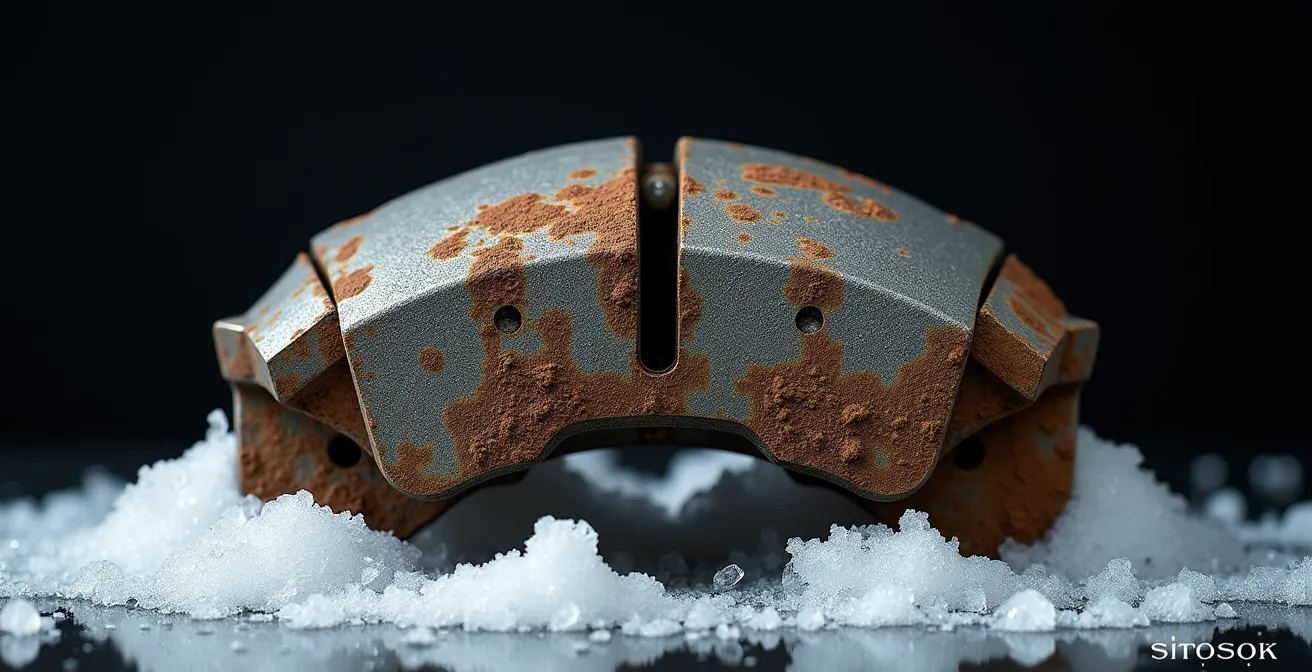
This leads to a host of problems. A seized caliper will cause rapid and uneven wear of the brake pads and rotor. It generates excessive heat, which can lead to brake fade and a warped rotor. You might notice a burning smell after a drive, a significant drop in fuel economy, or the vehicle pulling to one side. In a worst-case scenario, the constant friction can cause the brake assembly to overheat and fail entirely. Regular inspection and lubrication of the caliper pins during seasonal tire changes are critical preventative maintenance steps in a salt-heavy climate like Quebec’s.
The problem is not limited to the pins. The caliper piston itself can corrode within its bore, preventing it from retracting properly after the brake pedal is released. The rubber dust boots designed to protect these moving parts can become brittle from age and exposure, tearing and allowing the corrosive slurry of salt and water to penetrate the most sensitive parts of the caliper, guaranteeing its eventual seizure.
Why Your AWD Crossover Still Slides Into the Ditch on Ice?
One of the most pervasive and dangerous misconceptions in winter driving is that All-Wheel Drive (AWD) improves a vehicle’s ability to stop and turn on ice. Marketing has successfully sold AWD as a comprehensive winter safety solution, but it defies the laws of physics. An AWD system is designed to do one thing: improve acceleration by distributing engine power to all four wheels. This is advantageous when starting from a stop on a slippery surface, as it reduces the chance of wheelspin.
However, when you hit the brake pedal, the engine is disconnected from the equation. Your vehicle’s ability to stop is determined by the friction generated between your four tire contact patches and the road surface—and nothing else. An AWD system offers zero advantage in braking. An AWD crossover weighing 2,000 kg has the same four patches of rubber to rely on as a Front-Wheel Drive sedan of the same weight. If those tires are on ice, both vehicles are subject to the same drastically reduced coefficient of friction.
This fact is consistently confirmed by vehicle dynamics experts. As extensive testing from Car and Driver confirms, AWD systems don’t improve braking or turning ability on ice—only acceleration. This creates a dangerous confidence gap. Drivers of AWD vehicles can accelerate to higher speeds more easily on snowy roads, giving them a false sense of security. When they need to make a sudden stop or a quick turn, they are confronted with the same physical limitations as any other vehicle, but at a potentially higher speed, with more kinetic energy to manage.
Physics doesn’t care how many wheels are getting power. When you hit the brakes on ice, every vehicle relies on the same four contact patches of rubber gripping the road.
Ultimately, your safety on ice is dictated by your tires, your speed, and your understanding that an AWD badge has no influence on the laws of friction and momentum.
Key Takeaways
- Stopping distance is governed by kinetic energy (a function of speed squared) and the coefficient of friction, not just driver reaction time.
- System integrity is crucial: from the tire compound’s flexibility at 7°C to the boiling point of your brake fluid, every component matters.
- AWD improves acceleration on slippery surfaces but provides zero benefit for braking or turning on ice. Your tires are the only thing that can help.
Why Do Rear Brakes Seize More Often Than Front Brakes in Quebec?
It is a common observation for mechanics in Quebec: rear brake calipers and components seize up far more frequently than their front-axle counterparts. This phenomenon is a direct result of a combination of physical forces and environmental exposure. The primary reason is workload distribution. During braking, a vehicle’s weight dynamically shifts forward. This forces the front brakes to handle a significantly larger portion of the braking load—typically 60-70% of the total braking force. The rear brakes, consequently, do much less work. They generate less heat and their moving parts—the caliper pistons and guide pins—are actuated less forcefully and less often.
This lack of regular, forceful movement makes them more susceptible to seizing from corrosion. While the front brakes are constantly working hard, heating up and moving through their full range of motion, the rear components can remain relatively static. This allows the corrosive mixture of road salt and moisture to settle and begin its destructive work on the guide pins and piston seals without being disturbed.
Furthermore, the location of the rear wheels exposes them to a more direct and constant spray of corrosive slush kicked up by the front tires. This envelops the rear brake assembly in a perpetual salty mist. Without the higher operating temperatures of the front brakes to help evaporate this moisture, the rear components stay wet longer, accelerating the rate of corrosion. This combination of lower workload and higher environmental exposure makes rear brake seizure a near-certainty over time if not properly maintained.
This mechanical vulnerability is most dangerous in the very conditions it’s born from. Research from road safety authorities shows that ice at -1°C is twice as slippery as ice at -18°C. On that deceptively mild, wet, and slushy winter day, when friction is at its absolute lowest, a driver needs every component of the braking system to function perfectly. A seized rear caliper compromises the vehicle’s stability under braking and reduces its overall stopping power, at the precise moment it is needed most.
To ensure your vehicle can safely navigate Quebec’s demanding winter conditions, a comprehensive brake system inspection is not just a recommendation—it is a critical safety action. This should include checking for seized components, measuring the moisture content of your brake fluid, and verifying the condition of your winter tires. Your ability to stop is only as strong as the weakest link in this complex system.