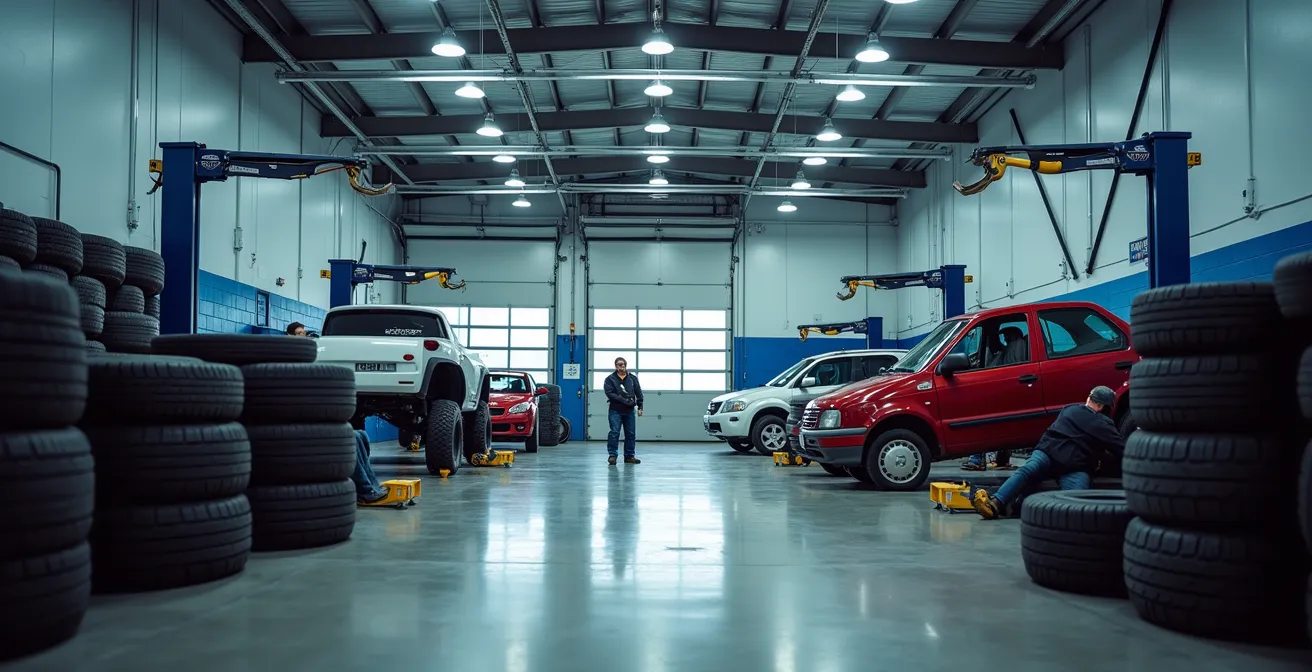
Waiting until the last minute for the December 1st winter tire deadline costs you more than just stress; it exposes you to expensive and dangerous “procrastinator traps.”
- Rushing often leads to buying worn-out used tires that are barely legal and unsafe after a few weeks (the “6/32-inch trap”).
- All-Wheel Drive (AWD) creates a false sense of security; it helps you go, but only proper winter tires help you stop and steer on ice.
Recommendation: Shift your mindset from just “changing tires” to “winter-proofing” your vehicle. A full inspection in October saves you from costly corrosion damage and ensures true on-road safety.
Every November, it’s the same story. The first snowflakes fall, and the phone starts ringing off the hook. That quiet sense of panic builds as drivers realize the December 1st mandatory winter tire deadline is just around the corner, and every garage in Quebec is booked solid for weeks. The scramble begins. But as a tire shop manager, I see what drivers don’t: the real problem isn’t just getting an appointment. It’s the cascade of poor, costly, and dangerous decisions made under pressure. The fine for non-compliance, which can run from $200 to $300 plus costs, is often the least of your worries.
Many articles will give you the standard advice: “book early” and “check for the snowflake symbol.” This is basic. It doesn’t address the real risks that come with procrastination. You might be tempted by a “great deal” on used tires or put too much faith in your vehicle’s All-Wheel Drive system. These are the classic traps. The truth is, beating the rush isn’t about speed; it’s about strategy. It’s about understanding the hidden costs lurking behind that firm deadline, from the physics of ice to the chemistry of road salt.
This guide offers an inside look from the shop floor. We’re going beyond the SAAQ’s basic requirements to reveal why these rules exist, how to avoid the common pitfalls of last-minute shopping, and how a proactive approach doesn’t just keep you legal—it saves you money and might just save your life. We’ll dismantle the myths and give you a clear, actionable plan to transition from a deadline-driven procrastinator to a prepared, confident winter driver.
To help you navigate this critical topic, this article breaks down the essential elements of Quebec’s winter driving reality. We will explore the reasoning behind the law, clarify tire requirements, and dive into the practical consequences of your choices, from tire wear to hidden vehicle damage.
Summary: Beat the December 1st Rush: A Quebec Tire Shop Manager’s Guide for Procrastinators
- Why Did Quebec Move the Winter Tire Deadline Earlier to December 1st?
- How to Identify if Your “All-Weather” Tires Are Legal in Quebec?
- Studded Tires vs Standard Winter: Which Is Better for Rural Living?
- The 6/32 Inch Trap: Buying Used Winter Tires That Are Only Legal for One Month
- Where to Store Your Summer Tires to Prevent Dry Rot?
- Low Profile vs Standard Tires: Which Survives Montreal Streets?
- Why Your AWD Crossover Still Slides Into the Ditch on Ice?
- Why Do Rear Brakes Seize More Often Than Front Brakes in Quebec?
Why Did Quebec Move the Winter Tire Deadline Earlier to December 1st?
The shift of Quebec’s winter tire deadline from December 15th to December 1st wasn’t an arbitrary change. It was a data-driven decision aimed at reducing the spike in accidents that consistently occurred during the first major snowfalls of late November and early December. Before the change, many drivers would wait, thinking they could “get by” on their all-seasons until the deadline. This created a dangerous gap where unpredictable weather met unprepared vehicles, leading to preventable collisions, injuries, and fatalities. The government acted to close this safety gap, forcing drivers to be ready *before* the worst of winter typically begins.
From a practical standpoint, the earlier date serves as a crucial behavioral nudge. It forces the issue before the “appointment bottleneck” becomes impossible to navigate. The goal is to smooth out the demand for tire changes over a longer period, from October through November. For the driver, this means recognizing that the law’s intent isn’t punitive; it’s preventative. It’s about aligning your vehicle’s readiness with the meteorological reality of a Quebec winter, not just a date on the calendar. A key exemption exists for those who purchase a vehicle within 7 days of the deadline, but for everyone else, planning is non-negotiable.
Thinking like a prepared driver means seeing December 1st not as the start date, but as the final, absolute fallback. The real work should be done by mid-November at the latest. This shift in mindset from reactive compliance to proactive safety is the first and most important step in mastering winter driving in Quebec. The law simply formalizes what experienced drivers have known for years: winter waits for no one.
How to Identify if Your “All-Weather” Tires Are Legal in Quebec?
This is one of the most common points of confusion I see in the shop. Many drivers hear “all-season” or “all-weather” and assume they are covered. In Quebec, the law is crystal clear and it has nothing to do with the marketing name on the tire. The only thing that matters is a specific symbol embossed on the tire’s sidewall: the Three-Peak Mountain Snowflake (3PMSF) symbol. If your tire does not have this pictogram, it is not a legal winter tire in Quebec, period. The old “M+S” (Mud and Snow) marking is insufficient as it doesn’t guarantee performance in cold temperatures.
The 3PMSF symbol signifies that the tire has passed a standardized test for acceleration performance on medium-packed snow. This is crucial because the rubber compound in a true winter or “all-weather” tire is designed to stay soft and flexible below 7°C, allowing it to grip cold pavement and ice. In contrast, the compound in a typical “all-season” (M+S) tire hardens in the cold, drastically reducing traction and becoming more like a plastic hockey puck on the ice. The distinction is about chemistry and performance, not just tread pattern.
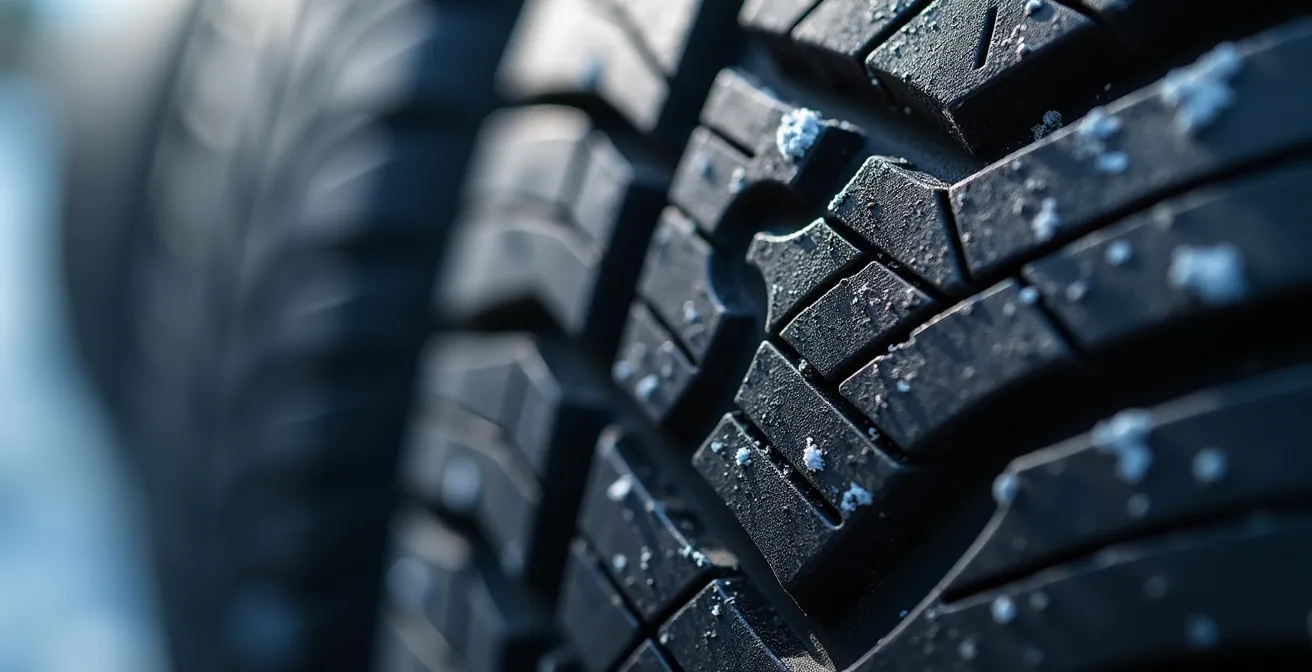
As you can see, the symbol is unambiguous. When buying tires, especially those marketed as “all-weather,” your first and only question should be confirming the presence of this pictogram. The table below, based on information from industry authorities, breaks down the key differences.
| Tire Marking | Legal in Quebec Winter | Temperature Performance | Best Use Case |
|---|---|---|---|
| 3PMSF Symbol (Mountain/Snowflake) | ✓ Yes | Effective below -7°C | All winter conditions |
| M+S (Mud and Snow) | ✗ No | Hardens below 7°C | Light snow only |
| Studded Tires | ✓ Yes (Oct 15-May 1) | Best on ice at -5°C to 0°C | Rural/icy roads |
Studded Tires vs Standard Winter: Which Is Better for Rural Living?
For city drivers, a high-quality standard winter tire is usually the best choice. But once you leave the well-plowed urban centers, the equation changes. For those living in rural areas like the Gaspésie, the Laurentians, or the Eastern Townships, studded tires can be a critical safety tool. The key difference is their performance on ice. Standard winter tires rely on sipes (tiny slits) and soft rubber compounds to grip. Studded tires add a mechanical element: small metal studs that physically dig into ice, providing superior traction on poorly maintained secondary roads, steep inclines, and during freezing rain events.
However, this advantage comes with trade-offs. As the official regulations highlight, studded tires are only permitted for a specific period. According to the Gouvernement du Québec:
Studded tires are permitted from October 15 to May 1 on commercial vehicles whose total loaded mass does not exceed 3,000 kg, passenger vehicles, and taxis
– Gouvernement du Québec, Official Quebec Winter Tire Requirements
This strict window is in place because studs cause accelerated wear on dry pavement. They are also significantly noisier on the highway and may be prohibited in certain urban parking garages due to the damage they cause to floor coatings. The choice, therefore, is a lifestyle decision. If your daily commute involves unplowed backroads or icy hills where an extra margin of safety is paramount, the noise and restrictions are a worthwhile compromise. If you primarily drive on treated highways and city streets, a premium non-studded winter tire will offer a quieter, more comfortable ride with excellent all-around winter performance.
The 6/32 Inch Trap: Buying Used Winter Tires That Are Only Legal for One Month
In the last-minute rush, the temptation to save money and time by buying used winter tires is strong. This is, without a doubt, the single biggest trap for procrastinators. Here’s the problem: the legal minimum tread depth for tires in Quebec is 1.6 mm (2/32″). However, a winter tire loses its effectiveness in snow and slush long before it hits that legal limit. Its ability to channel away water and grip snow is severely compromised once the tread wears down. This is why experts set a much higher bar for safety.
For instance, CAA-Quebec strongly recommends starting winter with at least 4.8 mm (6/32 inches) of tread. A brand-new winter tire typically has 10/32″ to 13/32″ of tread. If you buy a used set with exactly 6/32″, you might only get a few thousand kilometers of effective use before they drop below a safe level. You’re essentially buying a tire that may only be truly functional for a month or two, leaving you with poor traction for the rest of the winter. Furthermore, you must check the DOT code on the sidewall; a tire older than six years is a risk, as the rubber hardens and cracks regardless of tread depth.
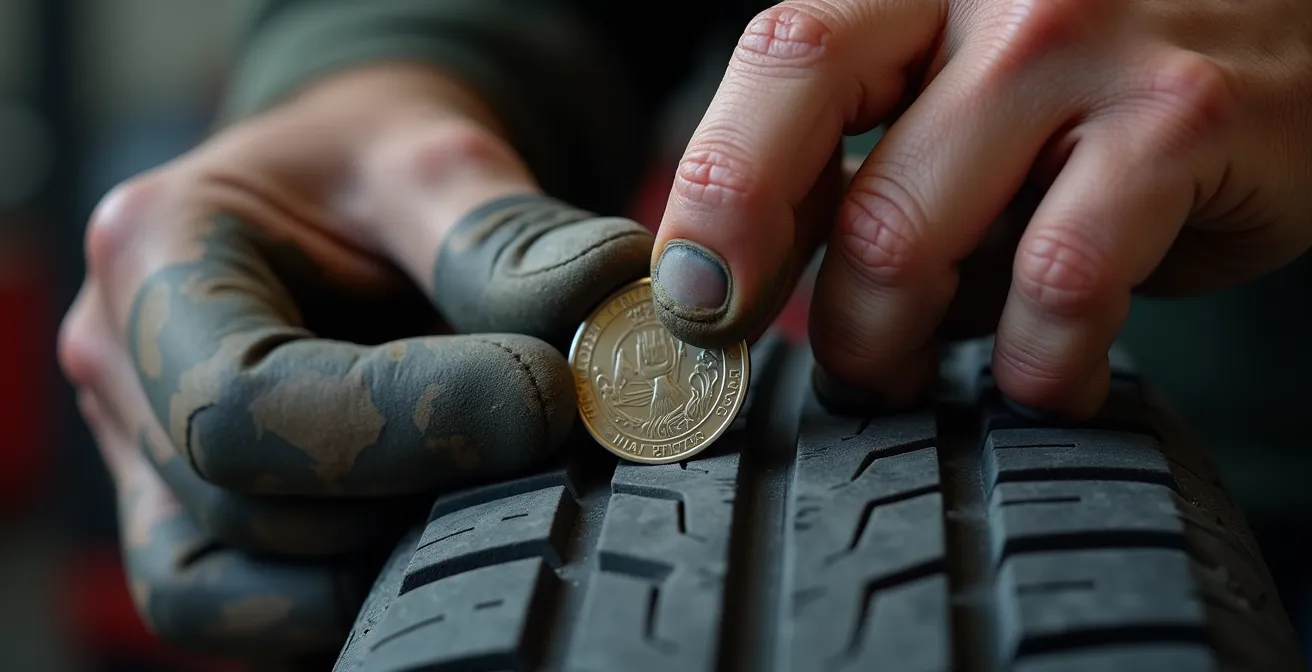
The famous “caribou quarter test” is a great visual guide. If you can see the tip of the caribou’s nose when you place the coin in the tread, the tire is already too worn for safe winter use. Before even considering a used set, you must perform a thorough inspection.
Your Action Plan: Used Winter Tire Inspection Checklist
- Use the caribou quarter test: insert the coin nose-down. If you see the snout, the tread is too shallow.
- Check the DOT code: The last four digits represent the week and year of manufacture (e.g., ‘3521’ is the 35th week of 2021). Avoid tires over 6 years old.
- Inspect for uneven wear patterns, which can indicate alignment or suspension issues from the previous vehicle.
- Verify the 3PMSF symbol is clearly visible and not worn away or cracked.
- Request a professional inspection from a CAA-approved shop before finalizing a private sale.
Where to Store Your Summer Tires to Prevent Dry Rot?
Once your winter tires are on, the next question is what to do with your summer or all-season set. Tossing them on the balcony or in an unheated “cabanon” is a common but costly mistake. The biggest enemy of tire rubber is extreme temperature fluctuations and UV light, both of which are abundant in Quebec. This is where the concept of “dry rot” comes in—the rubber degrades, becomes brittle, and develops dangerous cracks. A tire that looks fine in November can be ruined by April if stored improperly.
Quebec’s climate, with its swings from -30°C to +35°C, is particularly harsh. An uninsulated shed experiences these full temperature cycles, causing the rubber to repeatedly expand and contract, which accelerates its breakdown. Storing tires in a cool, dry, dark place away from electric motors (which produce ozone) is critical. A home basement is a good option if you have the space, but the most hassle-free and effective solution is a professional “tire hotel.” These services not only save you space but also ensure your tires are stored in a climate-controlled environment, often extending their usable life by two or three seasons compared to uncontrolled storage.
While a tire hotel has an annual cost, it should be viewed as an investment in the longevity of your tires. When you consider the price of replacing a set of premium tires prematurely due to dry rot, the storage fee becomes much more palatable. The following table compares your options.
| Storage Option | Annual Cost | Pros | Cons |
|---|---|---|---|
| Home Basement | $0 | Free, immediate access, full control | Takes space, must maintain conditions |
| Unheated Shed/Balcony | $0 | No indoor space used | Temperature swings accelerate dry rot |
| Tire Hotel (Dealer) | $60-100 | Climate controlled, insured, includes cleaning | Need appointment for retrieval |
| Storage Unit | $480-720 | Secure, climate options available | Most expensive, requires transport |
Low Profile vs Standard Tires: Which Survives Montreal Streets?
If you drive in Montreal, you’re not just battling snow and ice; you’re battling the city’s infamous potholes. The annual freeze-thaw cycle wreaks havoc on the pavement, creating a minefield for drivers. In fact, the city’s infrastructure is so challenged that Montreal repairs nearly 200,000 potholes annually. This is where your tire choice, specifically the tire’s profile or sidewall height, becomes a matter of financial survival.
Low-profile tires, with their short, stiff sidewalls, look sporty and offer sharp handling on smooth roads. However, that same stiffness makes them incredibly vulnerable to impact damage. When a low-profile tire hits the sharp edge of a pothole, there is very little rubber to absorb the shock. This can easily result in a pinched sidewall (a “bubble”), a bent or cracked rim, or even damage to your vehicle’s suspension components. A single bad pothole can destroy a tire and rim, leading to a repair bill of hundreds, if not thousands, of dollars.
Standard profile tires, by contrast, have a taller, more flexible sidewall. This extra rubber acts as a crucial cushion, absorbing much of the impact energy from potholes and protecting both the tire and the wheel. While they may not feel as razor-sharp in corners, their resilience is far more valuable for day-to-day driving on Montreal’s streets. For winter, a standard profile winter tire is almost always the smarter, safer, and more economical choice. You sacrifice a small amount of aesthetic appeal for a massive gain in durability and peace of mind.
Key Takeaways
- The December 1st deadline is a preventative measure; plan to have tires on by mid-November to avoid the rush and associated risks.
- The 3PMSF (mountain/snowflake) symbol is the only mark of a legal winter tire in Quebec; “M+S” alone is not sufficient.
- Be wary of the “6/32-inch trap” when buying used tires; a tire with this little tread has very limited life left and is a poor investment.
Why Your AWD Crossover Still Slides Into the Ditch on Ice?
This is the “AWD Illusion”—one of the most dangerous misconceptions in winter driving. You bought a crossover or SUV with All-Wheel Drive, so you feel invincible. The system works seamlessly, and you never feel a wheel slip when accelerating from a stoplight. The problem is, AWD only helps you GO. It does absolutely nothing to help you STOP or STEER. The laws of physics are unforgiving, and your vehicle’s ability to brake and turn on a slippery surface is almost entirely dependent on the four small contact patches of your tires.
An AWD system is brilliant at distributing power to the wheels with the most traction, which is why it’s so effective for accelerating in snow. But when you hit the brakes, AWD is irrelevant. Your vehicle becomes a 2,000 kg sled, and only the grip of your tires can slow it down. If you’re on all-season tires, their hard rubber compound will have minimal grip on ice, and your anti-lock braking system (ABS) will chatter helplessly as you slide. A proper winter tire, however, is designed to stay pliable in the cold and bite into the ice.
The difference is staggering. According to safety experts, the impact on braking is undeniable. As noted by CAA-Quebec, having the right tires can dramatically improve your ability to stop in winter conditions.
Winter tires reduce braking distance by 25% compared to all-season tires, even on dry winter roads
– CAA-Quebec, Winter Tire Safety Statistics
This is why installing winter tires on all four wheels is mandatory. Mismatching tires can confuse your vehicle’s stability control system, making it less effective when you need it most. Remember, all your advanced safety systems—ABS, traction control, stability control—are useless if your tires have no grip to begin with. AWD provides a false sense of security that can lead drivers to go too fast for the conditions, only to discover their mistake when they can’t make a corner or stop in time.
Why Do Rear Brakes Seize More Often Than Front Brakes in Quebec?
After a long, harsh winter, you might notice a grinding noise or a sticky feeling from the back of your car. This is often the sign of a seized rear brake caliper or slider, a problem I see constantly in my shop and a perfect example of the hidden “corrosion tax” of driving in Quebec. The reason it happens more often to rear brakes is a combination of chemistry and physics. Quebec’s aggressive de-icing strategy uses a hyper-corrosive cocktail of salts, including calcium chloride and magnesium chloride. This slushy mixture gets kicked up and coats every component under your car.
Front brakes do about 70% of the braking work. This means they generate a tremendous amount of heat, which helps to burn off moisture and the corrosive film. The rear brakes, doing only 30% of the work, run much cooler. They don’t get hot enough to self-clean through friction. As a result, the salt-laden moisture sits on the caliper pins, sliders, and piston, allowing rust to build up relentlessly. Over time, this corrosion causes the moving parts to seize, leading to uneven brake pad wear, poor performance, and eventually, a costly repair.
This corrosive assault is not a minor issue; it has a real financial impact. It’s estimated that the average cost of salt corrosion damage to Quebec vehicles is estimated at $170 per year. This is why a simple tire change appointment in the fall is a missed opportunity. A proper “winter-proofing” service should always include a thorough brake inspection and lubrication. By cleaning and lubricating the caliper sliders and pins before winter, you create a protective barrier against corrosion, ensuring your brakes function properly and saving you from a guaranteed repair bill in the spring. It’s the ultimate proactive move.
Don’t wait for the first snowflake to become your alarm bell. By thinking ahead and addressing not just your tires but your entire vehicle’s vulnerability to winter, you move from being a victim of the deadline to the master of your own safety and budget. To ensure your vehicle is truly prepared, the next logical step is to book a complete fall maintenance and winter-proofing inspection with a trusted mechanic.