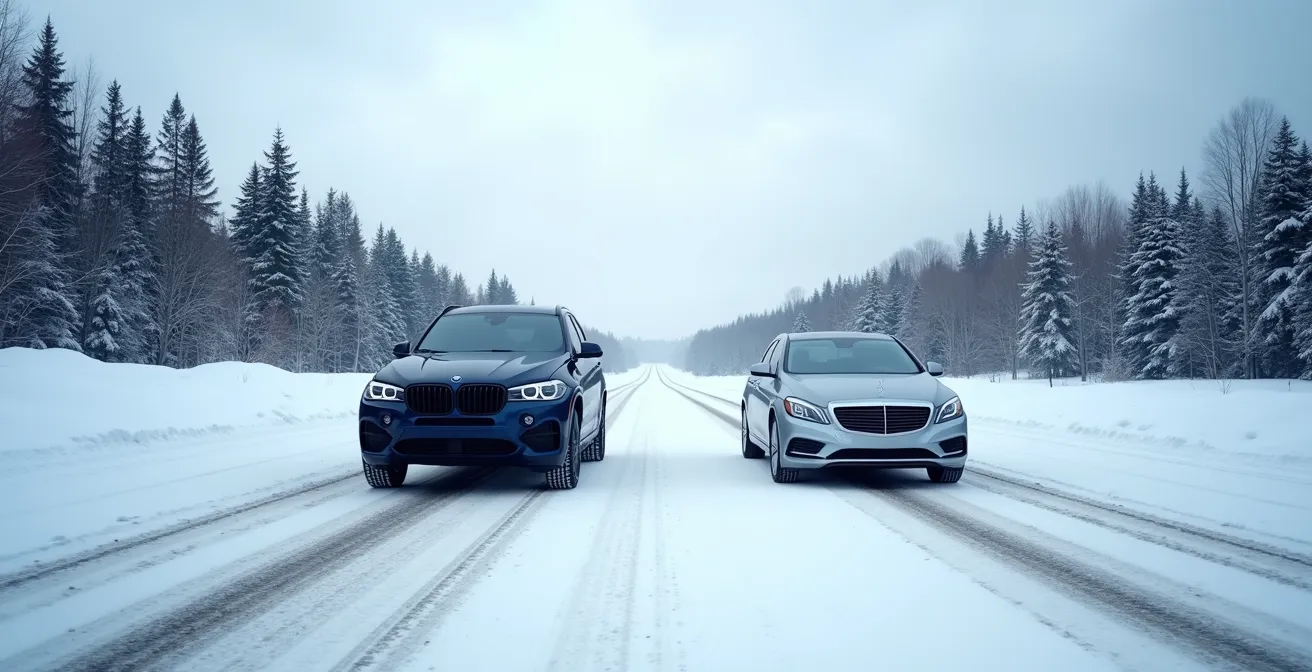
Despite marketing claims, a crossover’s perceived winter safety advantage is largely a myth rooted in a misunderstanding of vehicle physics; true safety comes from tires and driver skill, not just all-wheel drive or ground clearance.
- All-Wheel Drive (AWD) only improves acceleration and does not increase your braking or cornering grip on ice.
- A crossover’s higher weight and center of gravity increase its momentum, making it harder to stop and more prone to instability in emergency maneuvers.
Recommendation: Prioritize investing in top-tier winter tires for your current vehicle before considering the significant extra cost of a crossover, as tires are the single most critical factor for winter control.
Every autumn in Quebec, the marketing blitz begins. Images of crossovers and SUVs conquering snow-covered mountain roads fill our screens, promising unparalleled safety and freedom. The message is simple: to survive a Canadian winter, you need a bigger, taller vehicle with all-wheel drive (AWD). This has driven a market shift so profound that sedans are becoming a rare sight. As a skeptic driver, you’re right to question the narrative: is the higher price tag, increased fuel consumption, and costly maintenance of a crossover truly justified by its performance in a blizzard on Autoroute 40?
As a vehicle dynamics engineer, my job is to look past the marketing and focus on the physics. The common belief is that AWD and higher ground clearance are the ultimate solutions for winter driving. While they offer situational advantages, they also introduce significant compromises that are rarely discussed. The feeling of security they provide can be misleading and even dangerous, a phenomenon supported by research into driver psychology. The real key to winter safety doesn’t lie in the drivetrain or the vehicle’s height, but in the four small contact patches of rubber connecting you to the road, and your understanding of fundamental forces like momentum and grip.
But if the answer isn’t simply “buy a crossover,” what are the real engineering principles that determine control on snow and ice? This article will deconstruct the crossover myth by examining the physical forces at play. We will analyze why AWD systems can create a false sense of security, the hidden costs that surprise new owners, and the practical techniques that matter far more than your vehicle’s body style. It’s time to replace marketing hype with engineering facts to make an informed decision.
This guide breaks down the critical factors that separate marketing from reality. Below, you will find a detailed analysis of everything from vehicle dynamics on ice to the practicalities of ownership in a Quebec winter, allowing you to assess what truly matters for your safety and your wallet.
Summary: Deconstructing the Crossover Winter Safety Myth
- Why Your AWD Crossover Still Slides Into the Ditch on Ice?
- How to Measure Your Garage to Ensure Your New Crossover Fits?
- Compact vs Mid-Size SUV: Is the Extra Space Worth $500/Year in Gas?
- The $1,200 Tire Bill That Shocks New Crossover Owners
- How to Pack a Crossover with a Sloped Roof Without Blocking Visibility?
- Front-End Slide vs Rear-End Slide: How to React to Each?
- The Aerodynamic Mistake That Increases Your Consumption by 15%
- How to Beat the Rush for the December 1st Winter Tire Deadline?
Why Your AWD Crossover Still Slides Into the Ditch on Ice?
The most pervasive myth in winter driving is that All-Wheel Drive (AWD) makes a vehicle invincible on ice. This belief stems from the satisfying feeling of easily pulling away from a snowy stoplight while front-wheel-drive cars spin their wheels. However, this acceleration advantage creates a dangerous psychological trap: overconfidence. Drivers feel secure because their car accelerates well, leading them to drive at speeds too high for the actual grip available. The problem is that physics is unforgiving. An AWD system does absolutely nothing to improve your ability to brake or turn on a slippery surface. In fact, studies on driver behaviour suggest this false sense of security is a significant risk factor, a finding echoed by a Canadian Medical Association Journal report on driver overconfidence.
To understand why, we must consider the “traction circle.” Imagine your tire’s total available grip is a fixed pie. You can use that grip for accelerating, braking, or cornering. AWD helps you accelerate by distributing power to all four wheels, using a larger portion of the total available grip for forward motion. But when you need to brake or steer, you are still limited by the same total grip from your four tire contact patches. A 2,000 kg crossover on ice has the same (or less) braking grip as a 1,500 kg sedan with the same tires. The extra mass of the crossover means it has more momentum, making it even harder to stop or change direction. This is why you see so many SUVs in ditches; they can get up to speed easily, but when a corner or a stopped car appears, the driver discovers too late that the laws of physics have not been suspended. With almost 30% of car accidents in Canada happening on snowy or icy roads, understanding this limitation is critical.
How to Measure Your Garage to Ensure Your New Crossover Fits?
Beyond performance, the sheer physical size of a crossover introduces practical challenges, especially in older Quebec neighbourhoods with smaller garages or tight on-street parking. A vehicle that “fits” in the summer might become a winter liability. Snow banks shrink your driveway’s effective width, and a thick layer of snow on the roof could mean the difference between clearing the garage door and a costly repair. Before signing the papers, a precise measurement is not just recommended; it’s a necessity.
You need to account for more than just the vehicle’s length and width. Consider the “dynamic space” required for winter. This includes the full swing of the doors (can you open them wide enough to install a child seat without hitting a snow shovel?), the clearance needed to walk around the vehicle with bulky winter boots, and the extra height from a potential roof-top ski box. In cities like Montreal, where on-street parking relies on rapid snow clearance, a smaller vehicle might be more practical. In suburban or rural areas with less frequent plowing, a larger driveway is a must.
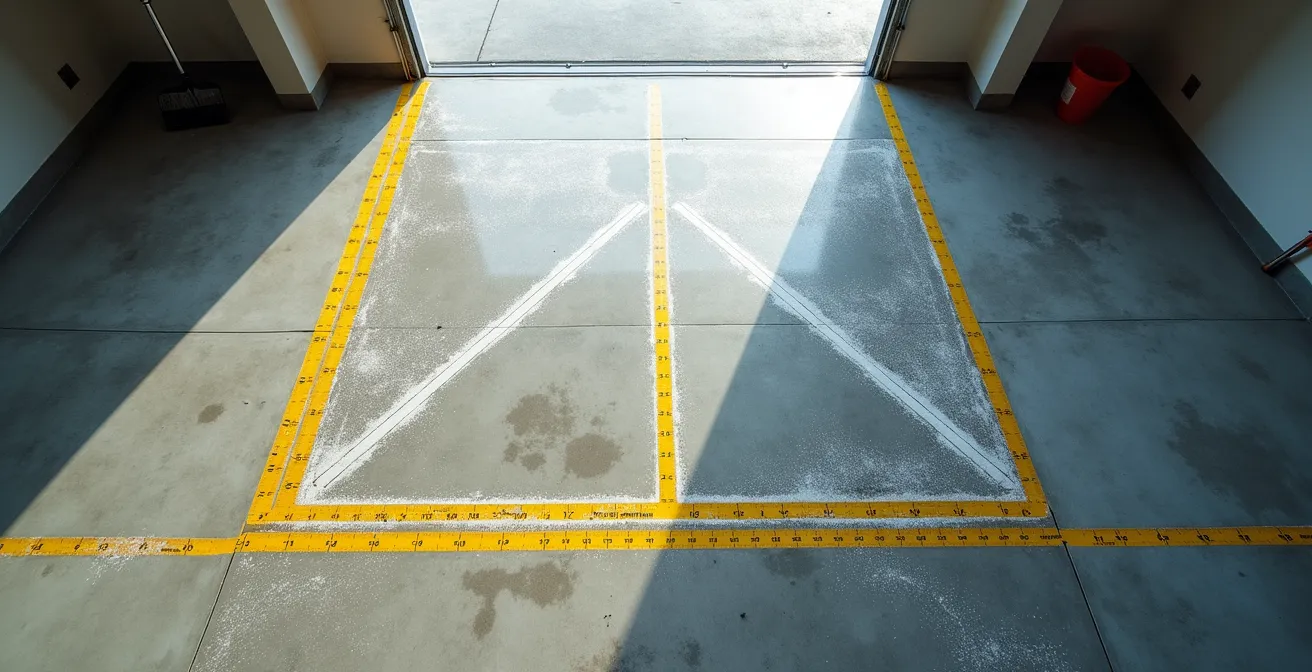
The image above illustrates the concept of planning for winter clearance. It’s not just about the static footprint of the car, but about the space needed for human activity and snow accumulation around it. A proper measurement can prevent months of frustration.
Your Quebec Garage Fit-Check for Winter
- Measure Vertical Clearance: Check your garage door opening height. Add at least 15 cm to the crossover’s height to account for un-cleared roof snow or a future cargo box.
- Account for Snow Banks: Measure your driveway width, then subtract at least 60-90 cm (2-3 feet) on each side for snow plowed or shovelled from the street and your property. Is the remaining space wide enough?
- Test the Door Swing: Park your current car where the crossover would be. Open a door fully. Is there at least 30 cm of clearance to the wall or another vehicle? Remember, crossovers often have larger, heavier doors.
- Assess Street Parking Reality: If you rely on street parking, observe the city’s snow clearing patterns. A wider vehicle may be ticketed or towed if it impedes plows in a designated snow removal zone.
- Consider Ground Clearance vs. Driveway Slope: While high ground clearance helps in deep snow, ensure it doesn’t cause the vehicle’s front or rear to scrape on a steep driveway entrance, especially when compressed with snow and ice.
Compact vs Mid-Size SUV: Is the Extra Space Worth $500/Year in Gas?
The jump from a compact to a mid-size crossover often seems logical for a growing family or for more cargo capacity. However, that extra space comes with a hidden and continuous penalty: increased mass and fuel consumption. A mid-size SUV can easily weigh 200-300 kg more than its compact counterpart. This extra mass directly impacts your winter driving dynamics and your wallet. From an engineering perspective, more mass means more momentum (mass x velocity). Once in motion, a heavier vehicle requires more force and distance to stop or turn, a critical disadvantage on low-grip surfaces like ice.
This weight penalty is compounded by higher fuel consumption. The larger engine needed to move the heavier vehicle, combined with its less aerodynamic shape, inherently uses more fuel. This effect is magnified in winter. Cold air is denser, increasing aerodynamic drag. Engines are less efficient until they reach operating temperature, and short trips in the cold mean you spend more time in this inefficient warm-up phase. Furthermore, winter tires, with their softer compounds and deeper treads, create more rolling resistance. This increased grip is essential for safety, but it also means your engine must work harder to move the car, a fact confirmed by research showing winter tires can increase fuel consumption.
When you combine the base fuel consumption difference with the winter penalties, an extra $500 per year in gasoline for a mid-size over a compact is a conservative estimate. The real question for the skeptic driver is whether the occasional need for that extra cubic foot of cargo space is worth the constant physical and financial burden of hauling around hundreds of extra kilograms, especially when that mass works against you in an emergency stop.
The $1,200 Tire Bill That Shocks New Crossover Owners
Perhaps the most significant and unexpected expense for new crossover owners is their first set of winter tires. Many drivers accustomed to buying tires for a sedan are shocked when quoted prices that can easily exceed $1,200 for a set of four. This isn’t simple price gouging; it’s a direct result of the engineering demands that crossovers place on their tires. The vehicle’s higher weight and higher center of gravity mean the tires must be more robustly constructed with reinforced sidewalls to manage the increased loads during cornering and braking.
Furthermore, crossovers are almost always equipped with larger diameter wheels, typically 17 inches and up. Tire prices rise exponentially with diameter. A quality 16-inch winter tire for a compact sedan might cost $150, while a comparable 18-inch tire for a crossover can easily be $250-$300 or more. This price difference is clearly illustrated by market data, which shows a significant cost jump for larger sizes.
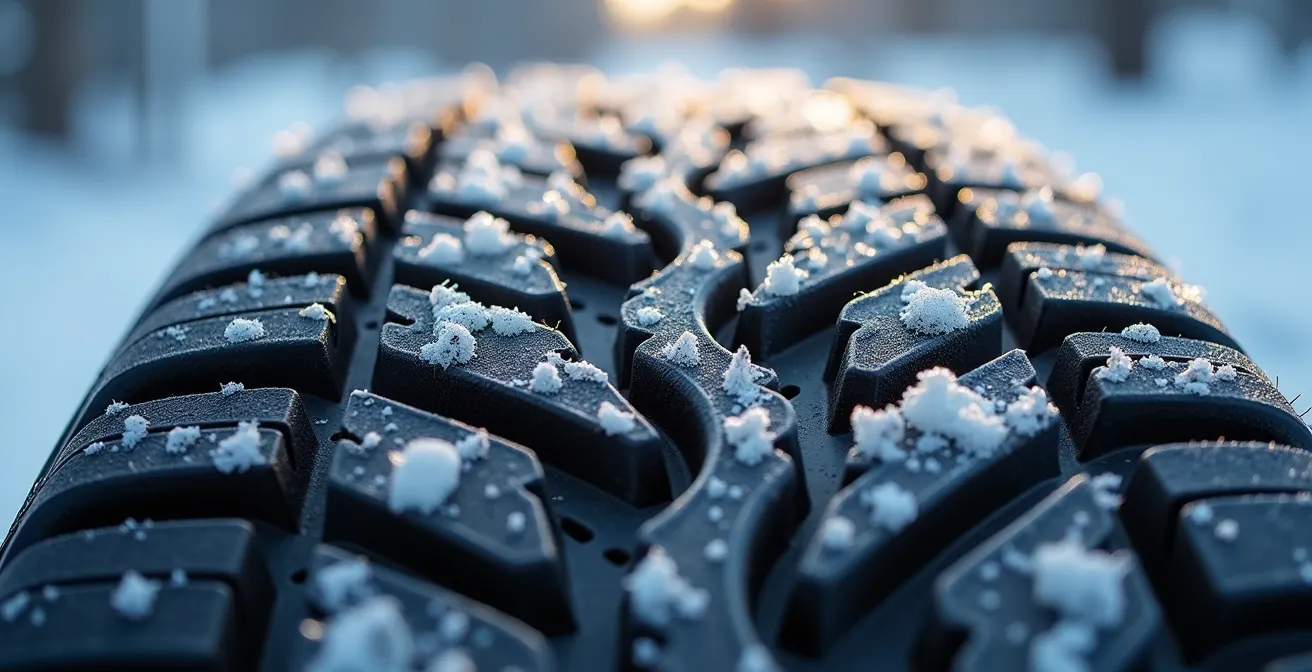
The intricate tread design, with its thousands of tiny “sipes” for gripping ice and deep channels for evacuating snow and slush, represents complex engineering. For a heavy crossover, this technology is pushed to its limit, requiring premium compounds and construction that come at a premium price.
This table breaks down typical costs, highlighting the significant price increase for the larger tires required by mid-size SUVs.
| Vehicle Category | Tire Size Range | Cost per Tire | Total for Set of 4 | Additional Considerations |
|---|---|---|---|---|
| Compact SUV (14″-16″ wheels) | 205/55R16 typical | $125-$200 | $500-$800 | Cheaper than larger sizes |
| Mid-size SUV (17″-19″ wheels) | 235/65R17 typical | $150-$300+ | $600-$1200+ | Prices rise sharply above 17″ |
| Steel Wheels (per set) | Various | $70-$100 each | $280-$400 | Popular for winter, cheaper to replace |
How to Pack a Crossover with a Sloped Roof Without Blocking Visibility?
A crossover’s utility is often judged by its cargo volume, but how you use that space is far more important, especially in winter. The trend of “coupe-like” crossovers with heavily sloped rear rooflines significantly compromises both usable space and, more critically, rear visibility. Packing for a ski trip can quickly turn into a dangerous exercise if luggage and equipment block your view through the rear window. In a winter storm with low visibility, being able to see what’s behind you is not a luxury; it’s a primary safety requirement.
From a vehicle dynamics standpoint, the placement of cargo is also critical. A crossover already has a higher center of gravity (CoG) than a sedan. Loading heavy items high up in the cargo area raises the CoG even further, increasing the vehicle’s tendency to body roll in corners and making it less stable during an emergency lane change or skid correction. The cardinal rule of packing is to place the heaviest items as low and as close to the center of the vehicle as possible. This means heavy suitcases and equipment should go on the floor of the cargo area, right up against the rear seatbacks.
To manage this effectively, use the vehicle’s features intelligently. A 60/40 split-folding rear seat can allow for long items like skis or snowboards to be passed through the middle while still accommodating passengers. Lighter, bulkier items like winter jackets and boots can then be packed around them. Never stack items above the height of the rear seatbacks. If you still need more space, the only safe option is an external cargo carrier, either a roof-mounted box or a hitch-mounted rack. While a roof box adds aerodynamic drag, it is infinitely safer than an obstructed rear view.
Front-End Slide vs Rear-End Slide: How to React to Each?
Even with the best winter tires and a modern vehicle, encountering a slide on a patch of black ice is a real possibility. Understanding how to react depends entirely on which end of the vehicle is losing grip. Modern vehicles are equipped with Electronic Stability Control (ESC), a life-saving system that detects a slide and selectively applies individual brakes to help bring the vehicle back in line. However, ESC is not magic; it can only work within the limits of available traction. A good driver understands what the system is trying to do and works with it.
There are two primary types of slides:
- Front-End Slide (Understeer): This is when you turn the steering wheel, but the car continues to plow straight ahead. It’s the most common type of slide, especially in front-wheel-drive and all-wheel-drive vehicles. It happens because the front tires have lost grip. The instinctive, but incorrect, reaction is to turn the steering wheel more. This only worsens the slide. The correct response is to ease off the throttle and, if necessary, slightly unwind the steering wheel to allow the front tires a chance to regain grip. Always look and steer where you want to go, not at the obstacle you’re trying to avoid.
- Rear-End Slide (Oversteer): This is when the rear of the car loses traction and begins to swing out. It’s more common in rear-wheel-drive vehicles but can happen in any car, especially when lifting off the throttle or braking mid-corner. The correct reaction is to steer in the direction of the slide (this is called “counter-steering”). So, if the rear of the car is sliding to the right, you steer to the right. As with understeer, your inputs must be smooth and deliberate. Look far down the road where you want the car to go. As the car straightens out, you must smoothly unwind your steering correction to avoid snapping back in the other direction.
In both scenarios, the golden rule is to be smooth. Avoid sudden braking, abrupt steering, or panicked throttle inputs. Your goal is to give the tires a chance to regain traction. Practicing these techniques in a safe, empty snow-covered parking lot is the best way to build muscle memory.
Key Takeaways
- AWD only improves acceleration; it provides no benefit for braking or cornering on ice, which are the most critical aspects of accident avoidance.
- A crossover’s greater weight and higher center of gravity increase its momentum, making it physically harder to stop and less stable in emergency maneuvers compared to a lighter sedan.
- The single most important factor for winter safety is a set of high-quality winter tires, which determine the ultimate limit of your vehicle’s grip, regardless of its drivetrain.
The Aerodynamic Mistake That Increases Your Consumption by 15%
While much focus is placed on engine efficiency and tire choice, many drivers overlook a significant factor in winter fuel consumption: aerodynamics. A vehicle is designed in a wind tunnel to be as slippery as possible, minimizing the energy required to push it through the air. However, this carefully engineered profile is often ruined by a common winter accessory: the rooftop cargo box or ski rack. While sometimes a necessity for carrying gear, leaving it on for the entire season is a costly mistake.
From an engineering standpoint, a rooftop carrier dramatically increases two key variables: the vehicle’s frontal area and its coefficient of drag (Cd). The cargo box adds surface area for the wind to push against, and its often-unrefined shape creates significant turbulence, disrupting the smooth airflow the designers worked so hard to achieve. This added resistance, or drag, forces the engine to work much harder to maintain highway speeds.
How much harder? While the exact figure varies by vehicle and box design, it is not uncommon for a rooftop cargo carrier to increase a vehicle’s fuel consumption by 10% to 25% at highway speeds. For an average driver, this can translate to an extra litre of fuel per 100 km. Over a 5-month Quebec winter, this aerodynamic penalty can easily add up to $100-$200 in extra fuel costs. The mistake is not in using the carrier when you need it, but in the complacency of leaving it on all winter “just in case.” The most efficient approach is to install it only for the trips where it’s truly required and remove it for daily driving.
How to Beat the Rush for the December 1st Winter Tire Deadline?
In Quebec, the December 1st deadline for mandatory winter tires creates a predictable and frantic rush at every garage and tire shop. Waiting until the last two weeks of November often means facing limited appointment slots, rushed service, and potentially depleted stock of the best tire models. Beating this rush isn’t just about convenience; it’s about ensuring you get the right tires and proper installation. The fact that 76% of all Canadians use winter tires (a figure driven by Quebec’s mandate) underscores the sheer volume of this annual changeover.
The strategic time to act is not based on the calendar, but on the thermometer. The general rule from tire manufacturers is to install winter tires when the average daily temperature is consistently at or below 7 degrees Celsius. At this temperature, the rubber compound in all-season and summer tires begins to harden, drastically reducing grip. Winter tires, in contrast, are designed with a softer compound that stays pliable in the cold, allowing them to maintain traction. In most parts of Quebec, this 7-degree threshold is typically crossed in late October or early November, a full month before the deadline.
Here is a simple strategy to avoid the chaos:
- Shop in September and October: This is when retailers have the best stock and are often running early-bird promotions or mail-in rebates. You can buy your tires and book your installation appointment far in advance.
- Book Your Appointment for Early November: Aim for the first or second week of November. You’ll avoid the rush, and the temperatures will be appropriate for the changeover.
- Invest in a Second Set of Wheels: Buying a set of inexpensive steel wheels for your winter tires is a smart long-term investment. It makes the twice-yearly swap faster and cheaper ($50-$60 savings per swap), and it protects your more expensive alloy wheels from salt and corrosion.
- Verify the Symbol: Always look for the Three-Peak Mountain Snowflake (3PMSF) symbol on the tire’s sidewall. This indicates the tire meets specific industry standards for severe snow traction and is legally compliant in Quebec.
By thinking ahead and acting based on temperature rather than the government deadline, you can turn a stressful annual chore into a smooth, simple process.
Ultimately, the decision to choose a crossover or a sedan should be based on a clear-eyed assessment of your real-world needs and an understanding of vehicle dynamics, not on a marketer’s winter fantasy. Evaluate your driving habits, budget, and cargo needs with these engineering principles in mind to make the safest and most economical choice for you and your family.